


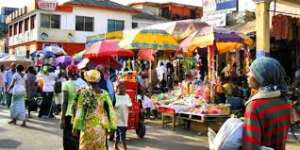
If pension reform in Ghana were a conversation, it would be one conducted almost entirely in a room where most workers are not allowed to enter. That room is the formal sector. Outside it stand market women, artisans, farmers, drivers, traders, gig workers, and small business owners, the people who form the backbone of the Ghanaian economy. They are productive, resilient, and indispensable. Yet when it comes to pensions, they are largely invisible. This is not a marginal policy failure. It is Ghana’s single biggest pension blind spot.
The Informal Sector Is Not “Small”, It Is Ghana
More than 80% of Ghana’s workforce operates in the informal sector. These workers pay taxes indirectly, raise families, and contribute daily to national output. What they do not have is a realistic pathway to income security in old age. For decades, pension policy has quietly assumed that informal workers will either save on their own, rely on extended family, or simply continue working until they can no longer do so. None of these assumptions is reliable anymore. Urbanization, migration, smaller families, and rising living costs have weakened traditional support systems. The idea that children will automatically care for ageing parents is no longer a policy, it is a hope. And hope is not a pension strategy.
Why Informal Workers Don’t Join Pension Schemes
It is easy — too easy — to blame low pension participation on “lack of education” or “poor savings culture.” That explanation is lazy and incomplete. The real reasons are structural:
- Irregular incomes: Informal workers do not earn predictable monthly salaries. Asking them to contribute fixed amounts on rigid schedules ignores how they actually live and earn.
- Low trust in institutions: Many workers do not believe pension promises will be honoured decades from now. This skepticism is not irrational, it is informed by history, opacity, and poor communication. If pensioners were properly taken care of, the informal sector could have come onboard in their numbers.
- Delayed gratification with no visible reward: Telling someone struggling with school fees and rent to lock away money for 30 years requires extraordinary institutional credibility. Ghana has not yet earned that level of trust.
- One-size-fits-all design: Pension products designed for salaried workers have simply been rebranded for informal workers, with minimal adaptation.
In short, informal workers are not refusing pensions. Pensions are refusing to meet them where they are.
SSNIT and the Trust Deficit
SSNIT remains the dominant institution in Ghana’s pension landscape, and it deserves credit for maintaining a functioning national scheme where many countries have failed. But it also carries a heavy burden — public distrust. This distrust is not helped by opaque investment decisions, periodic governance controversies, limited public understanding of how funds are managed, and the perception — fair or not, that pension assets are never far from political influence. For informal workers, the calculation is simple. If I am not sure this system will protect me, why should I sacrifice today’s income for tomorrow’s uncertainty? Until that question is convincingly answered, coverage will remain shallow.
Governance: The Quiet Determinant of Pension Success
Around the world, pension failures rarely begin with bad intentions. They begin with weak governance. When pension boards are politicized, when reporting is inaccessible, when accountability is slow or absent, confidence erodes — even if returns are reasonable. Ghana is not immune to this risk. Strong pension systems share three governance traits. One, clear separation between politics and pension assets. Two, independent, professionally qualified boards. And three, radical transparency in reporting and decision-making. Where these are missing, pension systems eventually lose legitimacy, sometimes before they lose money.
The High Cost of Doing Nothing
Ignoring informal-sector pensions does not make the problem disappear. It merely postpones it. In ten to twenty years, Ghana will face a larger elderly population, fewer working-age supporters per retiree, and rising pressure on families, churches, and local communities to fill the gap left by policy. At that point, the choice will not be between reform and status quo. It will be between planned reform and crisis intervention. History suggests crisis interventions are almost always more expensive, more painful, and less fair.
What Other Countries Did Differently
Countries that successfully expanded pension coverage did not lecture informal workers into compliance. They redesigned systems around reality. Flexible contributions, allowing workers to pay small amounts when income allows; mobile-based systems, making participation simple and visible; clear guarantees, especially a basic old-age income floor; and independent governance, insulating pensions from short-term political needs. None of these ideas is revolutionary. What is revolutionary is the political will to implement them consistently.
Informal-Sector Pensions Are Not Charity
One damaging misconception must be confronted. Extending pensions to informal workers is often framed as social welfare. It is not! It is deferred income. It is social insurance. It is recognition that productivity does not end at the gates of formal employment. When pensions are framed as charity, they are underfunded and vulnerable. When they are framed as rights earned through contribution — however modest, they command respect.
The Governance Question Ghana Must Answer
Ultimately, pension reform in Ghana hinges on one uncomfortable question: Can pension institutions be trusted to protect long-term savings from short-term political and fiscal pressures? If the answer remains uncertain, no amount of outreach or education will succeed. Trust is not built through slogans or rebranding. It is built through open books, independent oversight, consequences for mismanagement, and consistency over time.
My Thoughts
Ghana’s pension debate has spent too long circling the same narrow space — formal workers, contribution rates, and incremental adjustments. Meanwhile, the majority of workers age quietly outside the system. Informal workers are not an afterthought. They are the system. If Ghana fails to integrate them meaningfully into pension planning, old age will remain a private hardship rather than a shared social responsibility. The choice is not whether Ghana can afford to fix this. The choice is whether we are prepared to confront it before the demographic tide forces our hand.
Pension reform delayed is pension reform denied.
FUSEINI ABDULAI BRAIMAH
+233208282575 / +233550558008
[email protected]
