


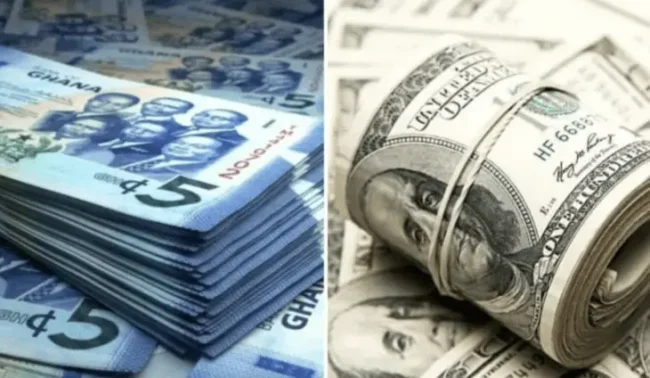
While the Bank of Ghana has been commended for its monetary performance in 2025, economists are warning that the nation’s currency stability and record low inflation cannot survive on central bank policy alone without urgent transformation of the real sector.
Dr. Dennis Nsafoah, Assistant Professor of Economics at Niagara University in New York, attributes the cedi’s remarkable appreciation in 2025 from about 15.80 cedis to around 10.80 cedis per dollar by mid year to aggressive monetary tightening. The central bank strategically withdrew cedi liquidity from the system and slowed the growth of bank reserves, effectively dampening excess demand for foreign exchange.
The contraction in liquidity reinforced disinflation and drove the shift from depreciation to appreciation, explained Dr. Nsafoah, who also serves on the Research Committee at Tesah Capital. However, he warns that relying solely on tight monetary conditions provides only a temporary shield against currency pressures.
Food inflation fell to 4.9 percent in December 2025, marking the 12th consecutive month of disinflation, according to the Ghana Statistical Service. The achievement represents remarkable progress from the 61 percent peak recorded in January 2023, but experts caution that sustaining these gains requires a fundamental shift in how the economy produces goods and services.
For stability to endure beyond short term monetary interventions, economists argue the economy must produce more of what it consumes and exports. While the central bank has performed its role effectively, there is growing consensus that the Ministry of Trade, Agribusiness and Industry must become significantly more vibrant to complement these monetary efforts.
As monetary policy continues to keep inflation low, the industrial sector must step in to fill the supply gap with locally manufactured goods. Without a surge in local production, any future relaxation of monetary policy could lead to renewed appetite for imports, putting the cedi back under pressure.
Industry watchers are calling for the Ministry of Trade, Agribusiness and Industry to move beyond administrative roles and take the lead in making local production competitive. The Made in Ghana drive must be backed by quality products and consistent supply to reduce the country’s massive import dependency, which stands at nearly three billion dollars annually for basic food items alone.
The government has realigned the Ministry of Trade and Industry into the Ministry of Trade, Agribusiness and Industry as a deliberate policy shift to place agribusiness at the heart of industrial strategy. This institutional restructuring signals recognition that agriculture and agro processing must drive economic transformation.
The global agribusiness market was valued at 3.4 trillion dollars in 2024 and is forecast to reach between 4.4 trillion and 5.8 trillion dollars by 2033, presenting Ghana with significant export opportunities. However, tapping into this expanding market requires innovation, value addition, contract farming and sustainable agribusiness practices.
The agriculture sector remains the most critical frontier for sustaining low inflation. Food inflation dropped from 28.3 percent when the current administration took office in January 2025 to 9.5 percent by October 2025, offering significant relief to families and businesses. Maintaining this progress requires relentless focus on agribusiness to prevent seasonal price shocks that often derail macroeconomic targets.
The government’s 24 Hour Economy agenda, officially launched in July 2025, seeks to create an enabling framework for productivity supported by infrastructure, financing and strong institutional collaboration. Analysts view this initiative as the perfect vehicle for agricultural transformation, but they are calling for more tangible action on the ground.
By transitioning from subsistence farming to continuous agro processing operations, Ghana can add value to raw materials, create jobs and drastically reduce the import bill for basic food items. The government is establishing agro industrial enclaves in key farming zones to process cocoa, rice, oil palm and cassava into higher value products that will operate round the clock.
Trade, Agribusiness and Industry Minister Elizabeth Ofosu Adjare has signaled stronger backing for local manufacturers, emphasizing that agro processing companies are central to reducing post harvest losses, improving farmer incomes and supporting sustainable economic growth. The minister noted that the 24 Hour Economy initiative offers factories the opportunity to operate more efficiently, scale output and meet rising domestic and export demand.
Infrastructure development will provide vital support through improved roads and electricity access, but it is the actual productivity from farms and factories that will ultimately provide the foreign exchange needed to back the cedi. For the currency to remain stable without the Bank of Ghana having to keep liquidity perpetually tight, a synchronized effort is required.
The Ministry of Trade must aggressively promote export led growth while the Ministry of Food and Agriculture scales up Feed Ghana initiatives to secure food prices. The government has announced that starting in 2026, all seeds supplied to Ghanaian farmers will be sourced locally, strengthening domestic production capacity and supporting long term agricultural transformation.
Dr. Nsafoah emphasizes in his recent policy analysis that if the growth rate of bank reserves were to reverse course and return to the 50 percent to triple digit annual growth rates observed in earlier years, this would signal a renewed surge in cedi liquidity. History suggests such an expansion would quickly translate into excess demand for foreign currency and a renewed phase of sharp cedi depreciation.
The discipline and decisiveness with which the Bank of Ghana deployed its monetary policy tools in 2025 deserve commendation, economists agree. Going forward, sustaining exchange rate and price stability will depend not only on the central bank’s continued resolve but also on whether the real sector can deliver the productive capacity to support a strong currency without perpetual monetary tightening.
The current economic recovery presents Ghana with a window of opportunity. The hard work of restoring fiscal discipline, stabilizing the cedi and regaining investor confidence following the 2022 debt crisis has been completed. What remains is transforming this stability into inclusive and sustainable growth that does not depend solely on favorable commodity prices or restrictive monetary conditions.
Without decisive action to boost domestic production across agriculture, manufacturing and agro processing, the impressive gains of 2025 could prove temporary. The coming months will reveal whether policymakers can translate monetary stability into real sector transformation that creates jobs, reduces imports and sustains the cedi’s strength over the long term.
