


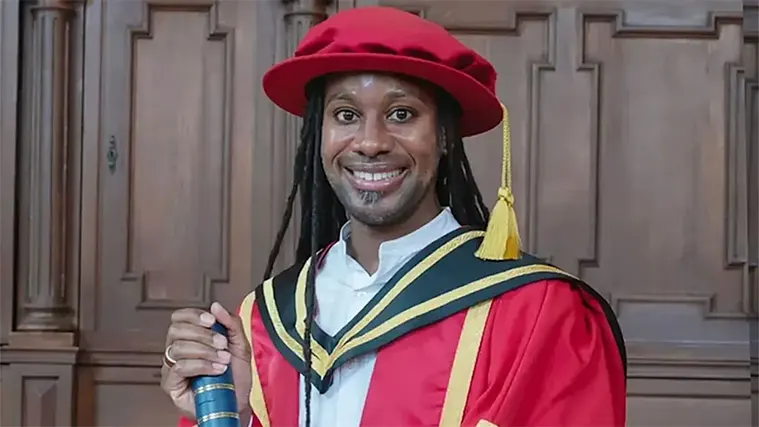
The late Prof. Jason Atta Kwei Arday
Last week, the death was announced of a British/Ghanaian professor at the University of Cambridge.
The death, especially the circumstances surrounding the unfortunate and untimely death of Prof. Jason Atta Kwei Arday, has triggered many conversations across the academic and outside world, and for good reasons.
Questions are being posed as to whether or not racism played a role in the untimely demise of the 41-year-old, the first black to reach that academic notch at Cambridge. His meteoric rise on the academic ladder, especially provided fodder for the discussions which some have described as “racist frenzy”.
Without doubt, the accusation of plagiarism levelled against him and the subsequent scrutiny he was subjected to weighed so much on his mental health prior to his untimely death.
It looked surreal his rise and death at Cambridge and the circumstances underpinning his fate.
In a world where racism is a feature in some societies and realms such as academia, Prof. Jason was not spared the acerbic remarks of drivers of racism when his name popped up for a negative reason.
In the 21st century, it is disturbing that the racist narrative continues to live with us and creating stumbling blocks for the progress of humanity.
The importance of education would be lost when we continue to have room to suspect racist inclinations in our actions, especially when these occur in citadels of learning. Unfortunately, this cannot be ruled out in the face of the realities on the ground, Prof. Jason’s case providing a sad commentary on this dark subject.
It can only be imagined what our forebears weathered when they set foot in Europe to seek knowledge in foreign universities.
Prof. Jason appears to have suffered for far too long, having attracted the envy and even ire of racist-inclined persons because of his feat. They silently questioned how a black man could have earned the professorship of an elitist university at his age.
Those who under the circumstances advance the conspiracy theory that he could have been set up so he could be hanged, might have a point after all.
They might not have hanged him physically, they did so by subjecting him to suicide grade emotional torture on social and traditional media.
It is instructive to note that the Liverpool John Moores University (LJMU) in 2015 cleared Prof. Jason of plagiarism, this showing that the project did not start now. Having lived with this trumped-up stigma since that time, the latest bout ended in the unexpected death as it were.
He might have died but the reality stands that this has provided the world of sane human beings to rethink the subject of racism and how to curb it. It is instructive and auspicious that the victim of racism was a sociology egghead who, as it were, would remain focal point for studies on the obnoxious subject of racism.
It would be instructive to find out whether or not there have been cases of whites suspected of plagiarism and how these were handled in various elitist centres of learning and research.
The treatment of such cases could not have equaled what the deceased suffered, we can bet.
Now that he had died, various activities are being held in his honour, the so-called plagiarism for now pushed to the backburner.
Lord Chris Smith, Chancellor of Cambridge University, has reportedly criticised the “racist feeding frenzy” that surrounded Jason Arday, saying that “people who didn’t believe a black man should be a Cambridge professor” started as soon as he was appointed by the university in 2023.
“This was a campaign against all of us,” he added.
More than 90,000 people – including Labour MP Diane Abbott and actress Jameela Jamil have signed a Good Law Project petition seeking an inquiry into media coverage of the deceased, who maintain that his death followed “two weeks of relentless harassment,” according to a BBC report.
