


“Today, It Has Been Bastardised by a Noisemaker” – GoldBod CEO Sammy Gyamfi Fires at Minority Leader Over Gold Program Criticisms
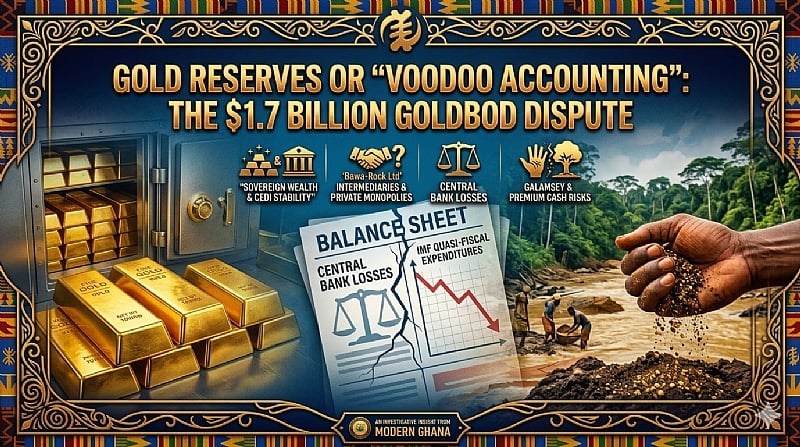
Ghana’s mineral wealth has become a high-stakes fiscal battleground as the Ghana Gold Board (GoldBod) and the Parliamentary Minority Caucus clash over central banking rules, shadow subsidies, and sovereign balance sheets. The core of the tension rests on recent evaluation reports highlighting vast operational costs under the state’s domestic gold acquisition architecture. While GoldBod CEO Sammy Gyamfi vigorously defends the entity’s direct revenue liquidity, the opposition warns of a structural “golden betrayal”. To educate the public objectively, this investigative piece moves past political hyperbole to unpack the structural mechanics of private gold aggregators, evaluate the legacy of the previous Precious Minerals Marketing Company (PMMC) framework, integrate authoritative donor assessments, and dissect how billions of dollars in gold trading impact the Ghanaian taxpayer.
The IMF Assessment: Calling Out Quasi-Fiscal Expenditures
The International Monetary Fund (IMF), in its Article IV Consultation and Program Review Reports for Ghana, directly addressed the structural anomalies underlying the Domestic Gold Purchase Programme (DGPP). The Fund stripped away the political messaging to highlight how the state’s reserve strategy impacts central bank capital.
- The Quasi-Fiscal Loss Mandate: In a formal briefing at Washington, IMF Director of Communications Julie Kozack clarified that while the gold accumulation program delivered undeniable macroeconomic armor, it simultaneously triggered heavy economic friction. The IMF noted that the DGPP resulted in what the Fund labels a “quasi-fiscal loss,” adding that the initiative recorded balance sheet drains of GH¢22 billion ($1.9 billion) in 2025 alone, equivalent to roughly 1.5% of Ghana’s GDP.
- Erosion of Central Bank Autonomy: The IMF explicitly challenged the institutional architecture of the program, warning that “this activity had quasi-fiscal characteristics and could compromise the autonomy of the central bank.” The Fund pointed out that the central bank had effectively assumed a costly, commercial trading role that belongs on the state’s fiscal ledger.
- The Directive for Structural Separation: To protect institutional credibility, the Fund stated that “protecting the independence and credibility of the central bank would require a permanent halt to quasi-fiscal activities and the complete transfer of the DGPP to the Ghana Gold Board (GoldBod).”
The Aggregator Flashpoint: The Rise of Monopolies and “Protected Intermediaries”
A critical point of escalation raised by Minority Leader Alexander Afenyo-Markin involves the centralization of artisanal gold purchasing. The Minority Caucus claims the current architecture facilitates an opaque supply chain that shields private middlemen while offloading systemic risks onto state entities.
- The Bawa-Rock Ltd Controversy: The opposition has flagged the creation of a de facto monopoly, identifying private entities like Bawa-Rock Ltd as preferred licensed aggregators for artisanal gold purchases under state programs. The group has formally questioned the selection process, lack of open-market competition, and ownership structures of these preferred aggregators.
- The Rent-Seeking Risk: Critics argue that narrowing the domestic purchase network down to exclusive private entities encourages corporate rent-seeking. Under this setup, these private aggregators are insulated from foreign exchange volatility, pocketing guaranteed margins while the central bank absorbs the broader costs of currency depreciation and pricing adjustments.
The Environmental Paradox: Laundering “Galamsey” Gold into Official Channels
Beyond the balance sheets, the caucus connects centralized purchasing to a wider regulatory and ecological failure. By purchasing artisanal gold aggressively to build reserves, the state risks acting as an unverified liquidity lifeline for environmental destruction.
- Perverse Financial Incentives: To outbid informal foreign buyers, the state-backed purchasing model pays high local premiums. This structural price distortion creates an intense cash incentive that pumps liquidity back into highly destructive illegal mining (galamsey) operations devastating rural Ghana.
- The Traceability Failure: GoldBod CEO Sammy Gyamfi acknowledged at a MyJoyOnline forum that decades of poor formalization have left the artisanal and small-scale mining (ASM) sector highly vulnerable. Without rigorous, site-level mineral traceability, tainted gold washed with illegal mercury and mined from degraded forest reserves or polluted riverbeds easily slips into the aggregation network.
- The State’s Ethical Blindspot: This creates a dangerous ethical paradox. The state successfully hoards bullion to show off an impressive $12 billion international reserve cover. However, that exact capital accumulation is subsidized by the structural destruction of Ghana’s vital water bodies and agricultural lands.
From PMMC to GoldBod: A Structural Shift in Economic Policy
To understand the current gridlock, it is essential to map out how Ghana arrived at this centralized gold model and compare it directly to the historical framework it replaced.
+—————————————————————————————+ | HISTORICAL EVOLUTION OF GHANA’S GOLD MARKETING | +—————————————————————————————+ | OLD PMMC FRAMEWORK | | – Competitive Market: Multiple private local and foreign buyers competed openly. | | – Price Discovery: Driven by open-market dynamics; no single state-backed monopoly. | | – Fiscal Risk: Zero direct trading risk or quasi-fiscal deficits socialized on BoG. | +—————————————————————————————+ | │ | | ▼ | +—————————————————————————————+ | NEW GOLDBOD FRAMEWORK (Act 1140) | | – Centralized Agent: Statutory monopoly over trading and export under the G4R program.| | – Guaranteed Fees: Earns 0.25% Assay & 0.5% Service Fees on central bank funds. | | – Fiscal Burden: Broader systemic costs and currency variances sit on BoG ledgers. | +—————————————————————————————+
- The Competitive PMMC Legacy: Under the old Precious Minerals Marketing Company (PMMC) framework, the domestic gold landscape operated as an open, competitive ecosystem. Private traders and small-scale miners engaged in decentralized price discovery. The state did not crowd out private market participants, nor did it dedicate vast public funds to purchase gold at international spot benchmarks using local currency.
- The GoldBod Monopoly Model: Enacted via the Ghana Gold Board Act (Act 1140), the new paradigm completely transformed the market by establishing an institutional monopoly over the trade and export of artisanal gold. While the old PMMC was a commercial participant, GoldBod was set up as a macro-stabilization engine.
- The “Voodoo Accounting” Friction: The structural split creates an institutional paradox. GoldBod acts as a buying agent utilizing funds provided by the Bank of Ghana (BoG). For this service, GoldBod secures a 0.25% Assay Fee and a 0.5% Service Charge, posting an internal operating surplus. However, the real cost—including freight, international refining discounts, and currency valuation adjustments—is born by the BoG. This prompts the Minority to argue that the state is artificially “socializing losses” while celebrating a segmented, superficial corporate surplus.
Commercial Banking Reaction to GoldBod’s Self-Funded Transition
In an attempt to sever the problematic funding loop with the central bank, GoldBod announced its full migration to a Commercial Self-Funding Model. This major policy shift has triggered a wave of cautious reassessments across Accra’s banking sector.
- High Liquidity Appetite: Despite the fierce political battles playing out in Parliament, local financial giants have shown a massive appetite for the program. According to official updates from graphic.com.gh, over 15 commercial banks have formally submitted letters of interest to bankroll the new aggregation scheme.
- Direct Forex Mobilization: In a major test run, GoldBod bypassed central bank intermediation entirely to execute a $75 million funded forward foreign exchange transaction directly with commercial counterparties. The board successfully secured and converted the cedi equivalent within 48 hours. Banks view this structure as a lucrative avenue to capture reliable, primary dollar flows directly from gold exports without relying on central bank distribution channels.
- The Risk Premium Dilemma: While commercial credit officers are eager to hold liquid, gold-backed export receivables, treasury departments remain highly sensitive to compliance. Banking executives warn that if a future parliamentary probe or an IMF mandate disrupts GoldBod’s statutory monopoly status, or if international off-takers flag traceability issues related to illegal mining, the commercial loans extended to GoldBod could face severe structural default risks.
Actionable Policy Recommendations and Suggestions
To bridge this deep political divide, ensure sovereign accountability, and maximize return on public resources, the state must implement immediate structural adjustments:
- Inaugurate a Parliamentary Ad-Hoc Investigative Committee: Parliament must advance beyond hostile press conferences. An independent, cross-party committee must be formed to audit the complete transaction history between the Bank of Ghana, GoldBod, and preferred private aggregators like Bawa-Rock Ltd.
- Enforce Open-Market Tendering for Aggregators: To permanently dissolve the threat of rent-seeking and artificial monopolies, GoldBod should eliminate exclusive single-aggregator arrangements. The procurement of gold buying, transport, and aggregation services must follow strict, transparent, and multi-vendor competitive bidding guidelines.
- Tie Commercial Financing to Strict Eco-Audit Standards: As commercial banks scale up their $450 million credit lines to GoldBod, the Bank of Ghana must issue a regulatory mandate. Financial institutions must condition all future gold purchase disbursements on strict, satellite-verified environmental compliance to ensure public funds stop bankrolling galamsey operations.
The fierce dispute surrounding GoldBod is a fundamental structural flaw in how public wealth and risk are balanced. While GoldBod operates efficiently within its narrow agency mandate—capturing risk-free service fees—the central bank has shouldered immense macro-stabilization costs to defend the national currency. Furthermore, the reliance on single-source private aggregators compromises the transparency that a sovereign resource vehicle demands. If Ghana is to truly benefit from its status as a top gold producer, its leaders must move past personalized rhetoric. True success requires competitive price discovery, absolute supply-chain transparency, and institutional designs that protect the taxpayer’s bottom line.
✍️ Submitted by:
Retired Senior Citizen
For and on behalf of all Senior Citizens of the Republic of Ghana 🇬🇭
Teshie-Nungua
[email protected]
