


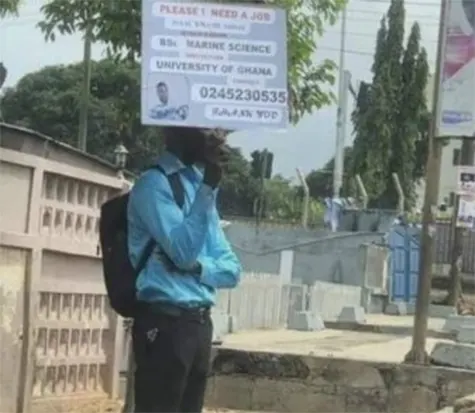
A graduate with a placard in search for a job
Every year, thousands of young people graduate from universities, colleges and other tertiary institutions across Ghana. They spend years studying, writing examinations and preparing for what they believe will be the next stage of their lives: getting a job and building a career.
But for many graduates, the journey from the classroom to the workplace has become a frustrating struggle.
After years of education, many find themselves at home, sending out applications, attending interviews and waiting for opportunities that seem increasingly difficult to find. Some spend months or even years searching for work. Others are forced to accept jobs unrelated to their qualifications, while some eventually give up on their career aspirations altogether.
This is not simply an individual problem. It is a national problem.
The Ghana Statistical Service (GSS) has consistently highlighted the difficult employment situation facing young people in the country. Its labour force reports show that young people make up a significant share of those without work. Behind these statistics, however, are real people: graduates with ambitions, families that sacrificed to educate them, and young Ghanaians who simply want an opportunity to work and contribute to society.
When Education and Employment Do Not Connect
One of the biggest problems is the gap between what many students are taught in school and what the workplace actually demands.
Too often, education remains heavily focused on theory. Students read textbooks, attend lectures, write examinations and graduate with certificates, but many leave school without enough practical experience.
The workplace, however, demands more.
Employers want people who can communicate effectively, use technology, prepare reports, solve problems, work in teams and adapt quickly. They want graduates who can contribute from the beginning.
This creates a difficult situation. A graduate may have the required academic qualification but still be told that they lack the practical skills needed for the job.
The problem becomes even more frustrating when employers demand two or more years of experience for entry-level positions.
How is a fresh graduate supposed to gain experience if nobody is willing to give them their first opportunity?
This is where universities and other tertiary institutions must take a serious look at what they are offering students. Education should not end with a certificate. Students should leave school with skills they can actually use.
Universities need stronger partnerships with industries. Internships, apprenticeships, practical projects and workplace exposure should become a more important part of tertiary education.
In a world increasingly driven by technology, education must also keep pace with the changing nature of work.
There Are Simply Not Enough Jobs
Even when graduates have the right skills, another problem remains: there are simply not enough jobs.
Government, which has traditionally been one of the biggest employers of graduates, cannot absorb everyone entering the labour market. Budget constraints and economic pressures have made public-sector employment increasingly limited.
The private sector, meanwhile, is not creating jobs quickly enough to absorb the growing number of young people entering the workforce.
The result is intense competition.
One job advertisement can attract hundreds of applications. A single vacancy can receive applications from people with degrees, professional qualifications, internships and years of experience.
For a young graduate, it can feel as though the competition is almost impossible to win.
But there is another issue that cannot be ignored: the perception that connections matter more than qualifications.
In Ghana, many young people believe that knowing the right person can sometimes matter more than having the right credentials. There are also concerns about vacancies that are not openly advertised and positions that are filled through personal networks.
Whether every such claim is accurate or not, the perception itself is damaging.
A young person should not have to know someone in an organisation to have a fair chance of getting a job. Recruitment must be transparent, competitive and based on merit.
“Start a Business” Is Not a Complete Solution
Whenever unemployment is discussed, one common response is: “Start your own business.”
Entrepreneurship is important, and initiatives such as YouStart are intended to help young people establish businesses and create employment.
But starting a business is not as simple as having an idea.
A graduate may have a good business plan but no money to execute it. Banks often require collateral that many young people do not have. Access to government funding and other support can also be difficult and, in some cases, slow.
We cannot tell young people to become entrepreneurs while leaving them without the resources needed to make entrepreneurship possible.
Business training, affordable financing, mentorship, market access and simplified support systems are all necessary.
Entrepreneurship should certainly be part of the solution, but it cannot become an excuse for failing to create enough formal employment opportunities.
What Needs to Change?
Ghana cannot solve graduate unemployment by simply producing more graduates and hoping the economy will absorb them.
The country needs a deliberate strategy.
First, education must become more practical. Universities and other tertiary institutions should work closely with industries to understand the skills employers need. Students should have more opportunities to gain practical experience before they graduate.
Second, Ghana must create more jobs. Government investment should focus on sectors with the potential to employ large numbers of young people, including manufacturing, agriculture, technology and small and medium-sized businesses.
Third, companies must give young people a chance. Not every graduate can have years of experience. Businesses should create genuine entry-level opportunities, internships and graduate trainee programmes that allow young people to develop professionally.
Finally, recruitment must be fair and transparent. Vacancies should be openly advertised, selection processes should be clear, and qualifications and competence should matter.
Ghana Cannot Afford to Waste Its Young People
Graduate unemployment is more than an economic problem. It is a waste of human potential.
Every unemployed graduate represents skills that are not being fully used, ideas that may never be developed and potential contributions to national development that are being lost.
Ghana has invested heavily in educating its young people. The country cannot afford to educate them and then leave them stranded at the point where their education is supposed to become productive.
Young Ghanaians are not asking for everything to be handed to them. Many are asking for something much simpler: a fair opportunity.
They want a chance to prove themselves, gain experience, earn a living and build a future.
The solution will require more than speeches and short-term programmes. Ghana must reform how it prepares young people for work, expand opportunities for employment, support genuine entrepreneurship and ensure that recruitment is based on merit.
The country’s graduates are ready.
The question is whether Ghana is ready to create the opportunities to absorb them.
Source Ofosu Belinda
