


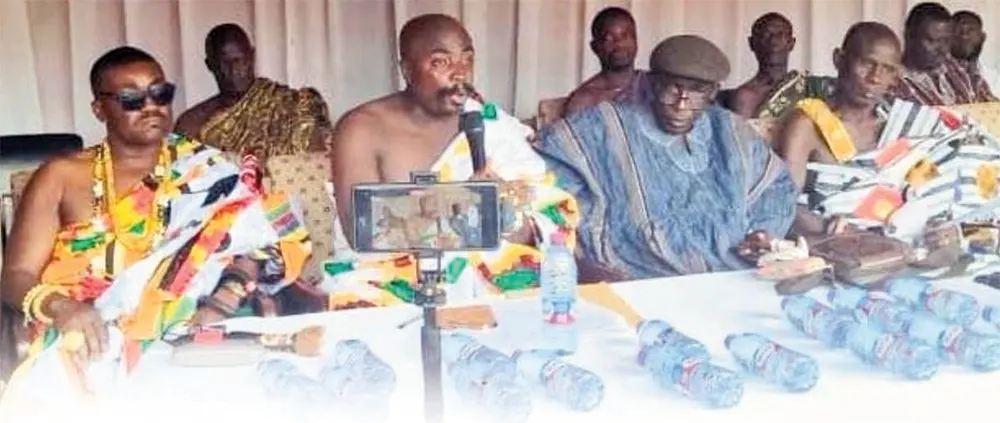
The chiefs addressing the media
Four months after Damang Gold Mine transitioned to indigenous Ghanaian ownership, chiefs and residents of Damang in the Prestea Huni Valley Municipality of the Western Region are seeing the first signs that promises made during the handing over ceremony are being kept.
The Chiefs and people of Damang have commended the management of Damang Gold Mine Limited (DGML) for early progress on employment, infrastructure and community engagement since the mine moved from Gold Fields Damang Mine to DGML on April 18, 2026.
Speaking at a press conference, the Chief of the Bosomtwi Divisional Council, Nana Kwabena Amponsah IV, said the early implementation of commitments by DGML under Chief Executive Officer, Ibrahim Mahama, has given the communities “grounds for cautious optimism.”
Nearly 400 Local Jobs In 4 Months
The most visible impact so far has been in employment. According to data shared with the community, nearly 400 people, predominantly from Damang Gold Mine catchment communities, have entered various stages of recruitment within the first four months of DGML’s operations.
Of that number, 180 candidates have already been engaged and are working. Another 135 have been selected for various positions and are at different stages of the process, from pre-employment medicals to induction.
An additional 85 have completed interviews and are awaiting results. The roles being filled include maintenance, heavy-duty drivers, security personnel and general hands.
Nana Amponsah also welcomed the appointment of Ghanaian professionals to key positions in the operation.
“For us, local participation in mining must provide a pathway through which the residents can acquire skills, experience and professional opportunities that can improve their livelihoods over the long term,” he added.
The chiefs called on DGML to complement recruitment with sustained skills development, training and career progression, and to deepen the involvement of local businesses and contractors in the mine’s procurement and supply chain as operations expand.
From Promise to Site Work
Alongside jobs, community leaders pointed to progress on infrastructure projects announced during the transition.
The most significant is the proposed construction of an airstrip at the Huni waste dump. DGML has completed the design and initial earthworks have commenced.
The Ghana Civil Aviation Authority and the Prestea-Huni Valley Municipal Assembly have already visited the site to inspect progress.
“The fact that design work, earthworks and institutional engagement have already begun represents an encouraging shift from project announcement to preliminary implementation,” youth representatives said. “We are, however, looking forward to the completion of the necessary regulatory and technical processes and the progression of the project into full construction.”
Work has also started on the Damang-to-Subri section of the Damang-Subri-Praso-Cape Coast road corridor.
Initial works have involved clearing the road fringes, cutting and filling sections with suitable materials, and constructing culverts in areas prone to waterlogging to reduce flooding during the rainy season.
The communities described the road as strategically important because it links mining towns to other population and commercial centers.
They stressed that sustained cooperation between DGML, government agencies and other stakeholders will be needed to deliver a lasting solution to the area’s infrastructure challenges.
Sports Facilities in the Pipeline
The development of sporting infrastructure is also at the preparatory stage. DGML plans to construct standard astroturf parks at Subri, Damang and Huni Valley.
Chiefs and community authorities have made land available for the facilities and a consultant being considered for the projects has visited the proposed sites and is expected to mobilize a team to commence work by the middle of August.
Beyond jobs and projects, community leaders said one of the most encouraging developments has been DGML’s approach to engagement.
“A sustainable mining operation cannot exist independently of the communities that host it,” Nana Amponsah pointed out. “For more than three decades, residents around Damang Mine have lived with both the economic opportunities and the social and infrastructure challenges of mining.”
A Test Of Indigenous Ownership
The transition of Damang Mine to DGML generated considerable expectations in the catchment communities. With about 180 people already at work and hundreds more in the pipeline, plus early works on roads, an airstrip and sports facilities, residents say the new owners have started on a positive note.
The chiefs, however, emphasised that the real test will be sustainability. They want to see long-term investment in skills, local contracting, and infrastructure that outlives the current commodity cycle.
For now, the mood in Damang is one of cautious hope. As Nana Amponsah puts it, the presence of valuable mineral resources in their communities should produce tangible opportunities for the people who live with the impact of mining.
With DGML still in its first year, the chiefs said they will continue to monitor progress and hold the company to the commitments made when it took over the mine.
From Emmanuel Opoku, Damang
