


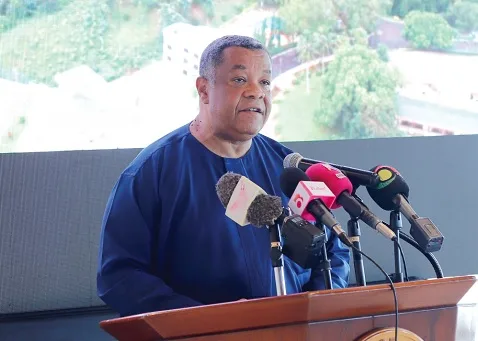
The Presidential Adviser on the 24-Hour Economy and Accelerated Export Development, Mr Augustus Obuadum Tanoh, has described the Northshore Apparel Hub at Savelugu as the anchor investment for a planned light industrial park that will transform the economy of Northern Ghana.
Speaking at the official opening of the factory on Friday, August 28, 2026, Mr Tanoh said the facility demonstrates that export manufacturing can succeed in the North and that young people of the region can find productive work at home.
“This factory demonstrates that export manufacturing can succeed in Savelugu, and that the young people of this region can find productive work at home, and that value can be and will be produced from every corner of Ghana under the 24-Hour Economy Programme and President Mahama’s reset agenda,” he said.
Mr Tanoh disclosed that at full capacity, Northshore Apparel expects to employ thousands of people directly, including persons with disabilities.
“The particular inclusion of differently abled persons in the workforce of Northshore Apparel is eminently commendable and a shining example for corporate Ghana to follow,” he said.
He also noted that the company has built a clinic and a crèche alongside its production lines, describing the move as exemplary.
Three-shift system
Mr Tanoh said Northshore is in the process of moving from a two-shift to a three-shift working system, tangibly actualising the 24-Hour Economy Programme “not in words but in deeds”.
He said the 24-Hour Economy and Accelerated Export Development Secretariat exists to change the structure of the economy by moving Ghana from the export of raw materials to the manufacture of finished goods for the domestic market and for the markets of AfCFTA, ECOWAS and beyond.
He stated that the programme is determined to increase the proportion of manufacturing in national output from 10 to 20 per cent over the next few years, ensuring that the unemployment rate falls below 5 per cent by 2034.
“These targets will be met in factories such as Northshore Apparel, and many others to follow under the 24-Hour Economy Programme, Feed Ghana and the Big Push,” he said.
Economic corridor vision
Mr Tanoh said textiles and garments are among the value chains the programme has prioritised, as the sector is labour-intensive and employs young people and women in large numbers.
He noted that the task is to connect farmers in Ghana and the subregion to ginneries, fabric processors, sewing lines, logistics providers and exporters into one competitive system.
“We may also dare to dream that the African Growth and Opportunity Act, which provides preferential trade access to the large US market, will be renewed beyond its current term, providing another important avenue of market access to Northshore Apparel and many others,” he said.
Mr Tanoh outlined four ways the anchor investment changes the economics of the area around it: creating demand for power, water, roads and warehousing; creating demand for skills; creating a market for local suppliers; and giving young people a reason to build their working lives in the North rather than migrating South or to Europe.
Planned industrial park and agricultural corridor
The Presidential Adviser announced that the factory is the anchor for the planned Northshore Light Industrial Park, a garments and agro-processing park in the Savelugu enclave that the Secretariat is preparing in partnership with the Ghana Infrastructure Investment Fund and the promoters of Northshore Apparel.
He also disclosed that at Tamale International Airport, the Secretariat and the Ghana Airports Company have jointly demarcated about 150 acres for an air cargo hub so that vegetables, fruit, shea and other high-value exports from the North can fly directly to international markets.
Additionally, he said land assembly under the 24-Hour Economy Participatory Land Access Model is underway at Singa and Daboya along the White Volta for an agricultural corridor of about 120,000 hectares. This corridor will support commercial-scale cultivation of vegetables, cereals, oil seeds, cut flowers, and a US$277 million integrated poultry industry.
“Farms at Singa, factories at Savelugu and Daboya, and export logistics at Tamale are not separate initiatives. They are part of a single production system: the economic corridor the 24-Hour Economy Programme is building to integrate and unify our national economy into one ecosystem to drive productivity, enhance production, create jobs, and deliver inclusive growth,” he said.
Acknowledgements
Mr Tanoh congratulated Mr Nurideen Mohammed, the Board, Management and workers of Northshore Apparel for their capital, patience and confidence in the vast potential of northern Ghana.
He thanked the Ghana Export-Import Bank and Investing for Employment, a facility under the German KfW Development Bank managed by GIZ, for their financing.
He also acknowledged the Development Bank Ghana, which is working with the Secretariat and its banking partners to secure additional financing to support the continued growth of the project.
He commended the traditional authorities, Yoo-Naa Abdulai Yakubu Andani II, the Savelugu Municipal Assembly and the Northern Regional Coordinating Council for their support.
Mr Tanoh thanked the Yoo-Naa for providing 1,000 acres of land contiguous to Northshore Apparel on which the Northshore Light Industrial Park will be located.
“The Northshore example demonstrates vividly what President Mahama’s reset agenda is about. Private capital, enabled by government policy to implement Ghana’s transformation agenda through investment, real capital formation, job creation and inclusive economic growth,” he said.
