


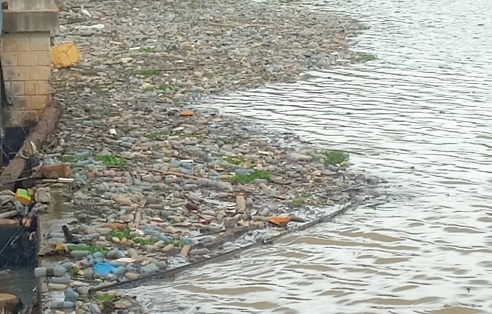
The Ghana Water Limited (GWL) will commence a comprehensive dredging of the Owabi and Barekese dams in the Ashanti Region to improve the treated water supply to millions of residents.
Announcing the decision, the Managing Director (MD), GWL, Adam Mutawakilu, said that considering the current state of both dams, it was necessary to undertake the exercise to ensure effective service delivery in the region.
He said the dredging of the dams was also duly captured by the Public Utilities Regulatory Commission’s tariff review, noting that “at least there is a revenue item to fund the dredging of the dams.”
The heavily silted Owabi and Barekese dams have been a long-existing challenge that the GWL has been dealing with.
They supply millions of treated water for use by many residents in the Ashanti Region, but are both silted.
Whereas the Barekese river base or reservoir is about 40 per cent silted, the Owabi Dam is about 75 per cent silted, thereby resulting in an inadequate treated water supply to the people, in case of any eventuality.
The Owabi Dam, in particular, is filled with plastics, which are carried into the dam whenever it rains, thereby impeding water production.
A staff member has been tasked with using a canoe to get rid of plastics whenever they accumulate in the dam.
Tour
Mr Mutawakilu made this known when he led some management members on a day’s tour to the Owabi and Barekese water treatment plants last Thursday (April 9, 2026).
The visit formed part of a move by the top management to tour the entire country to engage the staff, listen to them and come to terms with their challenges, in order to address them in line with the government’s reset agenda.
Based on that, he said, “We have requested commitment authorisation from the Ministry of Finance.
It is my hope that it will be approved so that we can kick-start the dredging intervention”.
Power situation
On the power situation, he said the Electricity Company of Ghana (ECG) has indicated its willingness to dedicate a transformer to deal with the erratic power supply issue, subject to GWL changing its transformer to 11KV.
Therefore, he charged the GWL management in the region to put in the request so that the transformer can be replaced to match that of ECG to ensure a dedicated power supply and its attendant consequences on water production.
“Due to the power fluctuation and the shallow nature of the dams, we could not meet our March regional target.
We fell short by almost 959 cubic metres of water, thereby denying some people the opportunity to have water,” he said.
Causes
Throwing more light on the level of siltation of the dams, the Chief Manager, Ashanti Production, GWL, Dr Hanson Mensah-Akuttey, said a lot of activities had been weeded into the course of both rivers, resulting in their siltation.
“The siltation of both dams is a result of encroachment as some people have degraded the nearby forest, coupled with the construction of buildings and properties along the encroachment, which continues to affect water production,” he said.
As a result, he expressed concern that the volume of water that was now left on the surface of the dams is small and not enough to ensure sustained water production volumes for the benefit of consumers.
Climate variability
He warned that if there is any serious climate variability change going forward, there would be a serious crisis, stressing, “If there is a severe climate change dryness or drought, it is possible that the whole of Kumasi will be out of water”.
To remedy the situation, he called for the immediate dredging of both reservoirs or dams to ensure adequacy of the volumes of water for treatment and for onward distribution to the millions of residents.
Dr Mensah-Akuttey further said their operational stability was being jeopardised due to power fluctuations and added that although the treatment plants had been designed to work for 24-hours, they sometimes run for a maximum of 16 hours due to erratic power supply”.
“We are losing about 84 per cent of our operations, which is impacting our production volumes.
Our production volumes have dropped to about 30 per cent, which is not enough to supply the full volumes to customers,” he said.
