


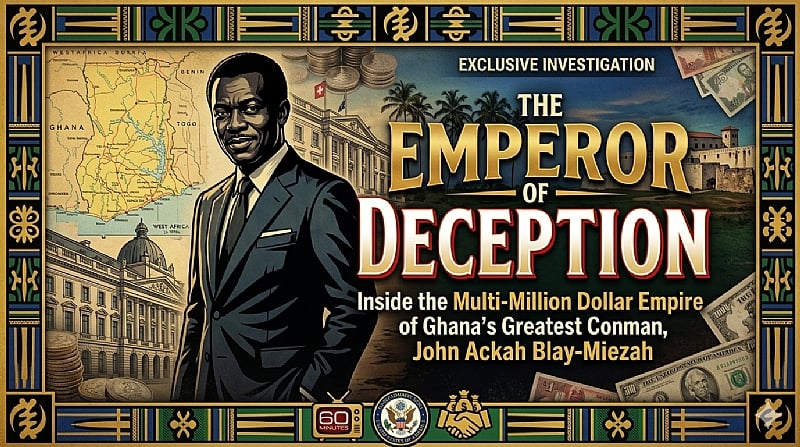
Long before internet connections birthed modern advance-fee fraud, a single charismatic Ghanaian engineered what global intelligence agencies termed one of the largest, most audacious scams of the 20th century. John Ackah Blay-Miezah did not use computers; he used sheer psychological manipulation, theatrical deception, and international diplomacy. From the early 1970s until his death in 1992, Blay-Miezah operated a fraudulent empire that swindled unsuspecting victims across North America, Europe, and Asia out of an estimated $200 million to $250 million.
By fabricating the mythical Oman Ghana Trust Fund—allegedly a multi-billion-dollar fortune left behind by Ghana’s first president, Dr. Kwame Nkrumah—Blay-Miezah successfully compromised high-ranking world politicians, eluded international law enforcement, and lived a life of staggering opulence. This is the comprehensive history of a master manipulator, his elite American accomplices, his legendary media evasion, and the legal battles that exposed his criminal enterprise.
The Genesis of the Lie: The Oman Ghana Trust Fund
Blay-Miezah’s global operation rested entirely on a brilliantly constructed, highly elaborate fiction. He claimed that he was the rightful sole trustee of a hidden national treasure.
- The Deathbed Promise: Blay-Miezah convinced investors that while Dr. Kwame Nkrumah was dying in exile in Romania, he appointed Blay-Miezah as the single beneficiary and trustee of the Oman Ghana Trust Fund.
- The Ghost Billions: He asserted that the secret fund held between $27 billion and $47 billion securely locked away in Swiss bank accounts.
- The Advance-Fee Pitch: To “unlock” this massive wealth from rigid international banks, Blay-Miezah claimed he desperately needed upfront capital to cover administrative fees, bribe officials, and secure diplomatic paperwork.
- The Return on Investment: He promised desperate and greedy investors astronomical returns, frequently offering $10 for every $1 invested, or returns as high as 50-to-1.
The American Partners: Driving the Hustle in Philadelphia
Blay-Miezah understood that to successfully target wealthy Westerners, he needed credible, local ground-enforcers. He focused his early operations in Philadelphia, Pennsylvania, establishing a highly polished front company called the Bureau of African Affairs and Industrial Development.
- Robert Ellis (The Primary Hustler): Blay-Miezah partnered with Robert Ellis (often referred to as Reverend Ray Ellis), a smooth-talking businessman described by Philadelphia prosecutors as a masterful “hustler”. While Blay-Miezah remained largely overseas to avoid immediate arrest, Ellis ran the physical operations in the US, actively soliciting hundreds of targets.
- Targeting the Elite: Ellis successfully targeted affluent Philadelphia professionals, including lawyers, doctors, and wealthy widows. He scammed at least 300 individuals out of an estimated $15 million specifically dedicated to his branch of the scheme.
- The Legal Insiders: The illusion of legitimacy was so profound that even John Mitchell, the disgraced former US Attorney General under President Richard Nixon, became entangled in the web. Mitchell acted as a legal adviser, inadvertently reassuring anxious investors that the fund was genuine.
- The Victims’ Ruin: A prominent Philadelphia attorney, Barry Ginsberg, and his associates poured $1.5 million into the empty trust, while an elderly widow famously lost her entire life savings of $70,000 to Ellis’s pitches.
The Diplomatic Battle: Shirley Temple Black and the Washington Cables
While wealthy financiers fell hook, line, and sinker for the ruse, America’s most high-profile diplomat stationed in Accra saw straight through the masquerade. Shirley Temple Black, the legendary former child film star who was serving as the US Ambassador to Ghana (1974–1976) under President Gerald Ford, became one of Blay-Miezah’s most formidable adversaries.
- Sounding the Alarm: As millions poured into the scam, Ambassador Black began firing off urgent, classified diplomatic cables from the US Embassy in Accra directly to US Secretary of State Henry Kissinger in Washington, D.C.
- The Sunk-Cost Warning: In her correspondence, Black brilliantly diagnosed the psychological trap Blay-Miezah had set for his victims. She noted that the biggest barrier to stopping the con was the sheer embarrassment of the elite targets.
- The Infamous Quote: In a declassified cable to Kissinger, Ambassador Black wrote: “Those who believe Blay-Miezah a fraud are worried he might just have the money and then they would look extremely foolish.”
- The Enabler of Fraud: Her cables detailed how the victims’ absolute reluctance to admit they were “suckers” actively shielded Blay-Miezah, granting him the time and breathing room needed to keep breathing life into his scam.
Court Details: Charges, Extraditions, and Prison Breaks
As the promised payouts repeatedly stalled, international law enforcement agencies intervened, resulting in a complex web of legal trials across multiple jurisdictions.
- The Bellevue-Stratford Arrest (1972): Early in his career, Blay-Miezah posed as an official diplomat at the luxurious Bellevue-Stratford Hotel in Philadelphia. After accumulating a massive $2,644 bill that the Ghanaian mission refused to pay, he was arrested and sentenced to prison for impersonating a diplomat. Historians note that this initial prison stint served as his “crime school”.
- The 1974 Check Fraud Charges: Blay-Miezah fled the United States in 1974 after being formally charged with attempting to cash $250,000 worth of stolen cashier’s checks, marking the beginning of his life as an international fugitive.
- The 64-Count Indictment against Ellis: In the mid-1980s, the US judicial system cracked down heavily on the American arm of the operation. Robert Ellis was arrested and hit with a crushing 64-count indictment charging him with theft, wire fraud, and conspiracy. He faced a maximum potential sentence of 543 years in prison and massive financial penalties.
- The Pennsylvania Escape: When the United States successfully pushed the Ghanaian government for Blay-Miezah’s indictment on several counts of wire fraud, he was briefly detained. However, showing his uncanny ability to manipulate security, he managed to escape from a prison facility in Pennsylvania and fled back across international borders.
- The Sovereign Shield: Upon returning to Ghana, Blay-Miezah used his financial clout to buy political protection. He managed to deceive Ghana’s Head of State, Ignatius Kutu Acheampong, into granting him an official diplomatic passport. This passport effectively granted him sovereign immunity, preventing the US government from extraditing him to face trial.
Media Appearances and Theatre of Deception
Blay-Miezah was not a hiding fugitive; he was a media-savvy showman who weaponized his public image to maintain the grand illusion.
- The CBS “60 Minutes” Exposure: The pinnacle of his media exposure came when CBS’s premier investigative program, 60 Minutes, broadcast a dedicated segment profiling his exploits. Journalist Ed Bradley officially crowned him “The Ultimate Con Man,” using hidden cameras and interviews to expose how he routinely defrauded victims out of their life savings.
- Theatrical Boardrooms: When investors grew restless, Blay-Miezah staged elaborate meetings in luxury hotels across London, Amsterdam, and Accra. He designed these meetings like theatrical productions, utilizing burning incense, playing classical music, and forcing strategic “diplomatic delays” to make himself seem like an inaccessible, hyper-busy statesman.
- The Bold Media Defiance: When explicitly questioned by foreign journalists and disgruntled investors about his lavish lifestyle, Blay-Miezah famously retorted to the media, “I can’t live like a pauper. I have to impress my people.”
The Final Act: House Arrest and a Deathbed Hoax
By the late 1980s, the political landscape in Ghana shifted dramatically under the Provisional National Defence Council (PNDC) led by Jerry John Rawlings. The myth of the Oman Ghana Trust Fund had deeply embarrassed the state on the global stage.
- The Fall from Grace: Recognizing that the billions were non-existent, the Ghanaian government placed Blay-Miezah under strict house arrest in Accra for repeatedly deceiving and bringing public embarrassment to the state.
- The Angry Vigilante: His physical safety was compromised as well. One furious American investor, completely broken by the scam, flew directly to Accra, bypassed security, and attempted to physically choke Blay-Miezah to death in a desperate bid to claw back his stolen investments.
- The Ultimate Departure (1992): John Ackah Blay-Miezah died while still under house arrest in 1992. True to his identity, he pulled one final prank on his deathbed, convincing his immediate family members that $15 billion was waiting for them in an overseas bank account. The family spent months searching for the funds, only to realize they had been conned by their own patriarch.
John Ackah Blay-Miezah remains a fascinating, dark chapter in the history of global financial crime. He weaponized the world’s perception of a young, post-independence African nation to exploit the greed and gullibility of Western elites. While his story reads like a Hollywood thriller, the devastation left behind was entirely real: shattered lives, bankrupt families, and corrupted institutions. For platforms like Modern Ghana, his legacy—meticulously documented by figures like Ambassador Shirley Temple Black—serves as a permanent, cautionary reminder of the dangers of institutional gullibility and the boundless reach of a charismatic criminal mind.
✍️ Retired Senior Citizen
For and on behalf of all Senior Citizens of the Republic of Ghana 🇬🇭
Teshie-Nungua
[email protected]
