


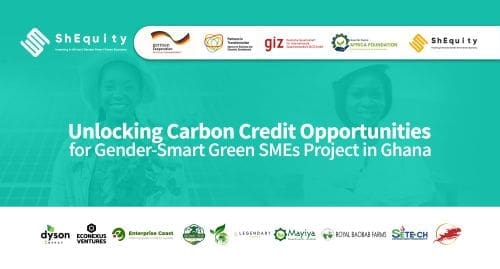

ShEquity Partners has selected 10 Ghanaian gender-smart climate businesses for the final stage of its Technical Assistance Facility, opening their path to carbon market finance and investor readiness.
The announcement, made Tuesday in Accra, marks the culmination of an intensive selection process that began with 30 gender-smart, climate-focused small and medium-sized enterprises (SMEs). That cohort received hands-on training in carbon market access and investment readiness before being narrowed to 15 companies. Those 15 then developed Carbon Opportunity Maps and received masterclasses on gender inclusion, governance, growth strategy, job creation, and strategic communications. The final 10 were selected based on their readiness to leverage opportunities under Article 6 of the Paris Agreement and Ghana’s evolving carbon market framework.
ShEquity operates the facility in partnership with the Agency for Business and Economic Development (AWE) and Greentec Capital Africa Foundation.
The 10 finalists will now receive one-on-one investor and communications coaching alongside support from carbon certification experts, who will guide them in developing Preliminary Project Design Document (pre-PDD) concept notes. The pre-PDD provides a structured overview of a potential carbon project, outlining objectives, expected carbon activities, and an initial assessment of suitable certification methodologies such as Verra or Gold Standard. The final stage will involve live pitching before an independent jury, with two winning businesses each receiving a grant of USD 25,000 and full Project Design Document (PDD) development support.
Pauline Koelbl, Founder and Chief Executive Officer of ShEquity, framed the stakes plainly: “Africa’s future depends on who gets funded,” she said, adding that the facility is designed to back women-led and gender-smart SMEs driving climate resilience and green growth across the continent.
Christina Pfandl, AWE advisor in Ghana, said enabling these SMEs to participate in climate finance mechanisms is essential for building a resilient and inclusive green economy, and described the initiative as a reflection of the broader cooperation between the governments of Germany and Ghana in advancing innovative climate finance solutions.
The 10 selected enterprises operate across sectors including circular economy, nature-based solutions, renewable energy and energy efficiency, sustainable agriculture, and sustainable mobility. They are Dyson Energy, Eco-nexus, Enterprise Coast Ghana, Gateway Feeds, GreenEarth Agro, Legendary Foods, Mayiya Investments, Royal Baobab Farms, Sustainable Energy Technologies Limited, and YomYom.
ShEquity said the initiative contributes to the United Nations Sustainable Development Goals (SDGs), specifically Gender Equality (SDG 5) and Climate Action (SDG 13), and positions Ghana as a growing hub for gender-inclusive climate finance.
