



The Economic Community of West African States (ECOWAS) has formally relocated its Regional Animal Health Centre (RAHC) to Guinea-Bissau, marking a significant institutional shift for the body responsible for coordinating the control of transboundary animal diseases across the 15-member bloc.
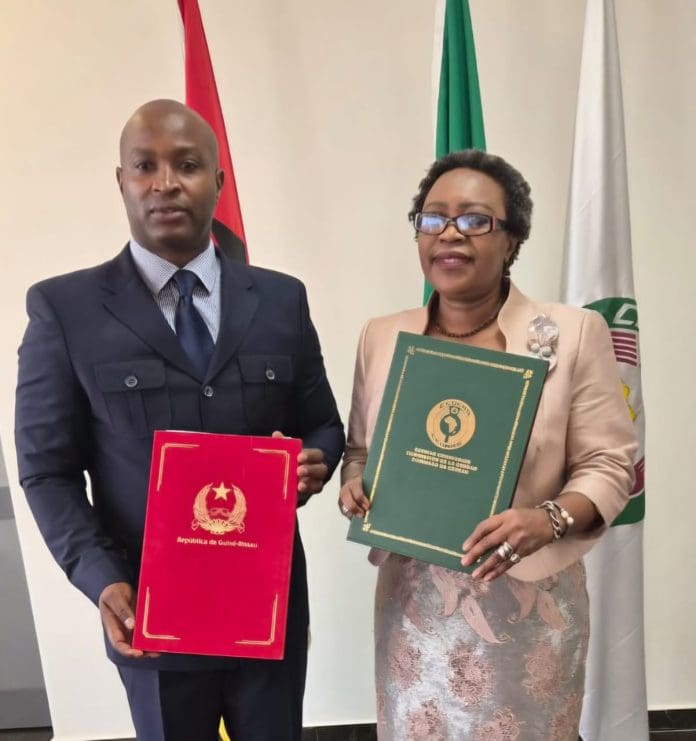
ECOWAS and the transitional government of Guinea-Bissau signed the agreement on Wednesday, March 18, 2026, in Bissau, setting out the legal and institutional framework for hosting the centre in the country. The Headquarters Agreement was signed on behalf of the host government by Foreign Affairs Minister Joao Bernardo Vieira and on behalf of the ECOWAS Commission by its Resident Representative in Guinea-Bissau, Ngozi Ukaeje.
The RAHC, a specialised ECOWAS agency previously based in Bamako, Mali, was established to coordinate and harmonise policies on transboundary animal diseases and zoonoses, support member states in developing national strategies, and strengthen regional epidemiological surveillance systems.
Vieira told reporters that the establishment of the centre in Bissau marked a strategic step for the country, reinforcing its role as host to a specialised ECOWAS agency. “By hosting this reference infrastructure, Guinea-Bissau asserts itself not only as a geographic point on the regional map, but also as a pillar in West Africa’s health resilience,” he said.
Ukaeje said the selection of Guinea-Bissau reflected ECOWAS’ confidence in the country and highlighted the significance of the agreement for harmonising animal health policies across the region. “This centre will be essential to ensuring food and health security by protecting livestock and, consequently, the communities that depend on them,” she said.
The relocation carries significant implications for food security and livelihoods across the region. The RAHC plays a central role in tracking and responding to disease outbreaks that can devastate livestock populations and rural economies. Among its most high-profile mandates is supporting the region-wide campaign to control and eradicate Peste des Petits Ruminants (PPR), a livestock disease that can kill up to 90 percent of infected animals and causes major economic losses across West Africa.
ECOWAS said the move underscored the shared commitment of the bloc and its member states to improving animal health systems, safeguarding food security, protecting livelihoods and mitigating the risks posed by zoonotic diseases, and reaffirmed its dedication to ensuring a smooth transition.
