
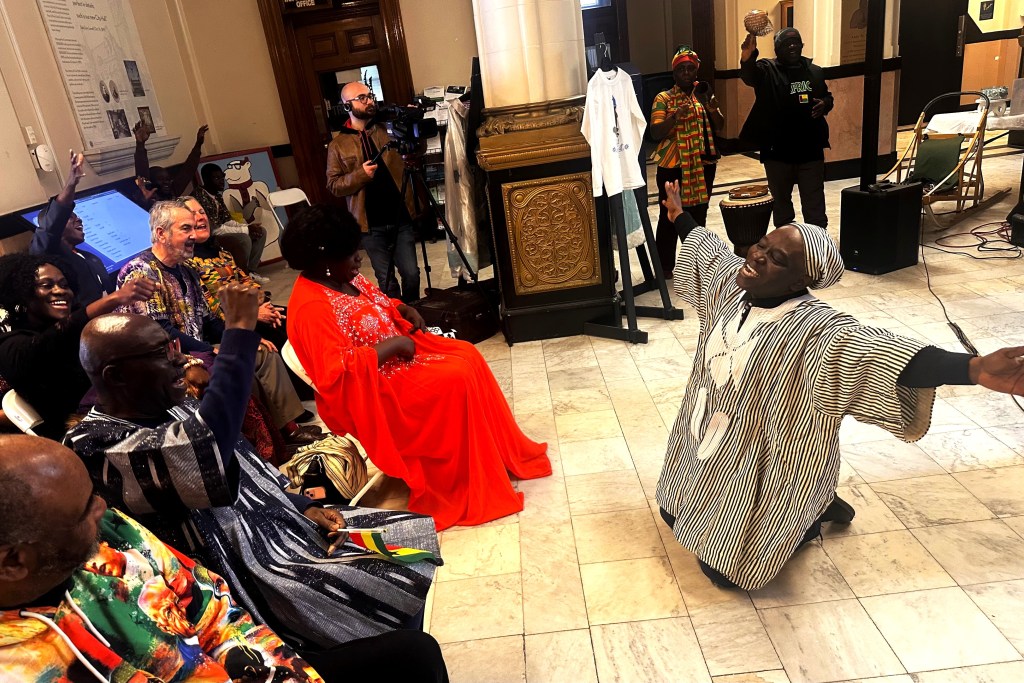
LOWELL — The Ghanaian national anthem echoed off the walls of City Hall on Saturday as the country’s flag rose into the frigid air in celebration of 69 years of independence.
For Gordon Donkoh‑Halm, executive director of the African Community Center of Lowell (ACCL), the ceremony is a long‑standing tradition. Born and raised in Ghana, he has led Lowell’s Ghanaian flag‑raising each year since the first one in 1998.
“It’s for the community to come together to celebrate Ghana’s 69 years of independence,” Donkoh‑Halm said before the event began. “To raise the flag and raise the spirit.
“We hope our children will continue this legacy when we play our part and are gone,” he added.
Donkoh‑Halm set the tone with attendees right away, leading drumming, dancing, and patriotic songs that filled City Hall and energized the crowd ahead of the flag‑raising.
The celebration also carried a reflective tone, led by keynote speaker Dr. Frank Abeka, who recently relocated with his family from Ghana and is now practicing medicine in Lowell.
Abeka highlighted the country’s progress since independence — more hospitals, more medical specialists, and a publicly funded national health insurance program — but he also spoke about the challenges that persist.
He pointed to the recently reported death of 29‑year‑old engineer Charles Amissah, who died last month in an ambulance in Accra, Ghana’s capital and largest city, after hospitals reported no available beds.
Known as the “no‑bed syndrome,” this has been an ongoing issue in Ghana.
“Let’s for a moment picture ourselves in that situation,” Abeka said. “What would run through our head? Our health system has failed us.”
He added that Ghana does not have a domestic industry capable of producing its own medicines and noted that only about 5% of Ghanaians can afford to travel abroad for “high‑priority medical care.”
Abeka urged the Ghanaian diaspora to see themselves as part of the solution, encouraging investment in Ghana’s healthcare system and visits from medical professionals to help train workers.
“I’m here today to remind us in the diaspora that we hold the key to making Ghana’s healthcare a better one,” he said. “We have one country called Ghana, and our second home called America. God bless our homeland Ghana, and God bless America.”
Tufts University music professor Kwesi Ampene also addressed the crowd, calling the day “a great one” while acknowledging the complexities of Ghana’s journey.
He noted that Ghana was the first sub‑Saharan African nation to gain independence from colonial rule and has experienced rapid population growth during that time — from about 6 million at independence to 35 million today.
He noted Ghana’s wide range of political transitions since its independence in March 1957, including shifts between civilian and military rule and the establishment of four republics.
In addition to those repeated transitions, there are infrastructure challenges, environmental concerns, and economic issues among the populace despite its fertile land and natural resources.
“We’ve accomplished a lot,” Ampene said. “But for those of us who are fortunate to go back, we can also see what we call retrogression.
“We don’t have to be scared,” he concluded. “We have to accept our shortcomings, because if we don’t accept our shortcomings, we can never move forward.”
Several local officials attended the ceremony, including City Councilors Vesna Nuon, Sidney Liang, Belinda Juran, and Rita Mercier, along with state Rep. Vanna Howard and School Committee Member Fred Bahou.
Nuon reflected on the speakers’ messages, saying that while Ghana’s independence is worth celebrating, it also raises important questions about who benefits most from progress. He said the comments from Abeka and Ampene were a reminder that the benefits are uneven — “only going to a few” — and that immigrant communities have a role to play in supporting those still facing challenges in their home countries.
“Yes, celebrate that independence,” Nuon said. “But at the same time … who benefited the most from that progress in healthcare, in education, in infrastructure, environment?”
Nuon presented Donkoh‑Halm with a proclamation declaring March 7, 2026, as Ghana Independence Day in Lowell. The flag was then carried outside City Hall, where the U.S. National Anthem and the Ghanaian national anthem were played before the Ghanaian flag was raised.
Mercier noted that St. Patrick’s Day festivities on Sunday will include raising the Irish flag at City Hall, but emphasized that once the holiday passes, the Ghanaian flag will return for the remainder of the month.
Among those in attendance were Chelmsford residents Dr. Sheila Morehouse and her partner, Dr. Vincent Waite, who spend time each year working in a hospital in northern Ghana, where Waite previously lived for 15 years.
Morehouse, a pediatrician, said she appreciated the ceremony’s energy and agreed with the speakers’ sentiment that celebrating independence also means acknowledging the work still needed to improve conditions within the country’s borders.
“I love the spirit of the Ghanaian people,” she added. “It’s such a joy within adversity.”
At the start of Saturday’s event, Donkoh-Halm led attendees in a moment of silence for state Sen. Edward Kennedy, who died in October.
For more information about ACCL, visit acclowell.org.
Follow Aaron Curtis on X @aselahcurtis, or on Bluesky @aaronscurtis.bsky.social.

