


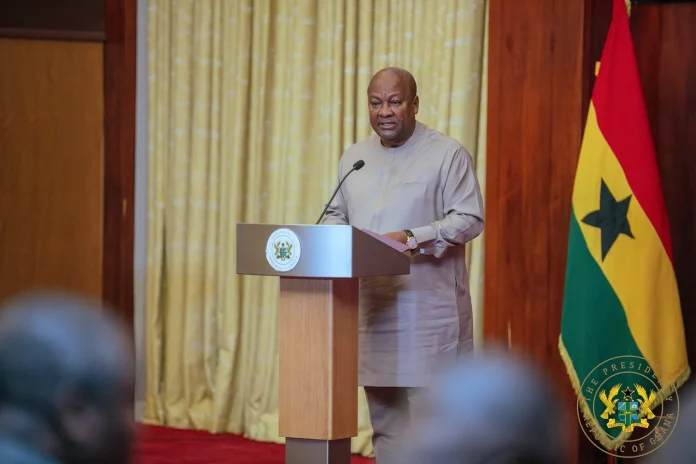

President John Dramani Mahama has announced the creation of the Ghana Sports Fund, positioning it as a financing vehicle for grassroots sports development, athlete welfare, school sports, infrastructure modernisation, and long-term talent pipelines, while challenging corporate Ghana to treat sports investment as national partnership rather than charity.
The President made the announcement at the Presidential Dialogue with the Private Sector held at the Kempinski Hotel Gold Coast City in Accra on Tuesday, February 24, 2026, framing Ghana’s sporting ambitions explicitly within an economic development argument.
“Sports is not just social, it is fundamentally economic,” Mahama told the gathering of private sector leaders, pointing to the upcoming 2026 FIFA World Cup, Commonwealth Games, and Summer Youth Olympics as international platforms Ghana must be positioned to leverage for maximum visibility and investment attraction.
The fund is designed to operate on transparent financing principles, with structured contribution pathways for corporate investors. “Corporate Ghana should view this not as charity but as a partnership in national development,” the President stated, signalling that the government intends to create a formal private sector co-funding mechanism rather than relying solely on public budget allocations.
Details of the fund’s governance structure, minimum contribution thresholds, and the regulatory framework under which it will operate were not disclosed at the event. The government has not yet indicated whether an independent board or existing bodies such as the National Sports Authority (NSA) will oversee the fund’s management and disbursement.
The announcement connects Ghana’s sports agenda to a broader economic transformation narrative the Mahama administration has been building since the start of 2026. Major international sporting events have demonstrated tangible economic multiplier effects for host nations and participating countries, spanning tourism, broadcasting rights, merchandise, and infrastructure investment. Ghana’s qualification for global tournaments has historically generated significant soft power value and diaspora engagement, both of which the government has identified as strategic priorities under its reset agenda.
The 2026 FIFA World Cup, co-hosted by the United States, Canada, and Mexico, is scheduled for June and July. The Commonwealth Games are set for Glasgow in July and August, while the Summer Youth Olympics are scheduled for Senegal in October and November, making 2026 an unusually dense international sporting calendar with multiple high-visibility platforms available simultaneously.
Ghana’s sports infrastructure has faced persistent underinvestment for more than a decade. Major facilities including the Accra Sports Stadium, Ohene Djan Stadium, and Baba Yara Sports Stadium in Kumasi require significant rehabilitation, while grassroots sporting infrastructure outside the two major cities remains severely limited. The Ghana Sports Fund, if adequately capitalised and transparently managed, would represent the most structured attempt in recent years to address the investment backlog across multiple levels of the sports development chain simultaneously.
