

Ghana’s largest opposition party, the New Patriotic Party (NPP), holds its presidential primary today across 333 polling centers nationwide to elect a flagbearer for the 2028 general election.
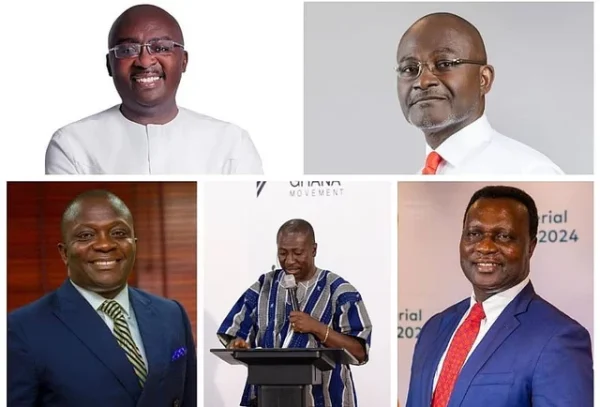
Five candidates are competing for the position: former Vice President Dr. Mahamudu Bawumia, businessman Kennedy Ohene Agyapong, former Minister for Food and Agriculture Dr. Bryan Acheampong, former Minister of Education Dr. Yaw Osei Adutwum, and former NPP General Secretary Kwabena Agyei Agyepong. Some 211,849 delegates began voting at 7:00 a.m. this morning, with polls scheduled to close at 2:00 p.m.
The decision to hold the primary two years before the next election has drawn criticism from some party members. Former Attorney General Nii Ayikoi Otoo questioned why the date was set before regional and constituency elections, suggesting the approach risked consolidating power among a narrow leadership circle.
The National Executive Committee (NEC) defended the January 31 date, which was announced in June 2025. General Secretary Justin Kodua Frimpong said the early timeline would help unite the party and give the chosen candidate adequate time to campaign nationally before 2028. The party scheduled the flagbearer race before executive elections.
All five aspirants signed a peace pact earlier this month, committing to accept the results and maintain party unity regardless of the outcome. Elections Committee Chairman Joe Osei Owusu emphasized the importance of the commitment. “All aspirants must commit themselves, openly and honestly, to accepting the outcome of the January 31 primary,” he said. “Such a commitment boosts confidence among party members and ensures a free, transparent and peaceful process.”
The pact requires candidates to support whoever emerges victorious and work together to rebuild the party. Frimpong said the agreement ensures “all candidates actively participate at every stage, accept the results of the primaries, and work to maintain party cohesion.”
Voting is taking place simultaneously at polling centers across all 276 constituencies. The Electoral Commission has assured it is prepared to conduct a free, fair and transparent election. Thousands of police officers have been deployed to maintain order and security.
Pre-election surveys from Global InfoAnalytics, Ghana’s largest polling organization, predict a commanding victory for Bawumia. Executive Director Mussa Dankwa released final projections on January 23 showing Bawumia with 57 percent support among delegates. Kennedy Agyapong trails at 28 percent, while Bryan Acheampong polls 13 percent. The survey placed Adutwum at 2 percent and Agyepong at zero percent.
The poll sampled 10,133 respondents across 272 constituencies using computer assisted telephone interviews (CATI) between December 29, 2025, and January 23, 2026. Global InfoAnalytics claims a confidence level of 99.9 percent with a margin of error of plus or minus 3.0 percent in its predictive model.
Dankwa told Channel One TV on January 28 that the data shows “a one touch victory for Bawumia.” The research indicates Bawumia maintains dominant support in the five northern regions and holds majorities in the North East and Upper West. Kennedy Agyapong retains competitive support in parts of the Central and Ashanti regions.
The race has featured spiritual predictions from several prominent Ghanaian prophets. Some religious leaders have declared Bawumia the winner, while others claim divine revelation shows Agyapong will prevail. None have publicly backed the other three candidates.
Bawumia previously won the NPP presidential primary in November 2023, defeating Kennedy Agyapong with over 60 percent of votes. He went on to lose the 2024 general election to John Dramani Mahama of the National Democratic Congress (NDC). The NPP is now in opposition for the first time since 2016.
Party officials acknowledge the primary’s aftermath carries greater significance than the vote itself. The NPP expects to unite and begin rebuilding immediately after results are announced. Leadership has emphasized that the party’s future depends on delegates’ ability to heal divisions and present a unified front.
The Ashanti and Greater Accra regions constitute the largest voting blocs, followed by the Eastern, Central and Western regions. Political observers note that voting patterns in these areas could prove decisive. Results from individual polling centers will be transmitted to a national collation center in Accra for final tabulation.
The winner faces the immediate challenge of uniting party factions, addressing internal grievances and crafting a compelling message to regain voter confidence after the 2024 defeat. The flagbearer will lead efforts to rebuild party structures and prepare for the 2028 election campaign against the governing NDC.
Counting begins after polls close at 2:00 p.m., with official results expected later today.

