


Read: Over 14 000 jobs at risk as Tongaat Hulett misses payment deadline
The Melville Sugar Mill in South Africa’s KwaZulu-Natal province is a sign of what used to be and what the future might hold.
Trees have grown through the two brick chimneys of the mill, which closed in 1978. The sugar-cane trucks now wend their way past it on a gravel road as schoolchildren snatch up the falling stalks to suck out the sweet juice. Consolidation and struggling businesses have seen a wave of mills close.
“When I see this place it always breaks my heart,” said 56-year-old Kiki Mzoneli, a fifth-generation sugar farmer who’s watched as sugar prices fall and kept planting for fear of ceding unproductive fields back to the Zulu royal household, which owns much of the land in the southeastern province. “We plant even when we make a loss. If we don’t plant on the land, we lose it.”
Mzoneli is one of more than a million South Africans dependent on sugar. It’s a more than century-old industry that’s now struggling to compete with imports from global giants like Brazil, low labour costs in neighbouring Eswatini and to cope with her country’s bungled industrial policy that’s failed to create local demand after two decades of indecision.
Read:
SA set to lift sugar-benchmark price to shield growers
Tongaat owes sugar association R517m in outstanding industry levies
Those pressures are now coming to a head. Tongaat Hulett, which accounts for more than 40% of South Africa’s refined sugar production and was founded 134 years ago, narrowly avoided liquidation after winning a state-led lifeline in June that will keep it funded until the end of this month. Its rival, Associated British Foods Plc-owned Illovo Sugar, is struggling to turn a profit at its South African operations.
The sugar industry is of limited economic importance to the country, generating about R24 billion ($1.5 billion) annually, but it sustains more than a million people and provides 270 000 direct and indirect jobs in a country where one in three is unemployed.
While welcoming the intervention, the cane growers that supply Tongaat’s mills see the measure as a band-aid that doesn’t address the challenges faced by the industry.
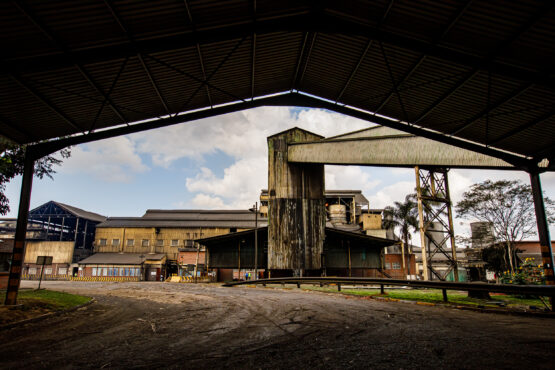
The processing area of Tongaat Huletts Maidstone Mill. Image: Cebisile Mbonani/Bloomberg
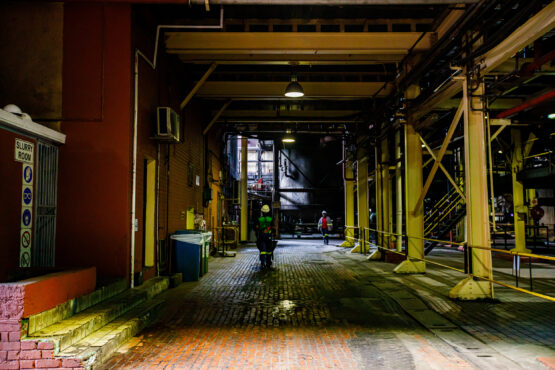
The mill has funding to keep it operational to the end of the month. Image: Cebisile Mbonani/Bloomberg
“What’s the point in spending so much money to keep mills open while failing to resolve the matter of cheap imports?” Mzoneli says of the state-owned Industrial Development Corp extending R2.5 billion of loans to Tongaat that will be converted into equity, enough to keep the company running until the end of September.
At about the same time, Vision Group bought R11.7 billion of the struggling company’s debt with a view to negotiating control at a later date.
“It averted liquidation — it preserved approximately 250 000 livelihoods across the sugar value chain,” said Rute Moyo, a Zimbabwean businessmen who controls Vision together with South Africa’s Robert Gumede. “Protecting Tongaat Hulett is not just a commercial interest, it’s a national responsibility.”
ADVERTISEMENT
CONTINUE READING BELOW
Both Illovo and Tongaat, the plight of which was worsened by an earlier accounting scandal where senior executives inflated profits and asset prices leading to arrests and criminal cases that are still in progress, have closed mills in the last six years and more may be shuttered.
It wasn’t always like this.
Read:
Vision-IDC Tongaat deal, contractor tender rights, and table grape export challenges
Tongaat Hulett escapes liquidation after IDC and Vision Group strike rescue pact
Sugar was first planted in South Africa in 1848. As the industry rapidly grew, indentured labourers were brought in from India from 1861, founding one of the world’s largest Indian communities outside south Asia, after failing to persuade Zulus to work in the plantations. After World War II it expanded, reaching a production peak of 2.76 million tons in 2003.
Since then, the industry — which stretches across the KwaZulu-Natal and Mpumalanga provinces — has been in decline but still produces about 2.2 million tons.
The consequences of that slump are visible in small towns such as Darnall, where Tongaat closed a mill in 2020, costing almost 400 permanent jobs and dozens of seasonal work opportunities.
The road to Darnall Country Club, which depended on Tongaat for funding and patrons, is lined with abandoned houses, some of which have been stripped. Membership has slumped leaving Roy Sukhu managing a business who’s economic anchor has left.
“We are trying to run it on our own at the moment,” said Sukhu, who traces his ancestry to the labourers who arrived from India in the 19th century. “It’s a struggle.”
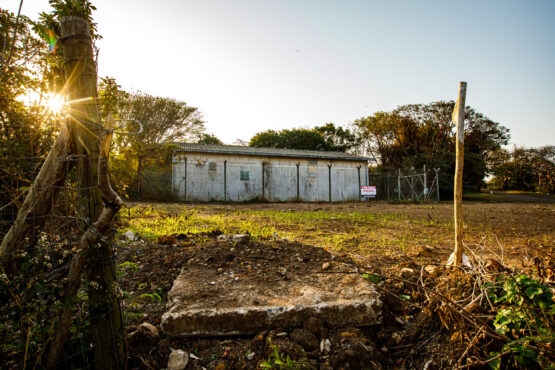
Former farm workers and farmers houses are vacant in Darnall, after the closure of the sugar mill in 2020. Image: Cebisile Mbonani/Bloomberg
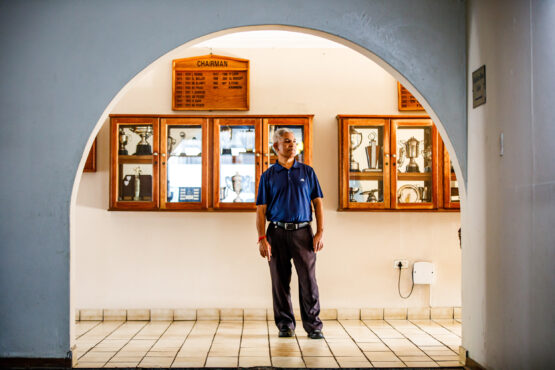
Roy Sukhu at the Darnall Country Club which he has run for decades. The club has become quieter in recent years. Image: Cebisile Mbonani/Bloomberg
And while the industry has deteriorated, the state has — despite a series of unimplemented plans to rescue it — largely stood by.
Imports in the first six months of this year were 124 594 tons compared with just 1 619 tons in the same period in 2022, according to the Congress of South African Trade Unions. Much of that sugar was imported from Brazil, India and Thailand. Sugar growers in those countries benefit from established ethanol industries and state subsidies.
“The sugar industry is in crisis,” Cosatu said in a statement, calling for lower electricity costs, better rail service and a crackdown on imports.
ADVERTISEMENT:
CONTINUE READING BELOW
RCL Foods, a smaller producer, said on August 31 that the imports forced it to sell sugar on international markers at less than half of what it could have got locally.
“Import volumes remain exceptionally high, the domestic market has contracted and producers continue to face pressure on volume and margins,’’ said Gavin Dalgleish, Tongaat’s chief executive officer. Illovo didn’t respond to requests for comment.
Read: Over 14 000 jobs at risk as Tongaat Hulett misses payment deadline
The government has now, after years of lobbying, offered producers some relief. In August, it raised the dollar-based reference price used to calculate sugar import duties to $785 a ton from $680, its first increase since 2018. While well below the $905 sought by growers, it’s above the price of sugar traded in London of about $520 and is an attempt to balance the interests of growers against sugar users.
The government is “committed to defending the domestic sugar industry against unfair competition,” the trade and industry department said in a response to questions. “South African producers compete with countries where sugar production may benefit from various forms of government support, different cost structures, economies of scale and favourable production conditions.”
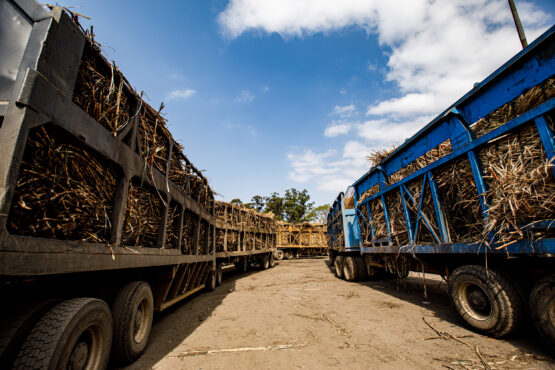
Trucks loaded with recently harvested sugar-cane queue at the Tongaat Huletts Maidstone Mill. Image: Cebisile Mbonani/Bloomberg
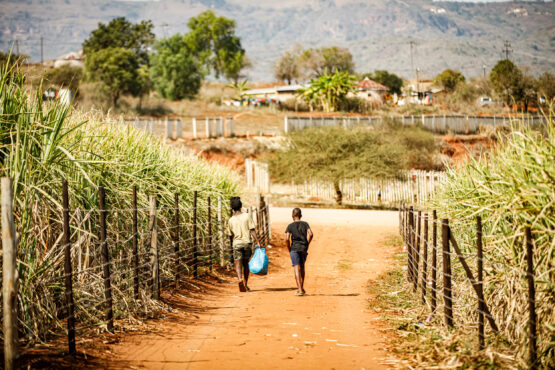
A road cuts through sugar-cane fields with settlements across the surrounding hills in Maphumulo. Image: Cebisile Mbonani/Bloomberg
The measure may make imports less attractive but it does little to address the industry’ structural woes.
Other countries have moved rapidly to blend bioethanol from sugar and other crops into motor fuel, with Brazil doing so from 1931 and Zimbabwe from 1980 with a Tongaat operation in that country making the fuel.
South Africa adopted a biofuels industrial strategy in 2007 and announced blending targets and then never implemented them. A new plan was signed by industry and the government in April that envisages biofuel production, the trade department said.
“Fuel ethanol from sugarcane is not a speculative idea in this country,” said Moyo. “It’s a policy that has been approved, announced, and then allowed to gather dust.”
His company now wants the government to act on its ethanol commitments and to pave the way for generation of electricity from sugar waste that could be sold via the national grid. The nation’s sugar association estimates the industry can contribute about 700 megawatts of power to the grid through co-generation projects.
Sugar milling is just one South African industry where state dithering and inaction on industrial policy has seen plants close and government scramble to put in place rescue plans when the damage has already been done.
ArcelorMittal SA’s local unit last year closed two construction steel plants, citing excessive imports and state assistance to smaller rivals that produce lower-grade products. The country is currently offering ferrochrome producers lower electricity prices after more than a decade of surging tariffs drove most of them out of business.
ADVERTISEMENT:
CONTINUE READING BELOW
“You hear all of this talk about how we are going to do something and then nothing happens,’’ said Jee-A van der Linde, a senior Africa economist at Oxford Economics. “Once it’s too late, there is a reaction.’’
For now, with few other options, the rural communities that supply the remaining mills with cane are doing their best to keep the industry afloat.
Siyabonga Madlala is leading attempts to revive cane farming in eSnamfu, where production fell to 2 000 tons a year in 2009 in the decade after Illovo closed the Glendale mill, leading to the collapse of irrigation programs. Some of those have now been restored and the plantations have partly been restored.
Still, the millers he sold his cane to have at times been in business rescue, a South African legal process that gives financially distressed companies temporary protection from creditors.
“I’ve had a really devastating two or three years,” he said.
But Madlala sees drought, floods, labour shortages and imports as risks that can be managed as long as farmers keep growing the crop.
“If you kill the primary production of sugar cane, you can imagine how many livelihoods you are affecting,” he said on a muggy Saturday morning as adherents of the local Shembe faith worshipped outdoors on his land and chickens wandered by.
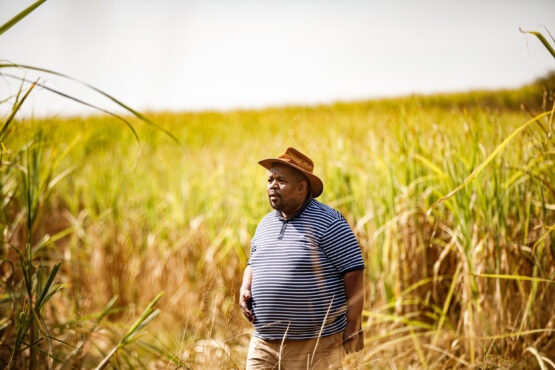
Siyabonga Madlala among mature cane plants in Maphumulo, KwaZulu Natal, an area whose landscape and economy have long been shaped by the crop. Image: Cebisile Mbonani/Bloomberg
The government’s higher tariff may buy some time.
The Tongaat rescue may, for now, preserve crucial milling capacity. But for the mainly poor Black South African farmers who rely on it, the economics of the crop are unchanged.
“My ancestors fought to be recognised as human beings, then they fought to be recognised as business people in their own right in the sugar industry,” Mzoneli said. “Now it is our turn” to fight to survive, she adds.
© 2026 Bloomberg
