



Are Ghana’s Electricity Demand Forecasts Keeping Pace With Structural Changes In The Economy? Evidence from the 2026 Energy Outlook
For years, electricity demand forecasting in Ghana has been treated largely as a technical exercise: estimate economic growth, project electricity consumption, assess generation requirements and plan the system accordingly. But Ghana’s electricity landscape is changing faster than a conventional forecasting model may be able to capture.
The question emerging from the 2026 Energy Outlook for Ghana is therefore not simply whether electricity demand is rising. It clearly is. The more important question is whether the assumptions used to forecast that demand are changing quickly enough to reflect the structure of Ghana’s evolving economy.
The evidence from 2025 is striking. Actual electricity demand repeatedly exceeded the Base Case forecast, while several important demand centres including mining and electricity exports—performed above expectations. At the same time, thermal generation expanded rapidly to meet this additional demand, increasing the system’s exposure to natural-gas constraints and expensive liquid fuels.
This raises an uncomfortable possibility: Ghana may not have a generation problem alone; it may also have a forecasting problem.
When the Base Case Becomes the Lower Case
In 2025, the Base Case projected a system peak of 4,125 MW. Actual peak demand reached 4,283 MW, 3.8% above the Base Case and 8.4% higher than the 2024 peak of 3,952 MW. More importantly, actual monthly peak demand exceeded the Base Case projection throughout the year. By October, the gap had widened to approximately 551 MW.
The same pattern appeared in total electricity consumption. Ghana consumed 27,015 GWh in 2025, compared with the Base Case projection of 25,836 GWh a difference of 1,179 GWh, or 4.6%. Compared with 2024, consumption increased by 2,299 GWh, representing growth of 9.3%. Actual consumption exceeded the Base Case in 11 of the 12 months.
One year of forecast deviation does not prove that the forecasting methodology is inadequate. Forecasts are, by definition, estimates under uncertainty. But the pattern is important because the deviations were not isolated to one month or one category of customer. They occurred across several parts of the electricity system.
The question, therefore, is whether Ghana’s ‘Base Case’ is still an appropriate representation of the economy that is emerging.
The Economy Behind the Electricity Numbers Is Changing
Electricity demand is not generated by households alone. It is a reflection of economic activity.
Factories consume power. Mines consume power. Commercial establishments consume power. Data-intensive businesses consume power. Transport electrification consumes power. Refrigeration and cooling consume power. And a policy such as Ghana’s proposed 24-hour economy, if successfully implemented, could alter the timing as well as the volume of electricity consumption.
The 2026 Outlook itself identifies the 24-hour economy as a potential driver of electricity demand, particularly in the commercial and industrial sectors.
This is important because traditional electricity forecasting can become less reliable when the underlying structure of the economy changes.
A model built primarily around historical relationships between GDP and electricity consumption may struggle when economic activity becomes more electricity-intensive, when industries operate for longer hours, when mining expands, or when electricity exports become a larger component of system demand.
Mining and Exports Are No Longer Peripheral
The mining sector provides one of the clearest illustrations.
In 2025, mining electricity consumption reached approximately 1,693 GWh, while NEDCo consumption also exceeded the Base Case projection. The Outlook notes that the combined performance of these segments pointed to greater activity in energy-intensive and geographically concentrated sectors. Mining’s relatively high load factor also means that deviations in its electricity use can have a disproportionate impact on peak demand and system stress.
Then there is electricity exports.
Ghana exported approximately 2,451 GWh of electricity in 2025, substantially above the Base Case projection of 1,954 GWh and close to the High Case projection of 2,622 GWh. Exports represented about 9.1% of total electricity consumption.
That changes the meaning of ‘national electricity demand’.
Ghana is increasingly operating not only as a domestic electricity market but also as a participant in regional electricity trade. Forecasting domestic requirements without adequately modelling export commitments could underestimate the amount of generation capacity and fuel required to maintain both domestic reliability and regional obligations.
More Demand Is Being Met by More Thermal Power
The 2026 Outlook reveals another dimension of the forecasting challenge: demand growth is interacting with supply-side vulnerability.
Total electricity generation in 2025 reached 27,015 GWh. Thermal generation accounted for 18,045 GWh, or 66.8% of total generation, while hydro contributed 32.4%. Thermal generation increased by 23.7% compared with 2024, partly compensating for an 11.5% decline in hydropower output. Renewable sources contributed only 207 GWh, or 0.8%, of generation.
This creates a feedback loop.
Higher demand → greater thermal dispatch → greater gas demand → greater exposure to fuel shortages → greater reliance on expensive liquid fuels.
That is precisely what happened in 2025.
The Outlook reports that total liquid-fuel consumption reached approximately 3.09 million barrels, compared with a much lower projected requirement for HFO at the AKSA plant. The report attributes the substantial increase to natural-gas supply constraints occurring alongside stronger electricity demand.
The implication is profound: an error in electricity-demand forecasting does not remain an error on paper.
If demand is underestimated, planners may underestimate fuel requirements, generation costs, gas requirements and ultimately the financial pressure on the electricity sector.
The 2026 Forecast Is Already Telling Us Something
The 2026 Outlook projects system peak demand to reach 4,581 MW in December under the Base Case—7% above the 2025 peak.
But the more interesting issue is the composition of supply expected to meet this demand.
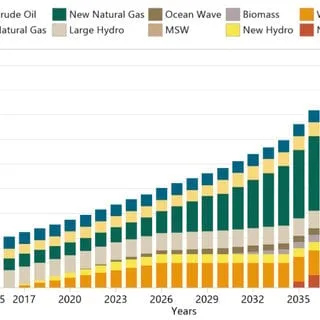
Thermal generation is projected to rise to 21,120 GWh in the Base Case, while hydro generation is projected at around 7,470 GWh. Renewable generation is expected to increase from 207 GWh in 2025 to 403 GWh in 2026. Even with that increase, renewables would account for only about 1.2% of generation, compared with 73% from thermal generation and 25.8% from hydro.
This means Ghana’s demand forecast is simultaneously a fuel-security forecast.
If electricity demand exceeds expectations, the country does not simply need more electricity. It needs more gas, more generation capacity, more transmission capacity and, under certain conditions, more liquid fuel.
The 2026 Outlook estimates natural-gas demand for power generation at 185.93 TBtu under the Base Case. Power generation is expected to account for more than 85% of total gas consumption, with average power-sector demand of approximately 460 MMscfd.
That concentration creates a vulnerability that conventional electricity-demand forecasting cannot afford to overlook.
The Real Forecasting Challenge: Structural Change
The central issue is therefore not whether Ghana’s electricity forecasts are ‘wrong’.
Rather, the issue is whether they are adaptive enough.
A forecast can be statistically accurate under relatively stable conditions but become less useful when the economy undergoes structural change.
Ghana is experiencing several changes simultaneously:
• Expansion Of Electricity-Intensive Mining;
• Growth In Regional Electricity Exports;
• Industrial And Commercial Expansion;
• Increasing Electrification;
• Changing Patterns of Household Electricity Use;
• Greater Cooling Requirements;
• Policy Efforts to Extend Economic Activity Beyond Conventional Working Hours;
• Emerging Electric Mobility;
• Increasing Digitalisation; And
• Changing Relationships Between Hydro Availability, Thermal Generation And Fuel Supply.
These factors do not necessarily make forecasting impossible. They simply mean that forecasting models must evolve.
Instead of asking only, ‘How much electricity will Ghana consume next year?’, the better question may be: ‘What economic activities will create electricity demand, where will that demand occur, when will it occur, how flexible will it be, and what will be required to serve it reliably?’
The Hidden Demand Problem
There is another reason why forecasts deserve closer scrutiny: observed electricity consumption is not necessarily the same as underlying electricity demand.
Where electricity supply is constrained, consumers may reduce consumption, postpone production, rely on generators or simply remain unserved. In such circumstances, historical electricity consumption can underestimate what consumers would use if reliable electricity were continuously available.
Recent research on Ghana has highlighted the importance of suppressed electricity demand, showing that climate change, the informal economy and system inefficiencies can significantly affect the country’s underlying electricity requirements.
This introduces a critical distinction:
Forecasting electricity consumption is not necessarily the same as forecasting electricity demand.
If the objective is to plan Ghana’s future electricity system, the forecast should ideally ask not only how much electricity consumers used, but also how much they would consume under reliable supply conditions.
Losses Are Part of the Forecasting Equation
The transmission network presents another warning sign.
Transmission losses increased from 3.8% in 2024 to 4.2% in 2025, exceeding the PURC regulatory benchmark of 4.1%. Monthly losses ranged from 3.7% to 4.5%, with actual performance frequently closer to the High Case projections than the Base Case.
This matters because every additional unit of electricity lost must effectively be replaced by additional generation.
Consequently, electricity planning should not treat demand growth and system losses as separate problems. A country can meet growing consumer demand either by generating more electricity or by reducing the amount of electricity lost between generation and consumption.
In an electricity system where thermal generation dominates, reducing losses may effectively be equivalent to creating additional supply without burning additional fuel.
Is Ghana Planning for the Economy It Has—or the Economy It Expects?
This is perhaps the most important question arising from the 2026 Outlook. Ghana’s electricity system was historically shaped by a relatively straightforward relationship between hydropower, thermal generation, household consumption, industry and economic growth. That relationship is becoming more complicated.
The economy is becoming more diversified in some areas and more electricity-intensive in others. Mining can generate large, concentrated loads. Regional electricity trade adds an external component to demand. Industrialisation creates new loads. A 24-hour economy could alter the daily load profile. Climate conditions can increase cooling demand while simultaneously affecting hydropower availability.
These factors do not necessarily make forecasting impossible. They simply mean that forecasting models must evolve.
The future electricity system will be shaped not simply by population and GDP, but by mining, industrialisation, regional trade, digitalisation, cooling, electrification, government policy, climate variability and the changing geography and timing of economic activity.
What Should Change?
Ghana does not necessarily need to abandon its existing forecasting framework. It needs to make it more responsive to structural change.
First, demand forecasts should place greater emphasis on sector-specific modelling. Mining, manufacturing, services, households, exports and emerging electricity-intensive activities should not be treated as though they respond to the economy in exactly the same way.
Second, forecasts should explicitly model electricity exports. Regional power trade is no longer too small to ignore. At 2,451 GWh in 2025, exports represented a material component of the electricity system.
Third, forecasting should incorporate high-frequency economic indicators. Monthly industrial production, mining activity, temperature, electricity prices, new industrial connections, appliance ownership and other indicators could help identify changes before they become visible in annual GDP statistics.
Fourth, Ghana should increasingly distinguish between consumption, demand and suppressed demand. A system-planning model based exclusively on historical electricity sales may underestimate future requirements if electricity supply constraints have previously suppressed consumption.
Fifth, demand forecasting should be linked directly to fuel-security modelling. Because thermal generation is expected to remain dominant, an increase in electricity demand can translate directly into additional natural-gas requirements. The 2026 Outlook explicitly identifies fuel availability as a binding operational and planning constraint.
Finally, Ghana should consider developing forecasting systems that combine conventional econometric methods with newer approaches such as machine learning. The objective should not be to replace economic reasoning with algorithms, but to improve the ability of forecasting systems to detect nonlinear relationships, structural breaks and emerging patterns.
Conclusion: The Forecast Is a Warning, Not a Failure
The 2026 Energy Outlook should not be read as evidence that Ghana’s electricity forecasting system has failed. The report’s High Case successfully provided an envelope within which actual demand largely fell.
But the persistent movement of actual demand above the Base Case deserves attention.
In 2025, peak demand was 3.8% above the Base Case forecast. Total consumption was 4.6% higher than projected. Actual consumption exceeded the Base Case in 11 of 12 months. Mining and exports performed above Base Case expectations. Meanwhile, thermal generation rose sharply as hydro output declined and gas constraints encouraged greater use of liquid fuels.
Taken together, these figures suggest that Ghana’s electricity system is responding to an economy that is changing in ways that deserve closer examination.
The central lesson is therefore not that Ghana needs a bigger number in its next electricity forecast.
It needs a better understanding of what is driving the number.
The future electricity system will be shaped not simply by population and GDP, but by mining, industrialisation, regional trade, digitalisation, cooling, electrification, climate variability and the changing geography and timing of economic activity.
If Ghana can identify these structural drivers early enough, electricity planning can move from reacting to demand to anticipating it.
And that distinction could determine whether the country’s next phase of economic transformation is powered by a resilient electricity system or constrained by one that consistently discovers tomorrow’s demand only after it arrives.
Energy Commission of Ghana. (2026). 2026 Energy Outlook for Ghana: Demand and Supply Outlook.
 WhatsApp
Comments (0)
No comments yet. Be the first to share your opinion!