


Kenya’s digital creator economy is growing quickly. Bloggers, influencers, online journalists, podcasters, YouTubers, and other creators are playing a bigger role in public conversations, promoting businesses, and making a living online.
However, when problems arise, many creators and members of the public have no specialized place to turn for help.
If you’re a content creator in Kenya, you already know the drill. Your account gets suspended and you have no idea why, a brand ghosts you after you deliver the work, or someone screenshots your joke out of context and suddenly you’re facing harassment or, worse, a police report.
Currently, there’s no single place built specifically to help you sort any of that out.
This is the gap that the Bloggers Association of Kenya (BAKE) wants to address through its proposed Office of the Creator Ombudsman (OCO).
The Idea Behind It
The proposal describes the OCO as an independent, quasi-judicial, and self-regulatory body that will function like a specialized complaints and mediation center for the digital space.
It will help resolve disputes between creators, tech platforms, brands, agencies, and the public while promoting digital rights and responsible online behavior.
Think of the OCO as a referee’s office for Kenya’s digital creator economy that sits inside BAKE but operates independently, offering a fast, low-cost, and often free way to resolve disputes without going straight to court or the police station.
Instead of a formal legal battle, most cases will be handled through mediation, meaning both sides sit down, get heard, and work toward a fair outcome such as an apology, a correction, a payment, or a reinstated account.
The goal is to fill a genuine gap. No existing body in Kenya focuses specifically on digital creators, and platform moderation systems often miss local context like Sheng, Swahili, satire, or Kenyan politics, which leads to content being flagged unfairly.
What the OCO Will Actually Do
The proposal sets out a wide range of functions.
| Area | What it would do |
| Platform appeals | Push back on unfair account suspensions, shadowbans, demonetization, and copyright strikes, explaining local context that automated systems often miss. |
| Public complaints | Give ordinary people a route for defamation, privacy violations, non-consensual image sharing, and harassment, seeking remedies like retractions or apologies rather than heading straight to court. |
| Commercial disputes | Mediate cases involving brands failing to pay creators, broken contracts, agency disagreements, and related conflicts. |
| Copyright and fair use | Offer guidance so parties understand their rights before a dispute escalates. |
| Protection from abuse | Support creators, particularly women and minority voices, facing coordinated harassment or cyberbullying. |
| Digital rights advocacy | Challenge state overreach or excessive enforcement of digital laws through public petitions and legal filings. |
| Policy reporting | Compile recurring complaints into quarterly reports to push for better rules from both platforms and government. |
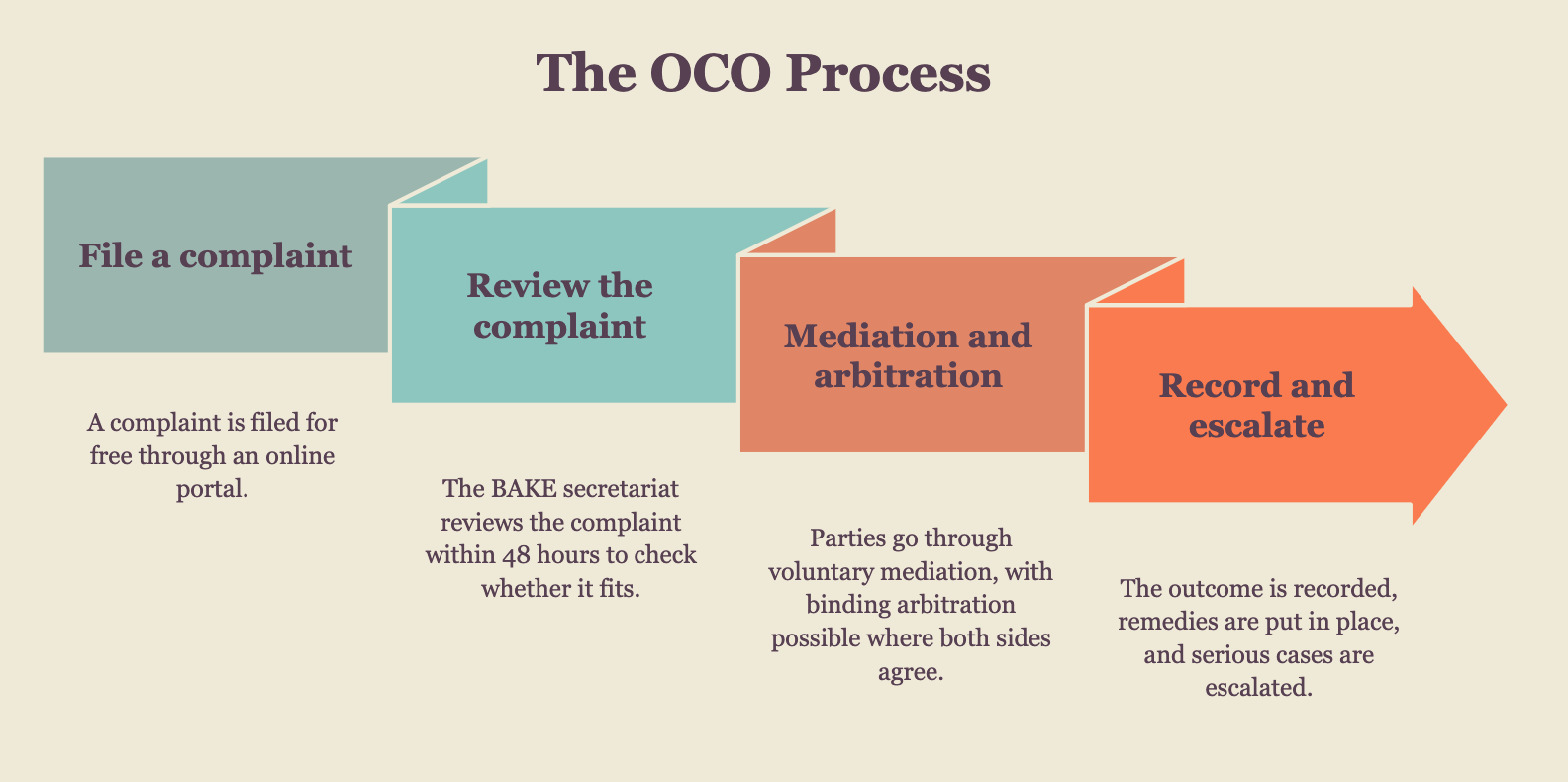
The process itself will run through four stages.
- A complaint is filed for free through an online portal
- The BAKE secretariat then reviews it within 48 hours to check whether it fits
- If it does, the parties go through voluntary mediation, with binding arbitration possible where both sides agree to it
- Finally, the outcome is recorded, remedies are put in place, and unresolved or serious cases are escalated to a platform, regulator, or court
BAKE’s Role
BAKE proposes to host the OCO, run its secretariat, manage communications, and operate a public online complaints portal.
Creators and members of the public will be able to file complaints free of charge, after which the secretariat will assess each case and determine whether it falls within the OCO’s mandate and has sufficient merit within 48 hours.
Essentially BAKE is positioning itself as Kenya’s go-to Alternative Dispute Resolution (ADR) mechanism for the digital space, serving four different groups at once.
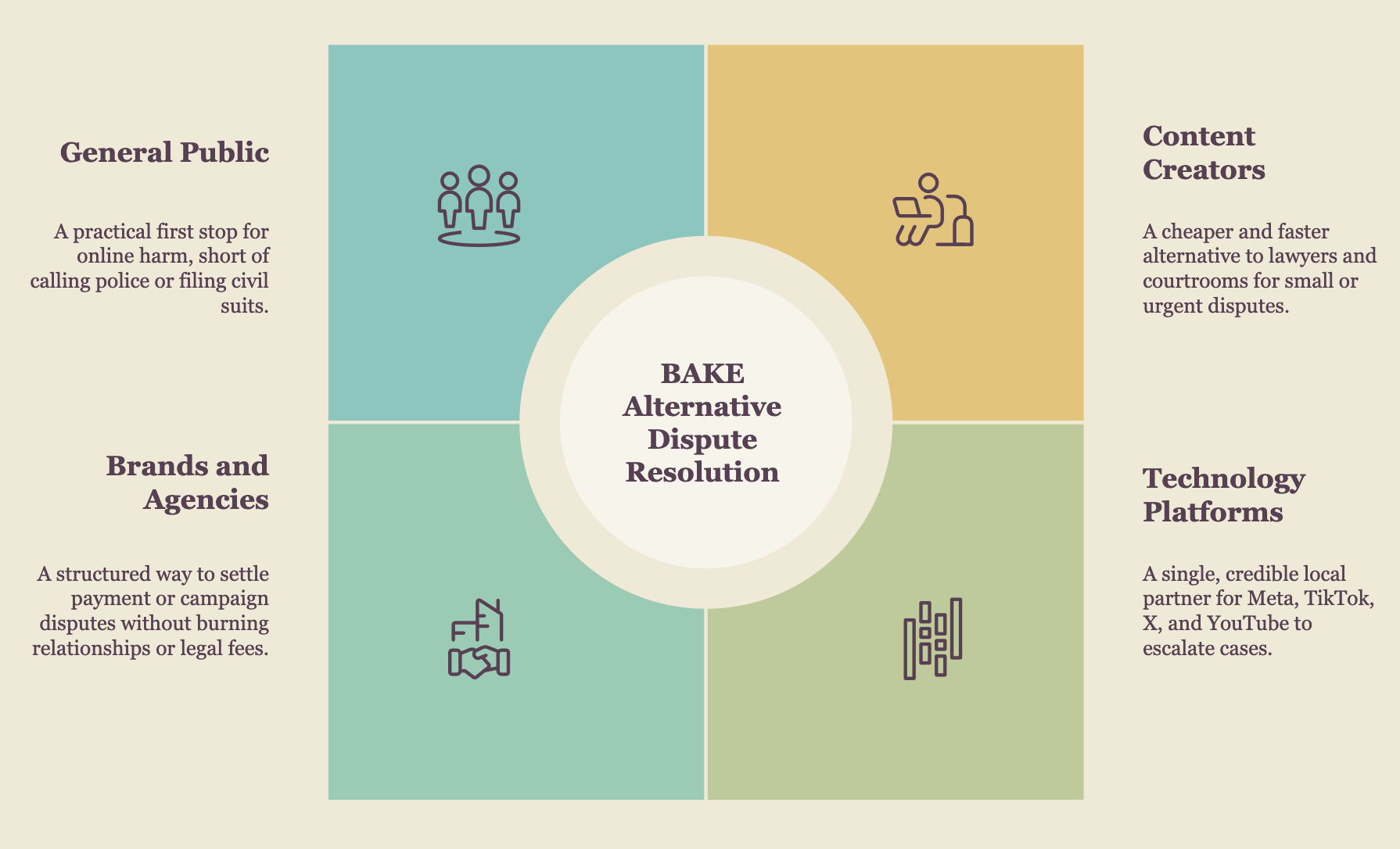
For BAKE itself, running the OCO means growing from an association that represents bloggers and digital publishers into something closer to a convening and accountability institution for the whole creator economy, backed by real case data it can use to advocate for reform.
Where the OCO’s Real Power Will Lie
The OCO will have no legal power to force a platform to reverse its decisions. Its ability to get results will rest on cooperation agreements and on platforms voluntarily choosing to recognize and act on its rulings.
READ: Google to Withhold 5% Tax From Kenyan YouTube Earnings From September
Its credibility will also hinge on being genuinely independent from BAKE’s own advocacy and membership interests, with transparent appointment rules, conflict of interest safeguards, and a real appeals process built in from the start.
Still, the pitch gives Kenya’s creator economy a first resort before things spiral into litigation or criminal complaints and gives BAKE the case evidence it needs to push for a fairer and more accountable digital environment overall.
