


By; Amoako Kwame
President John Dramani Mahama has urged investors to take a fresh look at Northern Ghana, highlighting improved infrastructure, reliable power, affordable labour and access to land as factors that make the region increasingly attractive for industrial investment.
He said the government was seeking investment rather than aid and would continue to create the conditions necessary for businesses to establish and expand in the northern part of the country.

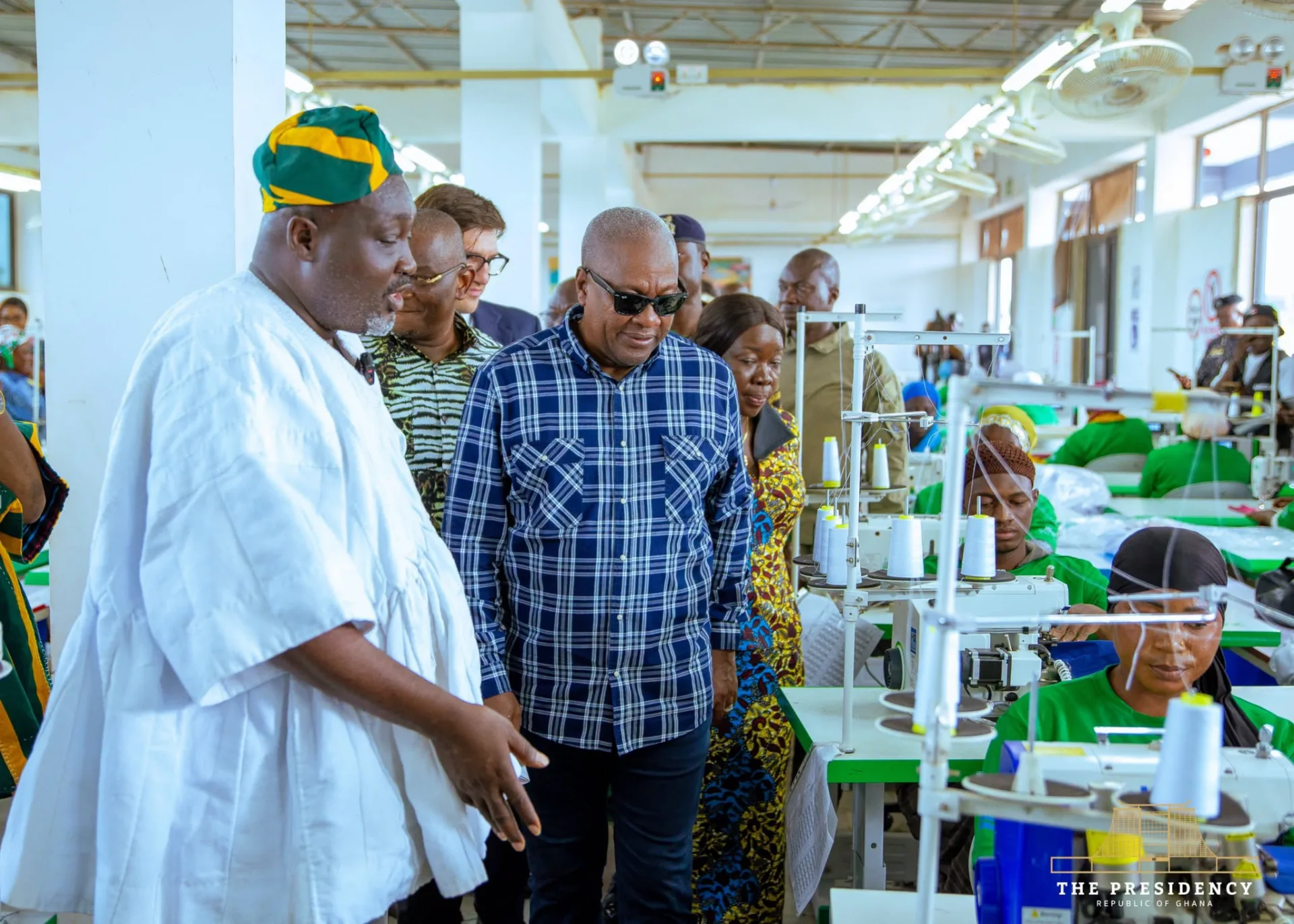
President Mahama made the call at the launch of the Northshore Apparel Hub, in Savelugu on 28th August 2026 where he said the project demonstrated that industrial ventures could be successfully established in Northern Ghana despite traditional assumptions about the region’s economic disadvantages.
The President said several factors that previously discouraged investors from locating in the North had either improved significantly or were being addressed.
He pointed to the availability of land without the extensive litigation challenges often associated with land acquisition in other parts of the country.
“In the north there isn’t that problem, you come and buy, we give you land, no litigation, no trouble on the land.”
He also said the region now had a more reliable power supply, while government was working to expand the Tamale water system to provide additional water to Tamale, Savelugu and surrounding communities.
According to President Mahama, Northern Ghana also has significant potential for renewable energy because of its abundant sunshine. He noted that NorthShore Apparel Hub had already incorporated solar power into its operations to reduce production costs.
The President further cited lower labour costs and improved air transport as additional advantages for businesses considering investment in the region.
He said ongoing improvements to the Eastern Corridor road network would also strengthen the North’s connection to major markets and ports.
“The remaining sections of the Eastern Corridor, which is the Nkwanta to Damanko stretch, are being worked on seriously,” he said.
President Mahama added that by the first quarter of next year, the entire Eastern Corridor from Napanduri through Atimpoku to the Tema Roundabout was expected to be completed.
NorthShore challenges traditional investment theory


The President said his secondary school studies in economics had taught him that businesses typically locate close to their sources of raw materials, markets or ports.
However, he said NorthShore Apparel Hub had demonstrated that these conventional considerations could be overcome through innovative logistics and infrastructure.
“I remember in secondary school I did economics and we have what we call the factors of production. You’re either near the source of material, or you’re near the source of the market, or you’re near the source of the port. You have to factor all of that into consideration,” he said.
He said he had asked the company’s proprietor, Alhaji Nurudeen, how the factory transported its raw materials and finished products, and was told that the company relied on the Eastern Corridor.
“That’s very ingenious,” President Mahama said.
Government targets investment and jobs
The President said government’s investment strategy was focused on attracting projects capable of generating jobs and strengthening domestic production.
He recalled that Ghana EXIM Bank was established in 2016 to support projects of this nature through financing.
“We created GhanaEXIM in 2016 for this kind of project—impactful financing of such projects that provides jobs and employment for our young people,” he said.
President Mahama said the strategy formed part of the government’s broader vision for the 24-Hour Economy, which he described as a policy designed to create jobs and accelerate exports.
“The 24-Hour Economy is designed for the creation of jobs and accelerated export, and NorthShore satisfies both,” he said.
He urged investors to consider the opportunities available in Northern Ghana, stressing that the region’s improving infrastructure and natural advantages should create stronger incentives for industrial development.
More Stories Here
