



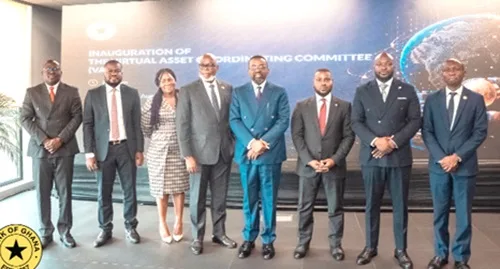
Ghana is targeting 2027 for the full operationalisation of its regulatory framework for virtual assets under the Virtual Asset Service Providers Act, 2025 (Act 1154), the Governor of the Bank of Ghana (BoG), Dr Johnson Pandit Asiama, has announced.
He explained that the BoG and the Securities and Exchange Commission (SEC) were developing operational guidelines and policy sandboxes to support implementation of the law.
He said the framework was critical to providing effective oversight of the rapidly growing virtual asset sector and addressing emerging risks associated with its use.
Inaugurating the Virtual Assets Coordinating Committee in Accra last Tuesday, Dr Asiama stated that the committee would provide the statutory platform for coordinated regulatory and supervisory actions to ensure the effective implementation of the Act.
“The operational guidelines are being developed by the designated regulatory authorities, the Bank of Ghana and the Securities and Exchange Commission, alongside the implementation of policy sandboxes by both institutions, towards fully operationalising the Act by 2027,” he said.
The committee
The seven-member Virtual Assets Coordinating Committee was established under the Virtual Asset Service Providers Act, 2025 (Act 1154), to strengthen coordination among institutions overseeing Ghana’s virtual asset ecosystem.
The committee is made up of representatives from the Bank of Ghana (BoG), Securities and Exchange Commission (SEC), Ministry of Finance, Cyber Security Authority and Financial Intelligence Centre (FIC).
The BoG representatives were Elhanan Owureku Asare and Philip Kwaw Sebuabe, while Emmanuel Mensah Thompson and Richard Kwame Dusi represented the SEC.
Patience Arko Boham represented the Ministry of Finance, Stephen Cudjoe-Seshie represented the Cyber Security Authority and Benjamin Ofori represented the FIC, with the law allowing other relevant institutions to be co-opted when necessary.
Coordinated regulation
Dr Asiama said the committee would strengthen information sharing and inter-agency cooperation among the institutions responsible for regulating and overseeing virtual assets.
He said the coordinated approach would also help Ghana respond to emerging risks, including money laundering, terrorist financing, cybersecurity threats and consumer protection concerns.
“Effective coordination, timely information sharing and a shared commitment to safeguarding the integrity of our financial system will be essential,” Dr Asiama said.
He added that the committee would facilitate the harmonised implementation of the Act and its subsidiary regulatory instruments while supporting coordinated responses to emerging risks.
Financial stability
Dr Asiama said the multifaceted nature of virtual assets required closer collaboration among domestic regulators and competent authorities, as well as foreign counterparts and governments.
He said the committee would also pay close attention to financial stability issues arising from the growing use of virtual assets and their increasing interconnectedness with the formal financial system.
He urged members to act with urgency to ensure that Ghana developed a virtual asset ecosystem that was safe, well regulated and supportive of innovation and financial inclusion.
Regulatory sandbox
The Director-General of the Securities and Exchange Commission (SEC), Dr James Klutse Avedzi, said Ghana had moved beyond legislation towards establishing a functioning regulatory framework for virtual assets.
He said the SEC and BoG were working to ensure that emerging virtual asset products and providers were brought within appropriate regulatory oversight.
“Ghana can be a serious, credible jurisdiction for virtual assets without compromising the protections that investors and the financial system deserve,” Dr Avedzi said.
He said the country’s regulatory sandbox and emerging licensing framework demonstrated its intention to position itself as a credible hub for virtual asset innovation in West Africa.

Comments (0)
No comments yet. Be the first to share your opinion!