


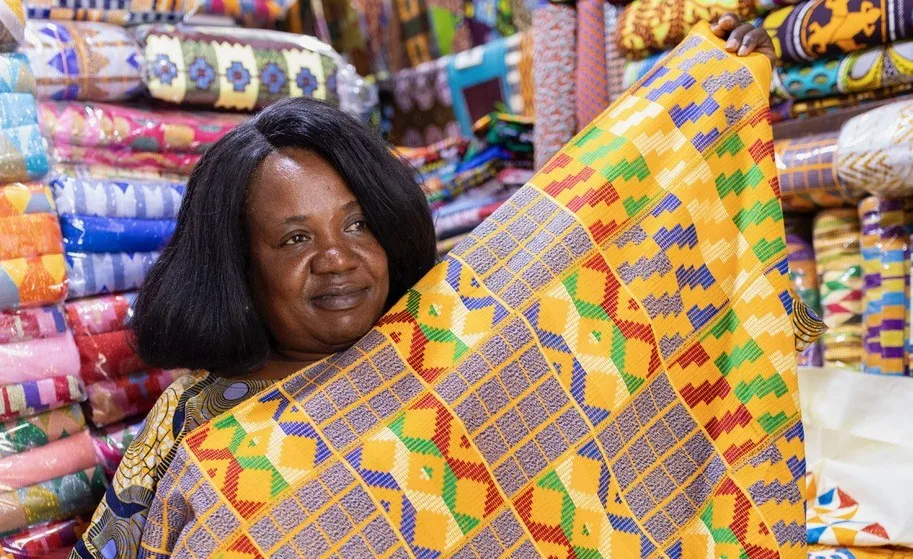
Ghana’s geographical indication for kente could help weavers protect the celebrated cloth from imitation, reach new markets and earn more from generations of skill. Turning legal recognition into livelihoods will require collective standards, business support and the revival of local raw-material production.
It is early morning in Ziope, in Ghana’s Agotime-Kpetoe District, 22 kilometres east of the Volta regional capital, Ho. After sweeping his work area, Emmanuel Kofi Atsisey says a prayer, arranges his threads by colour and organises his tools. He then settles onto a self-made folding stool attached to his loom and begins using both hands and feet to create a design.
Income from the craft he began learning 21 years ago helps Atsisey support his family and pay the bills. He is now considering taking his skills to neighbouring Burkina Faso in the hope of earning more.
“The same kente we sell here in Ghana for about GH¢2,500 (US225) can go for more than GH¢4,000 (US360) when converted from CFA francs. I even thought of relocating there if the opportunity is real,” he says, recalling a conversation with a contact there.
Kente weaving is often passed down within families, but Atsisey took a different route. He entered a formal apprenticeship with a master weaver before becoming an independent artisan.
Kente embodies generations of knowledge passed down through skilled artisans. Its patterns tell stories of power, dignity, wealth and community identity, and the cloth is often worn on significant occasions.
Coming from one of Ghana’s major kente-producing areas, Atsisey has spent years combining tradition with innovation. Although he says earnings do not reflect the labour involved, the fabric’s global standing gives him pride.
“Even if you push yourself, you may produce only one or two pieces. More complex designs take four to six weeks to complete a set,” he explains.
Alongside established patterns, Atsisey creates original designs that reflect both cultural continuity and personal creativity.
“The block in Fatia kente is called Sukluikpe — sugar cubes. I designed it differently and named it ‘Life is sweet’. I have created many designs myself,” he says. Known fully as “Fatia Fata Nkrumah” kente cloth, it translates from the Akan language to “Fatia befits Nkrumah.” Fatia was the wife of Ghana’s first President, Dr. Kwame Nkrumah from Egypt.
Kente’s growing presence in contemporary fashion at national and international events is encouraging artisans and entrepreneurs to see the cloth as both cultural heritage and an economic asset.
According to the Annual Non-Traditional Export Statistics Report by the Ghana Export Promotion Authority (GEPA), the country’s industrial arts and crafts subsector recorded 23% export growth in 2024. GEPA said the export value of Kente products rose to US $38,901.83 in 2024, compared to US $6,256.00 in 2023, representing growth of 522% and an indication of rising international demand for Ghanaian textiles.
As demand grows, artisans in production centres are also working to protect the historic fabric’s authenticity.
At 27, traditional textile artisan Richmond Quarshie, from Agbozume in southeastern Ghana’s Volta Region, is part of his family’s weaving business. The income helped support him through secondary school.
“I started around 19,” he says. “All my brothers are involved. It is the work we inherited.”
Quarshie learnt the craft from his two older brothers and specialised in the Bonwire style of kente for customers in the Ashanti Region. After completing school, weaving became his main livelihood.
“For now, I’m working for someone,” he says. “I don’t have the capital to start on my own. That’s my biggest challenge.”
Quarshie believes the government could help by creating structured employment and production systems. He also points to the cost of imported thread as a barrier, underscoring the need for local production support as Ghana seeks to strengthen its manufacturing sector.
“The government can set up a place, like a factory, and bring weavers together to work,” he suggests.
His experience reflects a broader reality: young artisans are eager to grow but remain constrained by limited capital, weak support structures and fragmented markets.
Kente became Ghana’s first protected geographical indication (GI) in August 2025. The Registrar-General’s Department (RGD) and its partners formally launched the designation in Accra a month later.
This followed the inscription of kente weaving in Ghana on UNESCO’s Representative List of the Intangible Cultural Heritage of Humanity in December 2024.
The RGD described the GI as a symbol or logo used on products that have a specific geographical origin, with verifiable qualities or characteristics.
For years, industry participants had raised concerns about labour-intensive, handwoven kente designs being copied and reproduced commercially on other fabrics in Ghana and abroad, without adequate benefits reaching the original artisans.
Godson Sena Adjavor, a textile consultant and engineer who specialises in reviving dormant factories, says institutions such as the RGD must now ensure that GI protection creates economic value for weavers.
“This is an opportunity for us to leverage the protection and earn intellectual-property income from anyone who wants to use kente designs,” Adjavor says.
He argues that long-term protection will require the RGD to register artisans in different weaving communities and recognise community-based intellectual property in the production hubs.
An experienced trainer and consultant in the development sector, Adjavor calls for investment in textile science, finishing, branding and business development. This, he says, would expose artisans to market trends and design principles that could improve their products.
He also believes the industry must move beyond ceremonial wear. Using authentic kente in furniture, fashion accessories, footwear and everyday clothing could expand the sector and raise weavers’ incomes.
“Everything that fabric is used for, kente can be used for,” says Adjavor.
But legal protection and product diversification will not resolve all the industry’s constraints. Adjavor says Ghana’s dependence on imported yarn raises production costs, while the decline of local cotton cultivation and limited spinning capacity restrict access to locally produced thread.
“Once we grow the cotton and process locally, the weavers can afford the yarns to produce softer fabrics, but the country doesn’t have the spinning capacity. The imported cotton yarns are expensive,” he says.
Ghana has five major kente production hubs across two regions. Bonwire and Adanwomase are in Ashanti, while Agotime-Kpetoe, Agbozume and Tafi Atome are in Volta. Smaller weaving areas surround these centres.
Dr Courage Besah-Adanu, head of geographical indications at the RGD’s industrial property office, says kente’s GI status goes beyond national recognition. It strengthens an identity that resonates across Africa and commands value globally. Work towards the designation began in 2016 with repeated community engagements and the development of multiple documents.
He describes it as an opportunity to unite weaving communities in the two regions and modernise the industry. The RGD has already begun engaging artisans in the main production centres.
“We needed to engage each community and train them in collective branding, management and marketing, what intellectual property means and how they fit into it. We have been doing this community by community,” he says.
He further says a national association has already been formed, though it is yet to be officially launched, and draft regulations are also in place. The next step is to move from the national level towards international registration, “as it is the practice in GI registration, and also more training for the producers across the country so they can fully utilise the protection for economic gains”.
“For geographical indications, you need what is known as a book of specifications, or a common code of practice,” Besah-Adanu says.
According to him, the system is designed to deliver three outcomes: better remuneration for weavers, stronger national branding and consistent quality for consumers.
Consumers in Ghana and across the international markets are assured of authentic labelling with a verification system. The GI also translates into structured membership for weavers, training, and inspections.
“The weavers have the right to use the approved GI tag only when standards are met; these are the next steps we are working on after registering the national association.”
Together, these could improve market access and help artisans earn more from skills preserved over generations.
“For geographical indications, the product must have certain characteristics associated with it over a long period and recognised by consumers,” he explains.
“For consumers to keep experiencing those consistent characteristics, the people involved must have acquired particular skills and developed at least some form of grassroots organisation.”
Naomi Panin has a fabric shop at Menaba Plaza in Accra’s central business district for 10 years, with kente accounting for a significant share of her stock. She manages the business with her brother, who works directly with weavers in the Volta and Ashanti regions. Sourcing from verified producers has helped them earn customers’ trust in the authenticity of their fabrics.
Although sales occasionally dip, Panin says the business has proved resilient. Her customers come from across Ghana and from countries including Nigeria, Tanzania, the United States, the United Kingdom and Canada.
Beyond its commercial value, she regards kente as a powerful symbol of national identity and pride.
“If I see someone in Canada wearing kente, I know it is from Ghana. I feel happy because it shows our culture. It tells you where the person is connected to,” she says.
Victoria Azah, who operates a fashion centre in Accra, says kente has become increasingly popular among customers dressing for graduations, weddings and other special occasions.
“I often make outfits using kente. Demand has gone up,” she says.
Azah also values its versatility. A single piece can become several types of garment, while offcuts can be repurposed so that little goes to waste.
For weavers such as Atsisey and Quarshie, however, the measure’s success will ultimately be judged by whether legal recognition translates into stronger markets, sustainable businesses and better incomes.
“The whole world got to know for the first time that Ghana and Africa is taking hold of what belongs to her,” said Besah-Adanu.
