


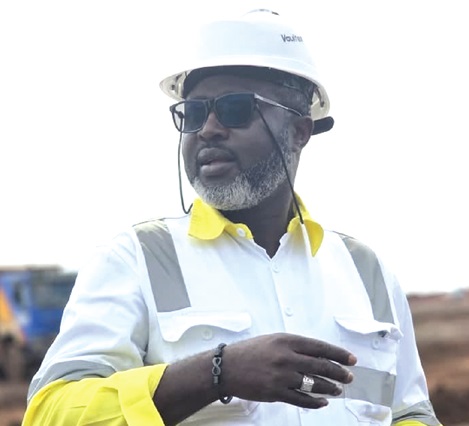
Ghanaian mining operator Rabotec Group is targeting its first wholly-owned gold mine within five years, seeking to transform itself from an indigenous contractor into a mine owner.
This comes as its West African project portfolio reaches an estimated $1.8 billion.
The strategic shift would mark a significant advance for the Ghanaian company, which began operations in 2002 and has expanded into five countries, challenging the longstanding dominance of foreign-owned businesses in key segments of Africa’s mining industry.
The Chief Executive of Rabotec Group, Alhaji Ali Ibrahim, told the Daily Graphic that Rabotec was developing concessions in Ghana and elsewhere in Africa, while executing contracts spanning mining, infrastructure and mineral processing.
“Within the next five years, I want Rabotec to have a fully operational, Rabotec-owned gold mine,” he said.
“I want us to be mine owners and mine operators, not just contractors.”
Rabotec’s current contracts run for periods of up to five years.
Alhaji Ibrahim estimates the portfolio at between $1.5 billion and $1.8 billion, reflecting the scale the company has achieved across Ghana, Guinea, Mali, Sierra Leone and Burkina Faso.
The disclosed projects include approximately $400 million at the Asanko Gold Mine in Ghana, following the renewal and expansion of an earlier agreement; $350 million in Mali; $285 million in Sierra Leone; and $250 million each in Burkina Faso and Guinea.
Those named contracts total about $1.535 billion. The company did not provide a breakdown explaining the upper estimate of $1.8 billion, which may include other work or prospective project value.
In Guinea, Rabotec conducts full mining operations, including drilling, blasting, loading, hauling and mine management.
It has also established a specialist position in the construction of Tailings Storage Facilities, engineered structures designed to contain mining waste and manage potentially serious environmental and safety risks.
Alhaji Ibrahim said Rabotec had built most of Ghana’s large-scale tailings facilities and delivered major projects abroad.
Each facility, he added, was designed to satisfy regulatory requirements and subjected to periodic inspections by mining and environmental authorities.
That capability gives Rabotec a foothold in one of mining’s most technically sensitive areas, where engineering failures can carry severe consequences for communities, ecosystems, regulators and mine owners.
Alhaji Ibrahim credited Ghana’s policy of encouraging mining companies to outsource operations to specialist contractors with helping indigenous firms acquire expertise and scale.
He described contract mining policy as a major advantage in Rabotec’s effort to become a Tier One contractor.
The company employs more than 5,000 people directly and supports another 15,000 jobs indirectly across its operations, according to Ibrahim.
Rabotec says it prioritises local recruitment and training while limiting expatriate appointments in countries where it operates.
Ibrahim said he had personally trained and mentored more than 300 employees who entered the mining industry with no prior experience. Developing local skills, he argued, was central to the company’s regional expansion and long-term competitiveness.
Growth, however, has exposed Rabotec to significant operational and political risk.
Ibrahim said unidentified individuals attacked one of its sites this year and destroyed equipment by fire.
The report describes the equipment as worth nearly $13 million, while Ibrahim’s quoted estimate puts the loss at almost $30 million.
The discrepancy requires clarification.
“We have overcome it and moved on,” he said, without identifying the country, motive for the attack or whether arrests had been made.
Rabotec also faces volatile exchange rates, community disputes and changing local-content rules as governments across the sub-region adopt localisation policies influenced by Ghana’s model.
Alhaji Ibrahim said the company complied with requirements in every jurisdiction, although regulatory shifts complicated operations.
The group has secured ISO certification and is exploring “green mining technologies” to meet evolving environmental, social and governance standards.
However, no specific technologies, investment figures, emission targets or implementation timetable were disclosed.
Beyond expanding Rabotec, Ibrahim wants Ghana to move higher up the mining value chain by developing and exporting technology and operating systems, rather than remaining primarily a supplier of minerals.
Citing industry data, he claimed Ghana retained mineral resources equivalent to nearly three times the volume extracted over the past century, providing “over 300 years” of future resources.
The underlying data and assumptions were not specified, making independent verification important.
“It is time for Ghana to create mining systems that the world will come here to buy,” he said, arguing that the country’s greatest constraint was not finance but “Ghanaians believing in Ghanaians”.
Alhaji Ibrahim said Rabotec’s social programmes supported hospitals, orphanages and flood victims, while offering employment to former prisoners.
Some beneficiaries now work as drivers, equipment operators and skilled artisans at company sites.
Rabotec’s mine-ownership ambition is its most consequential test yet.
Success would demonstrate that local participation can progress beyond supplying labour and services to controlling productive assets.
But securing viable concessions, financing development, meeting environmental obligations and managing commodity, security and community risks will determine whether “Rabotec Mine” becomes an operating reality — or remains a powerful aspiration on commercial terms.
