


Once upon a time in the Republic of Uncommon Sense, the government gave some citizens chickens and asked them to create wealth.
The idea was simple enough. Rear the birds, sell some, keep some, multiply the flock and gradually build a small poultry business. In the language of policy experts, this was called economic empowerment. In the language of some beneficiaries, however, it appears to have been called Sunday lunch.
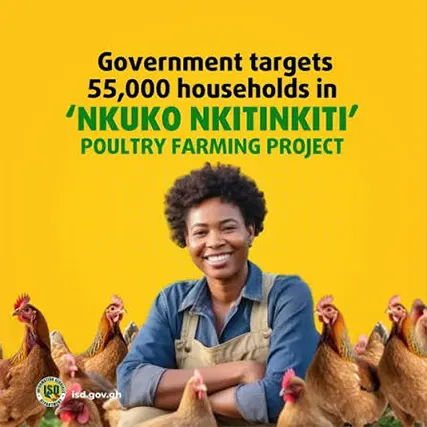
The Minister for Food and Agriculture has expressed concern that some beneficiaries of the Nkoko Nkitinkiti initiative have begun slaughtering and eating the birds distributed to them for rearing. According to him, some even sent videos of themselves enjoying the birds.
This is a remarkable development.
It is one thing to eat government investment. It is another thing to send documentary evidence to the Minister, perhaps with the confidence of a beneficiary submitting a progress report.
One can imagine the Minister sitting quietly in his office when his phone vibrates.
“Honourable, good afternoon. The programme is doing very well. Please see attached.”
He opens the video and sees steam rising from a bowl. Somewhere near the banku lies a chicken thigh. A voice in the background says, “God bless the government.”
In one short video, the entire agricultural value chain has been completed.
The government supplied the bird. The beneficiary supplied the pepper. The kitchen supplied the final processing. Somewhere in between, national development was served with soup.
To be fair, the programme itself was not designed as a feeding exercise. The birds were meant to become productive assets. Beneficiaries were expected to rear them, sell them and reinvest the proceeds. The government saw capital wearing feathers. Some citizens apparently saw protein walking around the compound.
This is where the Republic becomes complicated.
Years ago, a man gave his unemployed nephew a goat and advised him to rear it carefully. When the goat produced offspring, the nephew was to sell one, keep one and use the money to begin a small business.
Three Sundays later, the uncle visited.
There was no goat.
There was, however, a suspicious aroma coming from the kitchen.
When questioned, the nephew explained that the goat had indeed contributed to his development because, after eating it, he finally had enough strength to think seriously about his future.
This may sound foolish, but it contains a difficult truth. A productive asset given to a household under immediate pressure can easily become immediate relief. Development experts may call it capital. Hunger may call it supper.
That does not excuse beneficiaries who knowingly misuse public support. A chicken given for business is not free meat. It is public money wearing feathers. Those who receive such support have a responsibility to use it for its intended purpose.
But government must also ask some uncomfortable questions.
Were the right beneficiaries selected? Did they genuinely want to rear poultry, or were some names placed on a list because every constituency needed to produce beneficiaries? Did they receive enough training? Did they have proper coops? Was feed support adequate? Did extension officers monitor them after the launch ceremony? What happened when birds fell sick or began dying?
In Ghana, many public programmes enjoy two very different lives.
There is the life they live at the launch ceremony, where everything is healthy, smiling and wearing branded T-shirts. Then there is the life they begin after the dignitaries leave, the cameras disappear and the beneficiaries are left alone with the practical problems.
We are very good at distribution.
We distribute seedlings, laptops, fertiliser, outboard motors and chicks. Then monitoring develops malaria and disappears from work.
Months later, Parliament asks for results, and officials begin searching for the same beneficiaries who waved enthusiastically during the launch.
The Nkoko Nkitinkiti story should therefore not be reduced to mockery alone. Yes, eating the birds is irresponsible. Yes, sending the Minister videos is an extraordinary form of self-reporting. But the matter also reveals the distance between policy intention and household reality.
A hungry family may struggle to treat a chicken as a long-term investment when there is no food in the house today. A poorly selected beneficiary may never have had any interest in poultry. A person without housing for the birds may gradually lose them to disease, theft or predators and decide that the cooking pot is more reliable than the business plan.
This is why distribution is not development.
Development requires selection, training, supervision, incentives, accountability and time. It requires government to remain present after the ribbon has been cut and the television crew has gone home.
The success of Nkoko Nkitinkiti should not be measured only by the number of birds distributed. It should be measured by how many survived, how many multiplied, how much income households earned and whether local poultry production actually increased.
Otherwise, one day, when officials are asked to account for the impact of the programme, the report may read:
Birds distributed: successful.
Beneficiaries reached: successful.
Poultry businesses created: under investigation.
Soup produced: outstanding.
The Republic must learn from this. Citizens must respect the purpose of public support, and government must design programmes around the realities of the people expected to benefit from them.
Because when policy meets hunger without proper supervision, the shortest distance between agricultural investment and national disappointment may simply be a pot of light soup.
Source: Jimmy Aglah
