


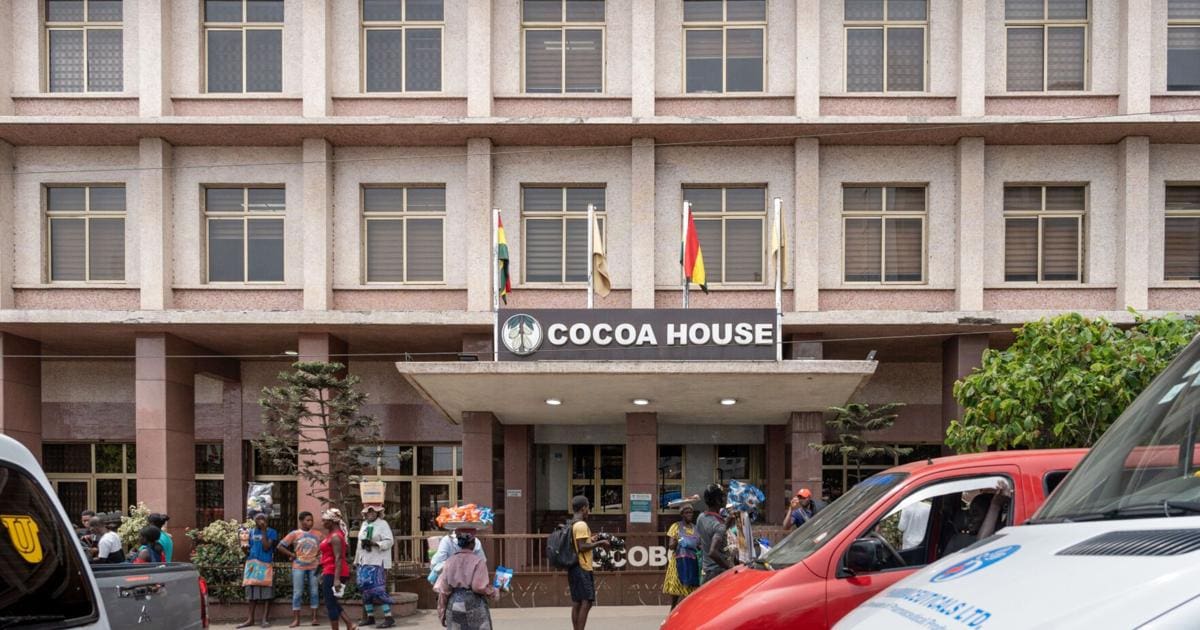
Ghana’s cocoa regulator has accused officials at licensed buying companies of diverting government purchasing funds to buy cheaper cocoa beans smuggled in from Ivory Coast, putting local farmers out of pocket and putting Ghana’s premium quality reputation at risk.
Jake Kudjo Semahar, Director of Special Services at the Ghana Cocoa Board (COCOBOD), told Reuters on April 30 that the practice had been identified across four regions along the Ghana-Ivory Coast border. The development represents a sharp reversal of the smuggling patterns that have historically plagued the sector, when Ghanaian beans were trafficked outward into Ivory Coast and Togo. The direction has now flipped.
The driver is a significant price gap. Ivory Coast is selling cocoa at the equivalent of GH¢1,200 per 64-kilogram bag under its current mid-crop pricing, compared with Ghana’s official farmgate price of GH¢2,587. Purchasing clerks and officers at some Licensed Buying Companies (LBCs) are allegedly exploiting that spread by channelling government-supplied funds through middlemen who cross the border to buy the cheaper Ivorian beans, which are then returned to Ghana and presented as domestically produced.
Semahar warned that blending Ivorian cocoa into Ghanaian supplies risked eroding the premium quality designation that underpins Ghana’s competitive position in international cocoa markets. Beyond the quality threat, the scheme deprives local farmers of income while effectively subsidising producers in a neighbouring country.
The Licensed Cocoa Buyers Association of Ghana distanced its member companies from direct institutional involvement. General Secretary Vitus Dzah told Reuters that no licensed buying company would sanction such purchases, placing responsibility instead on individual clerks acting outside their mandate. He noted that LBCs had suffered heavy losses in a similar episode during the 2004/2005 season.
COCOBOD’s anti-smuggling unit moved against the practice last week, arresting four suspects and impounding over 100 bags of Ivorian cocoa at Nkrankwanta in the Dormaa West District of the Bono Region. Semahar described the operation as the opening move in a broader enforcement campaign. The board said investigations are underway, and that sanctions will follow if LBC involvement is confirmed at the institutional level.
The allegations add a new dimension to an already troubled cocoa season. COCOBOD’s reduced purchasing capacity following a prolonged liquidity crisis has left many farmers unpaid for beans delivered since November 2025.
