
Ghana is confronting a threat that no longer fits within routine enforcement frameworks.
High-tech galamsey (HTG) has evolved far beyond informal, small-scale illegality. It is mechanised. It is networked. It is financed. It operates with logistical sophistication and, in some cases, with quiet political protection. Over the past decade, it has entrenched itself deeply in forest reserves and river bodies, leaving behind ecological scars that may take generations to heal.
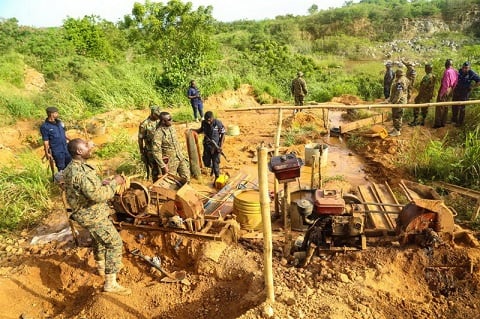
The Mahama-led administration has shown a visible commitment to the fight. The establishment of NAIMOS, the National Anti-Illegal Mining Operations Secretariat, signalled seriousness. Its field operations, reinforced by the Blue Water Guards and the Forestry Commission, demonstrate that the state is not indifferent. Officers risk their lives confronting heavily equipped operators. Excavators are seized. Sites are dismantled. Yet the problem persists.
Media reports continue to show that galamsey operators and their financiers remain bold. Machinery reappears. Rivers remain polluted. Forest reserves are breached again. The pattern suggests that while enforcement is active, the deterrent effect is still insufficient. This is not a failure of effort. It is a mismatch between the scale of the threat and the intensity of the response.
HTG thrives in bureaucratic delays, fragmented mandates, political caution, and legal technicalities. A gradualist approach may produce temporary wins, but it is unlikely to dismantle a deeply embedded system, especially as we move closer to the 2028 general elections. Election cycles tend to soften enforcement resolve. Political actors become more sensitive to local pressures. Firm policies are often recalibrated for electoral comfort.
Mr. President, the time has come to declare a targeted state of emergency on high-tech galamsey hotspots. Environmental collapse, however, does not adjust its timeline to political calendars.
Under Ghana’s 1992 Constitution, only the President has the authority to declare a state of emergency. That power exists precisely for moments when ordinary legal tools prove inadequate in confronting extraordinary threats. HTG now qualifies as such a threat.
Why a Targeted State of Emergency Is Not a Blanket Shutdown – And Why It Can Deliver Faster Results
A blanket state of emergency is broad in scope. It may apply nationwide or across large regions, imposing sweeping restrictions on movement, assembly, and certain civil liberties. It is typically invoked during war, large-scale civil unrest, or national catastrophe. That is not what is being proposed.
A targeted state of emergency would be geographically limited to clearly identified galamsey hotspots – specific forest reserves, river basins, and districts where HTG operations are demonstrably severe. It would be time-bound. It would be subject to parliamentary oversight. And it would focus strictly on illegal mining operations and their supply chains.
Because it is limited and focused, it carries a higher probability of producing immediate and measurable impact in the fight against HTG.
First, it would enable accelerated enforcement within designated zones. Security agencies could impose temporary restrictions on the movement and operation of heavy mining equipment, conduct swift searches, and shut down illegal logistics corridors without the procedural delays that often allow operators to regroup.
Second, it would strike the financial backbone of HTG. A targeted emergency framework could fast-track investigations into financiers, equipment owners, and procurement networks. High-tech galamsey survives not because of the diggers alone, but because of the capital that shields and replenishes them. Disrupt the financing, and the operations weaken significantly.
Third, it would reduce political interference. As 2028 approaches, enforcement intensity may naturally face pressure. A constitutionally declared targeted emergency would institutionalise firmness, making it more difficult to quietly dilute operations for short-term political convenience.
Fourth, it would shift the psychological landscape. Right now, many operators treat enforcement as a temporary inconvenience. A targeted emergency reframes HTG as a national security and ecological crisis. That reframing matters for deterrence.
None of this diminishes the sacrifices already being made by NAIMOS, the Blue Water Guards, and the Forestry Commission. On the contrary, it recognises that they are confronting a technologically advanced and financially backed menace with standard peacetime instruments. That imbalance must be corrected.
HTG is not merely an environmental nuisance. It threatens water security, agricultural productivity, biodiversity, and long-term public health. It undermines climate resilience and compromises the livelihoods of future generations. If river systems collapse and forest ecosystems are irreversibly degraded, no short-term economic gain will justify the loss.
Leadership in moments of crisis is measured by the willingness to take necessary, lawful, and proportionate action, even when such action carries political risk.
A targeted state of emergency is not anti-democratic. It is a constitutional instrument designed to protect the nation when normal regulatory mechanisms prove insufficient. Applied narrowly, transparently, and for a defined duration, it strengthens the rule of law rather than weakens it.
Conclusion: The Cost of Delay Is Higher Than the Cost of Decisive Action
Mr. President, NAIMOS is working. Government agencies are working. But without calibrated escalation, those efforts risk producing incremental gains against a rapidly evolving threat.
If we delay decisive intervention, the environmental damage will deepen. If we wait for a more politically convenient moment, that moment may never come. And if enforcement intensity is softened by electoral calculations, the HTG networks will only grow stronger. The choice before us is clear. Either we act decisively now within constitutional bounds, or we continue managing symptoms while the disease spreads.
A targeted state of emergency on high-tech galamsey hotspots is not an overreaction. It is a proportionate response to an extraordinary threat. The rivers cannot vote. The forests cannot protest. Future generations cannot defend themselves today. The responsibility rests with leadership now.

