
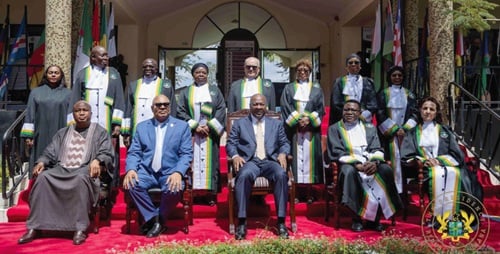
President John Dramani Mahama yesterday issued a direct challenge to his fellow African Heads of State, urging them not to fear the African Court on Human and Peoples’ Rights and to finally grant their citizens unimpeded access to continental justice.
In a keynote address that blended personal testimony with a firm call to action at the opening of the 2026 Judicial Year in Arusha, Tanzania, President Mahama told African leaders that they had “nothing to fear” from a court designed to protect, rather than to persecute.
“I call upon African Union member states who have not yet ratified the Protocol to please do so without delay,” the President declared to a packed courtroom of the continent’s most senior jurists.
“To my colleagues in those countries, I assure you that you have nothing to fear from this court,” he said.
A direct appeal
The President’s remarks come at a critical moment for the court, which marks its 20th anniversary this year.
Despite its establishment two decades ago, several African nations have yet to ratify the protocol granting the court jurisdiction, and even fewer have made the declaration allowing individuals and non-governmental organisations direct access.
President Mahama urged all member states to make that declaration, warning that the continent’s destiny was shared and that no nation stood alone in the face of injustice.
“We are one another’s keeper,” he said.
“This is why we need an institution that serves all but is beholden to none; the African Court of Human and Peoples’ Rights.”
Personal testimony, continental message
To illustrate why the court mattered, President Mahama reached into his own family history, recounting the repeated detention of his father, first after the 1966 coup that overthrew Kwame Nkrumah, and again in 1974 for writing a letter to then military ruler, General I. K. Acheampong, offering unsolicited advice.
“Although I stand before you as a Head of State, I remain the child whose father was detained for serving his country and advising its leader,” President Mahama said.
“I am still the boy who learned how dangerous it can be to challenge those in power, who may act with impunity,” he added.
His father’s experience, he explained, demonstrated that no victim of injustice stood alone.
“The effects of social injustice and human rights violations extend beyond individuals; they impact entire families and communities,” he said.
Reckoning with history
The President drew a direct line from Africa’s painful past to the court’s present mission, invoking the names of some of the continent’s martyrs, namely Patrice Lumumba, Thomas Sankara, Steve Biko and exiled leaders such as Ghana’s Nana Prempeh I and Yaa Asantewaa.
Had the court existed earlier, he argued, “we would have secured justice against racist apartheid criminals, colonialists and even our own oppressive African dictators who tortured and killed many”.
He challenged African nations to measure their wealth not by natural resources, but by the value of their people, “valued individuals, free from oppression, conflict, persecution, and violence, and assured of their rights to life, dignity, liberty, and self-determination”.
Warning from the West
In a striking turn, President Mahama cautioned against looking to the so-called Global North as a model, describing its democratic façade as “fast crumbling”.
“Judiciaries are no longer independent; citizens and lawful residents are being disappeared by masked law enforcement,” he said.
Quoting the late Mwalimu Julius Nyerere, he added: “One does not judge one’s state of health by comparing it to a sick person”.
‘Now Is the Time’
As he declared the 2026 Judicial Year officially open, President Mahama urged African nations to deepen their commitment to the court so that by its 40th anniversary, “it will stand as the leading international judicial body and a model for others”.
“Now is the time for us to meet the challenge of keeping the promises we have made to future generations, promises we have signed and pledged to uphold,” he said.
“Now is the time for Africa to step into its greatness,” President Mahama added.

