
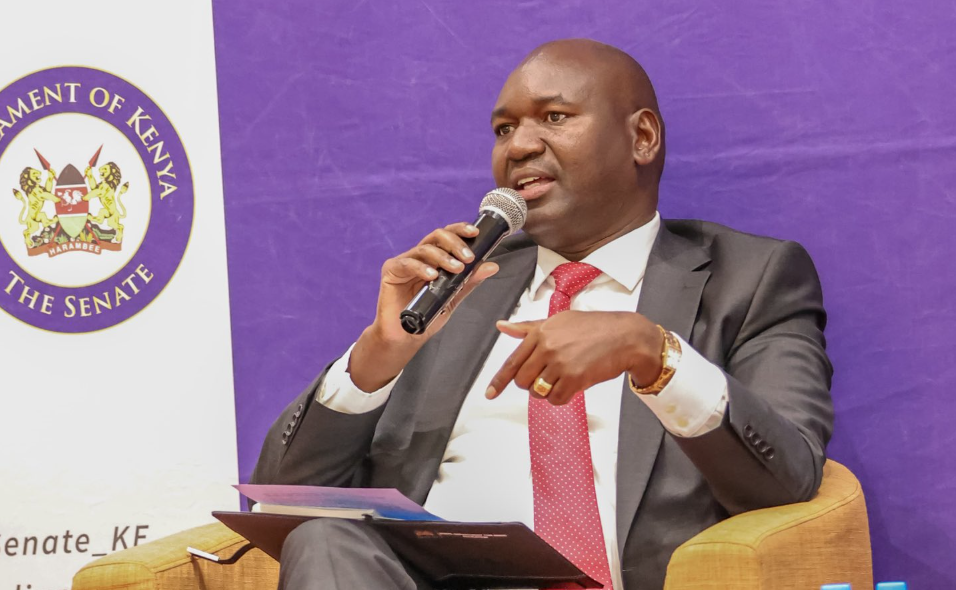
 Basic Educaiton PS JUlius Bitok speaks before the Senate during its Assessment and Planning Retreat in Naivasha on February 27, 2026. /JULIUS BITOK
Kenya is on the verge of attaining the global benchmark for teacher-to-learner ratios in basic education institutions, Principal Secretary Julius Bitok has said.
Bitok noted that the ministry has recruited more than 100,000 teachers to reduce pressure in classrooms, while also retraining educators to align their pedagogical approaches with the demands of the Competency-Based Education (CBE) curriculum.
“As we speak now, with 12 million learners in basic education, we have 458,000 teachers meaning the ratio is 1:26 across the board. The global standard requires us to have 1:25,” Bitok said.
He further stated that the ministry has expanded school infrastructure to keep pace with rising enrolment by building additional laboratories and classrooms.
This, he explained, is particularly aimed at supporting the pioneer CBE Grade 10 cohort, whose transition rate is approaching 100 per cent.
The Principal Secretary spoke during the Senate’s Assessment and Planning Retreat in Naivasha, where discussions centred on the state of education in Kenya and the management of education policy and standards.
Addressing concerns over data integrity, Bitok said a recent audit that uncovered ghost learners in schools has enabled the ministry to clean up enrolment records.
The updated data, he said, will guide more accurate capitation allocations. Disciplinary action is ongoing against school heads suspected of inflating student numbers and sub-county directors of education accused of facilitating the malpractice.
Bitok described Kenya as a global leader in pre-primary enrolment, standing at 94.2 per cent, but cautioned that learning outcomes remain a major concern.
“For instance, three in every 10 Grade Six learners cannot solve a Grade 3 level mathematics problem. Equally, nearly half of Grade 6 learners cannot comprehend a Grade 3 English story,” he said, urging a shift towards balancing access to education with quality learning.
The figures are drawn from the 2025 Foundational Literacy and Numeracy Assessment (FLANA) report by education advocacy group Usawa Agenda.
According to the report, many Grade 6 learners in public primary schools are inadequately prepared for junior school, with 51.3 per cent unable to comprehend a Grade Three-level English passage.
The survey was conducted between June and July 2025 across all 47 counties. It assessed 49,835 children aged between 10 and 15 years, both in and out of school, spanning Grades Three to Nine.
The findings further show that three out of 10 Grade 6 learners continue to struggle with Grade 3 mathematics, even as the country targets placing 60 per cent of learners in science, technology, engineering and mathematics (STEM) fields to drive a STEM-oriented economy.
The FLANA report warned that without basic reading skills, even numerical problems become difficult to solve because most mathematics questions are text-based.
Bitok called for closer collaboration between county directors of education, ministry-employed quality assurance officers and their counterparts working with county governments to address the learning gaps.
He observed that the framers of the constitution anticipated grey areas in foundational learning implementation, given the division of responsibilities between the national and county governments.
Under the current framework, the national government is responsible for funding, policy formulation, curriculum development, quality control and national assessments, while county governments oversee planning and management of pre-primary education and childcare facilities, school feeding programmes, infrastructure development and the hiring of ECDE teachers.
Bitok said the national government is fulfilling its mandate as evidenced through timely disbursement of capitation and urged county governments to equally deliver on their responsibilities.
He called upon the Senate to intensify its oversight of county governments in the management of ECDEs, particularly in prioritising child-friendly and safe learning environments and championing a national school feeding framework.
