
1
The Governor Umar Namadi-led Jigawa State Government is translating federal livestock reforms into subnational action through strategic partnerships aligned with the Jigawa State Agricultural Transformation Policy.
A major milestone in this effort was the Memorandum of Understanding (MoU) between the Jigawa State Government and El‑Meena Farms Ltd, which launched the Jigawa Alfalfa Value Chain Development Initiative.
The project targets a 100,000-hectare mega-estate from a 1,000-hectare pilot, an annual output of 2.0 million metric tonnes of alfalfa, and over 100,000 jobs, positioning Jigawa as the hub of livestock feed production and agro-exports in Nigeria and West Africa.
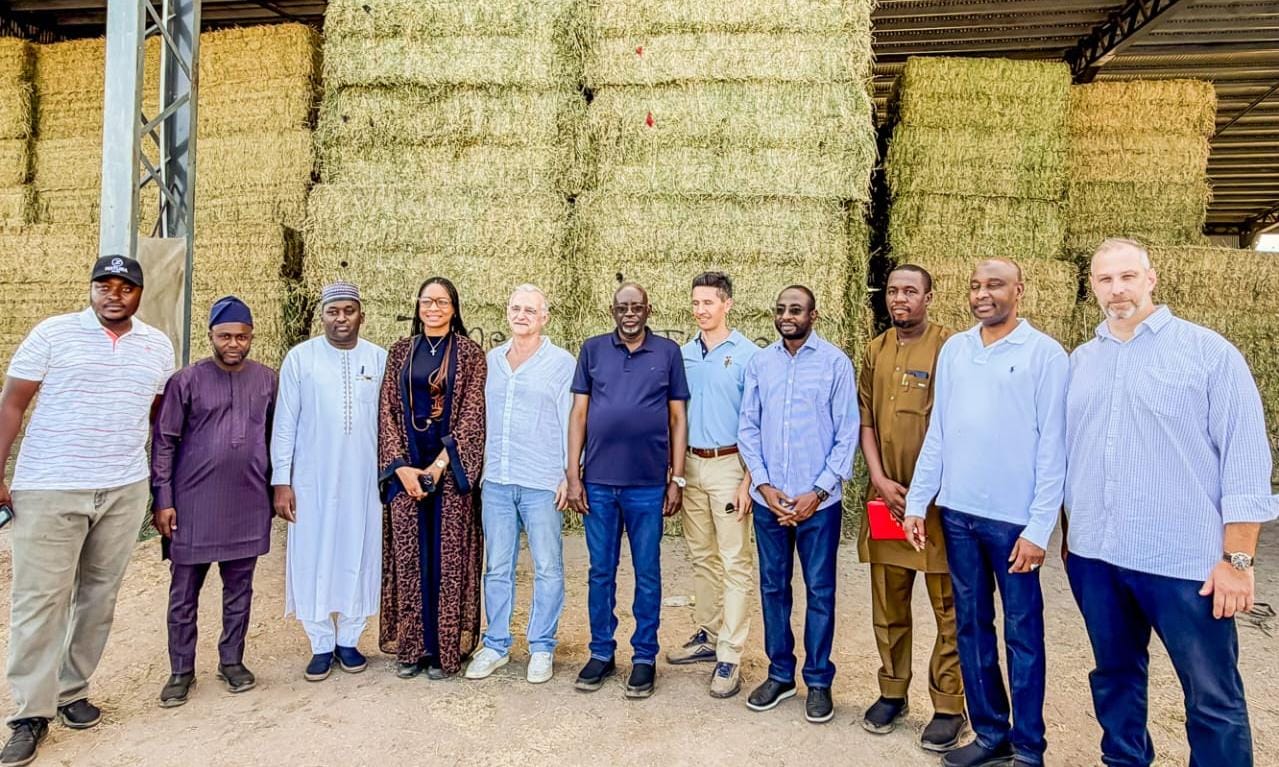
To ensure evidence-based execution and learn from proven global models, Governor Namadi recently led a high-level delegation of public and private stakeholders on a technical and investment engagement to Córdoba Province, Argentina.
Argentina, well advanced in research-driven agriculture, smart irrigation, mechanisation, and agro-industrial development, is currently the world’s second-largest producer of alfalfa, with Córdoba serving as its largest production hub.
The Nigerian mission included officials of the Jigawa Government, the National Information Technology Development Agency (NITDA), El-Meena Farms Ltd, Jigawa El-Meena Farms (the SPV), Nigeria Export‑Import Bank (NEXIM), Ministry of Finance Incorporated (MOFI), Jaiz Bank, Saudi Arabia’s Alkhorayef Group, and Cape Mano Agriculture.
The delegation toured major forage processing and animal nutrition facilities, including Megafardos del Norte, Nafosa, Pellfood, and Biofarma S.A., gaining first-hand exposure to large-scale alfalfa production, feed processing, livestock nutrition systems, and export logistics.
The mission also visited the Governor of Córdoba Province, culminating in the signing of an additional MoU between Jigawa State and Córdoba Province. It formalises cooperation in livestock development, sustainable alfalfa production, irrigation innovation, applied research, and agro-industrial value chains.
Facilitated by NITDA, under its Regional Digital Innovation and Investment Programme (RegDIIP), the Argentina engagement demonstrates how technology, applied research, and international partnerships can unlock regional competitive advantage.
Insights from NITDA and the MIT Regional Entrepreneurship Acceleration Programme (MIT-REAP) further validate alfalfa as an impactful feed input capable of improving livestock productivity, reducing feed shortages, easing farmer–herder tensions, and supporting export-driven systems.
The Jigawa-El‑Meena MoU signed in December 2025 aims to cultivate 100,000 hectares of premium alfalfa, with projected annual export revenues estimated between $440 million and $540 million. Alkhorayef Group is the technical partner for irrigation infrastructure.
At the signing ceremony in Dutse, Governor Namadi, who described the project as a cornerstone of his administration’s economic agenda, noted that it represents an economic bridge between Nigeria and the Middle East.
“By combining Jigawa’s vast land resources with El-Meena’s operational expertise and Saudi Arabia’s superior irrigation technology, we are building a secure, high-value export corridor that aligns with President Tinubu’s Renewed Hope Agenda,” the governor said.
The scheme is structured around the NEXIM Bank–Saudi EXIM Bank export-financing window, with an initial $5 million capital outlay earmarked for advanced centre-pivot irrigation systems for the 1,000-hectare pilot phase.

