
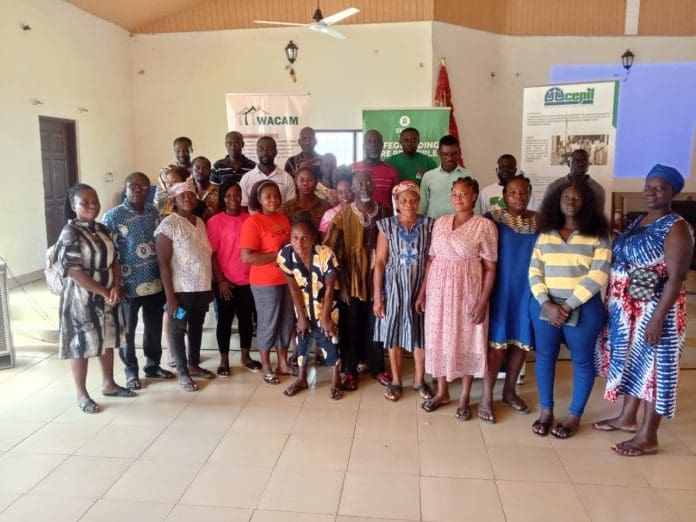
A multi-stakeholder forum has validated key findings from a major study used as a case study on the environmental and human rights impacts of Newmont’s Ahafo North and Akyem mining projects. The forum, organised by Wacam in collaboration with the Centre for Public Interest Law (CEPIL) and Oxfam in Ghana held under the Oxfam Fair Finance Ghana Project, convened on December 22, 2025, in Nkwateng in the New Abirem District. It brought together thirty-three (33) participants, including affected community members, traditional leaders, regulators, and civil society organizations. The event aimed to review and confirm the accuracy of a research conducted by members of the Fair Finance Project (Ghana), Wacam and the CEPIL.
The research, titled “Assessing Environmental and Human Rights Effects of Newmont Ghana Gold Limited Ahafo North and Akyem,” was finalised in March 2025 by Dr. Samuel Obiri. It establishes a factual record that outlines deep-rooted problems concerning the taking of land, payment of compensation, the failure to secure Free, Prior and Informed Consent (FPIC), ecological damage, security issues, and the heavier burden borne by women and other at-risk populations.
The study revealed widespread issues including: uncompensated or inadequately compensated farmers affected by Newmont’s land acquisition process, narrowed civic space and human rights abuses, including the use of military and police personnel to intimidate community members, violations of the FPIC principle. Community members who attended the programme affirmed that the report accurately reflected their lived experiences.
A participant from Nkwateng, Isaac Kwaku Ankomah, stated: “Everything captured in the report—including rights violations and Newmont’s use of military and police to intimidate community people—is exactly what we are going through in our community.” Nana Amoa Asare called on the mining companies to ensure that they respect the rights and customers of their host communities, stressing that this will help bring mutual respect between the two parties.
In his remarks, the Environmental Protection Authority (EPA) District Manager for New Abirem, Isaac Owusu, acknowledged the rigour of the research but urged civil society organisations to also highlight positive mining impacts to ensure balanced reporting. He also addressed gaps in compensation processes while reaffirming EPA’s monitoring role.
Key invited institutions, including the Minerals Commission and Newmont, did not attend the forum, raising concerns about institutional commitment to multi-stakeholder engagement. The report recommended, among other measures: ensuring informed consent for all project-affected persons and communities, revising the Minerals and Mining Act, 2006, to address compulsory acquisition, strengthening regulatory oversight to ensure Newmont complies with constitutional and legal provisions on fair compensation.

