

The late Dr. Kwame Nkrumah, The late Dr. K.A. Busia
So much money was left in the state kitty by the departing colonial administration. The incoming indigenous government had no shortage of funds when the country lowered the Union Jack.
Prime Minister Kwame Nkrumah could therefore be generous to his African friends and even elsewhere without thinking twice.
His friendship with Guinea’s leader Sekou Toure was known by many. It was unsurprising therefore when the Francophone West African country was the first to benefit from the largesse of Kwame Nkrumah.
When the announcement of the donation of an amount of ten million pounds by the government of the newly independent nation was made on November 28, 1958 by the Finance Minister K.A. Gbedemah, eyebrows were raised.
The leader of the opposition, Dr. K.A. Busia, described the loan as imprudent in a statement on November 28, 1958.
The statement was read on his behalf by the General Secretary of the United Party R.R. Amponsah to the media.
Dr. Busia was at the time in Geneva on a visit. According to the leader of the opposition, in his own words, “the size of the loan was unrealistic.”
It would appear that the opposition of Dr. K.A. Busia, and his party, to the loan to Guinea was shared by many. To date, the subject triggers questions of prudence when it is raised. Was Ghana that rich to be able to afford giving such a large amount of money to another African country?
Scholarships were also offered to African students from countries still under the yoke of colonialism. Those were the days when Ghana became a Mecca for African liberation fighters.
Dr. Busia, although acknowledged the fact that governments helped other countries, this he was quick to add, it must within their capacities. When they lent monies, governments, he went on, must make sure to do so in circumstances which ensured repayment.
“The money that a government raises in its country is to be used, primarily, for the benefit of its own people,” he said.
Dr. K.A. Busia’s statement read, “The Minister of Finance said that the ten million pounds was a loan to Guinea to be repaid at stated times and on conditions to be agreed between the two Governments.
“This means that the grant of such a large sum of money has been approved, but the conditions and terms of repayment have still to be settled. Is this the way to act in a responsible manner with public money entrusted to a government?
“The Government has, itself, started a policy of stringent economy.
“The total fixed capital formation by the Ghana Government in 1957 was a little over nine million pounds. That is to say, the money which Government spent on such things as buildings, roads, harbour equipment, was just over nine million pounds.
“We are to hand over to Guinea, a sum of ten million pounds which is more than one year’s capital formation by the Ghana Government.
“To lend money to a person who could not possibly repay except in the very distant future, is to create a condition not for friendship but for resentment and enmity.
“A debtor never likes a creditor, and creditor has never a good word to say about a debtor who cannot pay; and when one half of a Union lends money to the other half, the relationship of debtor and creditor would seem even more resentful.
“The minister sought to justify the Government’s imprudence by saying that Ghana has many millions of pounds lent at present to the United Kingdom, the governments of Australia, New Zealand and other countries, and so why should we not lend to the newly born African State of Guinea?
“He must have known he was making a very misleading statement: we have not lent money to Britain or Australia or New Zealand. We have invested money in safe market securities in these countries.
“The Minister of Finance was at some pains to emphasise that once Parliament has decided a matter of this nature, the decision becomes irrevocable.
“I did not say what he attributes to me, but I would like to state what he must know about.
“Very important and experienced states throughout the world have terminated at some time or other, sometimes unilaterally, sometimes by agreement, financial undertakings, or even debts owed, when such undertakings or debts proved to be too heavy a burden for the economies of those countries.
“I could cite instances of Britain, France, Germany, Russia and other countries. Guinea might very well one day be forced to do it as far as the loan of ten million pounds is concerned.
“We would certainly open negotiations with the Guinea Government if we were in power, to try to save some of the funds so rashly promised on our behalf.
“I wonder, from the false statements attributed to me by the Minister of Finance in his broadcast, whether he bothered to read my statement before he rushed to the microphone.
“If he had read my statement, he would have known that nowhere could he find what he imputed to me.
“I must mention the fact that although the Minister of Finance used the Radio to broadcast his attack on me to the nation, the same opportunity has been denied me. The Broadcasting Department is a Government Department.
“The country and the world will, I am sure, will not fail to note this new concept of freedom and justice.”
Pick Of The Week
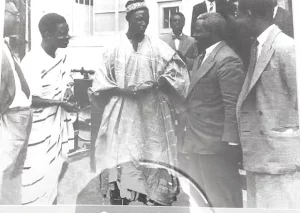
Mumuni Bawumia with J.B. Danquah and some members of the first Legislative Assembly of the Gold Coast. Photo taken on February 17, 1953
By A.R. Gomda

