7.5 C
London
Tuesday, December 23, 2025
Home Blog Page 344

Rethinking Ghana’s Economic Direction: A case against cosmetic stability

0

The recent outburst by the Governor of the Bank of Ghana that foreign remittances have dwindled despite a strong local cedi, and that certain austerity measures were therefore necessary to reverse the trend, was quite ludicrous.

When your currency appears strong, even if backed by all the gold reserves in the world, but your economy remains a retail-based one with no homegrown secondary industries creating jobs, what outcome do you expect? A strong cedi cannot compensate for an economy that imports almost everything it consumes, raises limited domestic revenue from taxation, and continues to suffer from a negative balance of trade.

Without a robust industrial base and value-added production, currency strength becomes cosmetic and reflects monetary manipulation rather than genuine economic health.

The obsession with a strong cedi and the illusion of macroeconomic stability are distractions from the deeper structural problems that cripple Ghana’s economy. True economic stability cannot be achieved through currency gymnastics or interest rate acrobatics. It must come from production, not presentation.

A nation’s real strength is not measured by the exchange rate of its currency but by its ability to manufacture, process, and export goods while employing its citizens in sustainable industries.

When local production is weak, even the most stable currency is a deceptive symbol of fragility. Ghana’s fiscal managers have become overly fixated on satisfying foreign creditors and defending an artificial exchange rate rather than building internal economic confidence.

Instead of investing in industries that add value to raw materials, government policies continue to prioritize imports and short-term borrowing. This is why every global shock sends the cedi tumbling and inflation soaring. The country cannot tax itself into prosperity. A strong economy comes from creating, innovating, and exporting, not taxing citizens to death.

Have you ever looked at the visa application index of all fifty-four African countries? Just a glance shows which nations are truly investing in their people.

Countries like Namibia, Botswana, Morocco, and Mauritius enjoy visa-free entry to regions such as the Schengen zone, the United Kingdom, and large parts of Asia and Latin America. Yet these same countries do not impose visa requirements on nationals from richer countries who visit them.

Now look at West Africa, particularly Ghana. It is often the countries whose passports attract the fewest privileges abroad that impose the heaviest visa fees on others. We are told these arrangements are bilateral, but they are not.

They reflect a mentality of inferiority wrapped in arrogance,  what I call monkeys playing by sizes. The result is an economic policy that punishes both citizens and foreigners, shrinking investment and stifling tourism, while the government continues to cry about dwindling remittances.

As if visa restrictions were not enough, our leaders impose a chain of taxes on Ghanaians abroad who try to support their families. They tax remittances, they tax the trotro plane ticket you buy to come home, they tax the calling card you use to check on your mother, and they tax the used vehicle you import just to move around.

Because the government lacks a meaningful strategy for generating real revenue through productivity, it turns ordinary citizens into prey. Anyone doing slightly better than the government becomes an enemy of state policy.

Imagine Ghana offering visa-free entry to all African countries and African Americans. The flow of cultural and financial investment that would follow would far outweigh the few dollars collected at visa desks.

My own classmate would have visited Ghana in 2019, and I am sure the amount she would have spent here would have been ten times what government gains from visa fees. But because that money would circulate in the local economy instead of going directly into government coffers, it is not a priority.

Even traveling home has become a punishment. Take a look at a simple air ticket from America to Ghana and you will see ECOWAS levies, COVID levies, and other unthinkable charges that make the average fare nearly twice that of the UK. It is not because London is closer or busier.

It is because Ghanaian policymakers are either wicked, operating with a crude Keynesian misunderstanding of economics, or they simply do not know what they are doing.

The same taxation madness applies to communication. I once called South Africa with a five-dollar calling card and spoke for almost two hours. The same five-dollar card to Ghana lasts barely ten minutes. Why? Because of taxes.

It is the recipient country that taxes incoming calls so heavily that even talking to your family becomes a privilege. Instead of tackling such distortions, our Ministry of Communications would rather engage in comical shows about DStv fees or indulge in moral theatrics over social issues, leaving the real economic injustices untouched.

The uncanny spectacle welcomes us everywere- from our ports to our policies. A 2016 Toyota Corolla with a modest 1800cc engine costs about forty-five thousand cedis to clear at the port, nearly equivalent to its market value in the United States.

How does it make sense that the duty on a used car almost equals its worth? When you break down the import charges, you will even cry. We are still paying COVID-19 levies long after the pandemic, and nobody in power seems embarrassed by this absurdity.

This slash-and-burn style of governance, where citizens are bled for every cedi, reflects a government that has lost all sense of economic reason.

Leadership continues to prioritize control over creativity and taxation over transformation. Instead of fostering industrialization, we have mastered the art of survival through levies. The people are taxed when they send money home, when they speak, when they travel, and when they die.

And yet, with all these taxes, public infrastructure is crumbling, hospitals lack basic supplies, and industries are shutting down.

If Ghana truly wants to build a resilient economy, it must rethink everything from its visa policies to its tax structures. Opening up the country to African and diasporan investors, reducing arbitrary fees, and encouraging the free movement of people and goods would stimulate growth more effectively than any IMF loan. A strong economy is not built by restricting entry or punishing success. It is built by empowering citizens and rewarding productivity.

And finally, instead of singing choruses about how much gold Gold4Good or any other government initiative was able to accumulate in eight months of existence from small-scale miners, let us chant choruses about the number of homegrown gold refineries, mineral cutting centers, and gold assaying facilities Ghana has built.

Let us measure progress not by the amount of raw gold exported, but by the value we add before it leaves our soil. And let us bear in mind that even the tiny state of Massachusetts, with no gold at all, has built lasting and enduring prosperity for its citizens by investing in human capital and penetrating deeper than any geology or gold mine can ever reach.

DISCLAIMER: The Views, Comments, Opinions, Contributions and Statements made by Readers and Contributors on this platform do not necessarily represent the views or policy of Multimedia Group Limited.

DISCLAIMER: The Views, Comments, Opinions, Contributions and Statements made by Readers and Contributors on this platform do not necessarily represent the views or policy of Multimedia Group Limited.

There is no pressure on me from Mahama to cut any deals with NPP appointees – AG clarifies

0

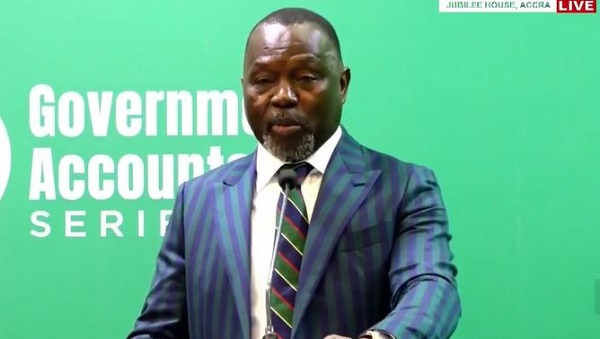
Dr Dominic Akuritinga Ayine is the Attorney General and Minister of Justice Dr Dominic Akuritinga Ayine is the Attorney General and Minister of Justice

The Attorney General and Minister of Justice, Dr Dominic Akuritinga Ayine, has debunked claims that he is under pressure to enter into plea deals with former government appointees who are under investigation for corruption-related activities.

He said this at the Government Accountability Series in Accra on Wednesday, October 22, 2025.

Dr Ayine disclosed that although some of the accused persons, including the Ashanti Regional Chairman of the New Patriotic Party (NPP), Bernard Antwi-Boasiako, popularly known as Chairman Wontumi, have made plea bargain offers, he has in no way been influenced by any individual or authority, specifically President John Dramani Mahama, to accept any offer in the discharge of his duties.

“I’m under no pressure from any quarters to cut deals. Mr President, who is my boss, has not put any pressure on me. He gives me his blessings when I brief him. The Chief of Staff has not put pressure on me to cut deals with anybody.

“Offers have been made, but I have turned all of them down. I have told everybody, please go to court. In the Wontumi case, offers were made to us for a plea bargain, but I said no, I’m filing charges. If you want to announce your intention for a plea deal, do it before the judge. That is now my strategy,” he explained.

Dr Dominic Ayine also shut down claims that he was negotiating plea deals with some NPP officials, describing such reports as false and politically motivated.

“The NPP took advantage and said I was cutting deals. No deals have been cut, and no deal will be cut,” he maintained.

Chairman Wontumi, the first accused in a case involving Akonta Mining Company Limited, is facing charges of engaging in unlicensed mining operations and assigning mineral rights without ministerial approval.

FULL TEXT: Attorney General briefs media on alleged criminal activities at Buffer Stock Company

He has pleaded not guilty to all charges.

He has since been granted bail in two separate rulings by different High Courts in Accra.

In the first instance, Justice Audrey Kocuvie-Tay granted him bail in the sum of GH¢15 million with three sureties, two of whom are required to justify with landed property within the court’s jurisdiction.

In a separate ruling, Justice Ruby Aryeetey granted bail to Wontumi and Edward Akuoko, the Operations Manager of Akonta Mining Company Limited, in the amount of GH¢10 million each, with two sureties, one of whom must justify with property.

Chairman Wontumi has since met the bail conditions and has been released from custody as proceedings continue in both cases related to Akonta Mining Company Limited.

ID/AE

Former Buffer Stock CEO Abdul-Wahab laundered and transferred over GHS40m

0

The Attorney General and Minister for Justice, Dr. Dominic Ayine, has unveiled another layer of financial wrongdoing involving the former Chief Executive Officer of the National Food and Buffer Stock Company, Abdul-Wahab Hannan.

The latest revelations form part of the Government Accountability Series spearheaded by the Presidency Communications.

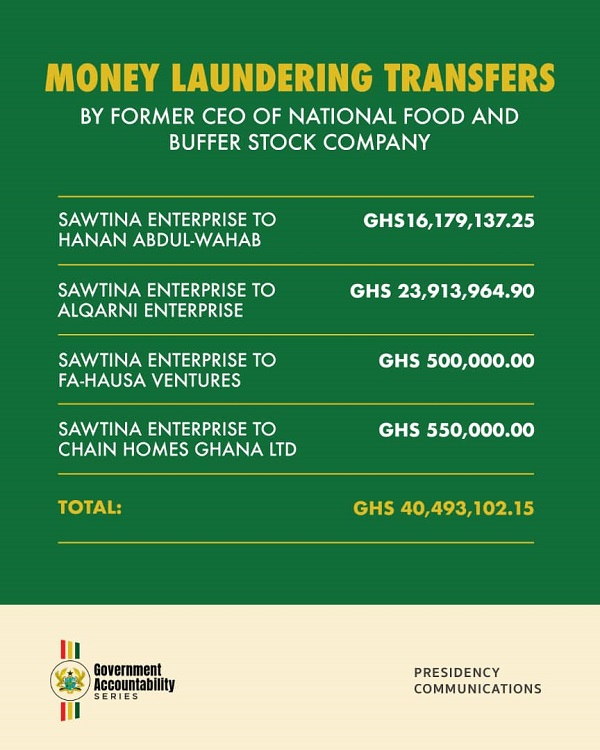
Dr. Ayine disclosed that investigations have uncovered a complex scheme of money laundering involving suspicious transfers totaling over GHS 40.5 million through Sawtina Enterprise, a company linked to the former CEO.

According to the Attorney General, the illicit transfers were made to various individuals and entities, raising serious concerns about financial impropriety, abuse of office, and attempts to conceal the origins of criminal proceeds.

The breakdown of the transfers is as follows:

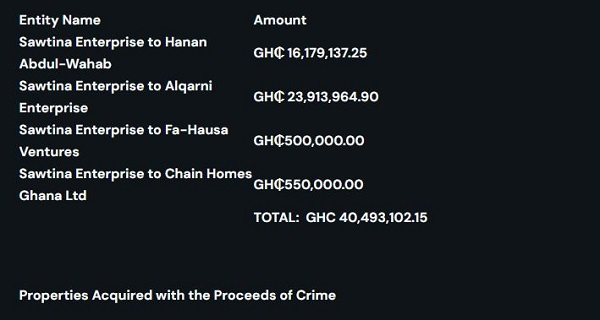
* GHS 16,179,137.25 from Sawtina Enterprise to Hanan Abdul-Wahab
* GHS 23,913,964.90 from Sawtina Enterprise to Alqarni Enterprise
* GHS 500,000.00 from Sawtina Enterprise to Fa-Hausa Ventures
* GHS 550,000.00 from Sawtina Enterprise to Chain Homes Ghana Ltd

Read also

Full list of properties allegedly acquired by ex-Buffer Stock boss with stolen funds


Amber Luke Starts Tattoo Removal Process After Spending £193,000 on Her Full-Body Ink Makeover

0

Australian model and social media star Amber Luke, widely known as the “Dragon Girl” for her extreme body modifications, has opened up about beginning the challenging process of tattoo removal after investing nearly £193,000 in her full-body transformation.

At 29 years old, Amber became a global sensation for her striking appearance, which featured tattoos covering nearly every inch of her skin, blue-inked eyeballs, a split tongue, and numerous piercings. Now, however, she says she is ready to embrace a more natural version of herself.

“I’ve realized that I went too far,” she admitted. “I want to rediscover the real me beneath all the ink.”

Amber, who got her first tattoo at 16, once viewed her body art as a form of empowerment and self-expression. But over time, she says her outlook has evolved. “The tattoos don’t define me anymore. I’m growing as a person, and that means letting go of some parts of my past,” she explained.

The process of tattoo removal has proven grueling physically and financially. Amber revealed that each laser session is “far more painful than getting tattooed” and can take hours, with multiple treatments required to fade the ink. Still, she’s determined to follow through. “It’s painful, but it’s worth it,” she said confidently.

Her decision has sparked mixed reactions online while some fans praise her for her honesty and courage, others say they’ll miss her iconic look that made her stand out in the modeling world.

For Amber, though, this is not about regret, but renewal. “I’m not erasing my past,” she said. “I’m simply turning the page and writing a new chapter of my life.”

As reported by punch

EOCO seizes $1.6m mansion, 17-bedroom hotel and other assets of ex-Buffer Stock CEO

0

EOCO has confiscated luxury assets, including mansions, vehicles, and designer items, belonging to former NAFCO CEO Hanan Abdul-Wahab and his wife after uncovering a GH¢78 million embezzlement scheme.

The Economic and Organised Crime Office (EOCO) has confiscated several high-end properties, vehicles, and luxury items belonging to former National Food Buffer Stock Company (NAFCO) Chief Executive Officer, Hanan Abdul-Wahab, and his wife, Faiza Seidu Wuni, after uncovering what authorities describe as a sophisticated GH¢78 million embezzlement and money laundering operation.

Mahama says Ghana Infrastructure Plan to ensure project continuity and efficient

0

President John Dramani Mahama has assured Ghanaians that the newly launched Ghana Infrastructure Plan (GIP) will put an end to the long-standing problem of abandoned projects by ensuring continuity across different governments.

Speaking at the launch of the Ghana Infrastructure Plan(GIP) in Accra, President Mahama said the initiative is designed to promote efficiency, accountability, and better use of public resources.

He explained that the GIP will be backed by Parliamentary approval, making it a national framework that transcends political transitions.

“The next step is to develop multi-sectoral linkages to ensure that infrastructure supports agriculture, industry, education, and health,” the President said.

“We also want to develop legal and institutional reforms that enhance continuity across governments, ending the cycle of project abandonment.”

President Mahama noted that successive governments have often refused to complete projects started by their predecessors, leading to waste and inefficiency. He gave an example from his recent visit to the Western Region, where he saw ongoing projects that had begun under the previous administration.

“Yesterday I went to the Western Region, and two of the projects I visited were projects that were advanced under the previous government. I want to assure the people of the Western Region that we are going to continue and finish these projects so that we can properly utilise taxpayers’ money.”

He added that the GIP will mark a shift from “scattered, politically motivated projects” to more coordinated, long-term investments aimed at job creation and national development.

“Our goal is straightforward, yet transformative to move from scattered, politically motivated projects to unified, long-term investments that generate jobs, unlock value, and foster prosperity,” he said.

President Mahama explained that the government’s Big Push Initiative will serve as the first phase of the Ghana Infrastructure Plan, focusing on completing abandoned and delayed projects in line with Article 35(7) of the 1992 Constitution.

Beyond ensuring project continuity, the President said the plan will also address the growing issue of rural-urban migration by promoting balanced regional development and equitable access to opportunities across the country.

“The Ghana Infrastructure Plan introduces special planning models that promote balanced regional development and equitable access to opportunities. You cannot progress as a nation when you have geographical imbalance in economic development.”

He criticised the past practice of changing development agencies with each new government, noting that this has weakened regional growth efforts.

“Setting up SADA as a special vehicle to accelerate development of the north was strategic,” he explained. “Unfortunately, a new government came, shut down SADA, and created three broad development authorities: Coastal, Middle Belt, and Northern, which really have done nothing, absolutely no impact.”

President Mahama said that the imbalance in development has forced many young people from the northern parts of the country to migrate to Accra and other southern cities in search of jobs.

“Every child finishing senior high school in the north, after a certain point, has no economic opportunities, no employment opportunities, so everybody is headed towards Accra.”

All foreign direct investment is coming into Accra. Incentives that have been given to rebalance development have not been very effective. And we must find a way of making them more effective, and that’s why we are suggesting an agro-industrial park in the northern part of the country,” the President added.

DISCLAIMER: The Views, Comments, Opinions, Contributions and Statements made by Readers and Contributors on this platform do not necessarily represent the views or policy of Multimedia Group Limited.

DISCLAIMER: The Views, Comments, Opinions, Contributions and Statements made by Readers and Contributors on this platform do not necessarily represent the views or policy of Multimedia Group Limited.

I deserve a diplomatic passport too

0

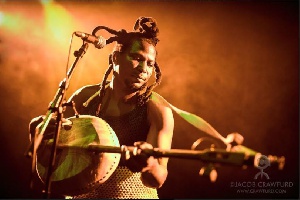
King Ayisoba is a Ghanaian musician King Ayisoba is a Ghanaian musician

With five Ghanaian creatives honoured with diplomatic passports for their contributions to promoting Ghana abroad, veteran traditional musician King Ayisoba believes he also deserves the same recognition.

In an interview with broadcaster Kafui Dey, the “I Want To See My Father” hitmaker mentioned that his long-standing commitment to promoting Ghana’s traditional music should also earn him a place among those recognised.

The traditional musician, however, noted that he holds no grudges against those who received the diplomatic passports, acknowledging that they have all made Ghana proud in their respective fields.

‘Music didn’t make me rich, it made me comfortable’ – Gyedu-Blay Ambolley

He singled out Grammy-nominated reggae artiste Rocky Dawuni for praise, describing him as someone who has worked hard to elevate Ghana’s name globally.

“For me, I can’t say those who have received it don’t deserve it. Someone like Rocky Dawuni has really worked hard, it’s not easy to earn a Grammy nomination. I just hope they also consider me because, truthfully, when it comes to Ghanaian music traditions, I’m one of those who’ve carried it,” King Ayisoba said.

The Minister of Foreign Affairs, Samuel Okudzeto Ablakwa, presented diplomatic passports to five Ghanaian creatives, travel vlogger Wode Maya, reggae artiste Rocky Dawuni, broadcaster Anita Erskine, visual artist Ibrahim Mahama, and entrepreneur Dentaa Amoateng.

The ceremony took place on September 17, 2025, during the launch of the Diaspora Summit 2025, jointly organised by the Office of the President, Diaspora Affairs and the Ministry of Foreign Affairs.

According to the ministry, the five recipients were selected for their proven track record of promoting Ghana and African culture internationally.

Meanwhile, catch this week’s episode of Nkommo Wo Ho, packed with showbiz gist and street buzz here!

AK/EB

See full list of properties allegedly acquired by former NAFCO CEO

0

Former NAFCO CEO, Abdul-Wahab Hanan is at the centre of fresh corruption related matters Former NAFCO CEO, Abdul-Wahab Hanan is at the centre of fresh corruption related matters

The Attorney General and Minister of Justice, Dr Dominic Akuritinga Ayine, has disclosed that the former Chief Executive Officer of the National Food and Buffer Stock Company (NAFCO), Abdul-Wahab Hanan, is at the centre of a major corruption investigation involving the alleged acquisition of high-value assets with state funds.

LIVESTREAMED: Attorney General provides new updates on ORAL cases

Speaking at the Government Accountability Series in Accra on Wednesday, October 22, 2025, Dr Ayine said investigators from the Economic and Organised Crime Office (EOCO) have traced several luxury properties and suspicious bank transactions linked to Abdul-Wahab, believed to have been financed with proceeds of crime.

“Investigators from the Economic and Organised Crime Office (EOCO) have traced several properties and bank transactions linked to Abdul-Wahab, which they believe were funded through illicit means,” he said.

The former NAFCO boss was arrested with his wife on June 25, 2025, and detained by EOCO for two weeks before being granted bail in the sum of GH¢60 million with two sureties.

His wife was released earlier on a GH¢30 million bail.

While the opposition New Patriotic Party (NPP) has criticised the bail conditions as excessively harsh and politically motivated, Dr Ayine maintained that the government remains committed to enforcing accountability and the rule of law.

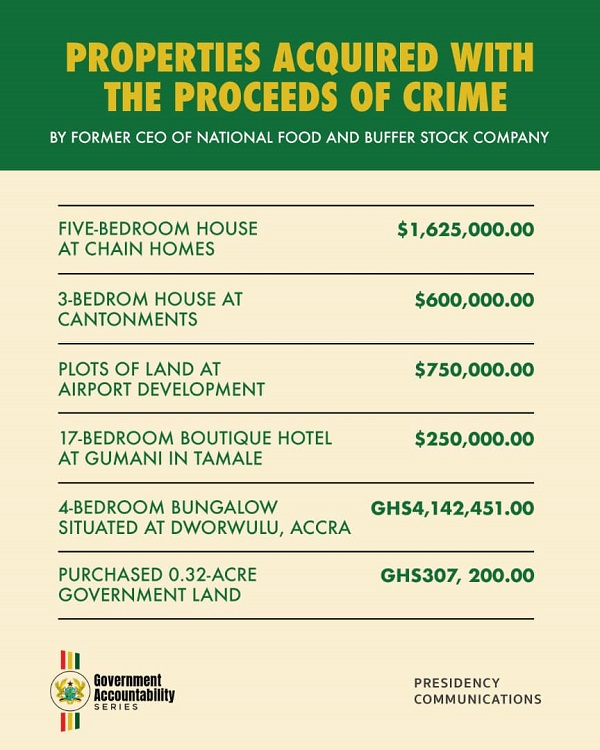
He disclosed that assets allegedly acquired with misappropriated funds include a five-bedroom house at Chain Homes, valued at $1.625 million; a three-bedroom residence at Cantonments purchased for $600,000; plots of land at Airport Development Area worth $750,000; a 17-bedroom boutique hotel in Gumani, Tamale valued at $250,000; a four-bedroom bungalow at Dzorwulu valued at GH¢4.14 million; and a 0.32-acre parcel of government land purchased for GH¢307,200.

Dr Ayine assured that all assets proven to have been purchased with stolen funds will be confiscated in line with the law.

See the list below


MRA/AE

How former Buffer Stock CEO laundered and transferred over GH¢40m

0

The Attorney General and Minister for Justice, Dr Dominic Ayine, has revealed fresh details of financial wrongdoing involving the former Chief Executive Officer of the National Food and Buffer Stock Company (NAFCo), Abdul-Wahab Hanan.

The new revelations were made during the Government Accountability Series on October 22, 2025.

According to Dr Ayine, ongoing investigations have uncovered a complex money-laundering scheme involving suspicious financial transfers totaling more than GH¢40.5 million through Sawtina Enterprise, a company allegedly linked to the former CEO.

He noted that the findings point to a deliberate effort to conceal illicit financial transactions, adding that his office is working with relevant investigative bodies to ensure full accountability and possible prosecution of all those implicated.

From GH¢548 Million to GH¢2.2 Billion: NSS payroll scandal deepens after forensic audit

Read the Attorney-General’s full presentation below:

My Fellow countrymen and women

I am here this morning to account to the sovereign people of Ghana as has been my practice since assuming office as Attorney General. Today, I will do two things. Firstly, I will provide update on the ORAL investigations we have been conducting and the ORAL-related prosecutions that have been filed so far.

Second, you would recall that on March 20, 2025, when I announced the Kwabena Adu-Boahene investigation, I referred to an ongoing investigation as the “Rumble in the Jungle”.

The reference was to the Buffer Stock criminal investigation. I will this morning announce the conclusion of investigations into the elaborate criminal enterprise that started in 2018 after the appointment of Abdul-Wahab Hanan as chief executive officer.

As far as the ORAL investigations are concerned, the status report is as follows: Out of the Report of the ORAL Committee submitted to my office, we instructed the National Intelligence Bureau in March 2025 to conduct investigations into cases of suspected acts of theft and graft by public officials and their allies in the private sector.

The investigations were necessary because the ORAL Committee Reports did not contain the evidence required to prove the guilt of the suspects in court beyond reasonable doubt. It is always important to remember that the ORAL Committee was tasked by His Excellency the President to receive complaints of looting of state resources.

Our investigators have diligently concluded investigations in the following cases-

• Skytrain

• National Service Ghost Names Scandal

• District Road Improvement Project (DRIP)

• National Lotteries

• Pwalugu Multipurpose Dam

SML

• Frontier Health Care Services

• Free Wifi

• National Ambulance

• Boankra Integrated Inland Logistics Terminal

• Sputnik V Vaccines Case

• Land looting- 8 instances investigated

Prosecutions have commenced in the Skytrain and National Service scandals. In the case of the latter, we have filed charges against the former Executive Director, Osei Assibey Antwi and his deputy, Gifty Oware. Charges are being prepared against the rest of the public officers and the so-called marketplace vendors.

In all, we intend to file about 10 cases in the NSA scandal and will use some of the public officers and vendors as prosecution witnesses. Also, I wish to announce that the Auditor General has conducted a forensic audit into the NSA scandal and the total amount of money stolen or illegally spent now stands at GH¢2 billion and not the GH¢548 million that was uncovered by our investigators as at June 2025.

Investigations are still ongoing in respect of the following matters-

• All African Games

• Mathematical Sets

• Bank of Ghana Building

• Stadia Renovation

• National Cathedral

Ladies and Gentlemen:

Rumble in the Jungle

Now to the Buffer Stock investigations which I nicknamed “The Rumble in the Jungle.” As of March 20, 2025, when we announced the arrest and detention of suspects Kwabena Adu Boahene and his wife Angela Boateng, the Economic and Organized Crime Office had gathered credible intelligence regarding a criminal enterprise that had been operated by the former Chief Executive Officer of the National Food and Buffer Stock Company Limited, Abdul-Wahab Hanan.

Initial estimates put the amount of money pilfered by Mr. Abdul-Wahab and his collaborators at the time at around Fifty-Eight Million Ghana Cedis (GH¢58,000,000.00), far in excess of the Forty-Nine Million Ghana Cedis (GH¢49,000,000.00) suspected to have been stolen by Mr. Kwabena Adu Boahene and his co-accused persons.

I called the criminal enterprise operated by Mr. Abdul-Wahab and his collaborators at the Buffer Stock “the Rumble in the Jungle” not only because of the huge amount of money at stake but because of the fact that, while food suppliers were wailing and gnashing their teeth due to failure to pay them for supplies to the Buffer Stock, and while our school kids were being denied nutrition under the School Feeding Program for lack of funds, Mr. Abdul-Wahab and his collaborators were busy lawlessly looting funds meant for the Program. That is jungle behavior.

The informal meaning of the word “rumble” is to discover an illicit activity or its perpetrator. Through painstaking investigations, the EOCO discovered this illicit, criminal enterprise run by a gang of corrupt, lawless officials at the Buffer Stock Company.

Summary of the Findings

On June 25, 2025, the EOCO conducted a coordinated operation based upon their initial investigations which resulted in the arrest of Mr. Abdul-Wahab, former Cehief Executive of the National Food And Buffer Stock Company (NAFCO), his wife Faiza Seidu Wuni and James Atieku, the Buffer Stock manager for the Northern Sector who was based in Tamale. The operation also led to the arrest of Emmanuel Arthur, Head of Corporate Affairs of NAFCO.

The arrest followed Initial intelligence and assessment by EOCO which suggested that while serving as CEO of Buffer Stock between 2017 and 2024, Mr. Abdul-Wahab Hanan colluded with his wife, Faiza Seidu Wuni, Richard Sam Asante (Head of Finance), Bismark Owusu Boakye (Finance Department), and Emmanuel Arthur (Corporate Affairs Manager) and others to, to create an elaborate criminal enterprise that was used to steal and launder public funds from the Buffer Stock Company.

Within the period between 2017 and 2024, Hanan Abdul-Wahab, in concert with Richard Sam-Asante and Bismark Owusu Bokaye, orchestrated the transfer of Seventy-Eight Million Two Hundred And Sixty Nine Thousand, Eighty Four and Four Pesewas and Four Ghana Cedis (GH¢78,269,084.04) from the bank accounts of Buffer Stock Company to a private company linked to Hanan Abdul-Wahab, his wife and staff of buffer stock Company at Republic Bank and ECOBANK.

Evidence shows that the funds were instantly retransferred to companies owned by Hanan Abdul-Wahab himself and companies and entities owned and associated with and Hanan and his wife . Similarly Evidence show that between December 2017 and May 2019, Hanan Abdul-Wahab transferred Five Million, Four Hundred And Ninety Five thousand, Seven And Forty Eight Ghana Cedis and Thirty Six Pesewas (GH¢5,495,748.36 ) from Buffer Stock accounts to two bank accounts belonging to Aludiba Enterprise at Republic Bank and ABSA, a company he owns.

Aludiba Enterprise is not a registered supplier of Buffer Stock Company. Hanan Abdul-Whab between October 2019 to January 2022 also orchestrated some suppliers to transfer an amount of Eleven Million Nine Hundred And Ninety Eight thousand Ghana Cedis and fourty Eight pesewas (GH¢11,998,830.48) to an entity owned by a staff of buffer stock and later instructed the staff to re-transfer the funds to a company owned and run by Hanan Abdul Wahab and his wife.

In July 2022, investigations found that Hanan Abdul Wahab transferred GH¢251,050 from Buffer Stock Accounts to a bank account at Republic Bank belonging to Energy Partners Ltd, a company co-owned by the Hanan Abdul Wahab and Emmanuel Arthur, the Head of Corporate Affairs of Buffer Stock company.

Energy Partners is not a service provider for Buffer stock. The evidence gathered so far shows that they run this criminal enterprise under the pretext of supplying food items to schools under the School Feeding Program.

Seven entities linked to Mr. Hanan Abdul-Wahab and his wife were used as vehicles to receive and to launder the proceeds of crime from Buffer Stock. The money laundering took the form of property acquisitions across the country, including real estate and luxury goods using the same entities.

The entities in question are as follows:

• Alqarni Enterprise

• Aludiba Enterprise

• Energy Partners Limited

• Fa-Hausa Ventures

• Fa-Hausa Company Limited and

• Aludiba Foundation and

• Sawtina Enterprise (owned by a third party connected to the couple)

Bank documents obtained by the EOCO reveal that within the period that the suspects operated the criminal enterprise, Mr. Hanan Abdul-Wahab, his wife and their entities became the largest depositors of Republic Bank.

Investigations established that in 2018, Sawtina Enterprise, an entity owned by James Atieku-Apawu applied to become a licensed supplier to the Buffer Stock Company. This application was approved by his boss, Hanan Abdul-Wahab, knowing very well that his approval placed James Tieku-Apawu in a conflict-of-interest situation.

Documentary evidence from bank accounts of Buffer Stock revealed that between September 2018 and June 2024 Buffer Stock transferred a total of GH¢78,269,082.04 to Sawtina Enterprise’s bank accounts at Ecobank and Republic Bank respectively. The payments were supposedly to pay for food supplies made by Sawtina Enterprise to schools under the School Feeding Program (SFP).

Verified records, including waybills and store receipt vouchers (SRVs) from Buffer Stock, indicated that only GH¢27,389,872.00 out of payments to Sawtina Enterprise were backed by supplies. There is no evidence that the remaining GH¢50,879,210.04 paid to the enterprise was backed by food supplies or any service rendered to Buffer Stock.
A review of Sawtina Enterprise’s bank account revealed that the bulk of the payments which Buffer Stock made to Sawtina Enterprise’s bank accounts (about 98%) of the GH¢78,269,082.04 were instantly re-transferred to Alqarni Enterprise, Fa-Hausa Ventures and other entities owned and controlled by or affiliated to Hanan Abdul-Wahab and Faiza Seidu Wuni.

Under interrogation, Mr. Atieku-Apawu stated that, although some of the funds received into Sawtina’s Ecobank and Republic Bank accounts were for the few genuine supplies backed by waybills and Store Receipt Vouchers (SRV’s), in most instances no supplies were made but he noticed that Buffer Stock kept making payments to his company, Sawtina Enterprise.

He also admitted that other third-party companies which our investigations have established to be Licensed Buying Companies (LBC’s) or suppliers to Buffer Stock also made several payments into Sawtina’s account. He said he neither knew the promoters of these companies nor did his company have any business dealings with them.
He had no explanation as to why the millions were transferred into his company’s bank account but observed that those payments, whether from Buffer Stock or from third parties, were made into Sawtina’s account on the instruction of his then boss Hanan Abdul-Wahab.

He further explained that whenever such payments were deposited into Sawtina’s account, he was prompted by Hanan to expect the transfer and was later instructed on where to move or re-transfer the funds. In effect, Sawtina became a conduit for Hanan Abdul-Wahab and his wife to steal Buffer Stock funds without easy detection.

Transaction analysis of Sawtina Enterprise’s Republic bank account and entities used as vehicles to launder the proceeds of the criminal enterprise established by Hanan and his Wife Faiza corroborated the claims made by Mr. James Tieku-Apawu. For example, a review of some of the re-transfers of the funds paid to Sawtina Enterprise by Buffer Stock revealed the following:
As is typical of all investigations conducted by the EOCO, contemporaneous tracing of the proceeds of crime has been undertaken and can confirm that the couple purchased a number of high-end real estate properties from their ill-gotten wealth. The properties are as follows:

Five-bedroom house bought from Chain Homes Limited between February 2019 and December 2020 at a cost of $1,625,000. Of this amount, GH¢5,758,165.00 (equivalent to $230,841.00) was paid directly from the accounts of the investigated entities. The balance was paid in cash to Chain Homes by the couple;

In July 2020, the couple purchased a 3-bedrom house at Cantonments from Golden Coast Developer Ltd at a cost of $600,000.00 using two of their companies- Fa-Hausa Ventures (owned by the wife) and Fa-Hausa Company Limited (owned jointly by the couple). The land documents are registered in the name of the wife;

Between October 2019 and February 2021, the couple purchased plots at Finali’s Airport development site for USD $750,000.00. The total payments were made in cash in the name of Faiza Seidu Wuni.

Subsequently, in July 2021, Faiza Seidu Wuni signed a contract with a construction company, Mendanha and Sousa Construction Ltd at a cost of USD$691,650.00 to construct the shell and core of the building.

This excludes the cost of architectural designs from Ansara Architecture Pty Ltd based in South Africa. The building sitting on three plots is now estimated to be valued at about USD$2,5000,000.00.

The couple purchased 0.32-acre government land from one Anthony Duke Essien, a known government land sales agent named in both the demolition of the Nigerian High Commission and the Sale and demolition of the Bulgarian Consulate.

Duke Essian used his sister Antoinette Tsiboe Darko, a staff of Danquah Institute as a front, to purchase from the Ministry of Lands and the Land Commission at a price of GH¢307,200. Duke Essien then instantly sold the land to Hanan Abdul-Wahab and received about GH¢2,567,000.00. The payment came from the criminal proceeds from Buffer Stock through Sawtina Enterprise through Alqarni Enterprise and Hanan himself to Anthony Duke Essien.

On the instruction of his brother, Duke Essien, Antoinette then wrote to the Land Commission in March 2020 to instruct them that the lease should be in the name of Hanan Abdul-Wahab. In May 2020, she made a U-turn and wrote to the Lands Commission to withdraw the documents bearing the name of Hanan Abdul-Wahab and now replace it with his wife Faiza Seidu Wuni. The couple developed four units of 4-bedroom apartments on the said land. Property is yet to be valued.

Other properties acquired by the couple are as follows:

17-bedroom boutique hotel at Gumani in Tamale in respect of which the couple used Fa-Hausa Company Limited to sign a franchise with Villa Monticello for $250,000.00 in order to hide the hotel under the brand name of villa monticello.

4-bedroom bungalow situated at Dworwulu, Accra valued at GH¢4,142,451.00.

Three storey building (Chicken Republic) situate at Estate Junction, Tamale;

• Five-bedroom mansion at Kanvili, Dorado Street, Tamale

• Three bedroom house, Kpalsi, Tamale

• One storey building, No. 10 Selby Gardens, Achimota, Accra

• 27 acre plot of land, Estate Junction, Tamale

• 29 acre land, Close to Workers College, Tamale

We have frozen all these assets and will be taking steps to have them confiscated to the state in the course of the criminal proceedings. Also, in terms of liquid assets, we have frozen a fixed deposit account belonging to Mr. Hannan containing GH¢10,000,000.00 with Republic Bank, Labone Branch, Accra. Additionally we have also frozen several vehicles and over 61 luxury handbags

Ladies and Gentlemen:

On account of the foregoing, we have decided to charge Mr. Hanan Abdul-Wahab and his wife, Faiza Seidu Wuni with stealing, conspiracy to steal, wilfully causing financial loss to the state, using public office for profit, obtaining public property by false statements and money laundering. The charges will be filed on Friday, October 24, 2025.

Thank you for your attention.

MA

Rival fans mock Kotoko as Hakim Ziyech joins Wydad ahead of return leg

0

Hakim Ziyech has joined Wydad AC Hakim Ziyech has joined Wydad AC

Social media has gone wild following confirmation that Moroccan star Hakim Ziyech has joined Wydad AC, with Ghanaian fans quickly turning the announcement into fresh banter at the expense of Asante Kotoko.

The former Chelsea and Ajax winger sealed a sensational one-year deal with the Casablanca giants as a free agent, returning home for what many are calling a “fairytale homecoming.”

But in Ghana, the news has sparked waves of trolling, mainly because Kotoko are set to face Wydad in the CAF Confederation Cup second preliminary round.

Wydad edged Kotoko 1-0 in Accra on October 19, 2025, and the return leg in Morocco is scheduled for Friday, October 24, 2025.

Watch highlights of Asante Kotoko’s 1-0 defeat to Wydad Casablanca

With Ziyech’s arrival, rival fans have been quick to joke that the Porcupine Warriors are “finished.”

Though it’s unclear if Ziyech will feature in the second leg, Fabrizio Romano confirmed the transfer with his signature “Here We Go!” post.

Read some of the comments below:

FKA/JE

Meanwhile, watch the latest Sports Check interview with Alex Kotey, the GFA Referees Manager below:

Auditor General’s forensic audit reveals Gh¢2.2B, not Gh¢548M, stolen in NSA scandal – AG

0

Gifty Oware-Mensah

The Attorney General and Minister for Justice, Dr Dominic Ayine, has revealed that a forensic audit conducted by the Office of the Auditor General into the National Service Authority (NSA) scandal has uncovered a total loss of Gh¢2.2 billion, contrary to the earlier estimate of Gh¢548 million.

According to Dr Ayine, the new findings have prompted his office to amend the charge sheet to reflect the updated figures and include new charges against the accused persons.

Speaking during the Government Accountability Series on Wednesday, October 22, Dr Ayine confirmed that charges have already been filed against the former Director-General of the NSA, Osei Assibey Antwi, and his deputy, Gifty Oware-Mensah. He added that more prosecutions are expected to follow as part of the government’s broader anti-corruption drive.

2025-08-18T17:06:11+00:00


2025-08-29T15:34:35+00:00


2025-09-05T13:29:31+00:00


Charges are being prepared against the rest of the public officers and the so-called marketplace vendors. In all, we intend to file about 10 cases in the NSA scandal and we will use some of the public officers and vendors as prosecution witnesses. This strategy is working well for us, and we intend to continue using it.

He further disclosed that the forensic audit had significantly expanded the scope of the investigation.


The Auditor General has conducted a forensic audit into the NSA scandal, and the total amount of money stolen or illegally spent now stands at Gh¢2.2 billion, not the Gh¢548 million uncovered by my investigators as of June 2025.

Dr Ayine also noted that investigations remain ongoing into several other high-profile cases, including the All-Africa Games, the mathematical sets procurement, the Bank of Ghana’s new building project, stadium renovations, and the National Cathedral. In the case of the National Cathedral, he confirmed that his office has requested another forensic audit to ensure full transparency and accountability.

Integrate 24-Hour Economy Into NDPC Framework – CPS

0

From R-L; Dr. Adu Owusu Sarkodie with officials of Centre for Policy Scrutiny (CPS)


The Centre for Policy Scrutiny (CPS), has urged the government to integrate the 24-Hour Economy programme into the country’s medium term development framework of the National Development Planning Commission (NDPC).

Executive Director at the Centre, Dr. Adu-Owusu Sarkodie, made the call during a review by the Policy Think Tank on the government’s 24 Hour –Economy flagship programme in Accra yesterday.

He pointed out that integrating 24-Hour Economy programmes into the National Development Planning Commission’s long term programme will not only ensure alignment with national priorities but also help eliminate duplication.

According to him,   the 24-Hour policy reflects the government needs to fill the pressing need for a stronger, more diversified economy, aligning with the country’s pursuit for long term transformation.

Dr. Sarkodie, however, stated that the success of the programme will not only depend on its vision but also on coherence and efficiency to reduce implementation and fiscal risk.

He also called on the government to establish transparent costing and phased fiscal planning to enhance the credibility for effective implementation of the progamme providing cost estimates based on impact and feasibility.

According to the think tank, such transparency will support budget discipline, improve stakeholder confidence, reduce the risk of overextension in a constrained fiscal environment.

He mentioned that the Centre observed that  the 24 Hour programme  correctly diagnosed Ghana’s development  challenges and prescribes solutions  similar to  previous development ambitions and strategies contrary to  earlier interpretations centred on adopting  a three-shift employment  system across the public and private sectors.

“None of the programmes suggested outcome indicators relates to shift work, whether projected rate of adoption or its projected prevalence in the economy by some future date,” he noted

“While the term 24-Hour economy may suggest round the clock –operations, the programme represents a broader national transformation agenda. The shift system may be one of the strategies employed but it is neither a perquisite nor a defining feature of economic transformation” the Centre observed.

The event which brought together some executives of the 24-Hour Economy Secretariat, members of the academia, members of the diplomatic corps, students as well as several other dignitaries assessed the strategic coherence, fiscal credibility and feasibility of the 24 Hour Economy programme.


By Ebenezer K. Amponsah

EPA To Train Journalists On Climate Communication

0

Prof. Nana Ama Klutse addressing the press


The Environmental Protection Authority (EPA) is partnering with Knutsford University to train journalists, skilled communicators, corporate actors, and educators on climate and environmental issues in Ghana—an effort aimed at bridging the gap between knowledge and action.

This partnership resulted in the launch of the National Climate and Environmental Communication Initiative (NCECI), which will strengthen the capacity of media professionals and communicators to report on environmental and climate issues accurately and creatively.

The initiative will also support corporate sustainability communications and ESG reporting, promoting transparency and accountability. It will also engage youth and communities through the Action for Climate Empowerment (ACE) framework, and foster collaboration among government, academia, the private sector, as well as development partners to promote a united national response.

Speaking at the event, EPA CEO, Prof. Nana Ama Klutse, said that across the world, climate change continues to threaten lives, livelihoods, and ecosystems.

She stated that too often, climate information stays confined to technical reports and policy circles, emphasising that the communication gap will be bridged with the launch of NCECI.

Prof. Klutse said NCECI positions Ghana to tell its own story—one of resilience, innovation, and leadership in a language that people, partners, and the world can understand.

“As we approach COP30, this initiative ensures that our national voice is clear, unified, and grounded in public understanding and participation. Because a well-informed nation is a stronger negotiating nation,” she stated.

She further added that, “We are proud to have Knutsford University as our academic anchor and look forward to a strong collaboration with the Ghana Journalists Association.

“The Media Foundation for West Africa, corporate networks, and development partners. Together, we can make climate communication not an occasional campaign, but a sustained national movement.”

Pro-Chancellor of Knustford University, Bishop John Kwabena, expressed the university’s willingness to execute the initiative to the benefit of the country.

He said, “We are happy to be working with communicators and journalists. Almost every year until quite recently, we have given training free of charge to journalists of all walks of life. To give them basic education or knowledge in management, in leadership, in communication, all the essentials that they need to do their work well.”


BY Prince Fiifi Yorke

GTEC Releases List Of Unaccredited Tertiary Institutions

0


The Ghana Tertiary Education Commission (GTEC) has released a list of 50 tertiary institutions considered unrecognised by the Commission.

According to GTEC, the United States has 24 institutions listed as unaccredited, which is the highest number. Ghana follows with five, and India with four unaccredited institutions.

Other countries with institutions on the list include Italy, Costa Rica, Germany, Nigeria, and the United Kingdom, among others.

The unaccredited institutions include Universidad Azteca in Mexico, Indian School of Management and Studies in India, Breyer State Theology University in USA, Debest College of Science, Arts and Business in Ghana, Osiri University in USA, Atlantic International University in USA, Faith University Seminary in Ghana, Christian University College in Monrovia Liberia, Rhema  Bible Training College in USA, Universidad Empresarial de Costa Rica in Costa Rica, Selinus University of Sciences and Literature in Italy.

Others include Crown University International Chartered in USA, Monarch Business School in Switzerland, City University in Cambodia, Kesmond International University in USA, Washington University of Barbados in Barbados, London Academy of Technology and Management in UK, IICSE University in USA,  Doxa Open University in Ghana, Brainae University in USA, University of Haana in Germany, Christian Leadership University in USA, International Institute of Church Management Inc in USA.

The rest are Electrical and Mechanical Engineering Training School in Ghana, Louisiana Baptist University & Seminary in USA, Tech Global University in Andorra, International Christian University in Nigeria, LIGS University, Hawaii in USA, Swiss Management Centre University in Switzerland, Quest International University in Ghana, Isles International University in Ireland, and Kingsnow University in USA.

Also, New Life Bible College and Seminary in USA, East Bridge University Paris in France, Taxila American University in Guyana, Vision International University in USA, Keisie International University in USA, Dublin Metropolitan University in UK/Cyprus, Logos University in USA, University of America in USA, Kazian School of Management in India, University of Northwest, Brooklyn in USA, Akamai University, Hawaii in USA, Trinity Graduate School of Apologetics and Theology (TGSAT) in India, American Bible University in USA, California Creek University in USA, Universidad Catolica De Murcia in Spain, Delta International University in USA, National Institute of Business Management (NIBM) in India, and Southern California International University in USA were listed as unaccredited institutions.

GTEC cautioned the public to verify the accreditation status of tertiary institutions before enrolling, stressing that qualifications obtained from unrecognised institutions would not be accepted for academic or professional purposes in Ghana.


By Florence Asamoah Adom

NSA ghost names scandal balloons to GHS2.2bn after forensic audit – AG

0

The scale of financial losses in the ongoing National Service Authority (NSA) scandal is far greater than initially reported, according to the Attorney General and Minister for Justice, Dr. Dominic Ayine.

Speaking as part of the Government Accountability Series on Wednesday, Dr. Ayine revealed that a forensic audit conducted by the Auditor General has uncovered a total of GHS 2.2 billion in funds either stolen or illegally expended within the NSA.

This figure is a staggering jump from the GHS 548 million originally identified by investigators as of June 2025.

“Also, I wish to announce that the Auditor General has conducted a forensic audit into the NSA scandal, and the total amount of money stolen or illegally spent now stands at GHS 2.2 billion,” Dr. Ayine stated.

“This is significantly higher than the GHS 548 million that was uncovered by our investigators earlier this year.”

Meanwhile, former Deputy Executive Director of the National Service Authority (NSA), Gifty Oware Mensah, who has been implicated in the scandal has pleaded not guilty to charges of causing financial loss of more than GH¢38 million to the state.

Mrs. Oware Mensah appeared before the Accra High Court on Wednesday, October 22, 2025, where she was formally charged with five counts—including willfully causing financial loss to the state, stealing, money laundering, and using public office for profit.

Prosecutors allege that during her tenure, the accused generated approximately 9,934 non-existent National Service personnel, and unlawfully profited from the monthly allowances disbursed under those ghost names.

The alleged infractions are said to have resulted in financial losses amounting to more than GH¢38 million to the government.

Mahama Ayariga outlines major interventions by Government since January

0

The Majority Leader in Parliament, Mahama Ayariga, has outlined key interventions introduced by the government since January to improve the economy, create jobs, and strengthen essential public services.

Speaking during the opening of the third meeting of the first session of the ninth Parliament, Mr. Ayariga explained that the government’s policies were beginning to yield results across various sectors, particularly in energy, education, health, and local development.

He noted that the economy was rebounding, inflation had dropped to single digits, and the cedi was showing stability.

According to him, these improvements were the result of prudent spending and better debt management, which had restored confidence in the financial system.

The Majority Leader mentioned that the government had paid over 2.8 billion cedis in National Health Insurance claims, clearing arrears that had long affected healthcare providers.

He added that an additional 3.4 billion cedis had been released to the National Health Insurance Authority after the decoupling of the National Health Reserve Levy, ensuring reliable funding for new initiatives such as Free Primary Health Care and Mahama Cares.

He indicated that the government expected active membership of the National Health Insurance Scheme to reach 20 million by the end of the year.

On education, Mr. Ayariga explained that schools were running smoothly under the Free Senior High School policy and that the academic calendar had not been disrupted.

He assured that the government would continue to invest in education and skills development to support the youth.

He also pointed to progress in local governance, noting that district assemblies had received timely Common Fund allocations, which were boosting local economies and creating jobs.

The Majority leader highlighted ongoing road construction and other infrastructure projects as part of the government’s broader plan to improve living conditions and drive growth.

He commended the Speaker and staff of Parliament for maintaining professionalism and openness, adding that Ghana’s Parliament had once again been ranked the most open on the continent by the Africa Open Parliament Index.

Mr. Ayariga reaffirmed the government’s commitment to accountability and inclusive growth, stressing that the administration of President John Dramani Mahama would continue to focus on policies that make life better for ordinary Ghanaians.

By: Jacob Aggrey

Ghana and Barbados Set to Boost Travel Opportunities Starting From This November

0

Published on
October 22, 2025

In a momentous move for international travel, Ghana and Barbados will officially inaugurate a direct flight route in November 2025. This significant milestone is a direct outcome of the GUBA Awards and Trade Conference 2025. The inaugural flight marks the beginning of a new chapter in air travel between West Africa and the Caribbean, offering both tourism and trade opportunities that promise to benefit the people and economies of both nations.

The route will reduce the travel time significantly, making it easier for both business professionals and leisure tourists to travel between the two destinations. The direct connection also paves the way for further tourism and trade developments, which are expected to have long-term positive effects on both countries.

Strengthening Bilateral Ties Through Aviation and Tourism

The launch of this direct flight route is a testament to the growing relationship between Ghana and Barbados, both of which are eager to strengthen their cultural and economic ties. The event served as the perfect catalyst for this historic achievement in aviation and tourism, helping lay the groundwork for the direct flight and increased travel options.

The new service will make it easier for tourists, business professionals, and members of the diaspora to travel between the two nations, bringing them closer together. Ghana is already an attractive destination for African-American tourists, and Barbados, with its vibrant Caribbean culture, offers a unique contrast. The cultural exchange between these two countries, through the new flight route, promises to benefit travelers by opening up more opportunities for exploration, business, and leisure. Travelers from both countries will find it easier to access their destinations, with reduced flight times and the convenience of a direct route.

Tourism and Trade Growth: The Benefits of the New Flight Route

One of the main benefits of this new route is the potential to grow tourism for both countries. Ghana, with its rich history, incredible landmarks, and lively music scene, is a growing tourism hub in West Africa. Barbados, known for its pristine beaches, historical sites, and warm weather, is a Caribbean gem that attracts millions of visitors each year. Now, the new direct flight will make it easier for travelers from both destinations to visit each other, allowing them to enjoy each country’s unique offerings.

In addition to tourism, the new flight will significantly benefit trade between the two nations. The airlines operating the route will be able to carry goods, services, and products between the two countries, further expanding commercial opportunities.

A New Era for International Travel: What to Expect from the Flight

As the November launch date approaches, both Ghana and Barbados are making final preparations for the new direct flight service. The new flight will be a welcome change for travelers who previously had to take connecting flights with long layovers, adding valuable hours to their journey.

For travelers, the experience promises to be smooth and enjoyable. The convenience of direct access between two fascinating destinations will enhance the travel experience, creating more opportunities for both adventure and business expansion. Both countries are eager to welcome international travelers, making this flight a gateway to new and exciting adventures.

Looking Forward to Stronger Connections and Shared Prosperity

As travelers from around the world prepare for this groundbreaking new flight route, the impact of the Ghana-Barbados direct flight is already being felt in both countries. Whether you’re looking to explore the cultural heritage of Ghana or relax on the idyllic beaches of Barbados, this new flight is the perfect way to experience the best of both worlds.

As the world opens up to more travel opportunities, the Ghana-Barbados direct flight promises to be just the beginning of deeper international ties and shared prosperity for both nations. Travelers eager to visit these vibrant destinations will no longer face the hurdles of long layovers and connecting flights, but will enjoy a seamless and efficient journey to their chosen destination.

Miniskirts, transparent dresses can get you arrested – Security analyst warns

0

File photo of patrons at a party File photo of patrons at a party

Security analyst Samuel Nana Appiah Owusu has cautioned Ghanaians, particularly women, to be mindful of how they dress in public, warning that indecent dressing could lead to arrest under the same laws that govern indecent exposure.

Speaking on Neat FM on Monday, October 21, 2025, Owusu explained that Ghanaian law permits prosecution in cases where individuals expose private parts of their bodies or wear clothing deemed inappropriate in public spaces.

“You have to be mindful of the way you dress whenever you step out, especially if you are a lady. Your breasts should be properly covered, and your panties should cover the areas they are supposed to cover,” he stated.

He further warned against wearing transparent or overly revealing outfits, stressing that:

“If you go to a party and your skirt is so short that your panties are visible, you can also get into legal trouble.”

According to him, such appearances fall under indecent exposure, which is punishable by law and can lead to being reported, arrested, and prosecuted.

Owusu added that these laws are intended to preserve societal morals and protect individuals:

“Such rules exist to ensure the moral fabric of society remains intact. What you wear at home should be different from what you wear in public.”

He also argued that dressing modestly could help reduce incidents of sexual assault, claiming that:

“Some rape culprits often say they were provoked by what the victims wore.”

Watch the video below:

ID/

Attorney General briefs media on alleged criminal activities at Buffer Stock Company

0

The Attorney General and Minister for Justice, Dr Dominic Ayine, has revealed fresh details of financial wrongdoing involving the former Chief Executive Officer of the National Food and Buffer Stock Company (NAFCo), Abdul-Wahab Hannan.

The new revelations were made during the Government Accountability Series on October 22, 2025.

According to Dr Ayine, ongoing investigations have uncovered a complex money-laundering scheme involving suspicious financial transfers totaling more than GH¢40.5 million through Sawtina Enterprise, a company allegedly linked to the former CEO.

He noted that the findings point to a deliberate effort to conceal illicit financial transactions, adding that his office is working with relevant investigative bodies to ensure full accountability and possible prosecution of all those implicated.

Read the Attorney-General’s full presentation below:

My Fellow countrymen and women

I am here this morning to account to the sovereign people of Ghana as has been my practice since assuming office as Attorney General. Today, I will do two things. Firstly, I will provide update on the ORAL investigations we have been conducting and the ORAL-related prosecutions that have been filed so far.

Second, you would recall that on March 20, 2025, when I announced the Kwabena Adu-Boahene investigation, I referred to an ongoing investigation as the “Rumble in the Jungle”.

The reference was to the Buffer Stock criminal investigation. I will this morning announce the conclusion of investigations into the elaborate criminal enterprise that started in 2018 after the appointment of Hannan Abdul-Wahab as chief executive officer.

As far as the ORAL investigations are concerned, the status report is as follows: Out of the Report of the ORAL Committee submitted to my office, we instructed the National Intelligence Bureau in March 2025 to conduct investigations into cases of suspected acts of theft and graft by public officials and their allies in the private sector.

The investigations were necessary because the ORAL Committee Reports did not contain the evidence required to prove the guilt of the suspects in court beyond reasonable doubt. It is always important to remember that the ORAL Committee was tasked by His Excellency the President to receive complaints of looting of state resources.

Our investigators have diligently concluded investigations in the following cases-

• Skytrain

• National Service Ghost Names Scandal

• District Road Improvement Project (DRIP)

• National Lotteries

• Pwalugu Multipurpose Dam

SML

• Frontier Health Care Services

• Free Wifi

• National Ambulance

• Boankra Integrated Inland Logistics Terminal

• Sputnik V Vaccines Case

• Land looting- 8 instances investigated

Prosecutions have commenced in the Skytrain and National Service scandals. In the case of the latter, we have filed charges against the former Executive Director, Osei Assibey Antwi and his deputy, Gifty Oware. Charges are being prepared against the rest of the public officers and the so-called marketplace vendors.

In all, we intend to file about 10 cases in the NSA scandal and will use some of the public officers and vendors as prosecution witnesses. Also, I wish to announce that the Auditor General has conducted a forensic audit into the NSA scandal and the total amount of money stolen or illegally spent now stands at GH¢2 billion and not the GH¢548 million that was uncovered by our investigators as at June 2025.

Investigations are still ongoing in respect of the following matters-

• All African Games

• Mathematical Sets

• Bank of Ghana Building

• Stadia Renovation

• National Cathedral

Ladies and Gentlemen:

Rumble in the Jungle

Now to the Buffer Stock investigations which I nicknamed “The Rumble in the Jungle.” As of March 20, 2025, when we announced the arrest and detention of suspects Kwabena Adu Boahene and his wife Angela Boateng, the Economic and Organized Crime Office had gathered credible intelligence regarding a criminal enterprise that had been operated by the former Chief Executive Officer of the National Food and Buffer Stock Company Limited, Mr. Hanan Abdul-Wahab.

Initial estimates put the amount of money pilfered by Mr. Abdul-Wahab and his collaborators at the time at around Fifty-Eight Million Ghana Cedis (GH¢58,000,000.00), far in excess of the Forty-Nine Million Ghana Cedis (GH¢49,000,000.00) suspected to have been stolen by Mr. Kwabena Adu Boahene and his co-accused persons.

I called the criminal enterprise operated by Mr. Abdul-Wahab and his collaborators at the Buffer Stock “the Rumble in the Jungle” not only because of the huge amount of money at stake but because of the fact that, while food suppliers were wailing and gnashing their teeth due to failure to pay them for supplies to the Buffer Stock, and while our school kids were being denied nutrition under the School Feeding Program for lack of funds, Mr. Abdul-Wahab and his collaborators were busy lawlessly looting funds meant for the Program. That is jungle behavior.

The informal meaning of the word “rumble” is to discover an illicit activity or its perpetrator. Through painstaking investigations, the EOCO discovered this illicit, criminal enterprise run by a gang of corrupt, lawless officials at the Buffer Stock Company.

Summary of the Findings

On June 25, 2025, the EOCO conducted a coordinated operation based upon their initial investigations which resulted in the arrest of Mr. Abdul-Wahab, former Cehief Executive of the National Food And Buffer Stock Company (NAFCO), his wife Faiza Seidu Wuni and James Atieku, the Buffer Stock manager for the Northern Sector who was based in Tamale. The operation also led to the arrest of Emmanuel Arthur, Head of Corporate Affairs of NAFCO.

The arrest followed Initial intelligence and assessment by EOCO which suggested that while serving as CEO of Buffer Stock between 2017 and 2024, Mr. Hanan Abdul-Wahab colluded with his wife, Faiza Seidu Wuni, Richard Sam Asante (Head of Finance), Bismark Owusu Boakye (Finance Department), and Emmanuel Arthur (Corporate Affairs Manager) and others to, to create an elaborate criminal enterprise that was used to steal and launder public funds from the Buffer Stock Company.

Within the period between 2017 and 2024, Hanan Abdul-Wahab, in concert with Richard Sam-Asante and Bismark Owusu Bokaye, orchestrated the transfer of Seventy-Eight Million Two Hundred And Sixty Nine Thousand, Eighty Four and Four Pesewas and Four Ghana Cedis (GH¢78,269,084.04) from the bank accounts of Buffer Stock Company to a private company linked to Hanan Abdul-Wahab, his wife and staff of buffer stock Company at Republic Bank and ECOBANK.

Evidence shows that the funds were instantly retransferred to companies owned by Hanan Abdul-Wahab himself and companies and entities owned and associated with and Hanan and his wife . Similarly Evidence show that between December 2017 and May 2019, Hanan Abdul-Wahab transferred Five Million, Four Hundred And Ninety Five thousand, Seven And Forty Eight Ghana Cedis and Thirty Six Pesewas (GH¢5,495,748.36 ) from Buffer Stock accounts to two bank accounts belonging to Aludiba Enterprise at Republic Bank and ABSA, a company he owns.

Aludiba Enterprise is not a registered supplier of Buffer Stock Company. Hanan Abdul-Whab between October 2019 to January 2022 also orchestrated some suppliers to transfer an amount of Eleven Million Nine Hundred And Ninety Eight thousand Ghana Cedis and fourty Eight pesewas (GH¢11,998,830.48) to an entity owned by a staff of buffer stock and later instructed the staff to re-transfer the funds to a company owned and run by Hanan Abdul Wahab and his wife.

In July 2022, investigations found that Hanan Abdul Wahab transferred GH¢251,050 from Buffer Stock Accounts to a bank account at Republic Bank belonging to Energy Partners Ltd, a company co-owned by the Hanan Abdul Wahab and Emmanuel Arthur, the Head of Corporate Affairs of Buffer Stock company.

Energy Partners is not a service provider for Buffer stock. The evidence gathered so far shows that they run this criminal enterprise under the pretext of supplying food items to schools under the School Feeding Program.

Seven entities linked to Mr. Hanan Abdul-Wahab and his wife were used as vehicles to receive and to launder the proceeds of crime from Buffer Stock. The money laundering took the form of property acquisitions across the country, including real estate and luxury goods using the same entities.

The entities in question are as follows:

• Alqarni Enterprise

• Aludiba Enterprise

• Energy Partners Limited

• Fa-Hausa Ventures

• Fa-Hausa Company Limited and

• Aludiba Foundation and

• Sawtina Enterprise (owned by a third party connected to the couple)

Bank documents obtained by the EOCO reveal that within the period that the suspects operated the criminal enterprise, Mr. Hanan Abdul-Wahab, his wife and their entities became the largest depositors of Republic Bank.

Investigations established that in 2018, Sawtina Enterprise, an entity owned by James Atieku-Apawu applied to become a licensed supplier to the Buffer Stock Company. This application was approved by his boss, Hanan Abdul-Wahab, knowing very well that his approval placed James Tieku-Apawu in a conflict-of-interest situation.

Documentary evidence from bank accounts of Buffer Stock revealed that between September 2018 and June 2024 Buffer Stock transferred a total of GH¢78,269,082.04 to Sawtina Enterprise’s bank accounts at Ecobank and Republic Bank respectively. The payments were supposedly to pay for food supplies made by Sawtina Enterprise to schools under the School Feeding Program (SFP).

Verified records, including waybills and store receipt vouchers (SRVs) from Buffer Stock, indicated that only GH¢27,389,872.00 out of payments to Sawtina Enterprise were backed by supplies. There is no evidence that the remaining GH¢50,879,210.04 paid to the enterprise was backed by food supplies or any service rendered to Buffer Stock.

A review of Sawtina Enterprise’s bank account revealed that the bulk of the payments which Buffer Stock made to Sawtina Enterprise’s bank accounts (about 98%) of the GH¢78,269,082.04 were instantly re-transferred to Alqarni Enterprise, Fa-Hausa Ventures and other entities owned and controlled by or affiliated to Hanan Abdul-Wahab and Faiza Seidu Wuni.

Under interrogation, Mr. Atieku-Apawu stated that, although some of the funds received into Sawtina’s Ecobank and Republic Bank accounts were for the few genuine supplies backed by waybills and Store Receipt Vouchers (SRV’s), in most instances no supplies were made but he noticed that Buffer Stock kept making payments to his company, Sawtina Enterprise.

He also admitted that other third-party companies which our investigations have established to be Licensed Buying Companies (LBC’s) or suppliers to Buffer Stock also made several payments into Sawtina’s account. He said he neither knew the promoters of these companies nor did his company have any business dealings with them.

He had no explanation as to why the millions were transferred into his company’s bank account but observed that those payments, whether from Buffer Stock or from third parties, were made into Sawtina’s account on the instruction of his then boss Hanan Abdul-Wahab.

He further explained that whenever such payments were deposited into Sawtina’s account, he was prompted by Hanan to expect the transfer and was later instructed on where to move or re-transfer the funds. In effect, Sawtina became a conduit for Hanan Abdul-Wahab and his wife to steal Buffer Stock funds without easy detection.

Transaction analysis of Sawtina Enterprise’s Republic bank account and entities used as vehicles to launder the proceeds of the criminal enterprise established by Hanan and his Wife Faiza corroborated the claims made by Mr. James Tieku-Apawu. For example, a review of some of the re-transfers of the funds paid to Sawtina Enterprise by Buffer Stock revealed the following:

As is typical of all investigations conducted by the EOCO, contemporaneous tracing of the proceeds of crime has been undertaken and can confirm that the couple purchased a number of high-end real estate properties from their ill-gotten wealth. The properties are as follows:

Five-bedroom house bought from Chain Homes Limited between February 2019 and December 2020 at a cost of $1,625,000. Of this amount, GH¢5,758,165.00 (equivalent to $230,841.00) was paid directly from the accounts of the investigated entities. The balance was paid in cash to Chain Homes by the couple;

In July 2020, the couple purchased a 3-bedrom house at Cantonments from Golden Coast Developer Ltd at a cost of $600,000.00 using two of their companies- Fa-Hausa Ventures (owned by the wife) and Fa-Hausa Company Limited (owned jointly by the couple). The land documents are registered in the name of the wife;

Between October 2019 and February 2021, the couple purchased plots at Finali’s Airport development site for USD $750,000.00. The total payments were made in cash in the name of Faiza Seidu Wuni.

Subsequently, in July 2021, Faiza Seidu Wuni signed a contract with a construction company, Mendanha and Sousa Construction Ltd at a cost of USD$691,650.00 to construct the shell and core of the building.

This excludes the cost of architectural designs from Ansara Architecture Pty Ltd based in South Africa. The building sitting on three plots is now estimated to be valued at about USD$2,5000,000.00.

The couple purchased 0.32-acre government land from one Anthony Duke Essien, a known government land sales agent named in both the demolition of the Nigerian High Commission and the Sale and demolition of the Bulgarian Consulate.

Duke Essian used his sister Antoinette Tsiboe Darko, a staff of Danquah Institute as a front, to purchase from the Ministry of Lands and the Land Commission at a price of GH¢307,200. Duke Essien then instantly sold the land to Hanan Abdul-Wahab and received about GH¢2,567,000.00. The payment came from the criminal proceeds from Buffer Stock through Sawtina Enterprise through Alqarni Enterprise and Hanan himself to Anthony Duke Essien.

On the instruction of his brother, Duke Essien, Antoinette then wrote to the Land Commission in March 2020 to instruct them that the lease should be in the name of Hanan Abdul-Wahab. In May 2020, she made a U-turn and wrote to the Lands Commission to withdraw the documents bearing the name of Hanan Abdul-Wahab and now replace it with his wife Faiza Seidu Wuni. The couple developed four units of 4-bedroom apartments on the said land. Property is yet to be valued.

Other properties acquired by the couple are as follows:

17-bedroom boutique hotel at Gumani in Tamale in respect of which the couple used Fa-Hausa Company Limited to sign a franchise with Villa Monticello for $250,000.00 in order to hide the hotel under the brand name of villa monticello.

4-bedroom bungalow situated at Dworwulu, Accra valued at GH¢4,142,451.00.

Three storey building (Chicken Republic) situate at Estate Junction, Tamale;

• Five-bedroom mansion at Kanvili, Dorado Street, Tamale

• Three bedroom house, Kpalsi, Tamale

• One storey building, No. 10 Selby Gardens, Achimota, Accra

• 27 acre plot of land, Estate Junction, Tamale

• 29 acre land, Close to Workers College, Tamale

We have frozen all these assets and will be taking steps to have them confiscated to the state in the course of the criminal proceedings. Also, in terms of liquid assets, we have frozen a fixed deposit account belonging to Mr. Hannan containing GH¢10,000,000.00 with Republic Bank, Labone Branch, Accra. Additionally we have also frozen several vehicles and over 61 luxury handbags

Ladies and Gentlemen:

On account of the foregoing, we have decided to charge Mr. Hanan Abdul-Wahab and his wife, Faiza Seidu Wuni with stealing, conspiracy to steal, wilfully causing financial loss to the state, using public office for profit, obtaining public property by false statements and money laundering. The charges will be filed on Friday, October 24, 2025.

Thank you for your attention.

NSS payroll scandal deepens after forensic audit

0

Dr Dominic Ayine, Attorney-General and Minister of Justice Dr Dominic Ayine, Attorney-General and Minister of Justice

The Attorney General and Minister of Justice, Dr Dominic Akuruting Ayine, has revealed that a forensic audit conducted by the Auditor-General’s Department has uncovered a loss of GH¢2.2 billion through ghost names on the National Service Scheme (NSS) payroll, far exceeding the previously reported GH¢548 million.

According to him, the new figure is four times higher than the earlier amount recorded, following investigations that began in February 2025.

Speaking at the Government Accountability Series on Wednesday, October 22, 2025, Dr Ayine explained that the updated figure resulted from a comprehensive forensic audit carried out over several months.

“I wish to announce that the Auditor-General has conducted a forensic audit into the National Service scandal, and the total amount of money stolen or illegally spent now stands at GH¢2.2 billion, not the GH¢548 million uncovered by my investigators as of June 2025,” he stated.

He further indicated that his office would, moving forward, rely on the Auditor-General’s forensic audit report to prosecute all individuals implicated in the illegal activities currently under investigation.

SP/MA

Watch the latest edition of BizTech below:

GFA Executive Council member Gifty Oware-Mensah pleads not guilty to GH¢38 million NSA scandal

0

Gifty Oware-Mensah is a member of GFA's Executive Council Gifty Oware-Mensah is a member of GFA’s Executive Council

Gifty Oware-Mensah, a member of the Ghana Football Association (GFA) Executive Council and former Deputy Executive Director of the National Service Authority (NSA), has pleaded not guilty to five charges, including stealing and money laundering, in the ongoing GH¢38 million ghost names scandal.

She entered her plea at the Accra High Court on Wednesday, October 22, 2025, where she appeared alongside her legal team.

This comes just months after she was tipped to become the GFA’s Second Vice President, following FIFA’s approval of a proposal to elevate the Women’s Representative role to that position.

The charges against Oware-Mensah stem from allegations by the Attorney General’s Department, accusing her of stealing over GH¢38 million between February 2022 and March 2024 while overseeing finance, audit, and procurement at the NSA.

Gifty Oware set to become GFA’s second Vice President following Congress approval

Prosecutors claim she diverted GH¢31.5 million from a loan facility intended to support National Service Personnel into private company accounts linked to her, using “ghost names” from the Authority’s system.

She faces counts of stealing, willfully causing financial loss to the state, abuse of public office for personal gain, and money laundering.

Oware-Mensah, who maintains her innocence, remains an influential figure in Ghanaian football governance despite the deepening legal case against her.

FKA/JE

Meanwhile, watch the latest Sports Check interview with Alex Kotey, the GFA Referees Manager below:

JA Plant Pool overpaid by $2m under DRIP contract — Ayine

0

Attorney General, Dr Dominic Ayine has revealed that the government has demanded a refund of $2 million from JA Plant Pool Ghana Limited after investigations uncovered financial irregularities in the District Roads Improvement Programme (DRIP) contract.

Speaking at the Government Accountability Series in Accra on Wednesday, 22 October 2025, Dr Ayine said the overpayment emerged during a forensic review of the $176 million contract awarded to the company.

“In the case of DRIP, JA Plant was overpaid by $2 million. The contract sum was $176 million. On the face of the contract, that is the sum that was stated. When we examined the invoices of payments, it was $178 million that was paid. So right away, there was a difference of $2 million. So we asked that the $2 million be paid back by JA Plant Pool,” he disclosed.

Dr Ayine further revealed that the investigation also uncovered tax evasion amounting to GH¢38.7 million, after 190 pieces of equipment were imported and cleared under false tax exemption claims.

“We also realised that 190 pieces of equipment were added and cleared without payment of tax. In other words, they were added to the release as if they were tax exempt,” he said.

“When they did the analysis, following the HS code, it came out that GH¢38.7 million of tax was evaded. So in respect of the two sums, we have made a demand on them to pay that money.”

The Attorney General added that his office has also identified significant over-invoicing of equipment purchased under the programme, with mark-ups ranging between 100 and 300 percent.

“We noticed that the equipment were over-invoiced by between 100–300%. For example, one piece of equipment that cost $40,000 was invoiced at $84,000. That is over 110%,” Dr Ayine explained.

He said a team of investigators is currently conducting a detailed item-by-item review of all equipment supplied under the DRIP contract to build a strong legal case.

“You can imagine all the equipment for all the districts, and we are going through each of them. And in criminal law, charges must be specific, and if you miss the specificity, your case will be thrown out,” he noted.

The revelations form part of a broader accountability drive aimed at retrieving misappropriated funds and holding individuals and companies accountable for financial breaches under previous contracts.

Read also….

GoldBod opens applications for Jewellery, Fabrication, and Refinery licences

Fans Gift BBNaija Star, Kaybobo N4m, 4 Bedroom Apartment And iPhone 17 Pro Max

0

According to sources, the duplex is already paid for, with a year’s rent reportedly valued at over ₦11 million.

BBNaija star Kaybobo has expressed delight after receiving a fully furnished duplex in Lekki, Lagos, along with N4 million in cash, a brand-new iPhone 17 Pro Max.

We rejected offers for plea deal in Chairman Wontumi case – Dr Ayine

0

Attorney General (AG), Dr Dominic Ayine

The Attorney General and Minister for Justice, Dr Dominic Ayine, has disclosed that his office rejected offers for a plea deal in the case involving the Ashanti Regional Chairman of the New Patriotic Party (NPP), Bernard Antwi-Boasiako, popularly known as Chairman Wontumi.

According to Dr Ayine, the Attorney General’s Department has adopted a firm policy to file charges against all suspects, allowing them to present any plea deals directly before the court rather than negotiating privately with the prosecution.

Chairman Wontumi, along with Kwame Antwi, a director of Akonta Mining, and the company itself, faces two separate charges of illegal mining (galamsey) currently before the High Court in Accra.

2025-08-21T13:07:32+00:00


2025-08-16T13:59:58+00:00


2025-08-29T15:34:35+00:00


Chairman Wontumi

Speaking during the Government Accountability Series on Wednesday, October 22, Dr Ayine reaffirmed his unwavering commitment to accountability and the protection of public resources. He stressed that he has not been influenced or pressured by any senior government official to reach settlements or drop charges.

I want to also let you know that I am under no pressure from any quarters to cut any deals. Mr President, who is my boss, has never put pressure on me. On the contrary, when I brief him, he gives me his blessing. He does not even express an opinion one way or the other. He simply says, ‘Dominic, I’ve heard you.

The Chief of Staff has never put pressure on me to cut a deal with anybody. The Secretary to the President, Dr Callistus Mahama, has never put pressure on me. On the contrary, he encourages me and tells me to keep going despite the stress. The Legal Counsel to the President, my former boss, has also never pressured me to reach any deal.


Dr Ayine confirmed that his office had turned down multiple requests for plea deals, including those related to the Wontumi case. He said:

Offers have been made and I have turned all of them down. I have told everyone, please go to court. If you want a plea deal, announce your intention before the judge. That is now my strategy.

He concluded by reaffirming his office’s resolve to ensure diligent and watertight prosecutions to uphold justice and accountability.

‘I won’t bow to pressure to rush cases’

0

The Attorney General and Minister of Justice, Dr. Dominic Ayine, has pushed back against growing calls for his office to expedite prosecutions in cases involving high-ranking officials.

The Attorney General has faced increasing pressure from some civil society groups and political commentators to move quickly on cases involving alleged misconduct by public officials, but he maintains that due diligence remains his top priority.

Speaking at the Government Accountability Series on Wednesday, October 22, Dr. Ayine said he would not bow to public pressure to rush cases to court without adequate evidence, stressing that doing so could lead to embarrassment and failed prosecutions.

“It’s important that we do painstaking investigations. ORAL reports are still coming to my office. Those who are pushing me to go to court, and those who are saying that by now convictions should have been obtained, I know you have legitimate expectations of the government officials, including President John Dramani Mahama and the Attorney General. But we need to do a good job.”

Dr. Ayine said accountability and justice require time, emphasising that rushing to court before building a solid case could backfire.

“Accountability takes time, and so it’s important that Ghanaians exercise patience. Not that I will rush to court, and defence lawyers will come and raise objections, and my case will be thrown out. And the same Ghanaians who wanted me to go to court expeditiously will turn around and say Ayine is an incompetent Attorney General,” he cautioned.

He assured the public that his office is committed to ensuring justice through thorough investigations and fair prosecutions, adding that he would not compromise professionalism for public applause.

“I was never an incompetent lawyer in private practice; I don’t want to be in public service,” he said.

…..

Explore the world of impactful news with CitiNewsroom on WhatsApp!

Click on the link to join the Citi Newsroom channel for curated, meaningful stories tailored just for YOU:
https://whatsapp.com/channel/0029VaCYzPRAYlUPudDDe53x

No spam, just the stories that truly matter! #StayInformed #CitiNewsroom #CNRDigital

‘Ghana risks losing more if Tullow deal is renewed’

0

Professor Aaron Mike Oquaye is a former Speaker of Parliament Professor Aaron Mike Oquaye is a former Speaker of Parliament

A former Speaker of Parliament, Professor Aaron Mike Oquaye, has questioned the government’s decision to renew the operating licenses of Tullow Oil Ghana, warning that the move could expose the country to further financial losses within the petroleum sector.

In January 2025, Tullow Oil won a legal battle against the Ghana Revenue Authority (GRA) at the International Chamber of Commerce (ICC) Tribunal in a tax dispute.

The ruling exempted the company from paying a $320 million back tax assessment issued by the GRA, reigniting debate over the robustness of Ghana’s petroleum agreements and fiscal oversight mechanisms.

IMF is a ‘no-go’ area, utilise natural resources – Prof Oquaye tells government

Speaking at an IEA Policy Dialogue in Accra on October 21, 2025, Professor Oquaye stressed that Tullow’s arbitration victory should serve as a wake-up call for Ghana to strengthen its management of natural resources and prevent future financial setbacks.

“The recent arbitration award by the International Chamber of Commerce in the case of the Republic of Ghana in London should teach us a lot. The IRS of Ghana made a calculation of how much money Tullow owed in taxes. Our agreements with them allow such outcomes. Having won their case, we are now to pay Tullow’s costs,” he said.

He also questioned the timing of Tullow’s push for a contract renewal, cautioning that Ghana should not rush into new agreements without first addressing the loopholes in existing ones.

“They have suddenly asked the government to renew their contracts, each of which expires in a few years. I would urge the government not to proceed any further,” he added.

SP/MA

Watch the latest edition of BizTech below:

Asante Kotoko arrive in Morocco for WAC Clash

0

Asante Kotoko SC have safely arrived in Morocco ahead of their crucial CAF Confederation Cup second-leg tie against Wydad Athletic Club (WAC).

Coach Karim Zito has named a 20-man travelling squad for the trip, featuring key players such as Aziz Haruna Dari, Patrick Asiedu, Francis Acquah, Amidu Peter, and Donzo Morifing.

The team will train later today to fine-tune preparations before Sunday’s decisive encounter in Casablanca.

Kotoko trail 0–1 from the first leg in Kumasi and will be aiming for a strong performance to overturn the deficit and progress to the next stage.

Afenyo-Markin demands parliamentary scrutiny of Ghana-U.S. deportee deal

0

The Minority Leader in Parliament, Alexander Afenyo-Markin, has called on the government to submit a recent agreement between Ghana and the United States—regarding the acceptance of deported persons—for parliamentary approval in line with the 1992 Constitution.

Speaking during a leadership presser on Wednesday, October 22, during the opening of the Third Meeting of the First Session of the Ninth Parliament, Mr. Afenyo-Markin said it had come to light during the recess that the government had entered into an arrangement with the U.S. to accept certain deportees.

He described the development as a major foreign policy decision that must not be executed in secrecy or without parliamentary scrutiny, insisting that such agreements are constitutionally required to go through Parliament under Article 75.

“Agreements of such magnitude should be subject to parliamentary scrutiny under Article 75 of the 1992 Constitution,” the Minority Leader stressed. “We will demand that this arrangement be brought before Parliament for ratification.”

Mr. Afenyo-Markin warned that bypassing parliamentary approval on international agreements could set a dangerous precedent, undermining democratic accountability and Ghana’s sovereignty in global affairs.

He emphasised that foreign policy decisions must always reflect the nation’s values and uphold its dignity, cautioning the government against compromising national interests for political or diplomatic convenience.

“Ghana’s foreign policy must never be conducted in secrecy, nor should we compromise our sovereignty for expediency,” he said. “We urge the government to always place Ghana’s dignity first and ensure that any international agreements reflect our values and command the confidence of the Ghanaian people.”

Concluding his remarks, Mr. Afenyo-Markin reminded Parliament that Ghana’s progress over the years has been built on visionary leadership and the resilience of its people, urging the government to uphold transparency and constitutionalism in all its dealings with international partners.

“Ghana’s story is one of triumphs achieved through visionary leadership and the indomitable spirit of our people,” he said.

…..

Explore the world of impactful news with CitiNewsroom on WhatsApp!

Click on the link to join the Citi Newsroom channel for curated, meaningful stories tailored just for YOU:
https://whatsapp.com/channel/0029VaCYzPRAYlUPudDDe53x

No spam, just the stories that truly matter! #StayInformed #CitiNewsroom #CNRDigital

Hit-and-run driver kills ‘pragya’ rider at One Leg Junction

0

A 26-year-old Nigerian national has been killed in a suspected hit-and-run incident at One Leg Junction, a suburb of Millennium City in the Gomoa East District of the Central Region.

The deceased, identified as Ismaila Emeka, was a rider.

He was found dead in the middle of the road, lying in a pool of blood after reportedly being hit by a speeding truck in the early hours of Monday.

According to his friend, Anas Chuku, the deceased had not been feeling well and had planned to return to his hometown for medical treatment.

He recounted that they had gone to sleep the previous night, only to wake up to the shocking news of Emeka’s death.

Residents of the area have expressed concern over frequent speeding and reckless driving on that stretch, describing it as a death trap.

They are calling on authorities to install speed ramps and ensure regular police patrols to prevent further incidents.

Police in Gomoa East have since launched an investigation to identify and arrest the driver involved in the fatal accident.

Rashid Ibrahim elected 59th NUGS President

0

Legal practitioner, Rashid Ibrahim has been elected as the 59th President of the National Union of Ghana Students (NUGS).

This follows a highly competitive election at the 58th Annual NUGS Delegates Congress held over the weekend.

The election, which was conducted peacefully and transparently, brought together delegates from universities, colleges, and pre-tertiary institutions across the country.

According to the official results released by the NUGS Electoral Commission, Lawyer Rashid Ibrahim secured 360 votes to emerge victorious, ahead of Agirapah Opoku, who garnered 321 votes, and Alvin Adjei Othcere, who obtained 289 votes. Other contenders included Latif Lawrence Jorhowie with 260 votes, Asare Bediako with 146, and Nazeer Saeed with 6 votes, out of a total of 1,382 valid ballots cast.

His victory has been described by many within the student movement as a reflection of a new era of purposeful, unifying, and visionary leadership for Ghanaian students.

Lawyer Rashid Ibrahim is a proud product of the University of Professional Studies, Accra (UPSA), where he earned his Bachelor of Laws (LLB) in 2023 and was called to the Bar in 2025. He is currently pursuing an LLM in International Business and Commercial Law at UPSA.

During his undergraduate years, Rashid established himself as one of the most influential and respected student leaders on campus — admired for his calm confidence, deep intellect, and unwavering dedication to service. He served in various student leadership and advocacy roles, where his ability to inspire trust, build consensus, and solve problems earned him the reputation of a leader who leads with principle and empathy.

Known for his collaborative spirit, Rashid consistently promoted unity and inclusivity among students, bridging divides and advancing constructive dialogue between student bodies and university management. His leadership approach — grounded in integrity, respect, and results — continues to define his public life.

As he assumes the mantle of leadership as NUGS President, Rashid Ibrahim has pledged to build on the solid foundation laid by the outgoing leadership, continuing their good work while introducing innovative reforms to make NUGS more responsive to the evolving needs of students.

“The work of NUGS is far from over. We are inheriting a strong legacy, and my goal is to continue that progress — to make NUGS more vibrant, transparent, and impactful,” he said after his election.
“I will lead with integrity and inclusiveness, ensuring that the voices of all students are heard, from basic school to tertiary level.”

His vision for NUGS focuses on strengthening institutional efficiency, advancing educational policy advocacy, promoting digital inclusion, and expanding leadership and career opportunities for students across Ghana and beyond.

DISCLAIMER: The Views, Comments, Opinions, Contributions and Statements made by Readers and Contributors on this platform do not necessarily represent the views or policy of Multimedia Group Limited.

DISCLAIMER: The Views, Comments, Opinions, Contributions and Statements made by Readers and Contributors on this platform do not necessarily represent the views or policy of Multimedia Group Limited.

Ghana Burns Millions While Gas Processing Plant Stalls

0

Oil Production
Gas flames flaring up from an off shore oil vessel

Ghana’s petroleum industry finds itself trapped in an expensive paradox, flaring roughly 10.6 percent of its natural gas production while simultaneously importing costly diesel to power thermal plants, a situation costing the country an estimated $100 million annually in wasted resources and revealing critical infrastructure gaps that threaten both economic competitiveness and climate commitments.

The gas flaring problem, discussed extensively during the Public Interest and Accountability Committee’s recent mid year report launch, exposes the stark limitations of Ghana’s current processing infrastructure. Despite having what officials describe as a zero flaring policy, the country burned approximately 13.8 billion cubic feet of natural gas in the first half of 2025 alone, gas that could have powered homes, factories, and reduced dependence on expensive imported liquid fuels.

PIAC Chairman Constantine K.M. Kudzedzi acknowledged the contradiction when questioned about Ghana’s gas flaring practices. While the Environmental Protection Agency technically prohibits companies from flaring gas, the reality is that companies must flare excess production because Ghana’s sole operational processing facility, the Atuabo Gas Plant, cannot handle all the associated gas being produced from offshore fields.

“Gas flaring is an inevitable part of the whole industry,” Kudzedzi explained during the press briefing. “Once you are producing gas, you cannot use all the gas. And when you inject some into the well and then you use some biomass, you have to flare some of it.”

The fundamental issue isn’t whether companies flare gas but how much they’re forced to burn. Ghana produced about 130.4 billion standard cubic feet of raw gas during the first half of 2025, with the Sankofa Gye Nyame field accounting for 53 percent, Jubilee contributing 26 percent, and TEN providing 21 percent. Of that total production, operators flared 10.61 percent, down slightly from 11.53 percent during the same period in 2024.

That modest improvement masks a deeper infrastructure crisis. Between 2020 and 2024, Ghana flared approximately 102 billion cubic feet of gas from its fields, equivalent to an average daily supply of about 55 million standard cubic feet. This represents gas that could have powered thermal plants currently running on diesel, heavy fuel oil, and light crude oil at costs nearly three times higher than domestic gas.

PIAC’s head technical officer provided a blunt engineering perspective on Ghana’s zero flaring policy claims. When he first heard about the zero flaring policy, he admitted he “giggled as an engineer because you always have to flare gas.” Every country sets allowable limits for flaring, and the reasons for exceeding those limits depend on specific industry circumstances.

For Ghana, those circumstances revolve around inadequate processing capacity. When oil production increases, it brings more associated gas with it. Without sufficient infrastructure to process that additional gas, operators face a choice between curtailing oil production or flaring excess gas. Ghana has essentially been doing both, limiting oil output to manage gas volumes while still flaring what the Atuabo plant cannot handle.

The technical officer emphasized that declining oil production is partly driven by gas curtailment concerns. Producing more oil generates more gas, and without requisite processing infrastructure, operators must flare more, which creates environmental and regulatory problems that discourage production growth.

The solution, according to both PIAC and government officials, hinges on completing a second gas processing plant that’s been discussed for years but has yet to materialize. The new facility would convert previously flared gas into usable energy, addressing both the waste problem and Ghana’s growing electricity demand challenges.

PIAC has engaged extensively with the Ministry of Energy on the second processing plant, with technical officials participating in construction discussions. Richard Kojo Ellimah, a PIAC member, expressed cautious optimism after hearing the Energy Minister confirm cabinet approval for the project, calling for it to be treated as a national priority.

“If construction begins quickly, Ghana could begin benefiting from its excess gas within the next two to three years,” Ellimah said, according to reports on PIAC’s 2024 findings. The urgency reflects mounting financial and environmental pressures.

Ghana’s Energy Minister indicated the country needs approximately $1.2 billion in 2025 just to procure liquid fuels for thermal power generation. Using gas instead would save 50 to 60 percent of those costs, potentially freeing up $600 million annually, enough to fund construction of the gas processing plant itself.

But the infrastructure challenge extends beyond just adding processing capacity. PIAC’s technical officer urged journalists to champion establishment of industrial enclaves along gas infrastructure routes, whether pipelines, processing plants, or compressor stations. These enclaves would maximize utilization of the gas product passing through, creating economic value beyond just power generation.

The flaring situation is further complicated by Ghana’s contractual obligations with Eni, the Italian energy company operating the Sankofa field. During the briefing, officials explained why Ghana sometimes flares Jubilee gas while importing Eni gas, a situation that seems counterintuitive.

Ghana initially received foundation gas from Jubilee at zero cost for about a decade. After that period ended, any additional Jubilee gas requires payment. Meanwhile, Ghana has a take or pay contract with Eni, meaning the country must pay for contracted gas volumes whether it uses them or not. Any government would prioritize fulfilling the Eni contract to avoid paying for unused gas.

“If Eni gas is available and Jubilee gas is available, we will take Eni gas,” the technical officer explained. If Ghana needs 100 million cubic feet of gas daily, and Eni has 90 available while Jubilee has 80, Ghana takes about 80 from Eni and 20 from Jubilee. The extra Jubilee gas that can’t be taken gets flared because storage capacity is insufficient.

This contractual dynamic means Ghana sometimes burns its own gas resources while importing from Eni, a situation driven by financial obligations rather than operational logic. The take or pay arrangement essentially gives Eni priority in Ghana’s gas procurement, forcing Jubilee operators to flare excess volumes.

The environmental implications are significant. Gas flaring contributes to greenhouse gas emissions and air pollution, affecting both climate and human health. Ghana has committed to eliminating routine gas flaring by 2026, four years ahead of the global 2030 benchmark, responding to European Union methane regulations that are reshaping petroleum export markets.

The EU’s Regulation 2024/1787, which entered force in August 2024, targets methane emissions from global supply chains feeding European markets. With the EU consuming over 500 million tonnes of oil equivalent annually, exporters must now comply with stringent methane emission measurement, reporting, and verification standards or risk losing market access.

Victoria Emeafa Hardcastle, Acting CEO of Ghana’s Petroleum Commission, noted during Africa Oil Week discussions that these new rules are redefining petroleum business dynamics. Between 2025 and 2030, the EU will require exporters to demonstrate comprehensive methane management capabilities, making emissions control a matter of market access as well as climate responsibility.

Ghana’s accelerated 2026 target for eliminating routine flaring reflects recognition that compliance delays could prove costlier than accelerated investment. The country flared an estimated average of 32.68 million standard cubic feet per day between January and July 2024, resulting in approximately $210 million in lost commodity value and $287 million in total value chain losses.

ActionAid Ghana’s Country Director John Nkaw has called for stricter regulations and infrastructure investment to support commercialization of associated gas rather than allowing it to be wasted through flaring. The continued burning represents not just environmental damage but a massive opportunity cost for a country struggling with energy security and budget constraints.

The infrastructure limitations have serious implications for national energy security. As electricity demand grows, domestic gas supply is approaching capacity thresholds. The 2025 Energy Supply Plan reportedly highlights these constraints, with Ghana increasingly relying on expensive liquid fuels when domestic gas cannot meet thermal plant requirements.

PIAC officials stressed that while gas flaring falls somewhat outside their primary mandate, the committee has engaged with the Environmental Protection Agency and other agencies during validation exercises. The solution requires coordinated action across government agencies and sustained commitment to completing the second processing plant.

The timeline for that plant remains uncertain despite cabinet approval. Construction hasn’t begun, and previous timelines for similar infrastructure projects have proven optimistic. Each month of delay means more gas burned, more money wasted, and tighter compliance pressures as European regulations take full effect.

Ghana’s gas flaring dilemma ultimately reflects broader challenges in petroleum sector management. The country has significant resources but struggles with infrastructure development, contract management, and policy implementation. Solving the flaring problem requires not just building a processing plant but also developing industrial ecosystems that maximize gas utilization and creating regulatory frameworks that prioritize resource optimization over short term convenience.

For now, Ghana continues burning roughly $100 million worth of natural gas annually while spending $1.2 billion importing liquid fuels, a situation that makes neither economic nor environmental sense but persists due to infrastructure gaps and contractual obligations that constrain better alternatives.

‘HipLife is dead!’ – Tinny declares

0

Tinny is a Ghanaian rapper Tinny is a Ghanaian rapper

Ghanaian rapper Nii Addo Quaynor, popularly known as Tinny has disclosed that the once-popular HipLife genre is now dead.

Speaking in an interview on Daybreak Hitz on October 22, 2025, Tinny shared his thoughts on how Ghana’s music industry has evolved since he began his career.

When asked how he would access the growth of the music industry over the years, he replied saying the music industry is growing.

He added that it’s satisfying seeing young artistes with great talents doing great works in the industry.

Tinny-1994132″ target=”_blank”>Mentorship is a calling, not for everyone – Tinny

“It’s growing and it’s wonderful to me. These young artistes coming up, I see great talents. Before they used to sound like themselves, but now I hear different talents” he said.

He continued, “To my knowledge when you talk music in Ghana, Ghana is on fire. Our population and what we do, to me, they don’t tally.”

However, the rapper lamented the decline of HipLife, the genre that once defined Ghana’s urban sound.

“The only thing is these days is that, hiplife is dead. I don’t see any upcoming artiste being asked what they do and they say they do hiplife music” he added.

FG/EB

Watch the latest episode of Health Focus below

Ntim Fordjour clears Akufo-Addo of blame in anti-LGBTQ+ bill assent no-show

0

Rev John Ntim Fordjour is the Member of Parliament for Assin South Rev John Ntim Fordjour is the Member of Parliament for Assin South

The Member of Parliament for Assin South, Rev John Ntim Fordjour, has firmly dismissed claims that former President Nana Addo Dankwa Akufo-Addo deliberately refused to sign the controversial Human Sexual Rights and Family Values Bill, popularly known as the anti-LGBTQ+ bill.

According to a myjoyonline.com report on October 22, 2025, Rev Ntim Fordjour clarified that legal challenges, not any presidential inaction, were solely responsible for preventing the bill from ever reaching the president’s desk for consideration.

“I have never said that anyone can blame President Nana Akufo-Addo for our loss. Neither did I say that President Akufo-Addo failed or refused to sign assent to the bill,” the MP stated.

Parliament to debate on LGBTQ on October 21

Rev Ntim Fordjour explained that the legal hurdles began early and persisted throughout the bill’s journey through Parliament, including during stakeholder engagements and amendment stages.

“When the hands of Parliament were stayed and enjoined from transmitting the bill, the President could not even have the privilege of receiving it to take a decision upon,” he added.

He noted that after Parliament thought all initial legal issues had been resolved, a fresh lawsuit emerged, placing a crippling injunction on Parliament.

Sam George, Ntim Fordjour and 8 others reintroduce Anti-LGBTQ+ bill in Parliament

This action effectively halted the constitutional process of forwarding the bill to the president for his assent.

Rev Ntim Fordjour maintained that it would be “unfair” to blame the former president for the delay, stressing that the process was stalled by legal manoeuvres that were beyond the control of the Executive.

The Human Sexual Rights and Family Values Bill, passed by Parliament in 2024, has been the subject of intense national debates, pitting supporters who demand swift assent against critics who raise constitutional and human rights concerns.

VPO/AE

Meanwhile, catch the highlights of Sarkodie x Shatta Wale’s epic performance at Rapperholic Homecoming on GhanaWeb TV below:

Economy under President Mahama is rebounding

0

Mahama Ayariga is the Majority Leader in Parliament play videoMahama Ayariga is the Majority Leader in Parliament

The Majority Leader in Parliament, Mahama Ayariga, has declared that Ghana’s economy is on a solid recovery path, with key indicators showing progress in inflation, currency stability, debt management, and social spending.

Delivering his opening address to Parliament, Ayariga said the government’s policies under President John Dramani Mahama had begun yielding ‘tangible and historic results.’

“The economy is rebounding and Ghana once again is gaining economic respectability globally, so far so excellent!” he declared.

He highlighted the consistent electricity supply, strengthening cedi, and single-digit inflation as signs of macroeconomic stability, saying the government is “spending within its means and on the right things.”

Ghana’s economy grew 5.7% in 2024 amid high inflation – SIGA report

On healthcare, he stated that the National Health Insurance Authority (NHIA) had paid GH¢2.84 billion in claims, the highest consistent payment trend since its inception, with no arrears outstanding.

“This improvement has restored confidence among healthcare providers and enhanced the Scheme’s credibility across all regions,” he said, adding that the uncapping of the NHIL had released an additional GH¢3.4 billion to fund key health initiatives such as Free Primary Health Care and MahamaCares.

Mahama Ayariga also cited multiple international endorsements of Ghana’s economic turnaround, from the IMF, Bloomberg, and the African Development Bank (AfDB), saying the country’s economic management was now receiving global respect.

“So much has been achieved in so short a time, but a lot remains to be done. We are not out of the woods yet,” he cautioned.

Muhammad Ali’s grandson goes viral for his striking resemblance to boxing legend

0

Laila Ali shared a picture of her son Curtis Muhammad Conway Jr Laila Ali shared a picture of her son Curtis Muhammad Conway Jr

Social media has erupted with nostalgia and admiration after Laila Ali, daughter of the late Muhammad Ali, shared new photos of her son, and fans can’t believe how much he looks like “The Greatest.”

The retired, undefeated boxing champion posted the photo of Curtis Muhammad Conway Jr, her teenage son, with former NFL star Curtis Conway.

Within hours, the image spread like wildfire across social media, with fans pointing out the boy’s uncanny resemblance to his grandfather.

From the chiseled jawline and confident gaze to the familiar spark in his smile, Curtis Jr. has inherited more than just Muhammad Ali’s name; he’s got his larger-than-life presence, too.

Beckham-esque: Watch Emmanuel Marfo’s sensational long-range goal for Aduana Stars

Many fans commented that it felt like “Ali is back,” while others joked that the young man should “pick up the gloves and finish what his grandfather started.”

Muhammad Ali, who passed away in 2016, remains one of the most celebrated athletes in history.

Known not just for his brilliance in the ring where he was a three-time world heavyweight champion but also for his charisma, courage, and activism, Ali transcended sport to become a global icon of strength and conviction.

Now, nearly a decade after his death, it’s his grandson who’s carrying that aura forward, reminding the world of a man who floated like a butterfly, stung like a bee, and inspired generations far beyond the ropes

Read some of the comments below:

FKA/JE

Meanwhile, watch the latest Sports Check interview with Alex Kotey, the GFA Referees Manager below:

WHO warns $1.7bn funding shortfall threatens polio eradication efforts

0

These regions will continue to receive essential interventions under the GPEI’s plan These regions will continue to receive essential interventions under the GPEI’s plan

WHO warns $1.7bn funding shortfall threatens polio eradication efforts

The significant funding reductions mean certain activities will simply not happen, says WHO’s polio eradication director.

The Global Polio Eradication Initiative (GPEI), a coalition including the World Health Organization (WHO) and the Gates Foundation, will face a 30 percent budget reduction in 2026 and a $1.7bn funding gap through 2029, threatening efforts to eradicate polio.

“The significant reductions in funding … mean that certain activities will simply not happen,” said Jamal Ahmed, the WHO’s director of polio eradication, at a news conference on Tuesday.

Officials said that the shortfall is largely driven by reduced foreign aid, particularly from the United States, which has stepped back from the WHO since President Donald Trump returned to office.

Other major donors, including Germany and the United Kingdom, have similarly reduced contributions.

“Eradication remains feasible and is doable,” Ahmed said. “We need everybody to remain committed and ensure that no child is left behind.”

To cope, the GPEI plans to concentrate its resources on surveillance and vaccination in high-risk areas. The initiative will also work more closely with other health campaigns, such as measles programmes, and adopt strategies like fractional dosing.

This approach uses as little as a fifth of a standard vaccine dose, stretching supplies while still protecting children from infection.

The initiative will also scale back operations in lower-risk regions unless outbreaks occur.

Polio eradication has been a global health goal for decades. Mass vaccination since 1988 has dramatically reduced cases, yet the virus persists. The first target to eliminate polio by 2000 was missed, and experts have warned that asymptomatic infections make tracking transmission difficult.

In 2025, there have been 36 reported cases of wild polio in Afghanistan and Pakistan, the two countries where the disease remains endemic.

These regions will continue to receive essential interventions under the GPEI’s plan. Meanwhile, 149 cases of vaccine-derived polio have been recorded in countries, including Nigeria.

Vaccine-derived polio occurs when children immunised with a weakened virus shed the virus, which can then mutate and spread among unvaccinated populations.

Despite this risk, global health officials emphasise that continued vaccination and surveillance are critical to ending the disease once and for all.

Cases of both wild and vaccine-derived polio have declined since 2024.

Afia Schwarzenegger Blasts Daddy Lumba’s Wife and Sister for Demanding A Second Autopsy

0

  • Afia Schwarzenegger has slammed Daddy Lumba’s first wife, Akosua Serwaa, and sister Ernestina Fosuh, for demanding an investigation into his death
  • In a statement issued on October 13, 2025, the duo accused Daddy Lumba’s second wife, Odo Broni, of hiding the late musician’s true cause of death
  • In an interview on United Showbiz on October 18, Ernestina Fosuh called for another autopsy, angering Afia Schwarzenegger, a staunch Odo Broni supporter

Controversial Ghanaian comedienne Afia Schwarzenegger has slammed Daddy Lumba’s wife, Akosua Serwaa, and his sister, Ernestina Fosu, for demanding a second autopsy.

Afia Schwarzenegger blasts Daddy Lumba’s wife, Akosua Serwaa and his sister, Ernestina Fosuh, for demanding a second autopsy to be conducted on him. Image credit: @president_schwar, @gists_online Source: TikTok

In a statement issued on October 13, 2025, Akosua Serwaa and Ernestina Fosuh, also known as Akosua Brimpomaa, called for an investigation into the circumstances surrounding Daddy Lumba’s death.

They accused the late musician’s second wife, Priscilla Ofori Atta, also known as Odo Broni, of giving contradictory statements following his death, raising suspicion about what led to his demise.

“Ms. Priscilla O. initially informed the family during the first family meeting that Mr. Fosuh had been taken to the Bank Hospital, where he received an injection that caused him severe pain before he passed away,” it said.

The statement added: “However, the following day, when Kwasi, a cousin of the late Mr. Fosuh, approached her with the same question, she gave a different account-stating that Mr. Fosuh had actually died at home, and that she had cleaned and dressed the body before calling a friend, identified as Serwaa A., to assist her in taking him to the hospital.”

Akosua Serwaa and Ernestina Fosuh called for an investigation to determine the late singer’s true cause of death and petitioned Ghanaian and German authorities to get involved.

Speaking on United Showbiz on October 18, Ernestina Fosuh demanded a second autopsy to be conducted, separate from the one Odo Broni conducted after her brother’s death without the consent of his immediate family.

Below is a TikTok post with the statement issued by the duo.

Afia Schwarzenegger drags Akosua Serwaa and Brimpomaa

In a video seen by YEN.com.gh on TikTok, US-based Ghanaian social media personality Afia Schwarzenegger slammed the duo for demanding a second autopsy.

She stated that Akosua Serwaa’s son with Daddy Lumba, Calvin Fosuh, his second child, Denise Fosuh, and another family member who represents Lumba’s two sisters, Jigga, were present for the autopsy.

Afia Schwarzenegger stated that Odo Broni was represented by her younger sister for the autopsy, so the accusation that the report was fishy was baseless.

“After Daddy Lumba died, there was an autopsy. Jigga stood in for Akosua Brimpomaa. Calvin, Daddy Lumba, and Akosua Serwaa’s firstborn. Denise, Daddy Lumba’s second child and his eldest daughter, who is a lawyer, and Odo Broni’s younger sister, Ewuradjoa, went to the mortuary for the autopsy. So is Akosua Serwaa saying we have bribed her son too?” she fumed.

Afia Schwarznegger called Akosua Serwaa’s actions a betrayal of her son and expressed disgust that she could do that to him while he was grieving.

She added that Odo Broni and Abusuapanin Kofi Owusu were not present for the autopsy to be accused of hiding Daddy Lumba’s true cause of death.

The TikTok video of Afia Schwarzenegger speaking is below.

Afia Schwarzenegger, John Mahama, Nana Agradaa, Agradaa prison, Agradaa jail, Free Agradaa
Afia Schwarzenegger slams President John Dramani Mahama for Nana Agradaa’s imprisonment and calls for her release from prison. Image credit: AfiaSchwarzenegger Source: Instagram

Afia Schwarzenegger blasts President Mahama

Previously, YEN.com.gh reported that Afia Schwarzenegger blasted President John Dramani Mahama over the incarceration of Nana Agradaa.

In a video, she called on him to release the jailed televangelist or face severe consequences.

Scrapping 1D1F undermines job creation agenda — Afenyo-Markin

0


Minority Leader, Alexander Afenyo-Markin, has taken a swipe at the government over what he describes as a lack of serious effort to tackle unemployment, particularly within the private sector.

Speaking at a press conference ahead of the third meeting of Parliament, the New Patriotic Party (NPP) MP questioned the administration’s economic direction, arguing that inflation figures alone are not enough to suggest economic stability.

“We cannot say that inflation has helped to stabilise prices,” he said. “If you monitor the opportunities for jobs, we are really getting nothing.”

Mr Afenyo-Markin criticised the government’s lack of focus on private sector-led job creation and lamented the decision to abandon the flagship One District, One Factory (1D1F) initiative a programme launched under the previous administration to spur industrialisation and local employment.

“They came to cancel the 1D1F. They say they don’t need it,” he stated. “But the 1D1F was a major boost for the private sector.

Highlighting the ideological contrast between the two main political parties, the Minority Leader emphasised the NPP’s belief in empowering the private sector as a key engine of economic growth.

“We in the NPP are centre-right ideologists. We believe in the private sector, the private market creates opportunity for industry to grow so they can employ more,” he said.

He contrasted this with the current government’s approach, suggesting that their centre-left, social democratic orientation has failed to produce clear or effective plans for private sector development.

“They are social democrats, centre-left. We don’t know what they intend to plan,” he remarked. “We cannot say that they have shown seriousness in terms of job creation for the private sector.”

DISCLAIMER: The Views, Comments, Opinions, Contributions and Statements made by Readers and Contributors on this platform do not necessarily represent the views or policy of Multimedia Group Limited.

DISCLAIMER: The Views, Comments, Opinions, Contributions and Statements made by Readers and Contributors on this platform do not necessarily represent the views or policy of Multimedia Group Limited.

Public confidence in Mahama govt declining

0

The Minority Leader in Parliament, Alexander Afenyo-Markin, has expressed deep concern over what he describes as a decline in public confidence in the Mahama administration, citing the government’s failure to deliver on key promises and worsening economic conditions.

Speaking at a Leaders’ Media Briefing in Parliament on Wednesday, October 22, Mr. Afenyo-Markin said recent survey data by Global InfoAnalytics revealed a significant dip in public optimism about the country’s direction and the government’s performance between July and September 2025.

“Recent data from Global Info Analytics comparing the July and September 2025 surveys shows a clear dip in public confidence in governance and performance. In July, 71% of Ghanaians believed the country was heading in the right direction, but by September that figure had dropped to 66%,” he stated.

He added that the proportion of Ghanaians who felt the country was moving in the wrong direction rose from 20% to 23%, while the job approval rating of the government declined from 73% in July to 67% in September, with disapproval ratings climbing to 22%.

“The percentage of respondents who described government performance as ‘very good’ or ‘good’ dropped from 61% in July to 54% in September, while those who rated it as ‘poor’ or ‘very poor’ increased from 10% to 16%. This consistent downward trend shows that Ghanaians are beginning to lose confidence in the government’s handling of national affairs,” Mr. Afenyo-Markin noted.

He attributed the dip in public trust to several factors, including the failure to abolish the COVID-19 levy as promised, two consecutive utility tariff increases, inadequate infrastructure delivery, and the government’s inability to tackle rising youth unemployment.

“The Mahama government promised to remove the COVID-19 levy, yet it remains in force. They spoke against nuisance taxes like the E-Levy in opposition but have now introduced the D-Levy. And despite pledging economic relief, utility tariffs have been increased twice this year alone,” he said.

The Minority Leader further criticised what he described as the government’s “rhetoric over results,” warning that the growing discontent among citizens could erode trust in democratic institutions.

“The optimism that greeted the administration’s early months is fading, replaced by growing scepticism about its ability to deliver on its promises. Ghanaians are losing patience,” he added.

Mr. Afenyo-Markin urged the government to take urgent corrective measures to restore public confidence by honouring its commitments and prioritising economic relief for citizens.

…..

Explore the world of impactful news with CitiNewsroom on WhatsApp!

Click on the link to join the Citi Newsroom channel for curated, meaningful stories tailored just for YOU:
https://whatsapp.com/channel/0029VaCYzPRAYlUPudDDe53x

No spam, just the stories that truly matter! #StayInformed #CitiNewsroom #CNRDigital

“You deserve better” – Video of Ned Nwoko’s son consoling Regina Daniels amid clash with his father trends

0

A touching video showing the moment Ned Nwoko’s son was seen consoling his stepmother, Regina Daniels, amid a heated clash with his father, has sparked massive reactions online.

The emotional footage surfaced days after reports of tension in the actress’s marriage to the billionaire politician.

‘673,000 people showed up for ShattaFest 2025’

0

Massive crowd turned up for Shatta Wale's 'ShattaFest 2025' Massive crowd turned up for Shatta Wale’s ‘ShattaFest 2025’

Amid the buzz around ShattaFest, there has been conversations over the number of fans who filled the Independence Square and its surrounding areas.

Public Relations Officer for the Shatta Movement, Sammy Flex, has claimed that attendance at the event surpassed 670,000 people.

In a statement posted on his X page on October 22, 2025, he said the figure was based on consultations with credible sources and data gathered by their team during the concert.

According to him, after careful analysis and verification, the official attendance was pegged at 673,000.

ShattaFest: I’m shocked at the crowd that came out for me – Shatta Wale

Sammy Flex said the data was gathered from ground teams who monitored the crowd at various points during the event and described the number as a realistic reflection of what was witnessed.

“To bring finality to the ongoing discussions and speculations regarding the number of attendees at ShattaFest 2025, the Shatta Movement Empire undertook a careful review in consultation with credible sources, supported by verified data collected from our team on the grounds at the Independence Square.

“After thorough analysis and validation, we are pleased to confirm that the official attendance figure for ShattaFest 2025 stands at six hundred and seventy-three thousand (673,000) people.

“Let this be clearly understood going forward, this figure represents a realistic and factual account of the turnout witnessed at this historic event,” the statement read.

However, an analysis by JoyNews painted a different picture. The media outlet, through its Research Desk, estimated that around 400,000 people attended the concert.

JoyNews said its findings were based on aerial imagery, drone footage, and on-ground crowd density mapping conducted during and after the event.

The analysis showed that about 250,000 people filled the main Independence Square, with another 100,000 occupying nearby streets and open spaces.

Shatta Wale staged the concert on October 18, 2025, at the Independence Square as part of his 40th birthday celebration, in partnership with MTN Mobile Money.

Meanwhile, catch this week’s episode of Nkommo Wo Ho, packed with showbiz gist and street buzz here!

AK/EB

Free SHS policy undermined by placement challenges — Afenyo-Markin

0


The Minority Leader in Parliament, Alexander Afenyo-Markin, has criticised the current implementation of the Free Senior High School (Free SHS) programme, particularly the school placement system, which he claims is undermining the intended benefits of the policy.

Speaking at the Leader’s Media Briefing in Parliament on Wednesday, October 22, Mr Afenyo-Markin acknowledged government claims that inflation is easing, but argued that this does not reflect the lived reality of many Ghanaians, particularly parents of students entering SHS this academic year.

“Whereas they would say that inflation has eased, we would want to look at the realities on the market,” he said.

“The recent SHS students who are going, parents are complaining that they have to buy everything. So, it really negates the import of the Free SHS.”

He pointed out that despite the policy’s promise to ease the financial burden on families, many parents are still being forced to bear substantial costs, including provisions and learning materials that should, in theory, be covered.

Afenyo-Markin also condemned the current school placement system, describing it as broken and burdensome.

He cited cases where students from places such as Winneba were being placed in schools as far away as Bawku or Koforidua distances that pose significant financial and logistical challenges for families.

“If somebody is in Winneba and then you place the person in Koforidua, or the person is going to Bawku from Winneba what is the gain?” he asked. “There is no value in Free SHS if accessibility becomes a burden.”

He insisted that the current system is a sharp departure from past practices, and called for an urgent review of the placement mechanism to make it more equitable and responsive to the needs of students and parents.

“The Free SHS placement system that has crashed must be looked at,” he stated. “It’s not the case in the past, and we challenge them on that.”

According to the Minority Leader, it is not only the political opposition raising concerns. He noted that several parents have taken to the media to complain about their children’s school placements and the unexpected expenses they are being forced to shoulder.

“It’s not the Minority that is saying so. Parents have had to complain about how their children were placed,” he said.

DISCLAIMER: The Views, Comments, Opinions, Contributions and Statements made by Readers and Contributors on this platform do not necessarily represent the views or policy of Multimedia Group Limited.

DISCLAIMER: The Views, Comments, Opinions, Contributions and Statements made by Readers and Contributors on this platform do not necessarily represent the views or policy of Multimedia Group Limited.

Galamsey Now National Disaster – Minority Leader

0


The Minority in Parliament has raised fresh alarm over the worsening scourge of illegal mining, known locally as galamsey, describing it as Ghana’s gravest governance failure and a full-blown national disaster that threatens lives, livelihoods, and the country’s environmental future.

Addressing Parliament at the opening of the Third Meeting of the First Session, Minority Leader, Alexander Afenyo-Markin, delivered a sobering account of what he called “the poisoning of Ghana’s soul,” warning that unchecked illegal mining has pushed the nation to the brink of irreversible ecological collapse.

“Even as we convene today, our rivers run brown with pollution, vast tracts of once fertile land lie scarred and toxic, and many of our citizens in mining communities face illness and death from poisonous chemicals,” Afenyo-Markin declared.

He cited new findings by Pure Earth and Ghana’s Environmental Protection Agency (EPA), which revealed that mercury contamination in some mining communities is 134 times above safe levels, while arsenic concentrations have surged 4,000 percent higher than World Health Organisation (WHO) standards.

“These poisonous metals are seeping into the water, into food crops, into the very bodies of our people. Doctors are reporting children with mercury pellets in their X-rays, children now requiring dialysis because of the poisonous fruits of galamsey,” he lamented.

The Minority Leader said the menace had persisted across successive governments but had worsened under the current administration.

Recounting earlier warnings, he cited the 2010 Africa Investigates documentary by journalist Anas Aremeyaw Anas, which exposed the human and environmental toll of galamsey, including the Dunkwa-on-Offin pit disaster that killed over 150 people.

The Minority Leader described the crisis as both an environmental and an economic catastrophe, noting that the rise of unregulated small-scale gold mining has created an underground economy draining state revenue while empowering criminal networks.

“In just eight months this year, small-scale gold exports surged to over $6.3 billion, according to the Ghana Gold Board. Yet much of this trade is believed to be illicit. The state loses billions while communities suffer devastation,” he said.

He called for a non-partisan national crusade against illegal mining, anchored on transparency, accountability, and sustainable livelihoods for affected communities.

The Minority Leader urged the government to work with civil society, religious bodies, and traditional authorities to design an all-inclusive recovery plan for degraded mining zones.

“If we fail to protect our rivers, land, and communities, we risk failing an entire generation,” he warned.


By Ernest Kofi Adu, Parliament House

AG defends cautious approach to ORAL prosecutions

0

Dr. Dominc Ayine

Attorney General Dr. Dominic Ayine has stated that he will not succumb to public pressure to hasten prosecutions arising from the government’s Operation Recover All Loots (ORAL), emphasising that due process must be followed to ensure sound legal outcomes.

Speaking at the government’s Accountability Series on Wednesday, Dr. Ayine said he does not wish to be perceived as an incompetent lawyer in public office, noting that he maintained a strong professional record during his years in private practice.

“Those who are pushing me to go to court and who are saying that by now convictions should be obtained, I know you have legitimate exception of your government officials including the president and the AG but we need to do a good job,” he said.

“Accountability takes time and so it is importance that Ghanaians exercise patience so that we have the kinds of result that I am announcing today, not that I will rush to court, defend lawyers will come raise objections throw my case out and then the same Ghanaians who wanted me to go to court expeditiously will now turn round and say that Ayine (Himself) is an incompetent Attorney General, I was never an incompetent lawyer in private practice, I dont want to be an incompetent lawyer in public service,” he added.

Dr. Ayine added that the Attorney General’s Department remains committed to upholding justice, but stressed that careful and thorough prosecution is key to securing credible convictions and maintaining public confidence in the legal process.

Recently, the former Auditor-General and a member of the ORAL team, Daniel Domelovo, has accused the government of dragging its feet in the prosecution of corrupt former public officials, nine months after assuming office.

Speaking in an interview on with KSM, Mr Domelovo expressed deep frustration over what he described as the “snail pace” of ongoing anti-corruption efforts under the Attorney-General’s office.

Later, he explained on JoyNews Newsfile that his comments were taken out of context. According to him, his remarks were not intended to criticise the government or question its commitment to prosecuting corruption-related cases in the ORAL document.

Rather, he said, his point was to highlight the importance of timely action in addressing such matters to maintain public confidence.

“I think what I said has been taken out of context because almost all of what you have listened to is an excerpt that KSM put out, not the full interview,” he clarified.

DISCLAIMER: The Views, Comments, Opinions, Contributions and Statements made by Readers and Contributors on this platform do not necessarily represent the views or policy of Multimedia Group Limited.

DISCLAIMER: The Views, Comments, Opinions, Contributions and Statements made by Readers and Contributors on this platform do not necessarily represent the views or policy of Multimedia Group Limited.

Ghana Could Capture 16 Billion Dollars in Oil Revenue

0

Ghana Oil Gas
Ghana Oil Gas

Ghana stands poised to capture $16 billion from West Africa’s projected $80 billion oil and gas market by 2033, according to a recent Deloitte report, but the optimistic forecast clashes sharply with the country’s current reality of declining production and seven years without a single new petroleum agreement.

The Public Interest and Accountability Committee confronted this paradox during its mid year report launch in Accra, where officials grappled with reconciling Deloitte’s bullish projections against Ghana’s grim production trends. The professional services firm estimates the West African oil and gas market will grow at a compound annual rate of 6.5 percent through 2033, with Ghana accounting for roughly 20 percent of that total value.

PIAC Chairman Noble Wadzah acknowledged the disconnect but insisted Ghana’s resource potential justifies the projection. The problem isn’t geological endowment but rather the country’s failure to convert that potential into actual production through sustained exploration and development investment.

“Resource potential does exist. We do have the potential,” Wadzah told journalists during a press briefing. “What we haven’t done well is the actual exploration and then getting into the production field. We have to exploit our hydrocarbons.”

But Ghana’s track record suggests a widening gap between potential and performance. Crude oil production has tumbled for five consecutive years, dropping from a peak of 71.44 million barrels in 2019 to 48.25 million barrels in 2024. The first half of 2025 saw output collapse by nearly 26 percent compared to the same period last year, falling from 24.86 million barrels to just 18.42 million barrels.

The decline stems from a basic problem that’s becoming increasingly difficult to ignore. Ghana is essentially depleting the same oil reserves discovered around 2010 without finding new fields to replace them. As those reserves get drawn down year after year, recoverable quantities inevitably shrink toward zero.

“Think of it this way: you discovered a certain quantity of oil several years ago from 2010 thereabout,” explained a PIAC technical official during the briefing. “Oil we know is a finite resource, so as you deplete the same stock of oil without replenishing it, the kind of quantities that you can extract at any given time will continue to deplete.”

What makes the situation more troubling is that Ghana hasn’t signed a new petroleum agreement since 2018, marking over seven years without fresh exploration commitments. During that period, global energy dynamics shifted dramatically, with major oil companies initially pivoting toward renewables before the Russian-Ukrainian war forced a reassessment of fossil fuel reliability.

Wadzah noted that energy transition discussions had dampened investment appetite for African oil projects. Companies like Chevron and Shell were talking seriously about moving away from hydrocarbons toward cleaner energy sources, which affected Ghana’s ability to attract capital during a critical period.

“There was a period when the energy transition gained traction, and all the big guys in the industry, the Chevrons, the Shell, and all that, they were all talking energy transition,” Wadzah said. “They were moving away from fossil fuels and looking at more of the renewables, so that affected investments into the hydrocarbons.”

But Europe’s energy crisis following Russia’s invasion of Ukraine changed the calculus almost overnight. Countries that had been championing rapid transition away from fossil fuels suddenly found themselves scrambling for reliable hydrocarbon supplies when Russian pipelines shut down.

“Before the Russian-Ukrainian war, almost all Europe was talking energy transition,” Wadzah explained. “But when the war started and the Russian supply of oil to these major countries was truncated, then these same countries went back on their word.”

That shift should theoretically create opportunities for countries like Ghana to attract investment, but several factors are working against that outcome. Deloitte’s report identifies five major challenges facing the West African oil sector, including limited funding access for independent producers, persistent cost premiums, ongoing security threats, regulatory hurdles, and inadequate infrastructure.

For Ghana specifically, which accounts for 20 percent of the West African market value, the report notes that recent policy shifts are helping to reposition the country as an investment destination following stalled production growth. But those policy adjustments haven’t yet translated into concrete exploration agreements or drilling activity that could reverse the production decline.

PIAC officials acknowledged they’ve repeatedly raised these concerns with both previous and current administrations, even organizing stakeholder conferences that produced comprehensive recommendations. Yet as an advocacy body, the committee lacks authority to compel government action beyond drawing public attention to the problems.

The funding challenge extends beyond attracting foreign investors. Access to capital remains what Deloitte describes as the most defining pressure point for the region’s independent oil producers, with African independents facing tightening margins and investor hesitancy due to environmental, social and governance pressures, divestment from fossil fuels, poor corporate governance practices, and perceived regulatory and political risks.

The capital drought has led to concentration of additional investments among a few big players with access to global lending or private equity relationships, while many others resort to sale and leaseback agreements, alternative funding arrangements, or joint ventures with non-traditional partners.

Ghana’s situation is further complicated by infrastructure deficiencies. Despite having significant reserves, many parts of Africa lack the basic infrastructure required to monetize those resources effectively, with midstream and downstream infrastructure like pipelines, refineries, roads, and storage facilities remaining underdeveloped or entirely absent.

During the PIAC briefing, questions arose about whether Ghana should be simultaneously investing in renewable energy to hedge against the eventual exhaustion of oil resources. Officials agreed that a balanced energy mix is essential, but emphasized that the window for exploiting hydrocarbon resources hasn’t closed.

The challenge is timing. Ghana needs to move aggressively to explore and develop its petroleum resources while there’s still appetite for such investments, even as it builds renewable capacity for the longer term. The country can’t afford to assume the Deloitte projection will materialize automatically.

What’s needed, according to PIAC, is a fundamental shift in how government approaches petroleum sector development. That means improving fiscal terms to attract serious players, upgrading the quality of geological data presented to potential investors, and reconsidering the size of concessions offered to exploration companies.

Deloitte emphasizes that Africa’s energy future hinges on availability of capital for both legacy and new energy projects, requiring bankable projects, investor ready business models, and improved perceptions of regulatory and operational stability in equal measure.

The establishment of the Africa Energy Bank, headquartered in Nigeria with $5 billion in initial funding, offers some hope for addressing financing constraints. But Ghana will still need to create conditions that make its petroleum sector attractive compared to other African countries competing for the same investment dollars.

PIAC’s repeated calls for a broad based, long term national development plan approved by Parliament reflect recognition that petroleum sector development can’t be treated as a series of disconnected decisions. The sector needs policy continuity across different administrations, something that’s proven difficult to achieve in Ghana’s political environment.

The Deloitte projection isn’t inherently unrealistic. West Africa does have substantial untapped reserves, and global energy demand continues growing despite transition pressures. Nigeria alone produces approximately 1.5 million barrels per day, while Angola produces 1.1 million barrels daily, demonstrating the region’s production capacity.

But potential only matters if it’s realized. For Ghana to capture its projected $16 billion share of the regional market, the country needs to reverse years of declining output, sign new exploration agreements, attract billions in development capital, and execute projects efficiently. None of that happens without deliberate, sustained policy intervention.

As of June 2025, Ghana maintained just 13 active petroleum agreements with only three fields in production. The Deepwater Tano Cape Three Points block has development plan approval but hasn’t begun actual field work. Other contract areas remain at various exploration stages with no guarantee of commercial viability.

The question hanging over Ghana’s petroleum sector isn’t whether the resources exist or whether market conditions will support development. It’s whether government can act decisively enough to convert geological potential into production growth before the investment window closes. With each passing year without new agreements, that window narrows further, making Deloitte’s optimistic projection feel increasingly distant from Ghana’s current trajectory.

Parents must not tolerate their daughters bringing married men home – Oheneni Adazoa

0

Oheneni Adazoa is a Ghanaian media personality Oheneni Adazoa is a Ghanaian media personality

Parents have been urged to draw the line when their daughters bring married men home.

The act of dating other people’s husbands according to Oheneni Adazoa, should never be entertained regardless of who the man is.

In a video shared on social media, she cautioned that parents must not be blinded by the social or financial status of the man involved.

‘Stay away from broke, jobless, and uneducated women’ – Oheneni Adazoa advises men

“Mothers should pay attention. If your daughter brings a man home and it is someone’s husband, no matter the caliber of that man, do not condone it. Because if the wife of the man doesn’t react or speak, her tears alone speak volumes, because karma is real,” she said.

Oheneni further shared a story from her childhood, revealing that she had experienced the pain caused by such relationships within her own family.

She recounted how her parents once encountered a woman at the airport while preparing to travel abroad.

The media personality indicated that her father introduced the woman to her mother as a former classmate, and her mother, in a friendly gesture, asked the lady to check on their children, who were then in boarding school in Accra, while they were away.

However, according to Oheneni, that same woman later became her father’s second wife, a development that caused conflict in their family.

She said the marriage brought many fights abroad and eventually took a toll on her father, who passed away before turning fifty.

Oheneni concluded her statement by advising women to stay away from married men.

“If a woman is married, it’s not right for another woman to go after her husband,” she added.

@koforiduaflowers5 #oheneniadazoa #ripdaddylumba #treanding #goviral #fyp ♬ original sound – KOFORIDUA_FLOWERS

AK/EB

MPs don’t go on holidays or vacation – Speaker Bagbin calls for official leave for legislators

0

Alban Sumana Kingsford Bagbin is the Speaker of Parliament Alban Sumana Kingsford Bagbin is the Speaker of Parliament

Speaker of Parliament, Alban Sumana Kingsford Bagbin, has called for the introduction of official annual leave for Members of Parliament (MPs), arguing that the demanding nature of their work leaves them with little time to rest or spend with their families.

Addressing the House on Tuesday, October 21, 2025, Bagbin said MPs continue to perform their duties either in their constituencies or at the committee level even when Parliament is on recess, contrary to public perception that they go on holidays.

“MPs don’t go on holidays or vacation. They recede to continue to do the work of MPs,” he stated.

We’re working, just not in the chamber – Doyoe fires back at absenteeism criticism

The Speaker emphasised that the Labour Act makes provision for annual leave for workers and suggested that Ghana’s legislators should also benefit from a similar arrangement.

“It is something we have to consider because the Labour Act expects that you should also have some leave. It is done all over the world,” he indicated.

Bagbin lamented the toll parliamentary duties have taken on the personal lives of MPs, noting that many have struggled to balance their professional responsibilities with family life.

“Those of us who have sacrificed all these years, we know how our families have been destroyed because you never have time for your family, you never have time for people dear to your heart,” he said.

Every MP should have an exit plan – Former MP

He urged parliamentarians to begin discussions on the proposal with relevant stakeholders to make official leave days for MPs a reality.

“Please, let’s think over it, discuss with our neighbours outside Parliament. At least, we must get a few days to have some breathing space if not to rest, then to share love with your immediate family members,” he appealed.

MRA/VPO

US Embassy official allegedly pickpocketed at ShattaFest

Building MMDAs capacities in SDG budgeting and expenditure reporting

0

File photo of participants at the SDG budgeting workshop File photo of participants at the SDG budgeting workshop

As part of our efforts to strengthen local financing for sustainable development, the Ministry of Finance (MoF), in collaboration with the United Nations Development Program (UNDP), Ghana, organized a five-day Workshop on

SDG Budgeting and Expenditure Reporting for selected Metropolitan,

Municipal, and District Assemblies (MMDAs) under the Integrated Assembly

Financing Framework (IAFF).

The workshop brought together budget and planning officials from five

Assemblies: Kumasi Metropolitan, Kassena-Nankana West District, Ketu South

Municipal, Sagnerigu Municipal, and Sefwi-Wiaso Municipal.

The sessions aimed to enhance their capacity in SDG budgeting and expenditure reporting, ensuring that local development planning and spending are better aligned with the Sustainable Development Goals (SDGs).

Through a series of technical and practical sessions, participants were guided on how to develop their respective 2024 SDG Budget and Expenditure Reports.

These reports outline the Assemblies’ budget allocations, expenditure patterns,

and the degree to which their local activities contribute to SDG targets.

The MMDAs were encouraged to provide verifiable evidence to support all data,

keep reports concise and user-friendly, and ensure that their expenditures align

with both SDG targets and local priorities.

Speaking during one of the sessions, Huzaif Musah, National Coordinator – Tax

for SDGs at UNDP Ghana, emphasized the importance of empowering local

governments to own and drive the implementation of the SDGs.

“When you want to reach the farthest behind, which is the main pillar of the work we do at UNDP Ghana, you work with MMDAs. That’s what SDG localization is about: empowering local governments to own and drive the SDGs. Through data, we

can see where Assemblies invest, what their priorities are, and how these align

with national SDG targets. This exercise may seem small, but it’s designed to

catalyze important conversations on financing, accountability, and local

ownership of the SDGs,” he noted.

The Workshop on SDG Budgeting and Expenditure Reporting forms part of

ongoing efforts under the Integrated Assembly Financing Framework (IAFF), a

framework that support assemblies to bring together all current financing

sources and also identify novel sources of financing.

By building the capacity of local assemblies in SDG budgeting and expenditure

tracking, UNDP Ghana and the Ministry of Finance are helping to promote

transparency and results-driven local governance, ultimately accelerating

Ghana’s progress toward achieving the SDGs.

Watch the latest edition of BizTech below:

Watch Emmanuel Marfo’s sensational long-range goal for Aduana Stars

0

Emmanuel Marfo hit a long range shot right in his half Emmanuel Marfo hit a long range shot right in his half

Emmanuel Marfo produced a moment of magic to seal the victory for Aduana Stars in their Ghana Premier League week 6 clash against Hohoe United on Sunday, October 19, 2025, with a breathtaking goal from his own half that left fans in awe.

With Aduana leading 1–0 and Hohoe United pushing hard for a late equaliser, the 26-year-old forward stunned the stadium in stoppage time.

A loose ball rolled his way deep inside his own half, and with just one touch to steady himself, Marfo unleashed a spectacular looping strike that soared over the stranded goalkeeper and landed straight into the net.

The audacious effort, reminiscent of David Beckham’s famous halfway-line goal for Manchester United in 1996, sealed a 2–0 win for Aduana Stars and secured all three points.

Kurt Okraku, Ablakwa meet US, Canadian officials on visa ahead of 2026 World Cup

The wonder strike was Marfo’s fourth goal of the campaign, cementing his status as the current top scorer in the Ghana Premier League.

Speaking after the match, Marfo explained that the goal was born out of instinct and confidence in his ability.

“When I first got the ball, I saw the goalkeeper was a bit forward, and when I was pushing the ball, I saw him going back. With my technique and ability, I had the confidence to score. So I just played the ball with good technique, and thank God it entered the net,” he said.

Aduana’s win keeps them firmly in the title race, and Marfo’s stunning strike is already being hailed as the best goal of the season.

Watch the video of the goal below:

FKA/JE

Meanwhile, watch the latest Sports Check interview with Alex Kotey, the GFA Referees Manager below:

‘We fear for our souls’

0

As women water vegetables and uproot weeds in a rural corner of north-eastern Nigeria, men in uniform stand guard nearby holding huge rifles.

They are Agro Rangers – a special security unit set up by the government to defend farmers from militants from jihadist groups Boko Haram and Islamic State West Africa Province (Iswap), who can strike farms in Borno state at any time.

“There is fear – we fear for our souls,” Aisha Isa, 50, tells the BBC as she tends to her crops.

Because it is no longer safe for her family to live in the home they fled 11 years ago, she and many others like her are bussed into Dalwa village from a pick-up point in the state capital, Maiduguri, early in the morning. It is less than an hour’s drive away.

She now lives in temporary housing, and growing beans and maize remains the only way for her to feed her family, she says.

“We will take the risk and come even if the rangers are not coming.”

Here, the military has marked out a stretch of land, surrounded by clearly defined trenches, where people can plant their crops. If they venture beyond that border, the threat of Boko Haram looms large.

“We have been hearing people are being kidnapped,” says 42-year-old Mustapha Musa. “Some are killed. That is why I’m scared and don’t want to come without security protection.”

The father of 10 says he left his village, Konduga, 13 years ago and will not resettle there until the government brings about lasting security.

In the 15 years since the Islamist insurgency began in north-eastern Nigeria, thousands of people have died and millions have been forced from their homes.

The number of people killed in targeted attacks on farmers this year has more than doubled since 2024, according to research by the Armed Conflict Location and Event Data (Acled) monitoring group.

Yet the governor of Borno State is speeding up the reintegration of displaced people from camps back onto the land – as part of his stabilisation agenda, and to counter disruptions in food production.

Almost four million people face food insecurity across conflict zones in Nigeria’s north-east, the UN warns. But some aid agencies say move to relocate farmers to boost agriculture has moved too fast.

International Crisis Group, a non-profit organisation focused on resolving deadly conflict, says the policy is putting internally displaced people in danger -highlighting that militant groups extort farmers in areas that it controls to raise funds for its violent extremism.

Kidnapped along with nine other farmers and still terrified long after the ordeal, Abba Mustapha Muhammed has seen first-hand what happens when victims do not pay up.

“There was one that got killed because he couldn’t pay the ransom. His family could not meet the time given,” says Mr Muhammed. “He was killed and thrown away. They asked the family to come and take the dead body.”

Being held captive in dense forest for three days was “unbearable”, he says. “The small meals they prepared often left us feeling hungry and gave us diarrhoea. There was no clean drinking water.”

The father-of-three tells the BBC he is too afraid to return to subsistence farming because “the insurgents are still lurking. Just yesterday, they abducted over 10 people”.

Despite stories like these, Mohammed Hassan Agalama, the commander who leads the Agro Rangers scheme in Borno, insists that the guards deter militants from staging violent assaults.

“We have not encountered more terrorists coming to attack the farmers because they know that we are fully on ground at the time of farming season,” says Cdt Agalama, who operates under the Nigeria Security and Civil Defence Corps (NSCDC).

James Bulus, a spokesperson for the NSCDC, argues that the government is making gains in its fight against the insurgents, telling the BBC: “The harvest alone is there to tell you that normalcy has returned, and farmers are doing their normal businesses in the farm.”

However, he admits that resources are inadequate.

Agro Rangers is a small-scale project and not a long-term solution for widespread regional insecurity.

“We cannot be everywhere. We are not spirits. Can 600 armed Agro Rangers cover the whole of farms in Maiduguri? No.”

For this reason, Nigeria’s federal government says it plans to expand the Agro Rangers scheme.

Acled’s senior Africa analyst Ladd Serwat says this year has seen a surge in the number of reported civilian fatalities due to targeted attacks on farmers by armed groups.

Furthermore, during the first half of 2025 reported killings by Boko Haram and Iswap reached their highest level in five years.

Over in Maiduguri’s city centre, a group of farmers gather in the home of Adam Goni, the chair of the Borno branch of the National Association of Sorghum Producers, Processors and Marketers.

The men sit on rugs beneath the wide boughs of a tree, while two women sit on mats in the shade of a nearby veranda, as goats and chickens roam the compound.

The entire group has had their lives irrevocably changed by violence.

Among them is Baba Modu, whose 30-year-old nephew was gunned down on his farm by Boko Haram.

“It pains me so much,” he says. “They killed humans like an ant, without remorse. The killings we’ve experienced have been devastating, but this year is the worst. When I go out to farm, there’s a constant threat of being killed. I don’t have peace of mind even at home – I often sleep with my eyes open, feeling like we might be attacked.”

Modu sinks into his chair at times, pausing in deep contemplation. He says the constant insecurity weighs heavily on him and the community.

“Even if you are starving and food is scarce, you can’t go to the farm. When we try, they chase us away or even kill us. At first, they would demand a ransom when they abducted someone, but now they collect the money and still kill the person they have kidnapped.”

Many farmers, like Modu, say the militants can outnumber and overpower the Nigerian army when they attack.

“Sometimes even the security operatives run away when they see the insurgents,” he adds.

On one side of the compound, Goni tends to a potato patch.

He tells the BBC that he has 10 hectares (24 acres) of land ready to be harvested 8km (5 miles) away, but he is terrified to gather his crops.

The owner of the neighbouring farm was killed on his land only weeks ago.

“There’s no safety. We are just taking risks to go there, because when you go to farm these Boko Haram people are there,” he says. “If you are not lucky, they will kill you.”

Mr Goni believes the military could do more to end the conflict.

“We are very angry. We are unhappy with what is happening. If the government is serious, within a month, Boko Haram will end in Nigeria.”

Meanwhile, the NSCDC’s Mr Bulus says the military is addressing the wider conflict.

“Peace is gradual. You cannot do it in one day. It has to undergo so many processes.”

But the process has taken too long for these farmers. More than 15 years on, insecurity continues to plague every aspect of people’s lives.

The BBC asked the Nigerian military about the farming community’s claims that it has not done enough to protect them, but it has not yet responded.