6.5 C
London
Wednesday, December 24, 2025
Home Blog Page 3

Xmas ‘mad rush’ chokes Accra, Kumasi

0

At least four people collapsed while the Ghana National Fire Service sprayed fresh water on a sea of people in the central business district of Accra as shoppers made a last-minute dash for Christmas purchases yesterday.

At Okaishie, shoppers largely moved toe to toe, the slow motion defining the hectic human traffic that has characterised this year’s Christmas shopping experience.

Amid the congestion, the Ghana National Fire Service deployed fire engines to spray water on the teeming crowd to cool temperatures.

The congestion built up over several hours, with four people collapsing in the process, a situation that disrupted trading activities across the CMB, Okaishie and Makola areas, as pedestrians and vehicular movement slowed significantly.

Vehicles appeared locked up and stranded in the area for long periods, while shoppers struggled to navigate through the narrow market paths.

The dense human traffic affected access to shops and stalls, forcing some traders to temporarily abandon their spaces to avoid accidents.

Others struggled to protect their goods as movement became increasingly restricted under the intense heat.

From Kumasi, thousands of shoppers across the Ashanti Region and beyond have besieged the Kumasi metropolis to buy essential items to celebrate the Christmas and New Year festivities.

Shoppers, some from the northern part of the country,  have stormed Kumasi to purchase food items and other personal effects for the occasion.

Since October, the entire central business district of the metropolis has been taken over by shoppers.

Safety concerns

Traders in Accra raised concerns over the lack of effective crowd control systems, despite the proximity of security agencies within the market enclave.  

Passengers scrambling for scarce vehicle seats

Passengers scrambling for scarce vehicle seats

A yam seller at the CMB, who asked to remain anonymous, said the situation persisted for over an hour without police intervention.

“The police station is just here, but the policemen won’t help us.

This place got congested more than an hour ago, with people collapsing, and no one was helping us,” the trader lamented. 

“People have left their goods and items because of the congestion.

If not for the Fire Service, a lot of people would have died aside from collapsing,” she added. 

The trader called for urgent action and appealed for better coordination among state agencies during festive seasons.

Despite the heavy human presence, some traders described business as slow.

At the Makola Market, a shop owner, Comfort Asamoah, said many shoppers were only making enquiries without committing to purchases.

“The market is slow this Christmas season.

There are a lot of people in town, but they are not buying anything,” she said. 

Mixed price experiences

Some shoppers, who spoke to the Daily Graphic, shared varied experiences regarding prices of goods in the market, with some noting stability in foodstuff prices and increases in prices of clothing.

Peace, a shopper at the Central Market, said prices of food items such as tomatoes, onions and other vegetables had remained relatively stable compared to last year, indicating that they were receiving better quantities for the same prices.

“If you bought tomatoes for GH¢10 last year, you got more for the same amount this year,” she said.

She, however, observed that the congestion created anxiety among shoppers, forcing many to rush through their purchases.

“Because of the congestion and the emergencies, people are in a hurry to leave town,” she said.

Another shopper, Esther Johnson, also said prices varied across different categories of goods.

“Not all prices have been reduced. Some items have had their prices increased, especially clothing,” she said. 

Kumasi scenario

Given the uncertainty that surrounded last year’s Christmas and New Year’s celebrations as tensions over the general election loomed over the country, this year’s shopping is an entirely different one, as people are busy shopping.

Traders in Kumasi say business is booming, with shoppers busily buying food and “Christmas items” such as clothes, shoes and other paraphernalia as the peak of the festivities approaches. 

Christmas shopping

With days to Christmas, some traders have moved out onto the streets to cash in on the season’s sales.

A seller of various brands of four-kilogramme and five-kilogramme of rice said “the price is now reduced. It is selling for GH¢60”.

She said business had been good as she was able to sell at least 10 of the four-kg mini-bags of rice by the close of the day.

“Last year, we had to wait for the election to be over. People came out to shop after the peaceful election.

This year has been smooth as people are buying without any difficulty,” one of the traders said.

A shopper, Joana Asamoah, welcomed the price reduction in rice and cooking oil, saying, “I am very happy about the reduction in the prices of these two items since they are mostly consumed during these seasons. Indeed, this is a relief to me”.

Temporary trading locations

As a result of increased commercial activities, the Kumasi Metropolitan Assembly (KMA) has approved temporary trading locations for the Christmas season.

In a statement dated December 12, 2025, the KMA informed the public that the decision followed stakeholder engagement between the Kumasi City Market and the leadership of the trade unions at Kejetia.

It said areas which were previously not designated for trading had now been opened from Monday, December 15, 2025, to Thursday, January 15, 2026, to accommodate the increased commercial activity associated with the Yuletide.

The KMA management emphasised that all walkways, along with the 14 gates and entrances, remained strictly prohibited for trading to ensure the free movement of shoppers and to maintain safety within the market.

Traffic congestion, unapproved fares

The Kejetia and Adum enclaves have been characterised by huge human and vehicular traffic, with shoppers enduring long periods in traffic.

Traders and shoppers within the central business district have no option but to face the traffic, whether they are entering or leaving the commercial area.

A typical example is the traffic from the Bekwai roundabout through the Komfo Anokye Teaching Hospital (KATH) roundabout to Kejetia. Commuters en route to Kejetia are compelled to alight at the KATH roundabout and make the rest of the journey on foot to the Kejetia Market due to the heavy traffic situation.

As early as 10 a.m., some shoppers at the Kejetia Market said they were in a hurry to leave the area since any further delay would mean they would struggle to get home.

Commercial vehicle operators have taken advantage of the heavy traffic situation to charge unapproved fares.

For instance, although the fare from Kejetia to Sofoline is GH¢3.50, some drivers charge GH¢5.

Similarly, some drivers charge as high as GH¢20 from Kejetia to Abuakwa, although the approved fare is GH¢5.50.

Improved security

Spelling out the security arrangements during the period, the Ashanti Regional Police Commander, Deputy Commissioner of Police (DCOP) Arthur Osei Akoto, said that over 1,000 police personnel, both in uniform and plain clothes, had been deployed to manage traffic and gather intelligence.

He indicated that the service was ready to protect lives and also ensure that residents went about their normal duties within the period with ease, saying, “We have mapped out a strategy to deal with the traffic situation and improve general security as well”.

On December 31, during Watch Night church services, he announced that all churches would be provided with security, accompanied by the deployment of special teams to prevent break-ins by criminals within all communities. 

John Boadu embarks on NPP unity tour ahead of presidential primaries

0

Aspiring National Chairman of the New Patriotic Party, John Boadu, is embarking on a tour to visit and interact with some elders, stalwarts and stakeholders of the New Patriotic Party (NPP), aimed at fostering unity and cooperation before and after the party’s upcoming Presidential Primaries in January.

A major focus of the tour is meeting the five presidential aspirants. Boadu is also scheduled to meet former President J.A. Kufuor, former President Nana Akufo-Addo, former Speaker of Parliament Professor Mike Oquaye, and former NPP Chairman Freddy Blay to extend seasonal greetings and blessings.

Initial courtesy calls were paid to Dr. Osei Yaw Adutwum and Kennedy Agyapong, both NPP flagbearer hopefuls, in Accra and Assin Fosu, respectively. The visits were marked by warm and cordial exchanges, reflecting a spirit of brotherhood and mutual respect, while providing an opportunity to discuss key issues affecting the party’s success and future.

Boadu emphasised that with well-organised party structures, the right leadership at all levels, and unity of purpose, the NPP is better positioned to reclaim power in the next general elections.

He urged aspirants to commit to party unity, regardless of their ambitions or the election outcomes, and to conduct themselves in line with election guidelines during the final stages of the campaign.

Dr. Adutwum, in his remarks, appreciated the visit and reiterated his commitment to working with all stakeholders, in the interest of party unity. He said observers could attest to the fact that he has demonstrated his commitment to unity by exercising self discipline while on the campaign trail.

He stated that, as a former Minister for Education and by personal conviction, access to quality education is the most valuable legacy one can leave for the next generation. Through his own resources, he established a scholarship scheme in the Bosumtwi Constituency to support brilliant but needy students. The programme has so far produced 93 engineers, with an additional 120 beneficiaries currently studying in various academic institutions worldwide, giving him pride and hope for the country’s future.

Kennedy Agyapong, in response, welcomed the gesture by aspiring NPP National Chairman John Boadu and endorsed the call for a united front to reclaim power from the ruling NDC. He noted that maintaining self-restraint and decorum is often challenged by provocative behaviour from opponents and their affiliates, making party unity difficult to sustain post-election.

He further highlighted that Ghana is endowed with abundant human and natural resources capable of driving accelerated economic growth. However, he stressed that decisive leadership remains the missing element for industrialisation. Agyapong also called for renewed efforts to address youth unemployment, describing it as a “time bomb” that poses a threat to national security.

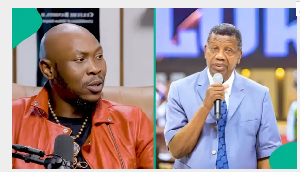
Seun Kuti claims family lost cancer patient and $250K trusting Pastor Adeboye’s healing

0

Seun Kuti recounts how a wealthy family allegedly spent $250,000 hoping for divine healing Seun Kuti recounts how a wealthy family allegedly spent $250,000 hoping for divine healing

Afrobeat singer Seun Kuti has shared a painful story about a wealthy Nigerian family who allegedly lost their loved one and $250,000 after trusting Pastor Enoch Adeboye’s prayers to heal a terminal cancer patient.

In a viral video, the musician recounted how the family turned to the popular man of God when doctors abroad told the woman her condition was beyond medical help.

According to Seun, the woman was moved to the Redeemed Christian Church of God (RCCG) camp, where prayers and spiritual interventions were carried out with strong assurances that she would survive the terminal cancer.

The singer explained that the family secured accommodation at the camp, commonly called Redemption Camp, where Pastor Adeboye personally prayed for the woman. Despite the spiritual efforts, Seun claimed the woman eventually died at the camp, leaving her devastated family in shock.

He alleged that the family spent about $250,000 throughout the process, holding onto the hope of divine healing. He criticised the reliance on faith healing, describing it as false hope that left the family unprepared for reality.

“This woman no wan die… Adeboye dey pray for the woman. He said she will be okay. She will not die,” Seun said in the video.

The singer went further to allege that after the woman’s death, Pastor Adeboye came out to his balcony and told the grieving family to stop crying. According to Seun, the clergyman promised to go inside and pray for the woman’s resurrection.

He claimed the pastor instructed the family to kneel beside the body outside for one hour while he prayed indoors.

“He said, make dem kneel down with the woman outside. Him dey go inside go pray for one hour. If the woman doesn’t wake up, na im be say na God”. Seun recounted. The musician expressed frustration at what he described as childish belief in miracles, questioning the sincerity of such spiritual practices.

US offers undocumented migrants $3,000 to voluntarily return home

0

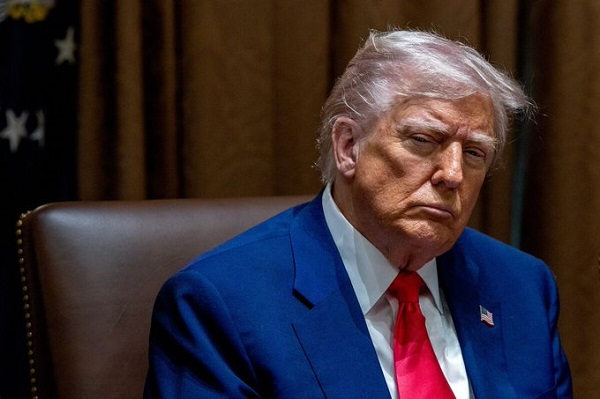
US President Donald Trump US President Donald Trump

The United States Department of Homeland Security has announced a limited-time incentive aimed at encouraging undocumented migrants to voluntarily leave the country during the holiday season.

In a statement released on its website on Monday, DHS said undocumented migrants who register to self-deport through the CBP Home app by the end of the year will receive a $3,000 stipend, in addition to a free flight to their home country.

The department said participants in the programme would also qualify for the forgiveness of any civil fines or penalties related to failure to depart the United States.

According to DHS, since January 2025, about 1.9 million undocumented migrants have voluntarily left the country, with tens of thousands using the CBP Home programme.

Homeland Security Secretary Kristi Noem said the incentive had been temporarily increased during the Christmas season.

“Since January 2025, 1.9 million illegal aliens have voluntarily self-deported, and tens of thousands have used the CBP Home program.

“During the Christmas season, the US taxpayer is so generously tripling the incentive to leave voluntarily for those in this country illegally—offering a $3,000 exit bonus, but just until the end of the year,” Noem said.

“Illegal aliens should take advantage of this gift and self-deport because if they don’t, we will find them, we will arrest them, and they will never return,” she added.

Guided by a Donald Trump presidential proclamation, Homeland Security established “Project Homecoming” in May 2025.

“The American people are generously offering illegal aliens $1,000 and a free flight to self-deport now,” it announced. To pay for the flights and “exit bonuses,” the State Department repurposed $250 million intended to help resettle refugees.

The department described self-deportation through the CBP Home app as a fast and free process, requiring individuals to download the app and submit their information, after which DHS would arrange and cover the cost of travel.

DHS warned that undocumented migrants who fail to take advantage of the offer would face arrest and deportation, with permanent restrictions on re-entry into the United States.

Accra regional police urge vigilance ahead of the festive season

0

In the lead-up to the festive season, the Accra Regional Police Command has stepped up its security operations across the region, with increased patrols, additional personnel, enhanced intelligence gathering, and visibility operations.

Speaking during a press briefing on Tuesday, December 23, Superintendent Juliana Obeng, the Head of Public Affairs for the Accra Region, outlined the service’s proactive measures and called on the public to remain vigilant, particularly during the holiday season.

“As part of our Christmas and end-of-year security operations, the Accra Regional Police Command has intensified patrols, deployed additional personnel, enhanced intelligence gathering, and mounted visibility operations across the region to prevent crime and ensure public safety,” Superintendent Obeng said.

The police are urging members of the public, especially those attending conferences and large gatherings, to be mindful of their surroundings and safeguard their personal belongings.

“We also take this opportunity to advise members of the general public to remain vigilant, especially at conferences and at large gatherings, to keep their personal belongings and valuables under close watch at all times, even where the police are visible,” she added.

Superintendent Obeng also emphasised the importance of reporting suspicious activities swiftly, whether at public events or elsewhere. She encouraged citizens to use the police’s emergency lines for quick responses.

“Suspicious activities should be promptly reported to the nearest police station for immediate action or through our emergency lines 18, 555, and 191,” she stated.

The Accra Regional Police Command reassured the public of its unwavering commitment to protecting lives and property, especially during the festive period, and urged everyone to stay informed through official police communications.

“The Accra Regional Police Command remains committed to protecting lives and property and urges the general public to rely on official communication for accurate information during this time and beyond,” Superintendent Obeng concluded.

With these measures in place, the police aim to create a safer environment for all residents and visitors in Accra, ensuring a peaceful end to the year and a joyful start to the New Year.

DISCLAIMER: The Views, Comments, Opinions, Contributions and Statements made by Readers and Contributors on this platform do not necessarily represent the views or policy of Multimedia Group Limited.

DISCLAIMER: The Views, Comments, Opinions, Contributions and Statements made by Readers and Contributors on this platform do not necessarily represent the views or policy of Multimedia Group Limited.

‘Unreasonable behavior’ has no expression in the NPP – Kozie

0


Special Aide to former Vice President Dr. Mahamudu Bawumia, Akosua Asaa Manu, popularly known as Kozie, has emphasized the need for discipline and unity within the New Patriotic Party (NPP) as the party prepares to elect its flagbearer next month.

Speaking on Movement Radio on Monday, December 22, 2025, Kozie addressed growing public discourse around internal party conduct, campaign tensions, and recent controversies involving party actors.

According to her, the NPP remains a values-driven political organisation. She said the party’s traditions are anchored in respect, the rule of law, and responsible political engagement.

“The NPP is a party with a strong tradition and clear values. We have well-defined structures and disciplinary processes. Unreasonable behaviour, no matter who is involved, finds no expression here,” Kozie stated.

While acknowledging that internal competition can be intense, especially during party elections, she urged members to prioritise discipline and cohesion. She cautioned supporters and communicators of various factions against actions or statements that could fracture unity or damage the party’s public image.

“Our conduct reflects on the entire party. Reckless commentary, misinformation, and personal attacks do not serve our collective interests,” she noted.

Kozie stressed that unity is essential as the party prepares for the January 31 elections. She warned that internal divisions have historically weakened political parties. She therefore urged surrogates to be mindful and conduct their campaigns in ways that do not harm the party.

“Elections are won by united parties. Differences must be resolved with respect, discipline, and loyalty to the party’s cause,” she added.

Her comments come amid rising political tensions ahead of the NPP’s internal activities. Attention is increasingly focused on the conduct of aspirants, surrogates, and grassroots supporters as the January 31 flagbearer election approaches.

DISCLAIMER: The Views, Comments, Opinions, Contributions and Statements made by Readers and Contributors on this platform do not necessarily represent the views or policy of Multimedia Group Limited.

DISCLAIMER: The Views, Comments, Opinions, Contributions and Statements made by Readers and Contributors on this platform do not necessarily represent the views or policy of Multimedia Group Limited.

Security agencies embark on route march in Kumasi ahead of festivities

0

Security officers from multiple state agencies conducted a joint route march through the streets of Kumasi and other parts of the Ashanti Region on Tuesday, December 23, 2025, to reassure the public of their preparedness for the festive season.

The exercise involved personnel from the Ghana Armed Forces, Ghana Police Service, Ghana National Fire Service, and Ghana Immigration Service, with additional participation from the Ghana Prisons Service, National Ambulance Service, National Security, and the National Investigation Bureau.

The joint march aimed to showcase inter-agency collaboration, boost public confidence, and deter crime during the holiday period, when human and vehicular movements typically increase across the region.

Speaking after the exercise, Ashanti Regional Police Commander DCOP Arthur Osei Akoto called for strong cooperation among security agencies and stressed the need for discipline among officers. He reaffirmed their readiness to maintain public safety and pledged unity and commitment in service delivery.

“With the birth of Christ, let us forgive each other and turn over a new leaf. On your behalf, I assure the Regional Minister that from today onwards, we will display unity and a common sense of purpose, which will translate into effective and efficient service delivery to the good people of Ghana,” DCOP Osei Akoto said.

STC, Metro Mass to receive new buses in 2026 – Transport Minister

42-year-old car sprayer found dead in Winneba

0

file photo

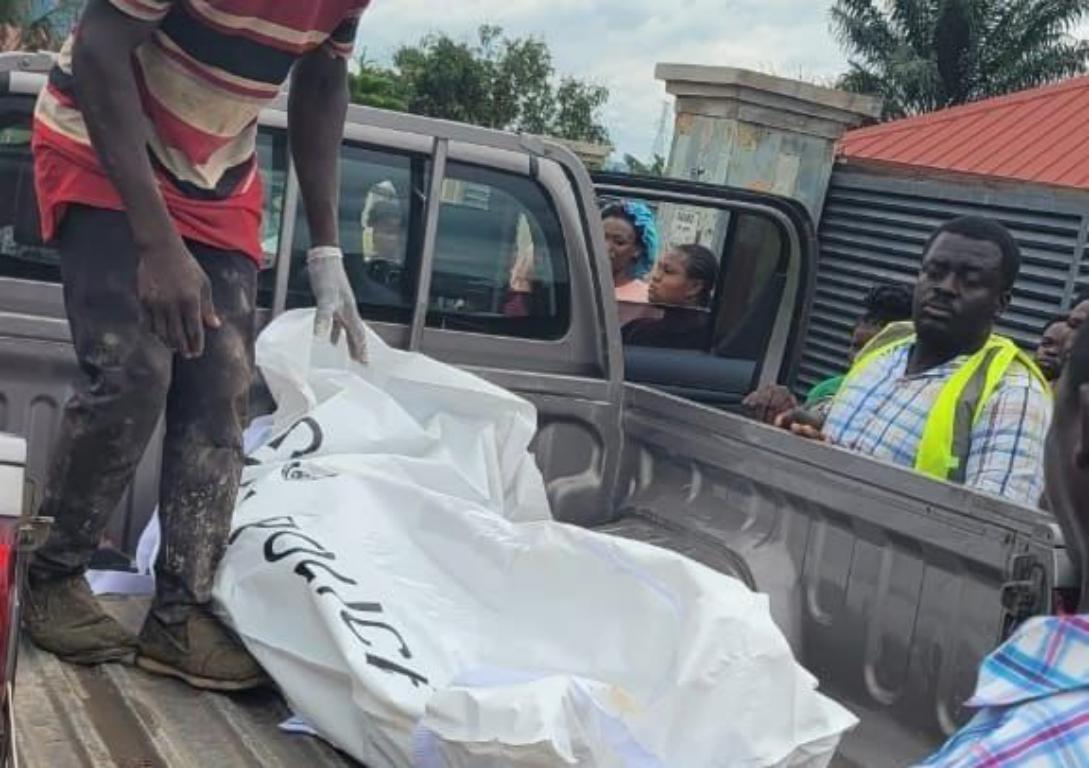
A 42-year-old car sprayer, Albert Sam, popularly known as Kwame Sam, has reportedly been killed, with his body abandoned in Winneba by alleged car dealers from whom he purchased a vehicle in Accra.

The deceased, a native of Gomoa Potsin in the Gomoa East District of the Central Region, was working in Cape Coast. Family members said he left Cape Coast on Friday to buy a car he had been tracking but never returned.

In an interview with Adom News, the deceased’s uncle, Charles Odoom, also known as Kofi 2, said Albert Sam had informed friends that he had received the car and was driving back to Cape Coast, but he never made it home.

Mr Odoom has appealed to the Central Regional and Winneba Divisional Police Command to urgently investigate the incident and apprehend the suspected car dealers.

The deceased, who was married with four children, had his body deposited at the Winneba Trauma and Specialist Hospital.

Meanwhile, Samuel Addo, a former classmate of the deceased, also called on the Inspector-General of Police to ensure justice is served.

Authorities have launched an investigation and are working to arrest those responsible for the killing.

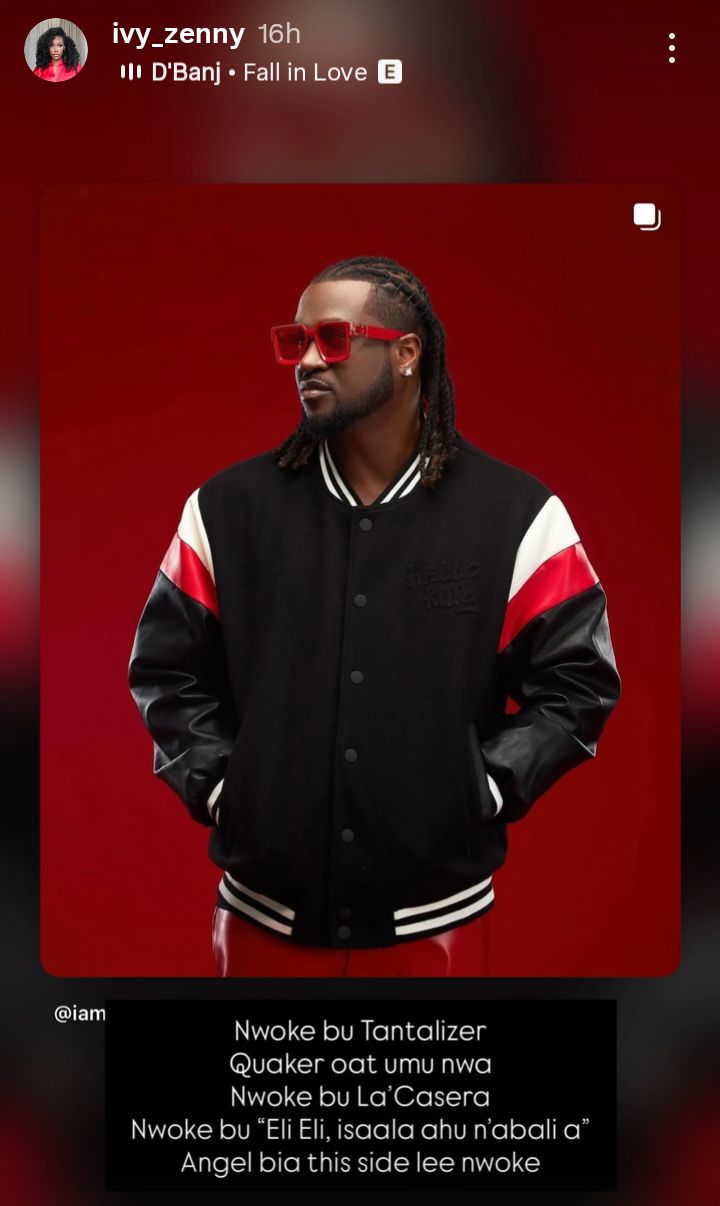
Singer Paul Okoye’s wife Ivy Ifeoma showers praises on him

0

Singer Paul Okoye

Ivy Ifeoma has hailed her husband, singer Paul Nonso Okoye, aka Rudeboy, showering him with elaborate titles. 

Sharing his photo in an Instagram story on Monday, she wrote: “Nwoke by Tantalizer. Quaker oat umu nwa. Nwoke bu la Casera. Nwoke bu Eli Eli, isaala ahu n’abali a. Angel bia this side lee nwoke,” she wrote. 

Rudeboy married Ifeoma in a traditional ceremony in May 2024 after his divorce from his first wife, Anita. 

The couple welcomed their first child a few months later.

Singer Paul Okoye

Watch the moment Semenyo lit up dancefloor at father’s 60th birthday bash

0

Semenyo and his family were dancing during the birthday celebration Semenyo and his family were dancing during the birthday celebration

What began as a classy all-white celebration in London quickly turned into a heartwarming family moment when Antoine Semenyo and his loved ones took over the dancefloor to mark his father’s 60th birthday.

In a scene that stole the spotlight, the Ghanaian international engaged in a lively dance exchange with his parents and younger brother, turning the elegant party into a joyful display of love, laughter, and rhythm.

Dressed in white like everyone else in attendance, Semenyo arrived late, drawing cheers as he loosened up with smooth moves that hinted at his off-pitch confidence.

Watch Mohamed Salah’s stoppage-time winner in Egypt’s AFCON opener

His mother matched him step for step, before the birthday celebrant himself, Larry Semenyo, joined in, much to the delight of guests.

At 60, he proved that age is just a number, holding his own in what quickly felt like a friendly family dance battle. Young Jai also joined the circle, fearlessly expressing himself and earning applause for his energy and flair.

Watch the video below:

@aleshathedesigner Fun times with the family the live band. #AntoineSemenyo #bournemouthfc #celebrity #jaisemenyo #footballer @Antoine Semenyo ♬ original sound – Alesha

FKA/MA

Watch highlights of the bout between Freezy Macbones and Jonathan Tetteh below:

Gunmen abduct 28 Muslim travellers in central Nigeria

0

28 people kidnapped in Nigeria 28 people kidnapped in Nigeria

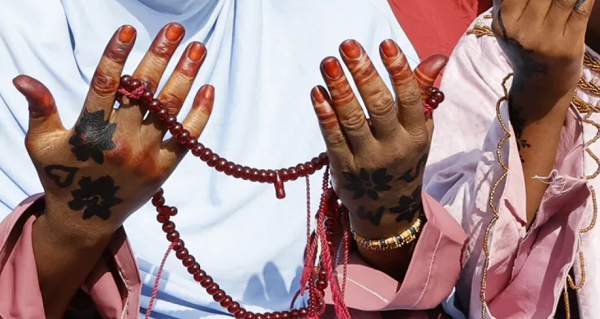
Armed men have kidnapped 28 people travelling to an annual Islamic event in Nigeria’s central Plateau state, local police told the BBC.

The victims, including women and children, were ambushed in their bus on Sunday night as it was driving between villages.

Police spokesperson Alabo Alfred said the authorities have “deployed assets” to the affected area to ensure that those abducted are rescued.

News of the abductions comes just a day after the Nigerian authorities announced the release of the remaining 130 schoolchildren and teachers from a separate mass kidnapping at a Catholic boarding school in Niger state last month.

A journalist based in Plateau state said the families of the latest victims had begun receiving ransom demands.

The police have not said anything about the identity of the possible perpetrators.

Kidnapping for ransom by criminal gangs, known locally as bandits, has become common across parts of northern and central Nigeria.

Although the handing over of cash in order to release those being held is illegal, it is thought that this is how many cases are resolved and seen as a way for these gangs to raise money.

The incident in Plateau state is unrelated to the long-running Islamist insurgency in the country’s north-east, where jihadist groups have been battling the state for more than a decade.

The insecurity in Nigeria received renewed international attention in November after US President Donald Trump threatened to send troops to “that now disgraced country, ‘guns-a-blazing'”. He alleged that Christians were being targeted.

Nigeria’s federal government has acknowledged the security problems but has denied that Christians are being singled out.

On Monday, Information Minister Mohammed Idris said that recent tensions with the US over insecurity and alleged persecution of Christians had been “largely resolved”, resulting in stronger relations with Washington.

He added that trained and equipped forest guards will be deployed to secure forests and other remote areas used as hideouts by criminal groups to supplement army operations.

Minerals Commission, Chamber of Mines call for responsible partnership as Ghana-China mining ties deepen

0

By James Amoh Junior, GNA

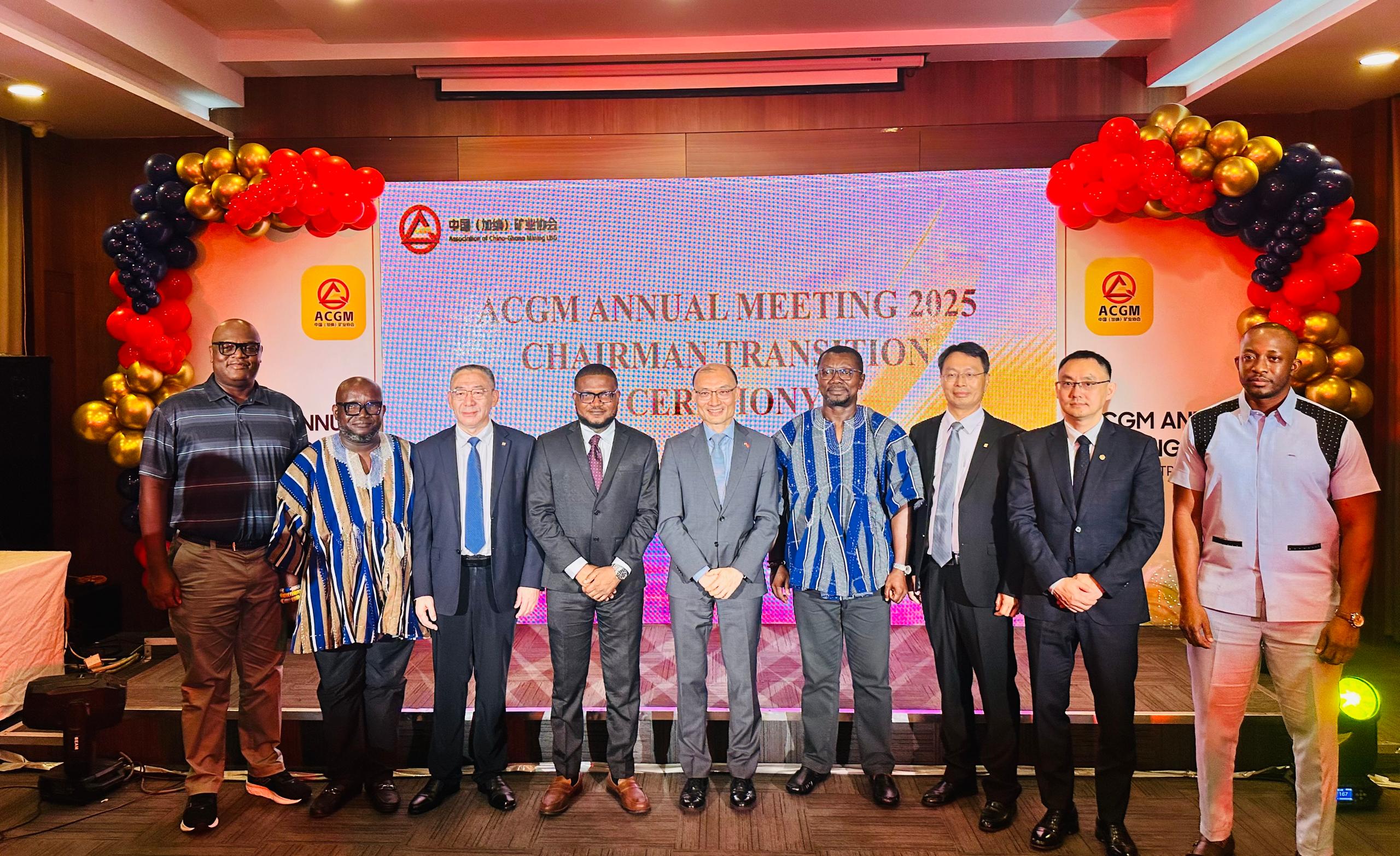
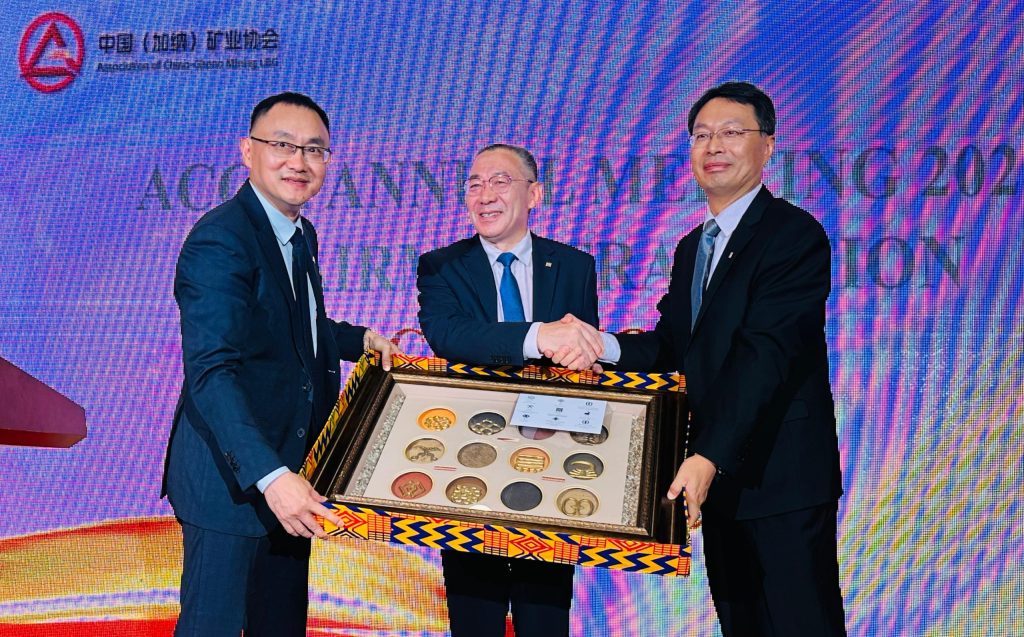
Accra, Dec. 23, GNA – The Minerals Commission and the Ghana Chamber of Mines have reaffirmed the need for responsible investment, genuine partnerships and stronger local value creation as Ghana and China continue to deepen cooperation in the mining sector.

The call was made at the 2025 Annual Conference and Chairman Rotation Ceremony of the Association of China-Ghana Mining (ACGM) in Accra, which brought together senior government officials, diplomats, regulators, mining executives to review progress in bilateral mining cooperation and outline priorities for the future.

Mr. Isaac Andrews Tandoh, the Chief Executive Officer of the Minerals Commission, said Ghana remained committed to attracting responsible foreign direct investment into the mining sector, but stressed that such investments must align with national development goals and regulatory standards.

Mr. Tandoh noted that Chinese mining companies and institutions had played an important role in Ghana’s mining sector through capital inflows, technology transfer, productivity improvements and skills development, contributing to broader economic activity across mining communities.

“Your investments create jobs, introduce new technologies and help build local capacity,” he said, adding that the long-standing relationship between Ghana and China in the mining sector had delivered tangible benefits to communities across the country.

However, Mr. Tandoh cautioned that future cooperation must be built on genuine partnerships, particularly in the area of local content and enterprise development.

He said the Commission would not tolerate “fronting” arrangements that undermined Ghana’s laws and deprived the country of the full benefits of its mineral resources.

“We want your investments to grow and succeed, but we also want Ghana to grow,” he said, urging mining companies to engage openly with regulators and pursue partnerships that bring technology, skills and long-term development into the country.

He added that sustainable and equitable mineral development required continuous improvements in environmental management, health and safety, transparency and social responsibility, while accelerating value addition and formalisation within the sector.

Dr. Kenneth Ashigbey, Chief Executive Officer of the Ghana Chamber of Mines, described the relations between the Chamber and the Association of China-Ghana Mining as constructive and cordial.

Dr. Ashigbey said Chinese enterprises continued to make meaningful contributions to Ghana’s economy, not only through mining operations but also across supporting value chains, including infrastructure support, employment creation and skills development.

“As representative bodies, we share a common interest in ensuring that Ghana remains a stable, competitive and attractive destination for responsible investment,” he said, stressing that this required continuous engagement, cooperation and balanced dialogue between industry players and state institutions.

He highlighted ongoing national discussions on fiscal reforms in the mining sector, including the review of mineral royalty frameworks, and called for inclusive dialogue that balances national revenue interests with the need to sustain investment and growth.

“We need to find a sweet spot that allows the country to benefit more from its mineral resources, while ensuring that mining companies are also able to grow and reinvest,” Dr. Ashigbey said.

He added that predictable and competitive fiscal regimes were essential to long-term sector resilience.

Dr. Ashigbey also encouraged closer collaboration between Ghanaian and Chinese business communities, regulators and diplomatic missions to support constructive policy engagement that served the sustainable development of both the industry and the national economy.

Mr. Tong Defa, who praised the progress made in China-Ghana mining cooperation, described the Association as an increasingly important bridge between the development strategies of the two countries.

He said Chinese mining investments in Ghana were evolving beyond commercial gain to support green transition, technological upgrading and community development.

Mr. Tang Zhenjiang, outgoing Chairman of the Association, reflected on achievements under his tenure, including the promotion of intelligent mining systems, green energy solutions, technical training programmes and community support initiatives.

He said the Association had sought to ensure that mining cooperation delivered shared value and aligned with Ghana’s development priorities.

Mr. Wang Jinquan, the incoming Chairman, pledged to build on that foundation, deepen engagement with Ghanaian authorities and industry stakeholders, and strengthen member services while promoting innovation, environmental sustainability and talent development.

Other mining stakeholders agreed that the future of Ghana-China mining cooperation would depend on stronger collaboration between regulators, industry associations and investors, underpinned by transparency, sustainability and mutual respect.

They said with clearer standards, effective regulation and shared commitment to responsible mining, the partnership had the potential to continue delivering inclusive and lasting benefits for Ghana’s economy, mining communities and the broader bilateral relationship.

GNA

Edited by Christian Akorlie

AG hints at plans to file civil suit against suspects

0

Dr Dominic Ayine is the Attorney General and Minister of Justice play videoDr Dominic Ayine is the Attorney General and Minister of Justice

Dr Dominic Akurutinga Ayine, the Attorney General (AG) and Minister of Justice has hinted at plans to file civil charges against those involved in the National Service Authority (NSA) looting scandal.

Speaking at the Government Accountability Series Press Conference at the Presidency in Accra on December 22, 2025, the AG said pursuant to discussions with the Auditor-General, the sums of money involved in the National Service scandal had been disallowed by the Auditor-General and had been surcharged on the public officers who superintended the looting of state resources at the NSA.

He said the notices of disallowance and surcharge had been duly issued and served on the said public officers.

“After 14 days, if they fail to show cause why the sums of money should not be disallowed and surcharged on them, the money becomes a debt due and owing to the state and I will proceed to take civil action to recover the sums involved,” he stated.

“Once judgment is obtained, it will be executed using the civil procedure mechanisms including the attachment of properties they own, whether or not these properties were part of the proceeds of crime.”

He reiterated that he intended to write formally to the Auditor-General for confirmation of the notices of disallowance and surcharge.

He said his Office continued to work with other institutions of state to bring charges in relation to the Operation Recover All Loots (ORAL) investigative reports submitted by the National Intelligence Bureau (NIB).

“Overall, the ORAL investigations are proceeding well, and we continue to beef up initial investigative reports in order to file charges that meet the standard of proof in criminal trials,” Dr Ayine said.

Shatta Wale pushes me to sing more in my songs

0

Ghanaian rapper, Sarkodie Ghanaian rapper, Sarkodie

Sarkodie has revealed the quiet influence nudging him beyond rap and into melody, crediting dancehall star Shatta Wale as a key voice encouraging him to sing more on his records.

He revealed this while admitting he remains cautious about fully embracing that side of his artistry.

In an interview with Kwame Dadzie and Doreen Avio on Hitz FM, the celebrated rapper disclosed that he has recorded several unreleased tracks built entirely on melody rather than rap.

He explained that Shatta Wale has consistently urged him to explore that sound without hesitation.

Though widely celebrated for his lyrical precision and dominance as a rapper, Sarkodie has occasionally blended singing and melodic flows into his music.

Still, fans are yet to experience a full project centered entirely on his singing voice. Such a move could mark a new chapter in his career, broadening his appeal and drawing in audiences who connect more with melody-driven music.

The recent ‘bromance’ between Sarkodie and Shatta Wale also reflects that they have put past differences behind them.

Watch Ofori Amponsah discuss interesting issues surrounding Lumba’s death, career path on this episode of Talkertainment:

Residents protest electricity and water tariff hikes

0

Residents of Kadjebi in the Oti Region have expressed dissatisfaction over the recently announced increases in electricity and water tariffs by the Public Utilities Regulatory Commission (PURC), warning that the adjustments could worsen economic hardship for households and small businesses.

The new tariffs, expected to take effect on January 1, 2026, were announced by PURC on Wednesday, December 3. Electricity tariffs will rise by 9.86%, while water tariffs will increase by 15.92%.

According to PURC, the increments are necessary to ensure the sustainability of utility providers, enable them to meet operational costs, and maintain or improve the quality of services nationwide.

However, residents who spoke to the Ghana News Agency expressed concerns over the timing and impact of the increases amid prevailing economic pressures.

John Kuyon, a cold-store operator in the Cocoa Market area, said the electricity hike would significantly affect his business, as electricity accounts for the largest portion of his operational costs.

“With this new increase, my cost of operation will rise sharply. I may be forced to raise prices on frozen products just to survive, but that could drive customers away,” he said, adding that recovering investments under current economic conditions was already difficult.

Janet Amenorgbe, a seamstress in Asito, also voiced concern, noting that the rising cost of powering sewing machines, pressing irons, and lighting had steadily strained her business over the years.

“This electricity increase will collapse my small shop if nothing is done. I am appealing to PURC to review the decision so that small businesses like mine can continue to operate,” she pleaded.

Other residents warned that the tariff hikes could reduce disposable incomes, drive up the prices of goods and services, and further stretch tight household budgets. Some expressed worry that rural and semi-urban communities like Kadjebi, where income levels are low and employment opportunities are limited, would be disproportionately affected.

Residents called on PURC and the government to consider the living conditions of ordinary citizens and introduce measures to cushion vulnerable households, including subsidies or the gradual implementation of the new tariffs.

While a few residents acknowledged the need for utility companies to remain operational and efficient, they insisted that any increases should be moderate and matched with visible improvements in service delivery.

Residents urged PURC to engage further with the public and reconsider the adjustments to protect livelihoods and ensure access to essential utilities remains affordable for all.

Source: GNA

Xmas operation: Police arrest 56 suspects in Western North Region

CURED Africa Donates School Uniforms,Trees To Kokrobite DA School

0


Vibrant Ghanaian Non Governmental Organization (NGO) Centre For Urban Rural Empowerment and Development (CURED)Africa has yet again extended a helping hand to the Kokrobite DA School

The CURED team had a total of 100 new uniforms made for the students of Kokrobite DA School in Accra, Ghana.

It was its end-of- the-year goal to supply new school uniforms to the students who were in the most need.

” We feel that our children must have a proper nutritional diet, adequate school supplies & learning material and uniforms,” said Phillip Belcher, founder of CURED Africa.

The UK Volunteers also donated several fruit – bearing trees for the students to plant and nuture aimed at serving as fruits for desert upon its maturity.

Principal of the school Madam Nancy Ekor expressed profuse thanks to the leadership of CURED for the gesture.

Also present for the donation were Brewster-Nathan, Ronald Nathan, Dr Stephanie Boddie Candace Skelton Glynis and Professor Helen Ollivierre Waters, Baylor University Waco, Texas.

Ghana Education Trust Fund (Amendment) Bill and it’s consequences for education financing

0

On Thursday, December 11, 2025, the Parliament of Ghana passed the Ghana Education Trust Fund (Amendment) Bill. This bill marks a major milestone in Ghana’s quest to expand equal access to education.

The amendment seeks to (i) ensure sustained financing for the Free Senior High School (Free SHS) programme, (ii) establish free tertiary education for persons with disabilities (PWDs), (iii) expand free education for learners with special educational needs, and (iv) permit the deductibility of the GETFund levy for tax purposes.

This review analyses the policy objectives, expected impacts, fiscal and administrative implications, and potential objections to the amendment. It concludes with recommendations to strengthen the effectiveness and sustainability of the reform.

Established in 2000, the Ghana Education Trust Fund (GETFund) was designed to provide additional funding for education, considering educational infrastructure, teaching and learning materials, scholarships, and research grants. Over the years, GETFund has become a core financing mechanism, especially for secondary and tertiary education.

The passage of the amendment comes at a time when: • Free SHS continues to face funding gaps, delayed disbursements, and a huge infrastructure pressure. • The national disability agenda is calling for stronger inclusion in tertiary education. • Special education services in Ghana remain underfunded, with limited trained personnel and inadequate learning materials. • Businesses have requested clarity on the deductibility of the GETFund levy, which has long created tax interpretation challenges.

The amendment, therefore, seeks to streamline the Fund and align it with emerging national priorities.

This amendment comes with some key pillars.

a. Financing for Free SHS

The amendment formally mandates GETFund to contribute to the funding of Free SHS. This policy is justified on the grounds that high school enrolment has increased significantly since 2017, straining the budget and depleting the achievement rate of the core policy objectives as a result of the pressure on facilities and the lack of other essential materials. And also, this policy will create a dedicated and protected financing line to ensure programme continuity.

b. Free Tertiary Education for Persons with Disabilities

GETFund will now support full financing of tertiary education for PWDs. This policy move responds to Ghana’s commitments under the Disability Act (2006) and UN Convention on the Rights of Persons with Disabilities, and also bridges the gap between the unequal access to education among minority groups, especially that of Persons with disabilities. Moreover, the policy will enhance the inclusion and economic participation of Persons with disabilities.

c. Free Education for Learners with Special Educational Needs

GETFund is empowered to support Special schools, Special needs teaching materials and Training of specialised educators. Only 1–2% of children with special needs receive adequate support, which deprives the greater percentage from participation. With that, the amendment solidifies the financing backbone for inclusive education in Ghana.

d. The amendment introduces tax relief on the GETFund Levy to reduce the overall tax burden on taxpayers. Businesses can now deduct the GETFund levy as an allowable tax expense. This will improve clarity and reduce business tax burdens, and equally ensure predictability in corporate taxation.

Potential Benefits of the Amendment

This amendment has the potential to strengthen and sustain education financing in Ghana. A clearly defined mandate for GETFund reduces dependency on irregular budget allocations and supports long-term planning.

Heighten Equity Education and Inclusiveness

The introduction of free tertiary education for PWDs and commitment to support the special needs of learners addresses long-standing educational disparities that hinder the access to education of most PWSs in Ghana.

And also, the policy is viable for improving the quality of education in Ghana. With more funds channelled to infrastructure, teaching materials, and specialised instruction, the amendment may improve effective learning and produce positive outcomes, particularly at the senior high school level.

Better Business Environment is another key feature of this amendment, on account that tax relief improves compliance, reduces litigation with GRA, and builds investor confidence.

e. Fiscal and Administrative Implications

Fiscal Burden

Increasing the financing mandate raises pressure on the Fund. Free SHS alone consumes a significant budget share; adding special needs and tertiary support could overstretch GETFund if revenue inflows do not also increase significantly.

Potential Crowding Out

The original functions of GETFund, such as infrastructure development and tertiary scholarships, could face reduced funding if Free SHS absorbs a large share of its funding.

Administrative Capacity

Managing new programmes, especially for PWD tertiary financing and special needs education, will require new operational frameworks, new disbursement criteria, monitoring and evaluation mechanisms, coordination with the Ministry of Education, GES, and disability institutions.

Tax Revenue Implications

Allowing tax relief may somewhat lessen short-term tax revenues, even though improved compliance could offset this loss.

Risks and Challenges associated with the amendment.

Inasmuch as the amendment has a lot of positive potential, it also comes with some risks and challenges.

Revenue unpredictability due to reliance on VAT-based collections could be a major challenge to the amendment, and also leakages and inefficiencies if monitoring systems remain weak

Additionally, possible politicisation of GETFund allocations, especially during election cycles and pressure from competing priorities, potentially reduces funding for tertiary infrastructure.

Inadequate data systems to identify PWDs and special needs learners accurately, and implementation delays if administrative capacity is not strengthened.

Policy Recommendations

For this policy to realise its full potential, strengthening transparency and reporting is a factor to consider.

Publishing annual GETFund allocation reports and creating an online dashboard for real-time disbursement tracking will boost the potential of the policy.

Restricts Funds for Special Education and PWD Tertiary Support Establishing a protected budget ceiling to prevent Free SHS from consuming all available funds.

It is pertinent to expand domestic revenue mobilisation; improve the account of VAT compliance mechanisms, and also explore earmarked education bonds for capital-intensive projects.

The amendment will build institutional capacity by training administrative officers on disability financing frameworks and partner with special schools and NGOs for programme implementation.

Strengthen Monitoring, Evaluation and Learning by conducting annual impact assessments alongside improving data collection systems across all education levels.

It is also recommended that there should be stakeholder engagement, which involves teacher unions, CSOs, disability groups, and local governments, to promote surveillance, oversight, and feedback concurrently.

In essence, the Ghana Education Trust Fund (Amendment) Bill represents an advanced policy shift toward equitable, inclusive, and sustainable education financing. By supporting Free SHS, expanding access for persons with disabilities, and strengthening special needs education, the bill amendment aligns with Sustainable Development Goals 4 and 10, which talk about quality education and reducing inequality, respectively.

The amendment further has the potential to substantially improve Ghana’s human capital development. However, its success will emphasise strong reliance on effective implementation, robust fiscal management, and transparent governance. Ensuring these safeguards will be essential to maximising the amendment’s long-term impact on Ghana’s education system.

Kennis FM presenter Ife Ajagbe dies at 38

0

Kennis FM presenter Ifeoluwa Ajagbe has died at the age of 38.

Mrs Ajagbe died on Sunday, December 21.

Radiocast NG announced her death on Monday in a statement titled, “R.I.P IFEOLUWA ‘IFE’ AJAGBE. REST WELL IFE. YOU WILL NEVER BE FORGOTTEN.”

Catherine Afeku appointed WTFI brand ambassador for Africa

0

Catherine Afeku (L) with Abla Dzifa Gomashie, the Minister of Tourism Catherine Afeku (L) with Abla Dzifa Gomashie, the Minister of Tourism

The World Tourism Forum Institute (WTFI) has unveiled former Minister of Tourism, Arts and Culture, Catherine Abelema Afeku, as its Brand Ambassador for Africa in Accra on Monday, December 22, 2025.

The appointment highlights her expertise in the global hospitality industry and took effect on July 29, 2025.

In a letter appointing Afeku, the WTFI President, Bulut Bağcı, acknowledged her capacity to promote Africa as a tourism investment hub.

“We believe your proven experience as a former Minister of Tourism, Arts and Culture of the Republic of Ghana alongside your deep understanding for regional dynamics makes you uniquely suited for this position”, noted Bağc, adding “Our shared goal is to position the hospitality sector as a core pillar for economic transformation with a clear focus on boosting job creation, empowering local communities, and reinforcing the image of Africa as a competitive global destination”.

Afeku’s appointment has been endorsed by the government, signaling its commitment to collaborating with her to exploit the tourism potentials in Africa for economic transformation.

Abla Dzifa Gomashie, Minister of Tourism, Culture and Creative Arts, who graced the occasion described Afeku’s appointment as an honour for Africa.

She urged Afeku to use her new role to trumpet and champion Africa unit through tourism.

“Lift high the red, gold, green with a black star and do not forget the image of our country, Ghana”, she urged.

Director of Diasporan Affairs, Kofi Okyere Darko, known in the entertainment circles as KOD, urged Afeku to use her personality and image to impact positively on the African continent and “make us proud”.

Okatakyie Nana Anim, Saanahene of Akyem New Tafo, who chaired the occasion acknowledged the immense contributions of both Catherine Afeku and Dzifa Gomashie in the tourism sector, urging the two to collaborate effectively and work to impact positively on Ghana and the African continent.

AG to prosecute Kofi Akpaloo, wife over alleged COCOBOD contract fraud

Watch Mohamed Salah’s stoppage-time winner in Egypt’s AFCON opener

0

Egyptian national team captain, Mohamed Salah Egyptian national team captain, Mohamed Salah

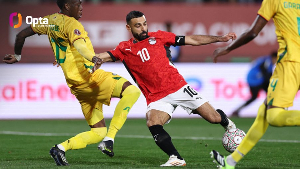
Drama unfolded at the Grande Stade d’Agadir as Zimbabwe grabbed the opening goal, immediately putting Egypt on the back foot.

The Pharaohs began the match on a high note, with Emam Ashour spurning an early promising chance, before following it up with another effort that was comfortably dealt with by Warriors goalkeeper Washington Arubi.

While Egypt appeared to be in control during the opening 15 minutes, Zimbabwe turned the tables as Prince Dube’s sublime first touch from an Emmanuel Jalai pass set him up perfectly, before he calmly finished to put the visitors in the lead. The hosts’ desperate response soon forced an early change, with Ashour making way for Mostafa Mohamed.

Despite Omar Marmoush’s tireless efforts, Egypt was unable to find a way back into the contest before the half-time interval.

The second half sprang to life when the Manchester City forward finally broke through, grabbing the equaliser for the Pharaohs.

The hosts then took control, relentlessly hunting for a second goal and keeping the Marumo Gallants shot-stopper busy between the sticks.

Their pressure eventually paid off as Mohamed Salah beat Teenage Hadebe in the 90th minute to seal the victory.

Energy Ministry assures of stable power as AKSA project nears completion

0

The Energy and Green Transition Ministry has assured residents of Kumasi and the wider Ashanti Region of a more stable power supply, as additional megawatts are expected to be added to the national generation mix upon the completion of an ongoing project by AKSA Energy at Awomaso.

The assurance follows recent power outages that plunged parts of the Ashanti Region into darkness, prompting concerns among residents and businesses.
In response, the Ministry has apologised to residents for the disruptions and attributed the outages to rising demand and ongoing system adjustments.

Deputy Minister for Energy and Green Transition, Richard Gyan Mensah, who visited the AKSA Energy site to inspect the progress of work, said measures are being put in place to ensure improved power stability, particularly during the festive period.
“As we speak now, we have adequate power to meet demand, even though demand is rising. We do not want to wait for demand to surpass supply, which is why we are consistently planning to add more reliable generation capacity,” he said.
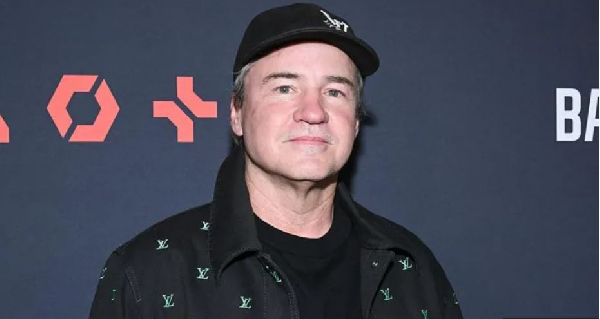
The Ministry said the completion of the AKSA Energy project is expected to significantly enhance power supply in the Ashanti Region and strengthen the overall resilience of the national grid.

‘Call of Duty’ co-creator killed in car crash

0

Vince Zampella is the co-created of the popular video game series Call of Duty Vince Zampella is the co-created of the popular video game series Call of Duty

Vince Zampella, who co-created the popular video game series Call of Duty, has died in a car crash in California, aged 55.

Zampella’s death was confirmed by Electronic Arts, which owns Respawn Entertainment, a game studio he co-founded.

The influential video game developer was travelling in a Ferrari with another person, when it crashed and caught fire on a highway in Los Angeles on Sunday.

“This is an unimaginable loss, and our hearts are with Vince’s family, his loved ones, and all those touched by his work,” a spokesperson for Electronic Arts told the BBC.

Officials said the person on the vehicle’s passenger seat was ejected while the driver remained trapped. It is unclear if Zampella was driving the car and who the other person inside was.

Both people inside the vehicle died.

“For unknown reasons, the vehicle veered off the roadway, struck a concrete barrier, and became fully engulfed,” the California Highway Patrol said in a statement to the BBC.

Zampella created Call of Duty with his long time collaborators Jason West and Grant Collier in 2003.

Partly inspired by events in World War II, the game has sold more than 500 million copies making owners Microsoft’s Activision one of the most profitable gaming companies. It has also spawned an upcoming live-action film.

The Call of Duty franchise was not his only success. He was also behind other widely popular games including the Medal of Honor, Titanfall and Apex Legends.

Journalist and Game Awards host Geoff Keighley, who wrote a book about the making of Titanfall, called Zampella a “dear friend” in a post on X and a “visionary executive” who “never wavered in his commitment to honesty and transparency”.

“While he created some of the most influential games of our time, I always felt he still had his greatest one ahead of him,” he said. “It’s heartbreaking that we’ll never get to play it.”

“He really cared about the player experience,” Keza MacDonald, the Guardian’s video games editor, told BBC Newshour.

“He cared about making games, he cared about how people felt when they played and that really came across whenever you spoke to him.”

In 2010, Zampella and West were fired from Activision, which publishes the Call of Duty games, and the pair were subsequently locked in a long dispute with the company which they settled out of court in 2012.

At Electronic Arts, Zampella worked on Battlefield 6, which is seen as a direct competitor to Call of Duty.

Infinity Ward, the American company that developed Call of Duty, said Zampella “will always have a special place in our history”.

“Your legacy of creating iconic, lasting entertainment is immeasurable,” the company said in a statement on X.

The Methodist Church of Ghana inducts new Bishop for Northern Accra

0

Rihana Adam, GNA

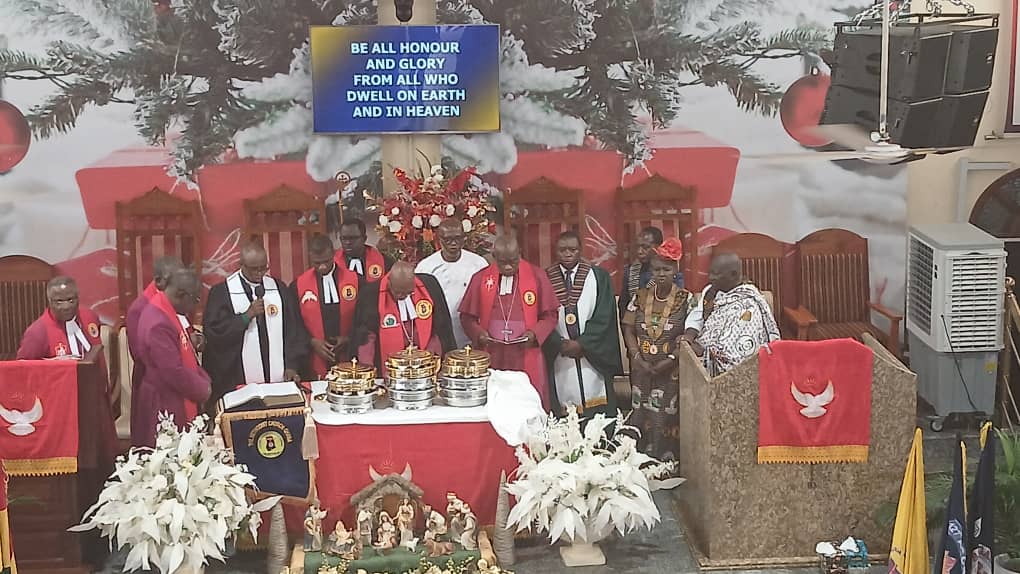
Accra, Dec. 23, GNA – The Right. Reverend Andrew Mbeah-Baiden, Bishop of the Northern Accra Diocese of the Methodist Church Ghana, has inducted the Very Rev. Solomon T. Nortey as Superintendent Minister of the Church, urging him to serve faithfully and beyond expectations.

The induction service, held under the auspices of the Methodist Church of Ghana and the Northern Accra Diocese, brought together clergy, church leaders and congregants to witness the commissioning of the new Superintendent Minister.

Delivering the sermon, the Rt. Rev. Mbeah-Baiden drew inspiration from Bible (Luke 6 and Acts 13:1–4), describing the induction as a divine commissioning carried out by the Lord Himself.

He said the call to ministry was rooted in obedience to God and service to humanity, expressing confidence that the Very Rev. Nortey would perform his duties with dedication and excellence.

He said, “the ministry is a sacred trust. When God calls and sets apart His servants, He also equips them to minister effectively to His people.”

He charged the new Superintendent Minister to remain accountable to God, lead with humility and compassion, and work tirelessly to advance the mission of the Church.

In his acceptance remarks, the Very Rev. Solomon T. Nortey pledged to subject himself fully to the will of God and to serve the Church diligently.

He promised to continue winning souls for Christ, promote unity and peace within the Church, and work in love with clergy and laity to strengthen the Methodist Church of Ghana.

“I take this responsibility fully as a duty to God. I remain grateful to my Church mothers, congregants, my wife and my children, and I thank them for the love and support they have shown me throughout this journey.

I also acknowledge all the fathers present and pray that God will richly bless you all.

My final appeal is for your support towards the ongoing construction of a chapel, and I humbly invite everyone to contribute to the successful completion of the project.”

The Rt. Rev. Mbeah-Baiden wished the Very Rev. Nortey well in his new role, praying that his ministry would reflect the saving love of Christ to humanity and bring glory to God.

GNA
23 Dec. 2025
Edited by Samuel Osei-Frempong

Martin Kpebu rejects proposal for five-year presidential term

0

Martin Kpebu is a legal practitioner Martin Kpebu is a legal practitioner

Private legal practitioner Martin Kpebu has strongly rejected a recommendation by the Constitutional Review Committee to extend the presidential term from four to five years.

According to him, extending the current four-year term to the proposed five-year term is unacceptable.

In a Facebook post on December 22, 2025, the lawyer and a member of the Operation Recover All Loot (ORAL) committee posted, “Extending the 4-year term to a 5-year term is a NOT NOT.”

According to the Constitutional Review Committee, the current tenure does not allow sufficient time for governments to effectively implement policies.

Presenting the report to President John Dramani Mahama at Jubilee House on Monday, December 22, 2025, Committee Chairman Professor Henry Kwasi Prempeh emphasised that the proposal is aimed at enhancing governance efficiency and deliberately excludes any provision for a third term.

“We couldn’t find a place for a third-term; there was no demand for it, and nobody seemed to support it including President Mahama,” he said.

The Committee also noted that a significant portion of a four-year presidential term in Ghana is often lost to administrative transitions and electioneering.

Professor Prempeh explained, “The President spends about six months settling into office and nearly a year campaigning.”

MAG/EB

Meanwhile watch highlights of Black Sherif’s performance at Zaama Disco 2025

Virtual Assets Bill 2025:  What Its Passage Means for Ghana’s Digital Economy

0

Ghana is on the brink of a decisive shift in how its digital economy is governed. With the passage of the Virtual Asset Service Providers Bill 2025, the country formally ends the era of regulatory ambiguity of cryptocurrencies, tokens, stablecoins, and other blockchain-based assets. The bill establishes a legal framework that brings virtual asset activity into Ghana’s financial regulatory system under the joint oversight of the Bank of Ghana (BoG), the Securities and Exchange Commission (SEC), and the Financial Intelligence Centre (FIC). 


A recent report by Bloomberg reveals that about 3 million Ghanaians, an equivalent of 17% of the adult population of Ghana, deal in digital currency. The Web3 Africa Group also estimates that crypto transactions from June 2023 to June 2024  amounted to roughly $3billion. The numbers show how profitable and highly engaged the crypto sector is despite systematic regulation from the Central Bank and other financial institutions.


The implications for the digital economy are significant. First, the bill signals that virtual assets are now recognised economic instruments, not fringe experiments. By requiring Virtual Asset Service Providers to register and obtain licences based on the activities they perform, Ghana positions itself as a jurisdiction that supports innovation while demanding accountability. This alone improves investor confidence, especially for fintech startups, remittance platforms, blockchain developers, and foreign partners who previously viewed the sector as legally uncertain and unsafe.


Second, the bill strengthens Ghana’s digital financial system integrity. Ghana deliberately rejected an outright ban on virtual assets, aligning instead with global best practice recommended by international bodies such as the Financial Action Task Force (FATF). The risk-based regulatory model means higher-risk activities, such as custody, payments, and trading, would now face stricter oversight, while lower-risk innovation is not smothered by unnecessary bureaucracy. This balance is crucial for a country where digital payments, informal remittances, and mobile-first finance already dominate daily life.


Third, the bill improves consumer protection and cybersecurity resilience. Mandatory compliance with anti-money laundering, counter terrorist financing, and proliferation financing rules reduces the likelihood of scams, fraud, and platform collapses that have historically harmed users in loosely regulated crypto markets. Coordinated supervision involving cybersecurity and data protection authorities further reduces systemic digital risk.


Most importantly, the bill anchors Ghana’s digital future within the global financial system. Enforcing standards such as the FATF Travel Rule. The rule requires financial institutions and Virtual Asset Service Providers (VASPs) to share sender/beneficiary information such as names, addresses, accounts and many more during virtual transactions. This ensures traceability of virtual asset transfers, making Ghana compatible with international payment rails rather than isolated from them. For a country positioning itself as a regional fintech hub, this interoperability matters.


In effect, the Virtual Assets Bill does not just regulate crypto. It formalises a new layer of Ghana’s digital economy, one where innovation is allowed to grow but not to run unchecked. The long-term outcome is a more credible, investable, and resilient digital financial ecosystem.

 – Elliot Nuertey


NPP having sleepless night with Mahama’s rising popularity – Suhuyini

0

Alhassan Suhuyini, the Deputy Minister for Roads and Highways and Member of Parliament for Tamale North, has said President John Dramani Mahama’s popularity is giving the New Patriotic Party (NPP) sleepless nights.

According to Mr Suhuyini, the New Patriotic Party (NPP) had hope to profit from on customary political dynamics, but Mahama’s support is undermining those expectations.

Stonebwoy promises growth, conscious music and fresh experience at BhimFest

0

Award-winning dancehall artiste Stonebwoy says his refusal to settle and his push for conscious music will shape this year’s BhimFest, scheduled for December 24.

Speaking in an exclusive interview with Becky on JoyNews, the musician said personal growth and consistency remain central to his career, stressing that success should never lead to complacency.

“It should be an aim to always reach higher. I still have thoughts of improving every time because there’s always room for improvement.”

“Even after an excellent period, you have to move on to another one. You can’t really be satisfied.”

“At every opportunity, I make sure I deliver so people can feel satisfied, and I can also feel like I’ve done my best.”

Turning attention to preparations for BhimFest, Stonebwoy promised fans a fresh and elevated experience when the festival returns this December.

“For the 24th of December, we go hard on production. We’re going back to the stadium again, and my team and I are definitely going to do something different.”

“This will be the first time I’m performing the Torture EP live in front of the people. That’s something new to anticipate.”

“There’s a need to bring back consciousness, music that speaks positivity and strengthens the soul, the mind and the heart. People are yearning for that now.”

Stonebwoy also revealed that this year’s BhimFest has been themed ‘Reggae Revival and Dancehall Energy,’ with surprise performances expected on the night.

BhimFest 2024 comes off on December 24, with fans anticipating a blend of high-energy performances, live debuts and conscious music.

DISCLAIMER: The Views, Comments, Opinions, Contributions and Statements made by Readers and Contributors on this platform do not necessarily represent the views or policy of Multimedia Group Limited.

DISCLAIMER: The Views, Comments, Opinions, Contributions and Statements made by Readers and Contributors on this platform do not necessarily represent the views or policy of Multimedia Group Limited.

Ghana Police Foil Robbery Attack At Ashaiman, Kill 3 Attackers In Shootout

0

The Tema Regional Police Command has foiled an attempted robbery at Community 24 in the Adjei-Kojo District of the Ashaiman Division, following a deadly shootout that left three suspected robbers dead.

Don’t miss out! Get your daily dose of sports news straight to your phone. Join YEN’s Sports News channel on WhatsApp now!

The incident occurred in the early hours of Sunday, December 21, 2025, after the Ashaiman Divisional Police Intelligence Team received information at about 1:30 a.m. about an ongoing robbery at a private residence in the area.

According to a statement issued by the police on Monday, December 23, a team was immediately dispatched to the location to intervene. Upon arrival, officers encountered six young men wearing face masks and hoodies and armed with machetes, guns, and other offensive weapons.

The police said the suspects opened fire on the officers, who returned fire in self-defence. During the exchange, three of the suspects sustained gunshot wounds and later died, while the remaining three, believed to have also been injured, managed to escape from the scene.

A search of the area led to the retrieval of several exhibits, including three face masks, three machetes, and an unregistered Royal 125 motorbike believed to have been used by the suspects.

The bodies of the deceased suspects have since been conveyed to the Police Hospital for preservation, identification, and autopsy.

Meanwhile, the police have placed hospitals and health facilities within the locality on alert and directed them to immediately notify the command through emergency lines if any male persons report with gunshot wounds.

The Tema Regional Police Command commended the officers involved in the operation for their swift response and professionalism and urged members of the public to continue providing timely information to support efforts to maintain peace and security in the region.

Is Ghana pricing women and children out of justice?

0

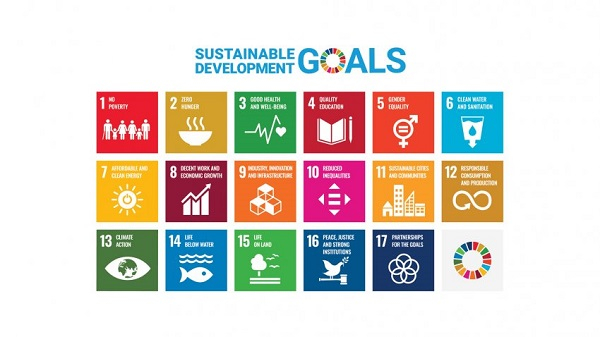
The SDG focuses on hunger, education, gender equality, climate action The SDG focuses on hunger, education, gender equality, climate action

With less than five years left to achieve the Sustainable Development Goals, Ghana must confront uncomfortable truths about systems that continue to exclude the most vulnerable. One such system lies at the intersection of healthcare and justice, where women and children who report, abuse are required to pay for medical evidence before their cases can proceed.

In Ghana, survivors of domestic and sexual abuse are routinely referred by the police to hospitals for medical examination and completion of police medical forms. These forms are critical to investigations and prosecutions.

Yet, according to widely cited Ghana Medical Association fee schedules, doctors charge between GH¢300 and GH¢800 to complete and sign police medical forms for rape, defilement, and other sexual offences. In some cases, particularly where a formal medical opinion is required for court, the cost can rise to GH¢1,000 or more. These fees are typically paid directly by victims and are not covered under the National Health Insurance Scheme.

For many women and families, these costs are simply unaffordable. The result is predictable and tragic. Survivors withdraw complaints, parents abandon cases involving abused children, and investigations collapse before they can begin. The message unintentionally sent is that justice in Ghana is not a right, but a service reserved for those who can pay.

This reality undermines Ghana’s commitment to the Sustainable Development Goals, particularly Goal 5 on gender equality, Goal 10 on reducing inequalities, and Goal 16 on peace, justice, and strong institutions. It also contradicts the spirit of Ghana’s 1992 Constitution and the Domestic Violence Act, which were designed to protect victims, not burden them with financial obstacles.

The issue is not about blaming medical professionals, who deserve fair compensation for their work. Rather, it is about state responsibility. When the justice system requires medical documentation, the state must ensure that the cost of obtaining that documentation does not fall on traumatised victims who cannot afford to pay. In a few districts, local authorities have absorbed these costs, proving that alternatives are possible when there is political will.

As Ghana counts down to 2030, the question is no longer whether this system is flawed, but how long it will be allowed to persist. Every abandoned case represents not only a failure of justice, but a breach of trust between the state and its citizens. If women and children cannot access justice because they cannot afford a doctor’s signature, then the promise of the SDGs remains unfulfilled.

Removing medical fees as a barrier to justice is not radical. It is necessary. It is achievable. And it is long overdue.

Why I spoke out on attacks against Christians in Nigeria

0

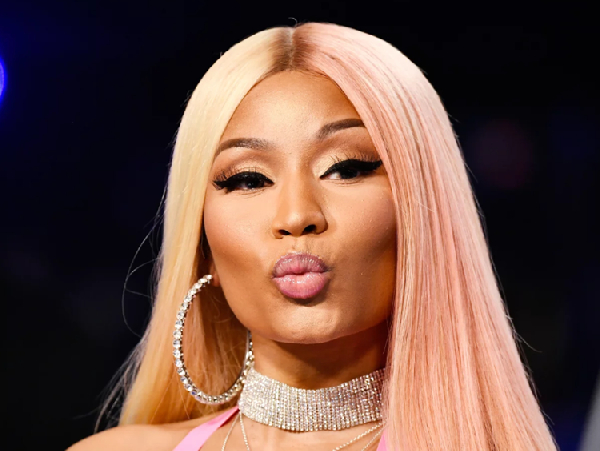
American rapper Nicki Minaj has explained her act of speaking about the plight of Christians in Nigeria, pointing to her connection to the country and disturbing reports of violence against worshippers.

Nicki Minaj addressed the issue during a surprise appearance at AmericaFest, where she took questions from the audience.

Responding to a question about Nigeria, she said the country means a great deal to her and that reports of attacks on Christians have been upsetting.

She disclosed that her pastor is Nigerian and that she enjoys strong support from fans in the country, widely referred to as “Nigerian barbs.”

Christians in Nigeria targeted, driven from their homes, says Nicki Minaj at UN

According to her, these ties made it impossible for her to stay silent. She added that reports of Christians being kidnapped and killed during church activities should alarm the global community.

“Nigeria is a place I’ve always loved. Someone very dear to me, my pastor, is Nigerian, and I have lots of Nigerian barbs. So hearing that people are being kidnapped while they’re in church, people are being killed, brutalised, all because of their religion that should spark outrage,” she said.

The rapper noted that remaining silent only fuels oppression, making it clear that she is no longer willing to keep quiet about issues of faith and persecution.

“We’re not backing down anymore. We are not going to be silenced by the bullies anymore. We will speak up for Christians wherever they are in this world,” she said.

The rapper also touched on the broader issue of religious freedom, pointing out that many people globally do not enjoy the basic right to worship openly.

“We take for granted that there, right now in this world, are people who cannot worship God as they please, where they please. Every time we pray in fellowship, we have to remember the people that are right now in this world hiding to pray in fellowship, and we have to pray for them,” she stated.

Her comments come weeks after she reacted to a social media post by United States President Donald Trump, who claimed that “Christianity is facing an existential threat in Nigeria.” At the time, Minaj expressed appreciation for the freedom to worship and condemned religious persecution.

“Reading this made me feel a deep sense of gratitude. We live in a country where we can freely worship God. No group should ever be persecuted for practising their religion,” she wrote.

At the AmericaFest event, Minaj also praised US President Trump and Vice President JD Vance, saying they understand the concerns of everyday people.

She added that Christians also face challenges in the United States, emphasising the importance of leadership in protecting religious freedom.

“Christians have been persecuted right here in our country in different ways. So when we talk about Nigeria and other countries, know that prior administrations saw nothing wrong with that, and that’s what was wrong with them,” she concluded.

Watch the video below:

AK/EB

L.I. 2462 exposed 89% of forest reserves to mining

0

L.I 2462 is the Environmental Protection (Mining in Forest Reserves) Regulation, 2022 L.I 2462 is the Environmental Protection (Mining in Forest Reserves) Regulation, 2022

Environmental Civil Society Organisations (CSOs) in a presser have revealed that the revoked Legislative Instrument (L.I) 2472 exposed up to 89 percent of the country’s forest reserves to mining.

L.I 2462 is the Environmental Protection (Mining in Forest Reserves) Regulation, 2022. It was a Ghanaian law passed on 23rd June, 2022, that permitted mining in forest reserves, if authorization is giving by the president.

After sparking up major environmental backlash, this regulation was officially revoked in December, 2025, banning mining in protected forest areas and nullifying all permits granted under it.

Before the introduction of L.I 2462, mining was allowed in only two percent of gazetted production forest areas — while the remaining 98 percent were legally protected from mining, according to them.

“Under L.I 2463, the protection of forest reserves was significantly weakened. Forest reserves, including Globally Significant Biodiversity Areas, were opened to large-scale mining activities,” they stressed.

The group also indicated that the regulation undermined sustainable forest management and contradicted the Forest Development Master Plan (2016–2036), which seeks to phase out mining in forest reserves by 2036.

It also weakened forest governance and conflicted with the country’s international environmental commitments, including the Paris Agreement and the Convention on Biological Diversity.

Data cited by the CSOs indicates that more than 50 out of the country’s 288 forest reserves came under intense pressure from mining activities when the regulation was in force.

Although there was an amendment in 2025, the risk remained high and 80 percent of forest reserves were still considered vulnerable to mining activities according to them.

CSOs including Coalition Against Galamsey- Ghana; ⁠Taylor Crabbe; ⁠A Rocha Ghana; ⁠Client Earth; Kasa Initiative Ghana;⁠ ⁠Civic Response; Eco-Conscious Citizens; Ghana Institute of Foresters; BRACE; Ghana Environmental Advocacy Group; Nature and Development Foundation; General Transport; Petroleum; Wacam; Chemical Workers’ Union of TUC (Ghana); ⁠OXFAM; Peasant Farmers Association; Christian Council of Ghana and SDG Civil Society Platform Ghana are pleased with the revocation, and described it as a major step toward restoring the integrity of Ghana’s forest reserves.

However, they have warned that threats to forests still persist and called on government to take further actions, including the review of Act 703 to explicitly ban mining in mining forest reserves.

Ghana introduces Sankofa Initiative to deepen diaspora engagement

0

James Gyakye Quayson, Deputy Minister of Foreign Affairs James Gyakye Quayson, Deputy Minister of Foreign Affairs

The 2025 Diaspora Summit in Accra officially introduced the Sankofa Initiative, a global programme aimed at deepening historical, cultural and development ties between Ghana and its diaspora, while reaffirming the diaspora’s status as the country’s 17th region.

Speaking at the summit, Deputy Minister of Foreign Affairs, James Gyakye Quayson, described the initiative as both a national policy and a deeply personal journey shaped by his own decades-long life in the diaspora.

Quayson, who lived and worked in Canada for 42 years before returning to Ghana to serve in public office, said the recognition of the diaspora as a formal region of Ghana reflects the enduring bond between the country and its citizens abroad.

“Like many in the diaspora, I carried Ghana in my heart even while living abroad. Setbacks do not cancel purpose, and restoration, when guided by intention, can uplift not only individuals but an entire nation,” he said.

He noted that his personal experience of legal and public scrutiny strengthened his belief in justice, resilience and inclusive governance, adding that people must always remain at the centre of public institutions.

The Sankofa Initiative draws inspiration from recent international efforts to confront historical injustices, including the renaming of Dundas Square in Toronto to Sankofa Square in August 2025, a move acknowledging the role of Henry Dundas in delaying the abolition of slavery in the British Empire.

Quayson described the renaming as “living proof that Sankofa is not merely a proverb, but a path,” explaining that it symbolizes returning to history to retrieve wisdom and restore dignity.

Under the initiative, Sankofa Monuments will be established across major diaspora hubs, including the United States, United Kingdom, Brazil, and the Caribbean, with the first monument scheduled for unveiling in Toronto in August 2026. The project aims to create a global network of remembrance, reconciliation and reconnection with Ghana.

Also addressing the summit on behalf of the Chief of Staff, Julius Debrah, Deputy Chief of Staff (Administration), Nana Oye Bampoe Addo, described the diaspora as a strategic national asset rather than a symbolic extension of the state.

She revealed that nearly three million Ghanaians currently live abroad and contributed an estimated US$6.65 billion in remittances in 2024, surpassing revenue from several traditional exports.

“The diaspora is more than remittances. It is skills, technology, innovation, influence, and belonging,” she stated.

She announced a series of policy reforms under the government’s Reset Agenda, including the institutionalisation of diaspora engagement, the introduction of key performance indicators for heads of diplomatic missions, and plans to link diplomatic performance to measurable diaspora engagement outcomes.

Other proposed measures include improved passport and consular services, diaspora investment vehicles, heritage tourism programmes, youth exchange initiatives, and structured skills transfer schemes to support sectors such as health, education and technology.

Presidential Adviser on Diaspora Affairs, Kofi Okyere Darko, expressed appreciation to participants and partners, commending President Mahama and Foreign Affairs Minister Samuel Okudzeto Ablakwa for their leadership and commitment to reparative justice.

He said the summit marked a decisive shift from rhetoric to action, aimed at building a more inclusive, connected, and development-driven relationship between Ghana and its global family.

The audacity to fight: Dr Bawumia and the power of quiet courage

0


Dr. Mahamudu Bawumia

When Ghana’s former national football team coach and former Sudan national team coach, Kwesi Appiah, decided to write a memoir, he chose a striking title: Leaders Don’t Have to Yell.
When one of America’s most influential presidents, John F. Kennedy, wrote Profiles in Courage, he focused not on physical bravery, but on a subtler form of courage often described as “grace under pressure”.

In recent times, debates around presidential character have intensified in the lead-up to the NPP primaries. Questions have been raised about temperament, resilience, and what it truly means to be a “fighter”. Courage, however, does not always express itself through loudness, aggression, or emotional outbursts. It may instead appear as calmness under pressure, perseverance in difficult circumstances, the willingness to take responsibility at critical moments, and consistency of character.

Within this context, Dr Mahamudu Bawumia’s record in the NPP reflects a particular form of courage. It has not been defined by theatrics or bravado, but by steadiness and resolve. His political career has involved sustained advocacy, participation in party strategy, and policy engagement, both in opposition and in government. His role has spanned different phases of the party’s development and governance, requiring adaptability rather than spectacle.

Dr Bawumia played a prominent role during the party’s years in opposition, during legal and institutional challenges, and later within government. He has been closely associated with policy initiatives centred on digitisation, economic inclusion, and public sector reform. These efforts have attracted both support and criticism, as is often the case with structural change.

Political history shows that some forms of leadership rely less on confrontation and more on endurance. During the 2012 election petition, when the NPP faced a defining legal and political moment, Dr Bawumia took on a central role in articulating the party’s case. At a time of heightened national tension, this required composure, preparation, and a willingness to operate within institutional constraints rather than public emotion.

It is therefore unsurprising that Dr Bawumia has become a focus of political contestation. Sustained engagement and visibility in political life often invite scrutiny, disagreement, and opposition.

Public commentary on leadership has long emphasised humility and restraint. Reverend Eastwood Anaba has observed that true power is often expressed through humility. Similarly, the familiar phrase “still waters run deep”, frequently cited by Joel Osteen, captures the idea that depth is not always accompanied by noise.

History provides numerous examples of leaders who understood this principle. Figures such as Abraham Lincoln and Franklin D. Roosevelt demonstrated that leadership often requires emotional control and measured decision-making. Ernest Hemingway’s definition of courage as “grace under pressure” remains relevant. Stuart Eizenstat, writing on the modern presidency, notes that the office embodies national mood and direction, making steadiness and judgement essential qualities for effective leadership.

Dr Bawumia’s digitisation agenda was initially met with scepticism in some quarters, though aspects of it have since become institutionalised. John Baldoni describes courage as the willingness to stand in service of a greater good, even when such positions are unpopular. Throughout his career, Dr Bawumia has maintained consistent positions on economic reform and governance modernisation, reflecting this interpretation of courage.

Contemporary scholarship has also moved away from traditional notions of courage rooted in confrontation. Writers such as Caroline Reichard argue for a definition that values prudence, deliberation, and the ability to compromise when necessary. From this perspective, courage lies not in constant conflict, but in judgement and restraint.

Viewed in this light, Dr Bawumia’s concession following the 2024 election has been widely noted as an important democratic gesture. Mary Anne Radmacher captures this form of courage succinctly: “Courage doesn’t always roar. Sometimes courage is the quiet voice at the end of the day saying, ‘I will try again tomorrow.’”

As the NPP reflects on its future, it faces the task of reassessing what courage means in a modern democratic context. C. W. Reichard’s observation remains instructive: “The deliberate life, not the belligerent, not the tempestuous and not the inflammatory life, has proven to be the heroic life.”

Prof. Etse Sikanku is an Associate Professor of Political Communication and Media Studies at the University of Media, Arts and Communication.

DISCLAIMER: The Views, Comments, Opinions, Contributions and Statements made by Readers and Contributors on this platform do not necessarily represent the views or policy of Multimedia Group Limited.

DISCLAIMER: The Views, Comments, Opinions, Contributions and Statements made by Readers and Contributors on this platform do not necessarily represent the views or policy of Multimedia Group Limited.

KATH calls for urgent completion of Heal Komfo Anokye project

0

Management of the Komfo Anokye Teaching Hospital (KATH) has reiterated that completing the Heal Komfo Anokye Project is essential to decongesting the facility and strengthening healthcare delivery.

The more than 50-year-old hospital serves as a major referral centre for patients from 12 of Ghana’s 16 regions and records over 1,300 outpatient visits daily, placing immense pressure on its wards, infrastructure and workforce.

As one of the country’s busiest tertiary health facilities, KATH continues to shoulder a heavy healthcare burden, a situation compounded by stalled hospital projects in the Ashanti Region and the absence of well-resourced peripheral hospitals to manage non-specialist cases.

Hospital management says the resulting congestion has pushed existing wards and healthcare personnel beyond their operational limits.

Chief Executive Officer of KATH, Dr. Paa Kwesi Baidoo, said despite rising demand for specialised services, successive governments have failed to adequately expand or upgrade the facility to meet current healthcare needs.

“The country has not done enough to expand and upgrade this facility. The support the hospital needs to meet its growing demand for specialised services has been largely inadequate,” he said.

Speaking at the launch of the hospital’s 70th anniversary celebrations on Tuesday, December 23, Dr. Baidoo renewed calls on government, corporate organisations and the general public to support the Heal Komfo Anokye Project.

He explained that the initiative seeks to rehabilitate ageing infrastructure, improve working conditions for staff and enhance the quality of care delivered to patients.

The Heal Komfo Anokye Project is an initiative spearheaded by the Asantehene, Otumfuo Osei Tutu II, to rehabilitate and modernise the ageing infrastructure of the Komfo Anokye Teaching Hospital (KATH) in Kumasi.

The project seeks to raise US$10 million to refurbish the hospital’s over 80-year-old buildings, which have deteriorated over time due to sustained pressure from heavy usage and years of limited maintenance.

Odunlade Adekola no longer invite me to his productions – Lalude

0

Veteran actor Fatai Adetayo, popularly known as Lalude, has said that Odunlade Adekola no longer invites him to act in his movie productions.

Lalude made the comment in an interview shared online, recalling that he featured in a movie that helped bring Adekola to public attention.

Ghana’s Economic Turnaround: Progress made, challenges ahead

0

As the festive season draws near and families across Ghana prepare to celebrate, it’s a good moment to pause, look back at our journey, and look ahead with hope.

Ghana’s economy has come a long way in 2025. After years of turbulence marked by fiscal stress, inflationary pressures, and debt vulnerabilities, the country has achieved significant stabilisation under the IMF-supported Extended Credit Facility (ECF) program. These gains are encouraging, but they must not lead to complacency. The next phase will determine whether Ghana can consolidate progress and build a resilient, inclusive economy.

2025: A year of stabilisation and recovery

This year has been a turning point. Economic growth rebounded strongly, with real GDP expanding by about 6% in the first three quarters of 2025, driven by services, agriculture, and robust gold exports. Inflation, which stood at 23.8% at end-2024, fell to single digits by November, restoring purchasing power and confidence in the cedi.

The fiscal position improved substantially, thanks to disciplined expenditure management and stronger non-oil revenues. A comprehensive audit of 2024 payables was completed in late 2025, leading to a lower fiscal deficit and public debt while enhancing fiscal transparency.

The comprehensive debt restructuring has advanced significantly. After the completion of domestic debt operations and a Eurobond exchange in the previous years, Ghana signed a Memorandum of Understanding with official creditors. These steps, combined with prudent fiscal policy, have eased financing pressures and improved debt sustainability prospects.

Social protection programs, including the Livelihood Empowerment Against Poverty (LEAP) and the Ghana School Feeding Programme, were maintained and expanded, ensuring vulnerable households were not left behind.

The Bank of Ghana has steadily built up foreign exchange (FX) reserves, strengthening the country’s ability to cushion external shocks and maintain confidence in the cedi. The introduction of a new FX Operations framework allows the Bank of Ghana to take actions in the currency market in a more transparent and predictable manner.

The framework is built on three main pillars: strengthening FX reserves to build resilience, smoothing excess volatility in the value of the cedi without fixing its rate, and channeling FX inflows such as those from gold exports into the market in a more transparent and market-neutral way.

The government has consistently taken bold steps to fix the energy sector’s finances. The multi-pronged strategy includes adjusting tariffs regularly, clearing legacy arrears with independent power producers, and making cash flows more transparent through the Cash Waterfall Mechanism.

Private sector investment is actively being encouraged, while strict spending controls aim to cut reliance on government support and stop new debts from piling up. These reforms are crucial to keep the lights on and make the sector sustainable for the future.

The recently published IMF Staff Report for the 5th review points out that while Ghana has made good progress in getting the economy back on track, there are still important challenges to tackle. The country needs to keep a close eye on its spending and make sure it doesn’t borrow excessively again, avoiding a return to past mistakes. Most importantly, the government must continue to fight corruption and manage public money wisely, building a trustworthy system that works for everyone.

There are also concerns around regional security. Instability in neighboring countries and cross-border threats can disrupt trade, raise borrowing costs, and strain public resources. At the same time, it is important to ensure that banks and other financial institutions remain strong. These risks make it even more important for Ghana to maintain strong institutions and safeguard economic progress. If these issues are not handled well, the progress made so far could be rolled back, disproportionately impacting the average Ghanaian.

The achievements in 2025 reflect strong policy commitment and broad stakeholder support. They also underscore the benefits of staying the course on reforms.

2026 Outlook: Opportunities and Risks

The outlook for 2026 is positive but not without risks. Growth is projected to remain robust, inflation within the Bank of Ghana’s target band, and external buffers strengthened by continued current account surpluses.

The 2026 budget marks a shift from economic stabilisation to resilience and more inclusive growth. The government targets a primary surplus of 1.5% of GDP, showing a commitment to responsible spending and debt management. Key priorities include creating jobs, investing in infrastructure, and supporting social programs. The new VAT Bill and improved digital systems at the Ghana Revenue Administration will help widen the tax base and raise revenues.

At the same time, spending will focus on projects that directly benefit Ghanaians such as roads, energy, and agriculture. The budget also promises to protect vulnerable groups and ensure that public money is used wisely, laying the foundation for a more resilient and inclusive economy.

This positive outlook could be challenged by global commodity price volatility, regional security concerns, and the unfinished process of debt restructuring, which could weigh on confidence. Domestically, the financial sector requires continued vigilance, and governance reforms must accelerate. The gains of 2025 can be reversed if fiscal discipline falters or structural reforms stall.

The Path Forward: Reform, Resilience and Trust

As Ghana prepares to complete the current IMF program in 2026, the real test begins. Program completion is not the finish line, but rather the starting point for a new chapter.

First, reforms must continue. Fiscal responsibility, sound public financial management, and anti-corruption measures are essential for credibility and investor confidence, while avoiding boom-bust spending cycles linked to elections is necessary for lasting stability. Tax administration modernisation, procurement reforms, and governance improvements in state-owned enterprises must remain priorities.

Second, rebuilding trust is critical. Citizens need assurance that public resources are managed transparently and equitably. Businesses need predictable policies. International partners need confidence in Ghana’s long-term commitment to sound economic management. Trust is the foundation for sustainable growth.

Third, resilience must be embedded. The shocks of recent years highlight the need for buffers, including fiscal and external. Diversifying the economy, investing in human capital, and strengthening social safety nets will help Ghana withstand future crises without derailing progress.

Ghana has consistently demonstrated that determined policy action can restore stability and growth. The challenge has always been to sustain these gains beyond IMF programs and translate them into lasting prosperity. With continued reform, renewed trust, and a focus on resilience, Ghana can move beyond stabilisation toward a future of inclusive and sustainable development. The IMF stands ready to support Ghana’s macroeconomic stability and development needs.

The writer is the IMF’s Resident Representative and Head of the Office in Ghana

Resetting Ghana agenda aims to rebuild confidence in economy

0

President John Dramani Mahama President John Dramani Mahama

As Christmas draws near, President John Dramani Mahama has outlined key economic priorities aimed at positioning Ghana for inclusive growth.

This was contained in a Christmas message posted on his Facebook page on Tuesday, December 23, 2025, his first Christmas address since returning to office as President.

In the post, President Mahama reaffirmed his administration’s Resetting Ghana agenda, expressing confidence and assuring renewed commitment to job creation, economic recovery, and accountability.

Oxygen City homes to be priced in cedis with single-digit interest rates – Mahama

According to the President, the Resetting Ghana Agenda is designed to reposition the country through prudent management, enhanced productivity, and policies that create opportunities for citizens, particularly the youth.

He said the government is focused on reviving the economy, completing stalled development projects, and expanding infrastructure to ensure that growth benefits all segments of society.

“It’s my first Christmas with you as your comeback President, and I am filled with gratitude for the trust you have placed in my government. We are committed to the #ResettingGhana Agenda to position Ghana on a path of inclusive growth, job creation, accountability, and prosperity,” he said.
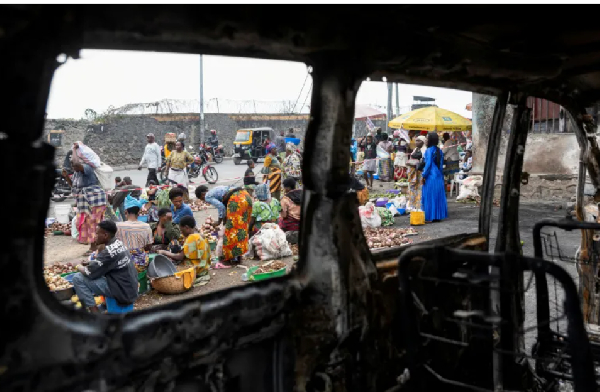
He added, “As we work together tirelessly to revive our economy, complete stalled projects, expand our infrastructure, and build a Ghana that works for every citizen, let us draw inspiration from the hope that Christmas brings.”

Read the president’s Facebook post below:

SP/EB

All you need to know about Ghana’s new vehicle number plates |BizTech:

Sudan facing escalating violence, worsening humanitarian crisis, UN Security Council hears

0

Sudanese families displaced from El-Fasher reach out as aid workers distribute food supplies Sudanese families displaced from El-Fasher reach out as aid workers distribute food supplies

The United Nations Security Council received a briefing on Monday about the escalating violence and worsening humanitarian situation in Sudan.

Representatives from a range of UN agencies warned the Security Council of growing risks to civilians and humanitarian workers as the paramilitary Rapid Support Forces and Sudanese army battle for control of the country.

“Since the Secretariat’s last briefing on Sudan in October, the conflict has again intensified, confirming fears that the dry season will bring increased fighting and renewed attacks on civilians,” Mohamed Khaled Khiari, UN Assistant Secretary-General for the Middle East, Asia and the Pacific, told the Council.

“Each passing day brings staggering levels of violence and destruction. Civilians are enduring immense, unimaginable suffering with no end in sight. In recent weeks, the conflict has centered in the Kordofan region, where the Rapid Support Forces have made significant territorial gains. On 1 December, the Rapid Support forces captured by Babanusa in West Kordofan, followed on 8 December by their capture of Heglig in South Kordofan – an oil field and critical processing station for South Sudanese crude oil pumping to Port Sudan for exportation. Kadugli and Dilling, both in South Kordofan, are now under tightening siege conditions.”

Food insecurity

Vital services including health centers have also come under attack, even as the population faces increased levels of disease and hunger.

“If we talk about malnutrition, Sudan is one of the world’s largest food crisis,” Shible Sahbani, a representative of the World Health Organization in Sudan, said.

“And it’s a shame to say this about Sudan, because it used to be considered the food basket of the whole region. So now, as we speak, I can tell you that over 21 million people are facing high levels of acute malnutrition and food insecurity. Forty-five per cent of the population is in IPC three and plus IPC three, four, and five, which is basically famine. Sudan is also among the top four countries globally with the highest prevalence of global acute malnutrition, affecting 13.6 per cent of the population.”

The World Food Program says it will need to address the situation, which will get worse within months, as food stocks run out and fighting continues. The agency is calling for more than $660 million to help reach those most in need.

50 large-scale mining companies face license revocation

0

The Ministry of Lands and Natural Resources has disclosed that the licences of about 50 large-scale mining companies could be revoked in the coming days, as part of an ongoing licence review exercise.

The announcement was made at a press briefing on Tuesday, December 23, 2025, by the Ministry’s Director of Public Relations, Mawusi Ama Mawuenyefia.

According to her, the Ministry has been undertaking a comprehensive review of mining licences across both small- and large-scale operations to address regulatory breaches.

“We had also indicated that we were reviewing the small-scale licences regime. We started that exercise, and about 906 initially faced possible revocation. After a fair review to correct any irregularities, 258 small-scale licences were eventually revoked,” she explained.

Madam Ama Mawuenyefia said the exercise has now been extended to large-scale mining companies.

“Today, we have 50 large-scale mining licences that face possible revocation,” she stated.

She stressed that affected companies would be given a one-month window to regularise their operations.

“If you find your company’s name on that list, you have a one-month period to correct or rectify the anomalies, if you have a legitimate reason why your licence should not be revoked,” she said.

The Ministry noted that the move forms part of government efforts to strengthen regulatory compliance in the mining sector and ensure that all operations adhere strictly to established standards.

Mahama dismisses rumours linking him to Chain Homes ownership

Unguarded guards: – the ordeal of Ghana’s forest guards

0

When 26-year-old Sulemana Fuseini Ziama set out for the Offin Shelter Forest Reserve on that fateful day with 23 other members of the Forest Commission’s Rapid Response Team (RRT) to clamp down on illegal mining activities, he was in high spirit because it was a national duty worth embarking on.

The native of Nadowli-Kaleo in the Upper West Region knew that he had the arduous responsibility to protect the country’s forest reserves from destruction in the hands of illegal miners and other environmental criminals. Little did he know that he would become prey to the predatory illegal miners.

Having been recruited as a Forest Commission staff at the Bole Bamboi District in December, 2022, Mr Ziama was given special training to serve in the RRT, a special unit of the Commission responsible for routine surveillance and safeguarding forest reserves from illegal activities. He was subsequently deployed to the Nkawie Forest District in 2024 to guard forest reserves.

Narrating events of the day in an interview with the Daily Graphic on December 11, this year, Mr Ziamah said on March 22, this year, the RRT was deployed to Mmofra Mfa Adwene in the Nkawie District to monitor illegal human activities in the Offin Shelter Forest Reserve when he was attacked and nearly lynched by the illegal miners.

guarf
26-year-old Sulemana Fuseini Ziama battling for his life on the hospital bed after attacks by illegal miners.

“When we got to the forest reserve, we raelised that illegal mining was ongoing. As we tried to get to where the illegal miners were, we were ambushed by gunmen who blocked the road. When stopped, we realised that they were 10 in number; but all of a sudden, about 20 others emerged from the bushes. As we tried to make a tactical retreat, three of them attacked me and cut my knee with machetes,” he said.

Although Mr Ziama narrowly survived the deadly attack, he is still battling for his life nine months after undergoing critical medical attention, including two surgeries, at multiple health facilities.

“I was first sent to the Nkawie Hospital and later moved to the Komfo Anokhye Teaching Hospital (KATH) in Kumasi. I went through the first surgery on March 23, 2025 and the second surgery was done four days later,” he narrated.

Mr Ziama said although his condition had improved, he still felt unbearable pain in his leg, making it difficult for him to freely move around.

“I am still going through physiotherapy at the Holy Family Hospital; and my doctor said it will take me at least one more year to be able to walk well. Life is really terrible for me now because I can no longer do the things I did,” he added.

Aside from his physical condition, Mr Ziamah is battling with psychological trauma as events of that fateful day keep playing back in his mind.

Nightmares

Sharing his field experiences with the Daily Graphic, Mr Ziama said anytime members of the RRT set out for the field, there was no guarantee that they would return safe. He explained that illegal miners and loggers had sophisticated weapons and were trigger thirsty.

“They have informants so anytime we move out for field operations, they know all our movements because they have people in nearby communities who give them information. The illegal miners also hire the services of armed guards to protect them while they destroy the forest,” he said.

He added that sometimes, when the RRT arrested criminals in forest reserves and was transporting them to towns for action to be taken against them, vehicles breakdown, exposing the team to attacks.

Wider picture

Meanwhile, the Nkawie District Manager of the Forestry Commission, Abraham Essel, said the ordeal of Mr Ziama was just one of the numerous traumatising challenges forest guards go through in the line of duty.

“Our forest guards come under attacks and receive threats and abuse from thugs all the time. I have personally met such confrontations by thugs in forest reserves, and it gets so scary,” he said.

As of December 2025, the Forestry Commission’s data showed that at least 10 of its officers have lost their lives in direct confrontations with illegal miners over the past five years.

guard3
Mr Sulemana Fuseini Ziama being transported to the hospital after he was attacked by illegal miners.

One of the most widely reported incidents occurred in January 2022, when a Forestry Commission guard, Stephen Kumi, was shot and killed by suspected illegal miners in the Neung Forest Reserve in the Western North Region.

Another significant event took place in August 2021, where a forestry guard was severely injured after being attacked by illegal miners in the Atewa Forest Reserve.

In October 2023, a team of Forestry Commission officers and military personnel on an anti-galamsey operation in the Atewa Forest Reserve were ambushed by illegal miners and inflicted with machete injuries

Earlier that same year, a similar attack occurred in the Western Region, where Forestry Commission officers attempting to halt illegal logging were attacked by thugs wielding machetes and other weapons.

Mr Essel said it was worrying that while the Forestry Commission was trying its best to protect the forest reserves with limited resources, the miscreants perpetrating crimes were getting more complicated in their mode of operation.

“The emotional and psychological toll on the remaining officers and their families is also immense, often leading to low morale and a reluctance to engage in high-risk operations,” he added.

Resource the guards 

Mr Essel said there was the urgent need for the government to provide more resources and build the capacity of forest guards to be able to deal with the thuggery associated with galamsey. “At this point, we need body cameras to capture images that showcase the scale of these illegalities in our forest reserves for appropriate action to be taken,” he added.

Again, he said it was important for the government to consider setting up permanent military bases in hotspot areas to tighten the noose on the galamsey fight.

Mr Essel also stressed that there was the need for sustained education in local communities for the people to understand the destruction of forest reserves by illegal miners affects everyone, so there was the need for collective action to stem the tides.

“When they get this understanding and support us, no illegal miner can enter any forest reserve in this country and destroy it,” he said.

No insurance

Meanwhile, the Daily Graphic’s checks with the Forestry Commission revealed that there is currently no form of insurance package for members of the RRT and the forest guards who risk their lives to protect forest reserves.

The Chief Executive of the Commission, Dr Hugh Brown, explained that discussions were ongoing on the possibility of rolling out an insurance package for the forest guards.

guadrd4
Dr Hugh C.A Brown, the Chief Executive of the Forestry Commission.

“Our major challenge is the huge amount involved in rolling out the insurance package. We have about 2,100 forest and wildlife guards. Initially, we were looking at only the RRT but we also realised that we cannot do it for only members of the RRT and leave out the forest guards who are permanently protecting the reserves,” he said.   

The Executive Director of the Africa Centre for Security and Counterterrorism, Emmanuel Mawanye Kotin, said the recurring attacks on forest guards underscored a significant security failure stemming from an insufficient political commitment.

“When forest guards confront armed gangs with superior weaponry, it reflects an asymmetric conflict and a lack of effective state intervention,” he stressed. 

Event organisers must take responsibility for filth after music concerts

0

Rita Naa Odoley Sowah is the Deputy Minister for Local Government, Chieftaincy and Religious Affairs Rita Naa Odoley Sowah is the Deputy Minister for Local Government, Chieftaincy and Religious Affairs

Event organisers have been warned by the Deputy Minister for Local Government, Chieftaincy and Religious Affairs (MLGCRA), Rita Naa Odoley Sowah, over the poor sanitary conditions left in major public areas following social events.

She cautioned that event organisers would no longer be allowed to leave the cost of post-concert clean-up to Municipal and District Assemblies, emphasising that this practice must stop.

Rita Naa Odoley Sowah made the comments during an inspection tour conducted as part of the Ministry’s one-week nationwide sanitation and clean-up exercise, aimed at assessing progress and achievements across the assemblies.

The team reviewed activities carried out by the Korle Klottey Municipal Assembly (KoKMA), focusing on areas around the Accra Sports Stadium, Independence Square, and the Beach Road enclave.

GTBank delivers big as GTCO Music Concert 2025 thrills thousands in Accra

She expressed disappointment at the amount of waste observed near Independence Square and the Sports Stadium, pointing out that a concert held on December 19, 2025, which is the GTCO Music Concert, had left behind significant filth.

“One thing we have realised is that after organisers are done with their programmes, they take their money and leave the work for the assemblies to clean up. I believe this is coming to an end soon,” she said.

The Deputy Minister further announced that the Ministry would begin engaging key stakeholders, including the tourism sector, national security agencies, and other relevant bodies, to enforce strict post-concert clean-up measures.

“After every programme, organisers must clean up or liaise with the relevant municipal or district assembly to pay the cost of cleaning. Assemblies will no longer use their limited resources to clean messes created by private events,” she emphasised.

Watch the video below:

Meanwhile watch highlights of Black Sherif’s performance at Zaama Disco 2025

AK/EB

Constitution review proposals reflect broad consensus – Kwame Anyimadu-Antwi

0

Ranking Member of Parliament’s Constitutional and Legal Affairs Committee, Kwame Anyimadu-Antwi, says the proposals contained in the Constitutional Review Committee’s (CRC) report largely reflect inputs from Parliament and wider public consultations.

Speaking on the Asaase Breakfast Show on Tuesday (23 Dember), the Member of Parliament for Asante Akim Central commended the CRC for what he described as extensive and inclusive engagements across the country.

Chelsea make initial enquiry to sign Antoine Semenyo from Bournemouth – Ghana Latest Football News, Live Scores, Results

0

Premier League side Chelsea have made an initial enquiry about signing Ghana international Antoine Semenyo in January.

According to a report by The Athletic, Chelsea had planned to sign a new forward in the summer but have contacted Semenyo’s camp about the conditions of a deal, with a view to potentially accelerating their plans to January.

They are one of a number of clubs interested in the Bournemouth forward, whose contract with the club runs until 2030, and contains a £65million release clause in January.

Tottenham, Manchester United, Manchester City and Liverpool are all said to be interested in the 25-year-old.

Semenyo has enjoyed a strong 2025-26 campaign, providing eight goals and three assists in 16 Premier League appearances.

The former Bristol City forward was valued at £70m by Bournemouth in the summer, but the sale price for the winter is now formally set at £65m.

It must be activated by a specific date, which would give Bournemouth a couple of weeks to replace their best player, and is available to any team.

If Bournemouth manage to fend off admirers in the coming months, the mechanism will again be available once the subsequent transfer window opens, at an even lower figure.

Christmas values should inspire service and progress – Prof Opoku-Agyemang

0

Vice President Jane Naana Opoku-Agyemang has urged Ghanaians to draw inspiration from the values of Christmas—hope, peace, love, and compassion—as the nation continues its journey toward development under the “Resetting Ghana” Agenda.

In her festive message, the Vice President called on citizens and public officials alike to contribute to national progress while reflecting on shared responsibilities.

She highlighted the importance of extending kindness to the vulnerable and working together to build the Ghana that everyone aspires to see.

“May this sacred season remind us of the profound gifts of hope, peace, love, and compassion that the Saviour brought to humanity. In this spirit, let us reach out to the vulnerable, share with those in need, and extend kindness to one another,” she stated.

Prof Naana Opoku-Agyemang said the light of Christmas should inspire greater service, harmony, and progress, linking the festive season to the government’s ongoing efforts to reset and strengthen the nation’s socio-economic foundation.

Apanga: Recommendations by CRC extremely significant

‘This Is Daylight Robbery Dressed As Public Service’ – Baba Dee Fumes Over Corruption At Lagos Train System

0

Nigerian singer cum filmmaker, Dare Fasasi, better known as ‘Baba Dee’, has frowned at the deep-rooted corruption and mismanagement in Nigeria’s public systems, citing his recent experience with the Lagos train service.

Naija News reports that Dare, in a post on Instagram, said he had to abandon his car to use the train while in Lagos due to the severe traffic on the roads.

“Is a NOT NOT” – Martin Kpebu rejects CRC proposal to extend Ghana’s Presidential term to 5 years

0

Martin Kpebu, a private legal practitioner, has rejected the recommendation made by the Constitutional Review Committee (CRC) proposing a one-year extension of Ghana’s four-year presidential term.

In a Facebook post on Monday, December 22, 2025, Lawyer Kpebu opposed the proposal, arguing that the four-year term provides sufficient time for a president to implement policies.

CURED Africa Donates School Uniforms,Trees To Kokrobite DA School

0


Vibrant Ghanaian Non Governmental Organization (NGO) Centre For Urban Rural Empowerment and Development (CURED)Africa has yet again extended a helping hand to the Kokrobite DA School

The CURED team had a total of 100 new uniforms made for the students of Kokrobite DA School in Accra, Ghana.

It was its end-of- the-year goal to supply new school uniforms to the students who were in the most need.

” We feel that our children must have a proper nutritional diet, adequate school supplies & learning material and uniforms,” said Phillip Belcher, founder of CURED Africa.

The UK Volunteers also donated several fruit – bearing trees for the students to plant and nuture aimed at serving as fruits for desert upon its maturity.

Principal of the school Madam Nancy Ekor expressed profuse thanks to the leadership of CURED for the gesture.

Also present for the donation were Brewster-Nathan, Ronald Nathan, Dr Stephanie Boddie Candace Skelton Glynis and Professor Helen Ollivierre Waters, Baylor University Waco, Texas.

More tensions as M23 fights on in DRC despite deal

0

When Qatar helped secure a peace deal to end ongoing conflict between the M23 rebel group and Democratic Republic of the Congo’s (DRC) government last month, there was hope among many Congolese that a permanent ceasefire would soon emerge to end the fighting that has uprooted close to a million people in the country’s troubled east, and give war-racked communities some respite as the new year rolls in.

Since late 2021, the group, which the United States and the United Nations say is backed by Rwanda, has clashed with the Congolese army in heavy offensives that have killed at least 7,000 people this year alone. Several regional attempts at resolution have failed. Still, when M23 representatives and Congolese government officials met for negotiations in Doha and proceeded to sign a peace deal in November, exhausted Congolese dared to hope. This deal, some reckoned, could be different.

So when the rebels launched yet another offensive and temporarily seized the strategic city Uvira this month, hopes for lasting peace were painfully crushed, as some concluded that those at the helm of the talks were playing politics.

“It’s clear that they don’t have any will to end this conflict,” Congolese lawyer and political analyst Hubert Masomera told Al Jazeera from the M23-held eastern city of Goma, blaming both sides. “Despite the number of deaths and the extent of the destruction, there is still procrastination over the implementation of the peace agreements and compliance with the ceasefire. People here feel abandoned to their sad fate.”

Fears that the conflict will not only continue, but that it could soon take on a regional dimension, are deepening, too – a sensitive prospect in a DRC where two civil wars in the past were prompted by its neighbours.

Uvira, the newly captured city the rebels then withdrew from as a “trust-building measure” following US pressure last week, is a major transport and economic hub in the huge South Kivu province. It’s strategically located on the border with Rwanda and is just 30 kilometres from the Burundian capital, Bujumbura. The city was the last eastern stronghold of the Congolese army and its allies – local “Wazalendo” militias and about 3,000 Burundian soldiers. Early this year, M23 also seized control of South Kivu’s capital city, Bukavu, as well as Goma, the capital of North Kivu province.

Experts say M23’s advance on Uvira widens the group’s area of control significantly, puts it at the mouth of the mineral-rich Katanga region, and positions Rwandan proxies right at Burundi’s doorstep at a time when both governments are ramping up a war of words and accusing each other of backing rebels.

Rwanda, for its part, continues to distance itself from accusations that it backs M23.

DRC conflict’s complex history

The recent scenes in eastern DRC appear like an eerie playback of a tragic tale, conflict monitors say.

Similar peace negotiations in late 2024, led by the African Union and Angola, seemed ready to deliver peace ahead of a new year. But they collapsed after a highly anticipated meeting between the presidents of Rwanda and DRC was called off. Both sides accused each other of foiling the talks.

“There’s a sense of deja vu,” Nicodemus Minde, East Africa analyst at the Institute for Security Studies (ISS), said. “It’s symbolic because we were exactly here last year … the prospects for peace are dire.”

Conflict in the DRC has long been mired in a complex mix of ethnic grievances, poor governance and interference from its much smaller neighbours. It goes back to the 1994 genocide of Tutsis and moderate Hutus in Rwanda, which displaced millions into neighbouring eastern DRC, making them a minority there. Rwanda has since viewed the DRC as a hiding place for Hutu genocidaires, however, and its hot pursuit of them toppled a government in Kinshasa and led to the first and second Congo wars (1996-2003). The UN also accused the Rwandan and allied Ugandan forces of looting the DRC’s vast mineral wealth, including gold, coltan and tin, during the conflict.

Scores of militias emerged as governments armed and counter-armed civilians in the wars, many of which are still active in the DRC. The M23 itself is only the latest iteration of a Tutsi militia that fought in the Congo wars, and whose fighters integrated into the DRC army. In 2012, these fighters revolted, complaining of poor treatment by the Congolese forces. Now, the M23 claims to be fighting the marginalisation of ethnic Tutsis, some of whom say they are systematically denied citizenship, among other complaints. The M23 and its allied Congo River Alliance (AFC) have not stated goals of taking Kinshasa, even though members of the group have at times threatened to advance on the capital. Officially, the rebels claim to be “liberating” eastern DRC communities.

In 2012, M23 initially emerged with enough force to take the strategic city of Goma, but was forced back within a year by Congolese forces and a special UN intervention force of troops from South Africa, Tanzania and Malawi. When the M23 resurfaced in late 2021, though, it was with much more ferocity, boosted by about 4,000 Rwandan troops in addition to its own 6,000 fighters, according to the UN. Lightning and intensely bloody offensives have since seen it control vast swaths of territory, including the major cities of Goma, Bukavu – and now, Uvira.

On the map, M23 appears to be eking out a slice of Congolese territory wedged between the DRC and neighbouring Rwanda, Uganda and Burundi. If it gains control of the two Kivus in their entirety, it would lord over a resource-rich area five times Rwanda’s size with easy access to Kigali and Kampala.

“They are trying to create some sort of buffer zone which the neighbouring countries, particularly Rwanda but also Uganda, have an interest in controlling,” analyst Paul-Simon Handy, also of the ISS, told Al Jazeera.

Kigali officially denies backing M23, but justifies its actions based on accusations that the DRC supports a Hutu rebel group, the Democratic Forces for the Liberation of Rwanda (FDLR). The FDLR did exist for many years in the DRC, but it simply no longer poses a significant threat to Kigali, analyst Minde said.

Rwanda’s tensions with Burundi have similar historic correlations, as Hutus who perpetrated the 1994 genocide similarly fled there, and Kigali alleges the government continues to back rebels. In 2015, Burundi accused Rwanda of sponsoring an abortive coup in Bujumbura. Kigali denies this.

Does the US deal have a chance?

Several African countries have attempted to help solve the crisis, militarily and diplomatically, but all have failed. The regional bloc, the East African Community, of which the DRC is a part, deployed about 6,500 Kenyan-led peacekeepers to stabilise eastern DRC, as Kenyan diplomats developed a Nairobi Peace Process in 2022 that was meant to see several rebel groups agree to a truce. The agreement collapsed only a year later, however, after Congolese President Felix Tshisekedi grew frustrated over the force’s refusal to launch offensives against M23.

Then, the Southern African Development Community (SADC), of which the massive DRC is also a part, deployed troops from South Africa, Tanzania and Malawi in May 2023. There was hope that the trio, which proved crucial in driving back the first M23 insurrection, would again record success. They appeared no match for the new M23, though, and withdrew this June.

Meanwhile, the Angola-led Luanda Peace Process collapsed after President Joao Lourenco stepped back in March, citing frustration with both sides amid constant finger-pointing.

Qatar and the US stepped in to broker peace in June this year, using a unique two-pronged approach. The Doha peace talks, on the one hand, have focused on negotiations between the DRC and M23, while the Washington talks focus on the DRC and the Rwanda governments. Some experts warned that Washington’s motivation – aside from President Donald Trump’s fixation on being a global peacemaker figure – was a clause in the deal that guarantees US extraction of rare earth minerals from both countries. The agreement was unlikely to hold on that basis, rights groups said.

After a few no-shows and wobbles, the M23 finally agreed to the Doha framework on November 15. The agreement includes eight implementation protocols, including one on ceasefire monitoring and another on prisoner exchange. On December 4, President Trump sat next to a smiling Paul Kagame and Tshisekedi as all three signed the US-peace deal in Washington, which mandated both Rwanda and DRC to stop supporting armed groups. There were pockets of fighting as the signatures were penned, but all was supposed to be largely peaceful from then on.

What happened in Uvira barely a week after was the opposite. The Congolese government said at least 400 people were killed and 200,000 others displaced as M23 fighters pressed on the city. Thousands more were displaced into Burundi, which already homes some 200,000 Congolese refugees. Fleeing Uvira residents shared accounts of bombed villages, summary killings and widespread sexual violence by both sides, according to medical group Doctors Without Borders (MSF).

Is there hope for peace?

Even though M23 began withdrawing from Uvira on Thursday, analysts are still scrambling to understand what the group was hoping to achieve by taking the city, shattering the peace agreements and angering Washington.

US Secretary of State Marco Rubio directly scolded Rwanda after Uvira’s capture, saying Kigali had violated the deal. Last week, Deputy Secretary of State Christopher Landau met with DRC Foreign Minister Therese Kayikwamba Wagner in Washington and promised that the US “is prepared to take action to enforce adherence” from Rwanda.

What that action looks like is unclear, but what’s certain, Minde said, was that the agreement seemed to favour Kigali more than Kinshasa.

“If you look at the agreement, the consequences [of either party breaching] were not forthright, and this points to the weakness of the deal,” he said, adding that there is much more at stake for DRC if there is a breach, including escalating conflict and mass displacement within the country. But that was not taken into account, the analyst explained.

Uvira’s fall, albeit on hold, is not only a blow to Trump’s peacemaker reputation but also sharpens tensions between Burundi and Rwanda, with analysts saying it could lead to direct clashes.

Bujumbura accuses Kigali of supporting the antigovernment Red Tabara rebels – a charge Rwanda and the rebels deny – and tensions between the two governments have led to border closures since last year. Last week, M23 announced that it captured hundreds of Burundian soldiers during the Uvira offensive.

Fears of a regional spillover also prompted the UN Security Council to extend the mandate of the MONUSCO peacekeeping mission for a year, ahead of its December 20 expiration. The 11,000 troop force has been in place since 1999, but has a complicated relationship with the DRC government, which says it has not done enough to protect civilians. MONUSCO forces initially began withdrawing in 2024, but then paused that move in July amid the escalating M23 offensive. Ituri, the force’s headquarters, is held by M23, meaning the troops are unable to do much.

Amid the chaos, the finger pointing, and the political games, it’s the Congolese people who are feeling the most despair at the turn of events so close to the new year, analysts say. After more than three decades of war that has turned the green, undulating hills of eastern DRC into a perpetual battlefield, Masameko in Goma said it’s locals, more than anyone else, with the most at stake.

“People have suffered enough and need to breathe, to sleep with the certainty that they will wake up tomorrow,” he said. “[They need] to live in their homes without fear of a bomb falling on them. That is all the people in this part of the republic need.”


A view shows the remains of a vehicle hit by heavy and light weapons during the fighting in the town that led to the fall of Goma to M23 rebels, on February 5, 2025


US President Donald Trump hosts the signing ceremony of a peace deal with the president of Rwanda, Paul Kagame, left, and the president of the Democratic Republic of the Congo, Felix Tshisekedi, right, at the United States Institute of Peace in Washington, DC, on December 4, 2025

Pope accepts Bishop Mante’s resignation, names UCC lecturer to lead Jasikan Diocese

0

The Vatican has announced the resignation of the Bishop of Jasikan, Most Reverend Gabriel Akwasi Ababio Mante, and the appointment of Reverend Simon Kofi Appiah as his successor.

In a statement issued on Tuesday by the Holy See through Agenzia Fides, it said Pope Francis had accepted Bishop Mante’s resignation from the pastoral care of the Diocese of Jasikan.

At the same time, the Pope appointed Reverend Appiah, who until now was a lecturer at the Department of Religion and Human Values of the University of Cape Coast, as the new Bishop of Jasikan.

Reverend Appiah is a priest of the Diocese of Jasikan with extensive academic and pastoral experience. He was born on July 1, 1964, in Teteman and undertook his philosophical and theological formation at Saint Peter’s Regional Seminary in Pedu, Cape Coast. He was ordained a priest on July 21, 1990, for the then Diocese of Keta Ho and was later incardinated into the Diocese of Jasikan following its creation in 1994.

His early pastoral ministry included service as a parish vicar in the communities of Kpedze, Vakpo and Kadjebi between 1990 and 1995. He later pursued advanced studies in Europe, attending the Universität Tübingen in Germany from 1995 to 2001, where he obtained a doctorate in theological ethics. He also earned a postgraduate diploma in psychology from the University of London and a diploma in teaching higher education from the Catholic University of Eastern Africa in Nairobi, Kenya.

Upon returning to Ghana, Reverend Appiah served in several key diocesan roles, including formator at the Saint Patrick Formation House, diocesan chancellor and director of the diocesan Office for the Pastoral Care of Vocations. He also worked as a pastoral collaborator in the parish of Kadjebi for several years.

Since 2011, he has been a lecturer at the University of Cape Coast and at the major seminary in Pedu, contributing to the formation of future clergy and the academic study of religion and ethics in Ghana.

His appointment as Bishop of Jasikan places him at the helm of a diocese located in the Oti Region, where he is expected to build on his pastoral experience and academic background to lead the local Catholic community.

Cost Of Living Is Good Under Mahama -Prof. Smart Sarpong’s Survey Report

0

A survey conducted by Citizens’ Perception Survey (CPS) 2025 on Governance has revealed that 68.8 per cent of respondents believe the cost of living in their vicinity this year is moderate, compared to the year 2024.

The report, presented by Prof. Smart Sarpong, Founder and Leader of Feedback Africa Limited, also quoted three per cent of the interviewees as saying that their condition of living remains unchanged.