Ghanaian civil society organization files lawsuit against the government of President John Mahama saying the acceptance of United States deportees violates constitution while Liberia says it is considering accepting Kilmar Abrego Garcia who is fighting illegal removal
Political Review
United States President Donald Trump has been persistent in deploying Immigration and Customs Enforcement (ICE) agents and National Guard troops to various regions of the country to arrest, detain and deport migrants.
Most of these deportations are deliberately targeting people from the Caribbean-Latin America, Asia and Africa for harassment and removals.
All of these efforts are aimed at terrorizing people of color communities and reducing their numbers in the U.S. Trump’s mantra of “making America great again” is clearly based on a determination to enhance the demographic status of European Americans while furthering the level of institutional racism and national oppression.
To rapidly facilitate the “cleansing” of the U.S., the MAGA Republicans who control the White House, House of Representatives and the Senate are upholding the illegal efforts of the Trump administration. By denying the right to due process under constitutional law, the administration has set the stage for the violation of the basic civil and human rights of all people living in the U.S. irrespective of their immigration status.
Since the inauguration of Trump, almost daily there are new initiatives to create greater instability and insecurity among the population. In Los Angeles, where the National Guard under federal control was first deployed, Marines were also sent into the city for several weeks.
Militarization of the urban areas serves as a backdrop to the worsening crisis. Tariffs and mass layoffs of government employees are weakening the socioeconomic status of working and oppressed peoples in the U.S.
Ghanaian Human Rights Organization Files Lawsuit to Halt Secret Migrant Deportation Deal with the U.S.
During the month of September, the Republic of Ghana government of President John Mahama was exposed for collaborating with the Trump administration in its efforts to subvert U.S. and international law by denying due process and deporting migrants to third countries. With its stated objectives of removing at least 11 million people from the U.S., select member-states of the African Union (AU) are being targeted for these illegal deportations.
The coercive mechanisms being utilized by the White House is part and parcel of its tariffs policy which penalizes states for trading with the U.S. Tariffs which exceed 100% have been leveled at the People’s Republic of China (PRC), the second largest economy in the world. In regard to AU member-states which represent an estimated 1.4 billion Africans, some governments have been subjected to tariffs as high as 50%.
Moreover, the Africa Growth and Opportunity Act (AGOA), which provided some duty-free imports to the U.S. from production facilities on the continent has been defunded by the current MAGA-dominated Congress. Textile factories in Lesotho which exported their products to the U.S. have laid off tens of thousands of workers.
With specific reference to Ghana in West Africa, President Mahama has stated that the raising of visa fees for nationals entering the U.S. was a factor in negotiating the secret deal with the Trump administration. Yet, the character of the migrant deportations, their treatment by federal agents of the U.S. and the failure to be transparent with the people of Ghana, Africa and the world has not been addressed by Mahama and his administration.
The African migrants were transported from the detention facilities in the U.S. without being told their destinations. Some were placed in straight jackets while the detainees were only feed bread and water. After being dropped at a military camp in Ghana, there was disinformation over the whereabouts of the migrants.
Their attorneys in the U.S. filed a lawsuit against the U.S. government for violating the due process rights of those deported to Ghana. The courts noted the violation of U.S. laws governing deportation, the judge in the case however said they did not have the authority to return those illegally removed.
In a most recent development in Ghana, the Democracy Hub organization has filed a case against the government’s secret deal with the Trump administration noting that the arrangement violates the national constitution as well as international law. The Ghana Supreme Court has ordered the Attorney General to respond to the claim filed by Democracy Hub within two weeks from October 27.
One source on the Democracy Hub case filed in Ghana’s highest court says: “The group’s lawyer, Oliver Barker-Vormawor, said that with the arrival of 14 new deportees on Monday, the total number of migrants sent from the US to Ghana has reached 42. Since July, the US has deported several migrants convicted of serious crimes—including murder and child abuse—to African countries such as South Sudan, Rwanda, and Ghana. Democracy Hub criticized the arrangement as lacking transparency, saying deportees are being sent to third countries where they have no ties and are deprived of their right to due process. US President Donald Trump is known for his anti-immigration policies, which have focused on tightening border controls, limiting legal immigration, and increasing deportations. On his first day in office, Trump signed an executive order repealing the ‘diversity, equity, and inclusion’ initiatives introduced under his predecessor, Joe Biden. He later announced the termination of the ‘CBP One’ program, which had allowed migrants to apply for legal entry into the US.” (https://www.aa.com.tr/en/africa/ghana-government-faces-lawsuit-over-deal-to-accept-migrant-deportees-from-us/3717615)
These events illustrate clearly the political and economic vulnerability of African states in their dealing with the imperialist countries. The Ghana government has been left with the indefensible task of legally justifying its arrangement with the Trump administration which it cannot provide sound legal arguments before the Supreme Court of the country.
Other African States Targeted
There are other African states which are known to have agreed to accept third-country migrants deported from the U.S. These states include South Sudan, Rwanda, Eswatini, and most recently the Republic of Liberia in West Africa. News reports indicate that the government in Liberia has agreed to accept Sheetmetal Workers Union apprentice Kilmar Abrego Garcia who earlier was deported to a notorious maximum-security prison in El Salvador.
It would take a national campaign involving his trade union leadership, assistance from a U.S. Senator and thousands of community activists to have him released and sent back to his family. He has been detained periodically and threatened with spurious criminal charges.
A report published by Africa News emphasized statements by a U.S. court judge on October 27: “A United States federal judge on Monday requested assurances that officials would not deport Kilmar Abrego Garcia while an injunction barring his removal from the US is in place. Last week, Immigration and Customs Enforcement (ICE) filed a notice of its plan to send the Salvadoran national to Liberia, the latest in a series of possible African destinations. Abrego Garcia entered the US illegally as a teenager in 2011 after fleeing gang violence in his home country and is married to an American with whom he has children. In 2019, an immigration judge granted him protection from being deported to El Salvador, saying he faced a ‘well-founded fear’ of violence from a gang that targeted his family.” (https://www.africanews.com/2025/10/28/us-judge-tries-to-block-deportation-of-salvadorian-native-to-liberia/)
In the Southern African kingdom of Eswatini, a Cuban deported from the U.S. has engaged in a hunger strike to protest his presence in a maximum-security prison without access to legal counsel. Although there are corporate media reports that the migrant is a dangerous criminal, the U.S. or Eswatini has no right to hold him incommunicado for weeks with no right to due process.
In a publication which covers Latin America, it notes of the current situation in Eswatini that: “A Cuban man deported to the African nation of Eswatini earlier this year has begun a hunger strike to protest his detention at a maximum-security prison. Roberto Mosquera del Peral was among five people sent to the African country earlier this month. He is being kept at the prison along with his fellow deportees and ten others removed also in October. His lawyer, Alma David, told Reuters that his client is ‘arbitrarily detained and now his life is on the line.’ She added that the strike began a week ago, on October 15.” (https://www.latintimes.com/cuban-man-deported-eswatini-begins-hunger-strike-supermax-prison-life-line-590829)
These African states should be condemned by the AU Commission in Addis Ababa, Ethiopia for their violation of the continental charter and international law. Trump’s policies domestically and internationally have had disastrous consequences on African and other peoples of the Global South over the last nine months.
People in the U.S. demonstrating in their millions against the denial of fundamental civil and human rights must include the struggle of migrants for just treatment by the courts and the administration in Washington. The plight of the Palestinians, the people of Venezuela, Russia, Ukraine and Africa are all being used in an attempt by the current U.S. administration to reassert itself as the dominant imperialist state in the world.
The total outflow was driven by 470,806 outbound visitors
Residents of Ghana spent an estimated GH¢4billion on international travel in 2023, according to the newly released Domestic and Outbound Tourism Survey (DOTS) from the Ghana Statistical Service (GSS).
The total outflow was driven by 470,806 outbound visitors, comprising 77,501 same-day travellers and 393,305 overnight visitors.
GSS explained that a visitor is a resident of Ghana who travels outside their usual environment for a period not exceeding 12 months for purposes other than employment in the destination country.
Outbound same-day visitors returned to Ghana without spending a night abroad, while overnight visitors stayed at least one night outside the country.
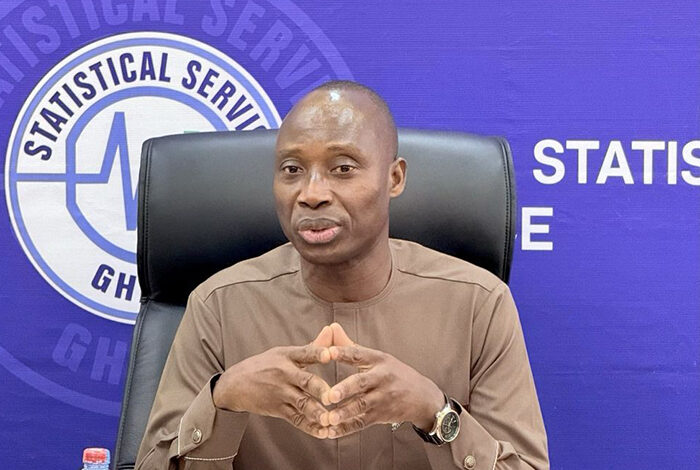
Presented by Government Statistician, Dr. Alhassan Iddrisu, the survey revealed that a significant majority of the expenditure – GH¢3.4billion – was attributed to outbound overnight visitors.
These travellers primarily visited friends and relatives (peaking at 40.6% of trips in Q3), with a significant portion also travelling for funerals.
Outbound overnight visitors aged 25–44 accounted for the largest share of visitors in each quarter. Female visitors aged 25–44 dominated visits except in Q4 where males dominated (40.8%).
OSP to charge Ofori-Atta, five others over corruption in SML-GRA contract
In contrast, the 77,501 outbound same-day trips, valued at GH¢59.8million, were predominantly for business and professional purposes (33.8% on average) followed by funeral-related travel.
Outbound same-day visitors aged 25-44 recorded the highest proportion in Q1 (49.0%), while visitors aged 0-14 had the highest share in Q3 (48.8%).
Rationale
Dr. Iddrisu emphasised that the survey is central to Ghana’s tourism planning and developing the Tourism Satellite Account (TSA), which measures the sector’s real contribution to the economy.
It provides reliable data on how Ghanaians travel, spend and engage in tourism, offering insights to guide investment, policy and service delivery.
The DOTS also aligns Ghana with international standards and supports the UN Sustainable Development Goal (SDG) 8, Target 8.9.1, which tracks tourism’s direct contribution to GDP and economic growth.
Regional and spending patterns
Greater Accra Region was the leading point of origin for overnight travellers, with quarterly figures ranging between 30,000 and 50,000. For same-day trips, Ashanti Region consistently recorded the highest number of travellers.
West Africa was the top destination for overnight travellers, receiving 242,055 trips throughout the year – with the highest quarterly volume of 73,069 in Q1. This reflected a strong sub-regional lane in mobility and culture.
The most significant spending by overnight visitors, however, was directed toward North America (GH¢734.70million) and Asia (GH¢721.50million).
For same-day travellers, Togo was the primary destination and recorded the highest on-trip expenditure at GH¢41.65million.
The data revealed a strong preference for self-arranged travel, which accounted for almost 90% of the GH¢3.03billion in on-trip expenditure by overnight visitors.
Policy recommendations
In response to the substantial outflow of travel spending, GSS noted that the country outbound tourism market is vibrant driven by young adults particularly professionals aged 25-44.
As such, GSS urged government to invest in transport and hospitality infrastructure to retain more spending locally and consider tax breaks for agencies that design outbound packages using local services and products.
The report also called on the private sector to develop comprehensive travel packages and quality local products to capture more value, while development partners were encouraged to fund training and digital tools for small tourism businesses to enhance competitiveness.
All you need to know about Ghana’s new vehicle number plates |BizTech:
Prophet Roja has issued a dire prophecy for the Ejisu constituency in the Ashanti Region of Ghana
In a video, the popular prophet narrated the events that transpired in the vision he received about the community
Prophet Roja also called on Ghanaians to engage in intense prayer sessions to avert the danger that could befall Ejisu
Don’t miss out! Get your daily dose of sports news straight to your phone. Join YEN’s Sports News channel on WhatsApp now!
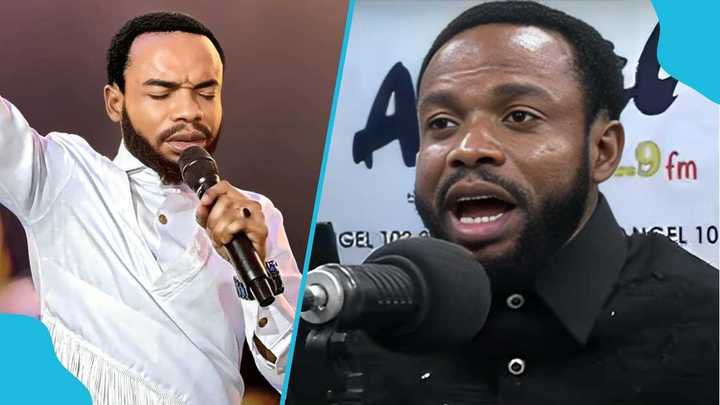
Ghanaian prophet Samuel Henry, popularly known as De Lighter Roja, has shared an alarming prophecy for the Ejisu constituency in the Ashanti Region of Ghana.
Prophet Roja issues a dire Prophecy for the Ejisu constituency. Photo source: @prophetrojaba Source: Twitter
In an interview with media personality Nana Romeo Walewale of Okay FM on Monday, October 27, 2025, the prophet responded to the backlash from critics, who accused him and his colleagues of manipulating their prophecies.
In response, Prophet Roja detailed how he received prophecies from God for public dissemination.
He explained that he regularly prayed to God to show him doom visions concerning the country, which he later disseminated and offered instructions on how to avert publicly.
He recounted the numerous doom prophecies he shared in the past, which eventually came true after Ghanaian leaders ignored his warnings.
Prophet Roja shares dire prophecy about Ejisu
Prophet Roja issued a dire prophecy concerning the Ejisu constituency. He claimed to have seen darkness hovering over the constituency in a vision.
He noted that Ghanaians, including the political leaders, needed to unite and pray to avert the danger that would befall the community.
He said:
“As I am sitting here and speaking with you, Ejisu is in darkness. We have to pray and prevent something bad from happening.”
Prophet Roja claimed that he also saw prominent members from the major political parties in Ghana travelling to Ejisu on multiple occasions in his vision.
The video of Prophet Roja issuing a dire prophecy for the Ejisu constituency is below:
Prophet Roja prophesies major flood in 2026
In the same interview, Prophet Roja claimed to have received a vision about major floods that would hit the country next year.
Prophet Roja speaks after being sued by the Mampontenghene, Barimah Saasi Ayeboafo II over a doom prophecy. Image credit: DeLighterRoja, MeY3Asanteni Source: Facebook
The popular preacher advised Ghanaians living near water bodies to start evacuating from their residences and relocate to avoid becoming casualties.
The prophet also called on government agencies to initiate plans to demolish the buildings close to water bodies or relocate the residents before the beginning of the new year.
The video of Prophet Roja prophesying major floods in Ghana in 2026 is below:
Prophet Roja’s prophecy about Ejisu stirs reactions
YEN.com.gh has gathered some comments from social media users below:
Godfada Gh commented:
“May God have mercy on us, Nana Afrane Okesse and Nana Yaa Asantewaa.”
Misslyn wrote:
“My hometown 😭😭😭. Lord, please show us mercy.”
Abyna Birago Dapaah remarked:
“Hmm, when it is coming and it is doing.”
Kharis commented:
“Dabiaa baabi ay3tum. Anny3 owuo a, 3y3 amane3. Mo hy3 nnepa ne nno)ma pa ho nkom for Ghana. Look at Singapore now and see the miserable nation, Ghana. We are behind development.”
Solomon Antwi shares prophecy about Prophet Roja
Earlier, YEN.com.gh reported that preacher Solomon Antwi shared a doom prophecy about Prophet Roja.
In a video, the prophet detailed a secret plot from some individuals against his colleague.
Solomon Antwi also called on Prophet Roja to get a spiritual solution to escape his doomed fate.
The Architects Registration Council (ARC) of Ghana has inducted 43 newly qualified architects into the profession at its 25th induction ceremony held in Accra.
Under the theme: “Impact of Illegal Mining (Galamsey) Menace on Housing Delivery and Water Resources in Ghana,” the event was attended by dignitaries including the Minister for Works, Housing and Water Resources, Mr. Kenneth Adjei; the Minister for Roads and Highways, Mr. Kwame Governs Agbodza, MP; and the Deputy Minister for Works, Housing and Water Resources, Mrs. Gizella Tetteh-Agbotui.
Stakeholders in the built environment used the occasion to reflect on the growing impact of illegal mining on sustainable housing and national development.
The overall Best Candidate for the 2025 Professional Practice Examination was Mr. Alfred Kweitsu.
The Registrar of ARC, Dr. Emmanuel Eyiah-Botwe, congratulated the inductees and reaffirmed the Council’s mandate as an agency under the Ministry of Works and Housing, established by the Architects Act, 1969 (NLCD 357), to regulate the architectural profession in Ghana.
Dr. Eyiah-Botwe highlighted the ARC’s achievements over the past year, including monitoring and evaluating programmes at KNUST and the Central University Department of Architecture.
“These include reviewing curriculum for Architectural Technology programmes at the Technical Universities; publishing an updated list of 770 registered architects and 112 architectural firms qualified to practice architecture in Ghana; implementing a five-year strategic plan (2021–2025) aimed at upholding international best practices in the built environment; developing a Code of Ethics and strategic policy framework focusing on education, compliance, and sustainable practice; and renovating and expanding the Council’s office block,” he said.
He noted that the Council continued to enforce compliance to ensure that only qualified architects and firms practice in Ghana, adding that environmental stewardship would now be a central pillar of architectural practice in the country.
“Illegal mining has a devastating impact on land, water, skilled labour, building material sources, and ultimately the cost of material. Sustainable housing and resilient cities cannot be achieved if we continue on this trajectory,” Dr. Eyiah-Botwe said.
Mr. Adjei, the Minister, commended ARC for its dedication to professionalism and ethics.
He described the theme as “timely and significant,” stressing the link between illegal mining and housing delivery. “Illegal mining is not merely an environmental issue; it is a multi-sectoral crisis affecting water security, public health, housing, and economic stability.”
The Chairman of the ARC Governing Board, Arc. Kofi Essel-Appiah, reminded the new professionals of their ethical duty to protect the environment while designing spaces that improve human well-being.
“Every generation of architects faces unique challenges. For yours, the threat of ‘galamsey’ and rapid urbanisation calls for creativity, ethical leadership, and collaboration,” he stated.
The President of the Ghana Institute of Architects (GIA), Mr. Tony Asare, inspired the inductees to pursue excellence and continuous learning throughout their careers.
“Your induction signifies not just a title, but a solemn trust to design with integrity, build with wisdom, and serve society with vision,” he said.
Mr. Agbodza challenged the inductees to use architecture as a tool for sustainability and advocacy.
“Illegal mining remains one of Ghana’s biggest threats. It undermines sustainable development, public health, and national planning,” he said.
Ghanaian musician and entrepreneur Mzbel has once again found herself at the center of public controversy following the release of a new video that has sparked mixed reactions across social media. The video, which has been trending under the title “Obaa Panyin Sei Boi, Mzbel Is In Trouble Over Her Latest Video As Agya Koo Speaks,” has attracted thousands of views within hours, stirring conversations among fans and critics alike.
In the trending clip, Mzbel is seen engaging in what many social media users describe as a “provocative” act. Although opinions are divided, a section of the public believes the video crosses moral boundaries, calling it inappropriate for a public figure of her stature. Others, however, defend her actions, arguing that as an artist, she has the right to express herself freely without being bound by conservative expectations.
The controversy deepened after veteran actor Agya Koo weighed in with his opinion. Known for his straightforward and often moralistic views, Agya Koo reportedly expressed disappointment over the content of the video, emphasizing that celebrities should set positive examples for the younger generation. His comments have since intensified the debate, drawing more attention to Mzbel’s actions and sparking arguments within the entertainment industry.
Mzbel, born Belinda Nana Ekua Amoah, is no stranger to public scrutiny. Over the years, she has courted controversy for her outspoken personality and bold artistic choices. Despite criticism, she has maintained that she will continue to be authentic and unfiltered in her creative expressions.
As the video continues to circulate online, reactions from fans remain sharply divided. While some accuse the singer of seeking attention, others see the uproar as evidence of Ghana’s ongoing struggle between cultural conservatism and artistic freedom. Mzbel has yet to issue an official response to the backlash, but close observers believe she may soon address the matter publicly.
The situation highlights how quickly social media can amplify controversy in the entertainment world. Whether this latest uproar will harm Mzbel’s reputation or simply add to her already controversial image remains to be seen.
Kojo Oppong Nkrumah, the former Information Minister and MP for Ofoase Ayirebi, has voiced strong concerns about what he describes as a worrying drift in the New Patriotic Party’s (NPP) moral and ideological compass.
During his address at the NPP National Delegates Conference at the University of Ghana Stadium, he urged party members to take a hard look at the current state of the party and rediscover the spirit of dedication and integrity that once set it apart.
According to Oppong Nkrumah, the NPP was founded on noble values selflessness, sacrifice, and service but these have been gradually eroded. “Ours was a party built on selflessness and service. Unfortunately, much of that has faded,” he remarked, a statement that resonated deeply with the audience.
He further cautioned that an increasing number of members appear motivated by personal enrichment rather than collective progress, a trend he said threatens the NPP’s moral standing and longevity.
With the party undergoing a constitutional review and internal reforms, Oppong Nkrumah’s message comes as both a challenge and a call to renewal. He emphasized that returning to the party’s founding ideals is vital for rebuilding public confidence and sustaining its political relevance.
“We must rediscover our original purpose sacrifice, selflessness, and service to Ghana,” he declared.
The conference, themed “Rebuilding Together with our Values,” has since ignited discussions about moral revival and the urgent need for unity and accountability within the party.
Bubu gowns have long been celebrated for their elegance, comfort, and cultural significance. Originating from West Africa, these flowing gowns are now embraced worldwide, especially when crafted from vintage materials. For ladies seeking a blend of tradition and timeless style, bubu gowns made from vintage fabrics offer a unique fashion statement that speaks to heritage while embracing contemporary aesthetics.
Vintage materials bring a nostalgic charm to bubu gowns. Fabrics such as lace, Ankara with retro prints, brocade, and handwoven textiles often carry stories of the past, reflecting cultural artistry and craftsmanship. Incorporating these materials into bubu gowns elevates the garment from everyday wear to a piece of art, perfect for special occasions like weddings, cultural festivals, or elegant evening events.
The versatility of bubu gowns allows for a variety of styles tailored to different tastes and body types. For instance, a flowing bubu gown with wide sleeves made from delicate vintage lace can exude femininity and grace. Alternatively, a structured bubu with intricate embroidery on vintage brocade fabric can offer a regal, sophisticated look. Pairing these gowns with modern accessories creates a perfect balance between old and new.
One of the appealing features of using vintage material for bubu gowns is sustainability. Repurposing fabric reduces waste and gives new life to beautiful textiles that might otherwise be forgotten. This eco-friendly approach resonates with the growing global emphasis on sustainable fashion, making vintage bubu gowns not just stylish but also responsible choices.
Bubu gown styles with vintage material provide ladies with an opportunity to celebrate cultural heritage, express individuality, and embrace sustainable fashion. These gowns are timeless pieces that blend the elegance of the past with the dynamic spirit of modern fashion, making them a treasured addition to any wardrobe.
Mavin Records founder and Afrobeats legend, Don Jazzy, has revealed his all-time favorite Afrobeats songs and albums, offering fans a nsstalgic look into the sound that defined a generation.
In an exclusive interview with RollingStone Africa shared on Wednesday, October 29, 2025, the veteran producer reflected on the music that shaped both his career and the evolution of Afrobeats from Lagos to the global stage.
The Northern Development Authority (NDA) has issued a strong response to members of a social media group allegedly linked to Samira Bawumia’s political opponents, after they reportedly mocked the Vice President’s children over an undisclosed health condition. The Authority condemned the act as “inhumane, shameful, and politically motivated,” calling for an immediate end to personal attacks on families of public officials.
According to the NDA’s statement, the mockery began when a viral post circulated online making insensitive remarks about the health of the Bawumias’ children. The post, shared by individuals allegedly aligned with a political faction opposed to the Vice President, quickly drew public outrage and condemnation from Ghanaians across the political divide.
In its official reply, the Northern Development Authority described the attack as “a new low in Ghanaian politics,” emphasizing that political competition should never extend to the private lives or medical conditions of children. “Mocking children over health challenges shows the moral decay of those involved. No parent deserves that pain,” the statement read.
The NDA also warned that such actions could provoke unnecessary tension and hatred among supporters within the ruling New Patriotic Party (NPP), especially as internal divisions continue to grow ahead of the 2028 elections. They urged party communicators to focus on policy debates and developmental discussions rather than personal insults.
Close sources to the Second Lady have also confirmed that Samira Bawumia was deeply hurt by the mockery but has chosen not to publicly address the issue, opting instead to focus on her humanitarian and advocacy work.
Meanwhile, several civil society organizations, including the Ghana Center for Women’s Rights, have joined in condemning the mockery, describing it as cyberbullying and a violation of basic human decency. They called on political leaders to ensure that the families of public officials are protected from online abuse and defamation.
As the controversy continues to trend on social media, many Ghanaians have rallied behind Samira Bawumia, sending words of encouragement and demanding accountability from those responsible for spreading the offensive content.
Ghanaian travelers spent the most money in Togo in 2023, confirming the country’s status as Ghana’s top short-haul destination for business and social visits.
According to the Ghana Statistical Service’s 2023 Domestic and Outbound Tourism Survey (DOTS), visitors to Togo recorded the highest on-trip expenditure among all same-day outbound travelers, reaching GHS 12.8 million in the first quarter alone — almost two-thirds of the total same-day spend of GHS 19.3 million for that period.
In total, 77,501 same-day travelers spent about GHS 59.8 million across the year.
Most of these trips were made for business, professional assignments, and visits to friends and relatives, underscoring Ghana’s deep trade and cultural ties within the sub-region.
The Ashanti Region accounted for the highest number of same-day travelers, reflecting its central role in commerce and cross-border activity.
By age, the largest share of outbound travelers were between 25 and 44 years old, the country’s most economically active population; an indication that outbound mobility is driven largely by work, trade, and entrepreneurial activity.
Beyond short visits, overnight outbound travel dominated Ghana’s foreign spending, with 393,305 visitors spending a total of GHS 3.4 billion abroad in 2023.
Expenditure peaked in Q2 at GHS 921.5 million, followed by Q3 (GHS 711.7 million), Q4 (GHS 796.3 million), and Q1 (GHS 604.4 million).
By destination, West Africa accounted for the largest share of overnight spending, ahead of Europe, North America, the Middle East, and Asia.
The trial of former National Signals Bureau (NSB) Director-General, KwabenaAdu-Boahene, and his wife took a lighter turn on Thursday when the presiding judge, Justice John Eugene Nyante Nyadu, jokingly questioned defence counsel, Samuel Atta-Kyea over his posture toward the bench.
In a light-hearted remark that drew hearty laughter from the bar and gallery, Justice Nyadu quizzed why Mr. Atta-Kyea would “smile with me in court and go outside to seek a prohibition against me,” a reference to the defence’s recent unsuccessful attempt at the Supreme Court to bar him from hearing the case.
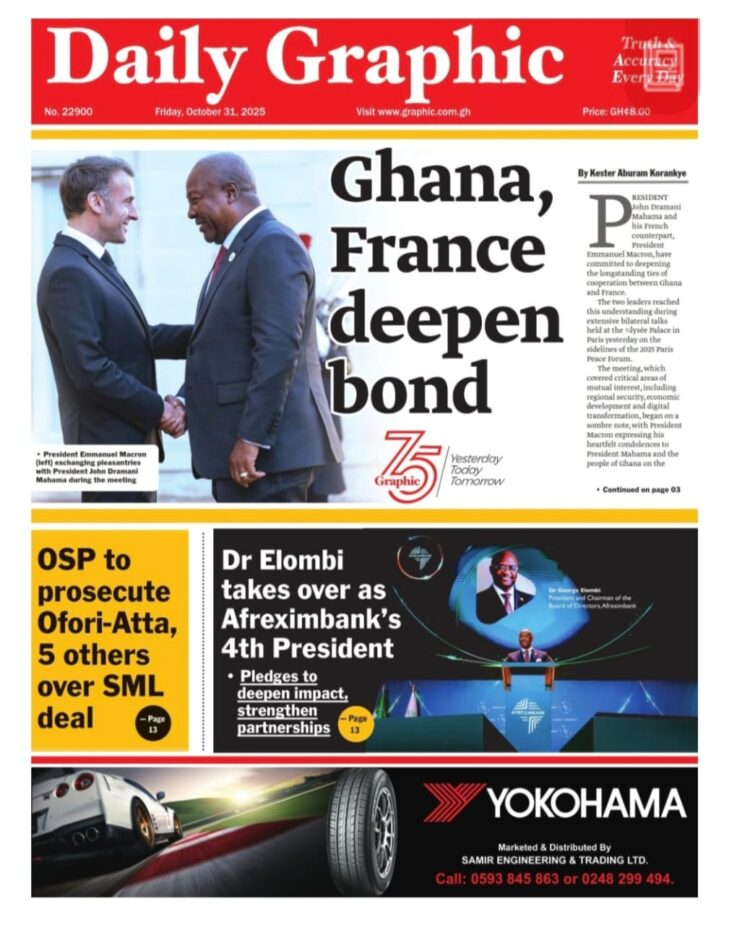
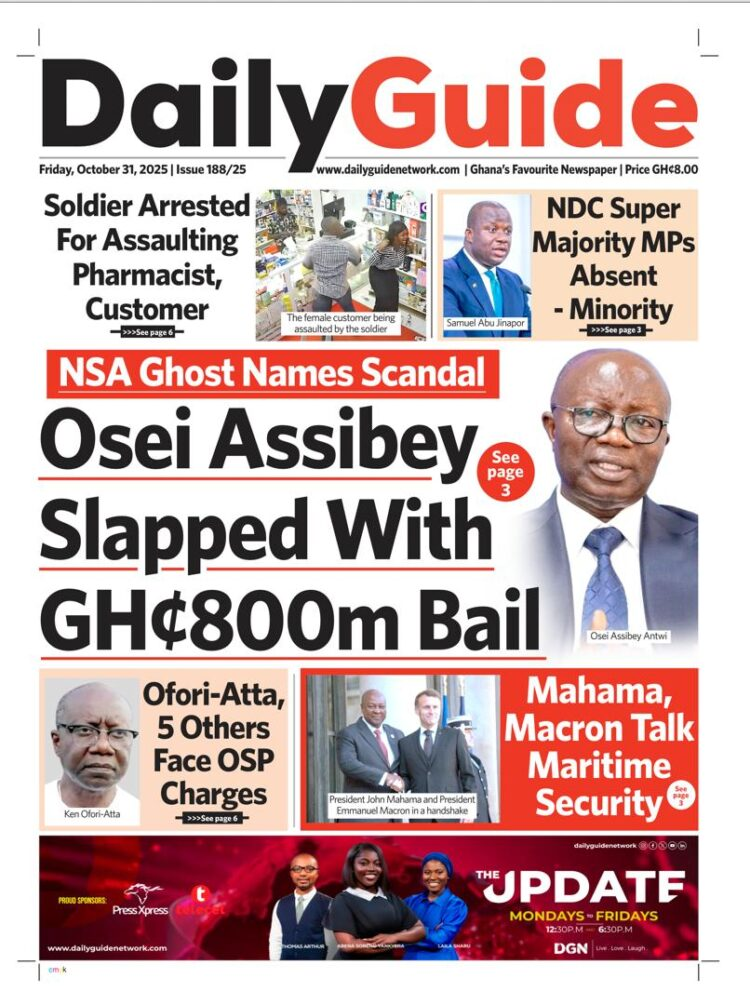
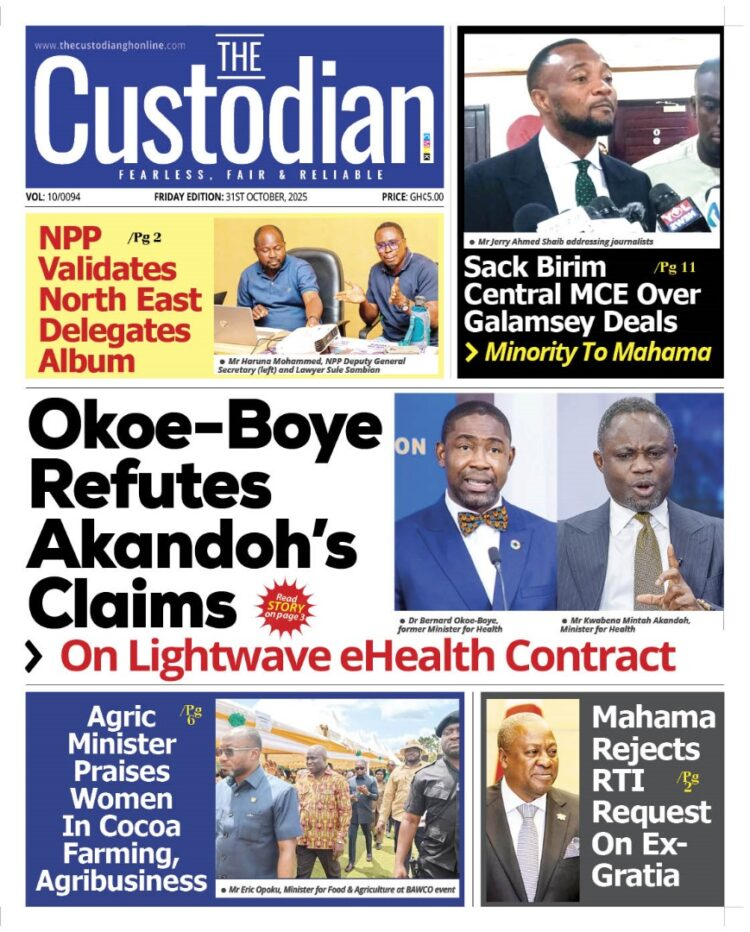
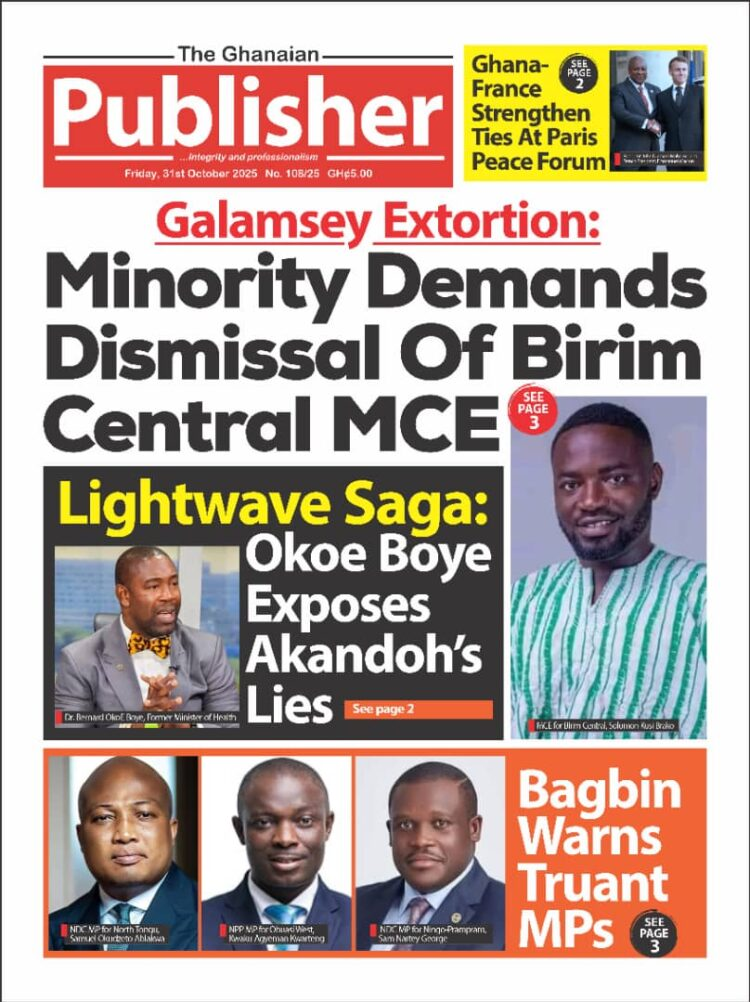
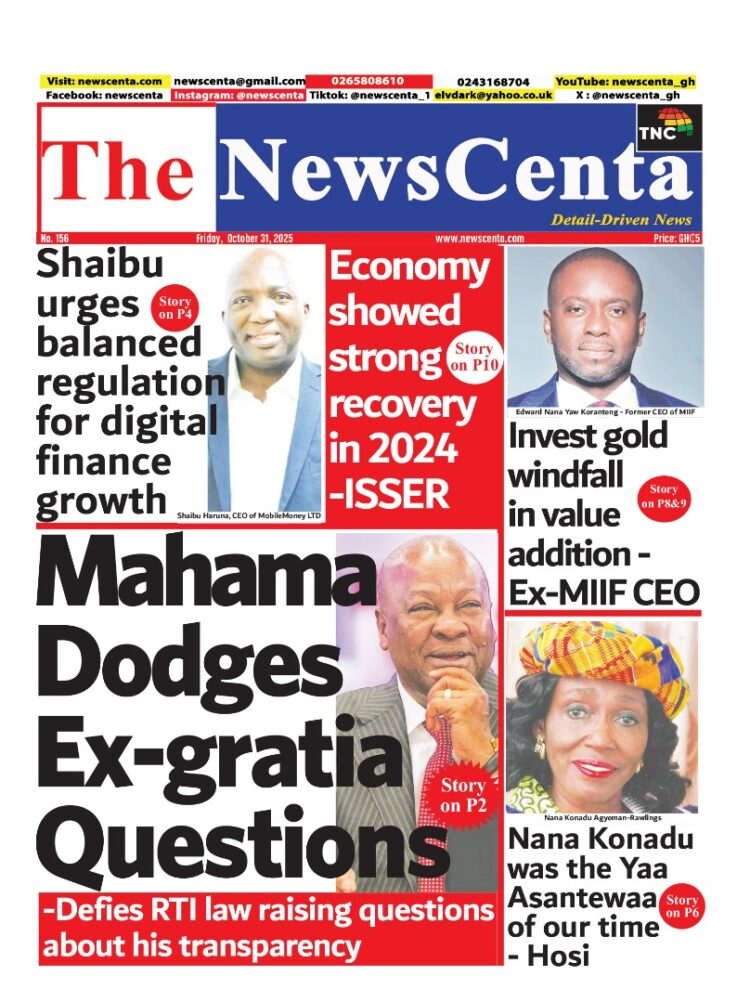
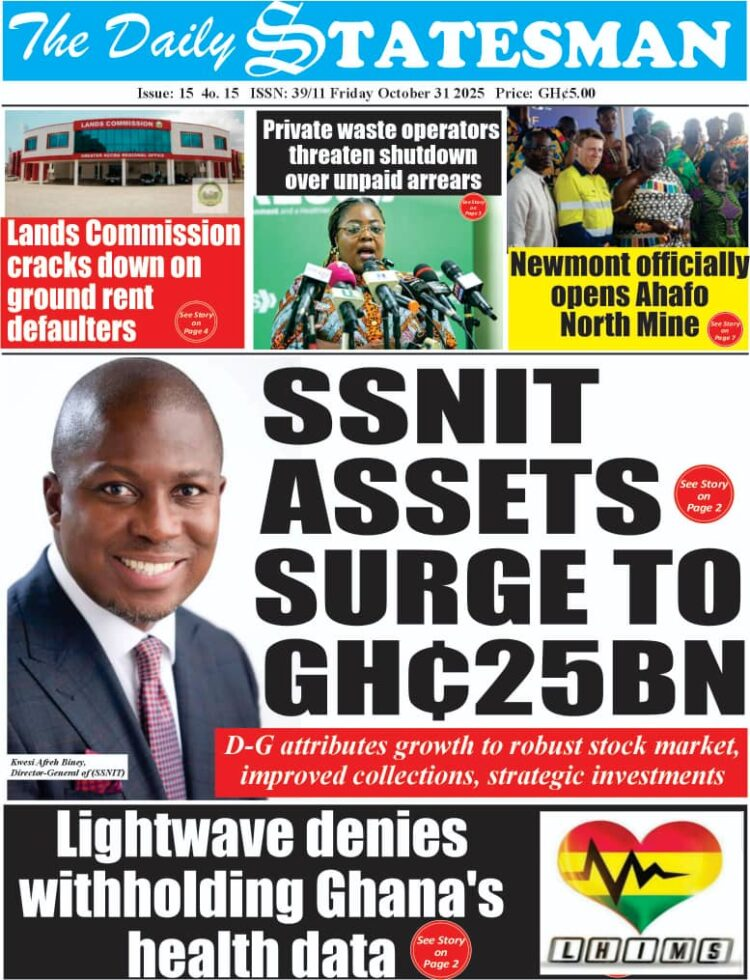
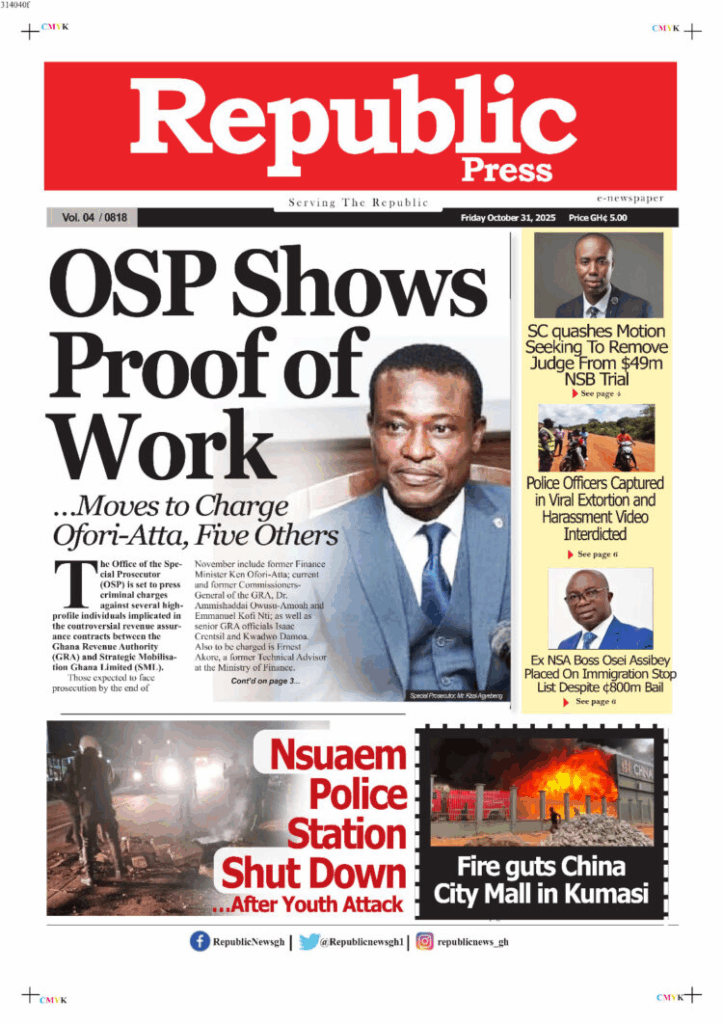
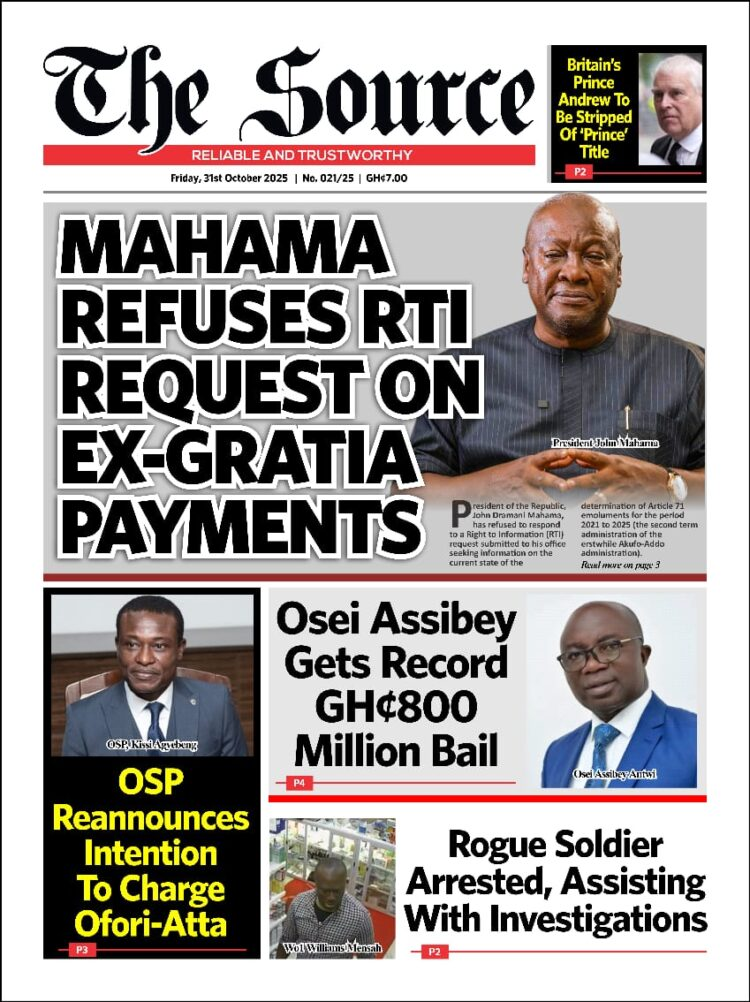
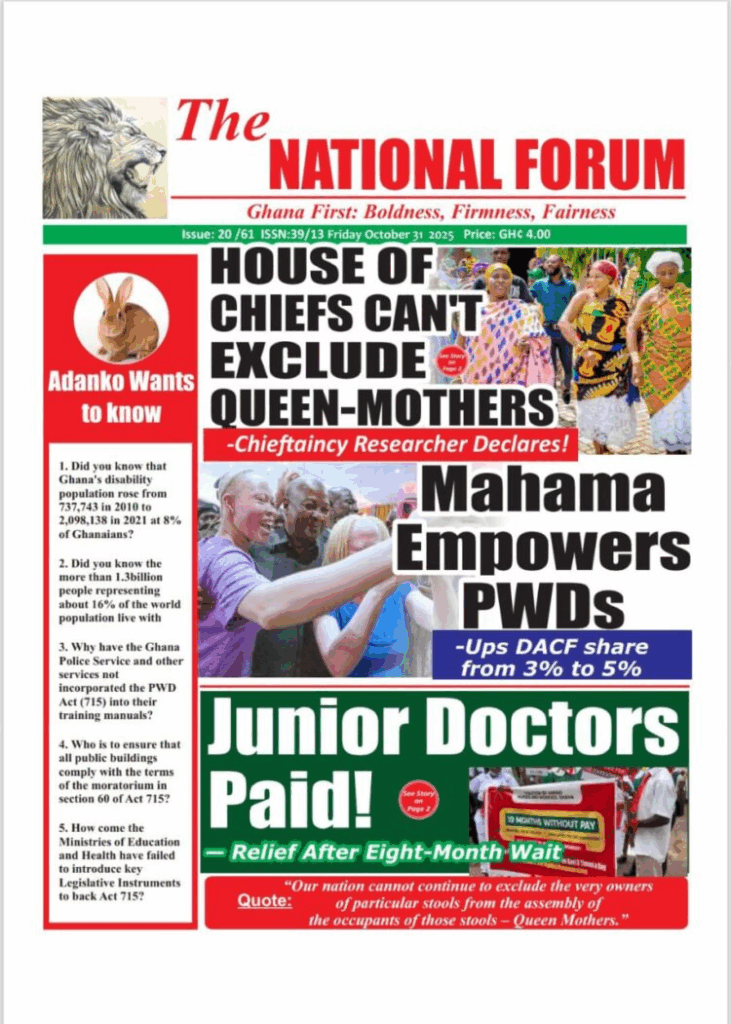
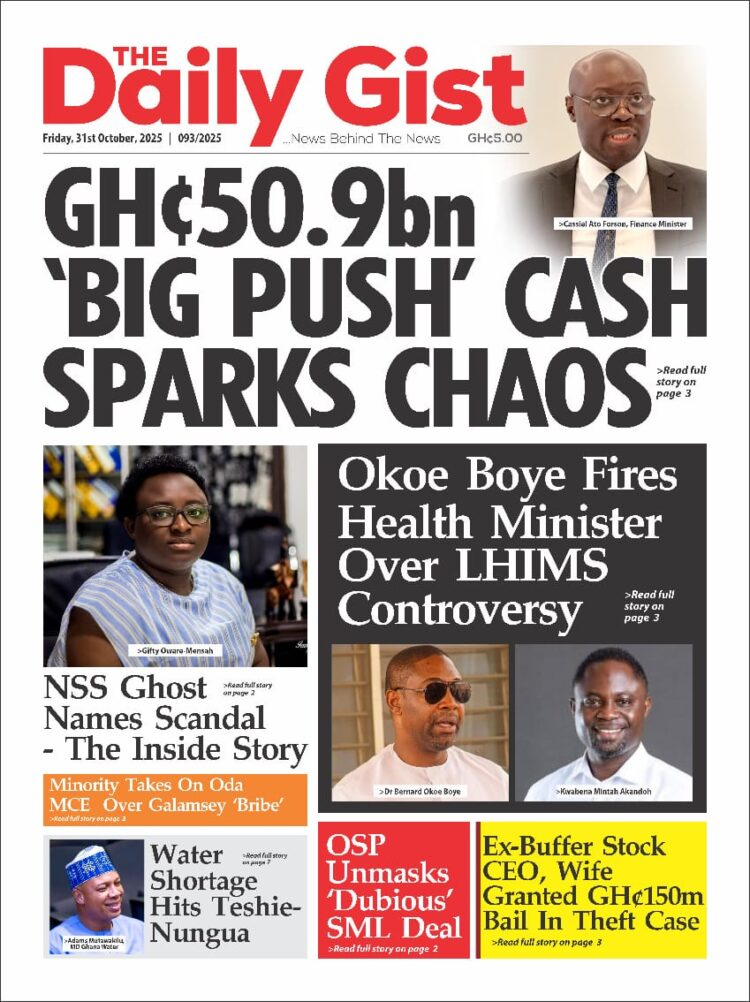
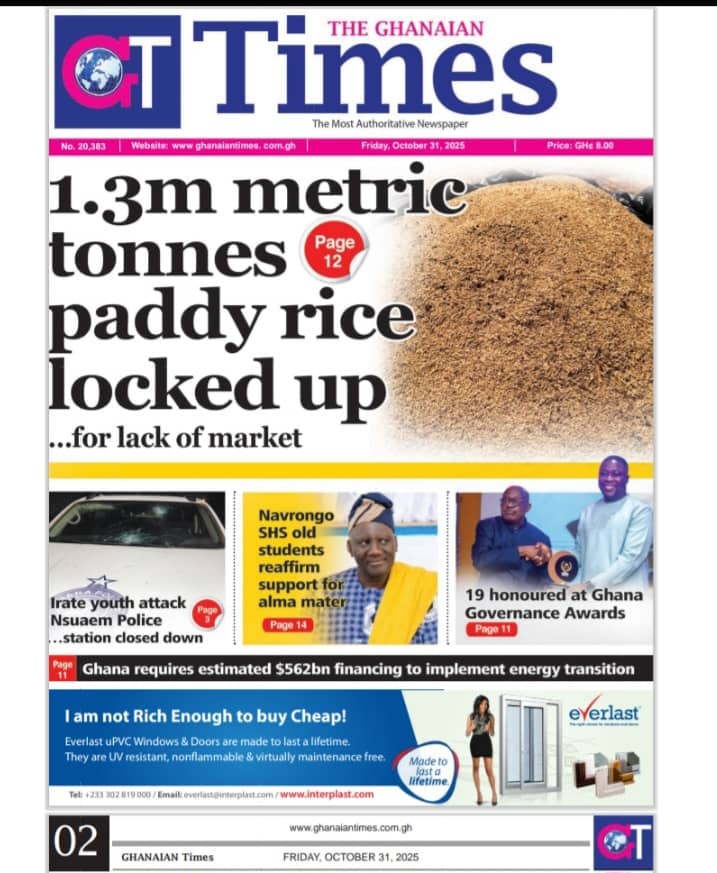
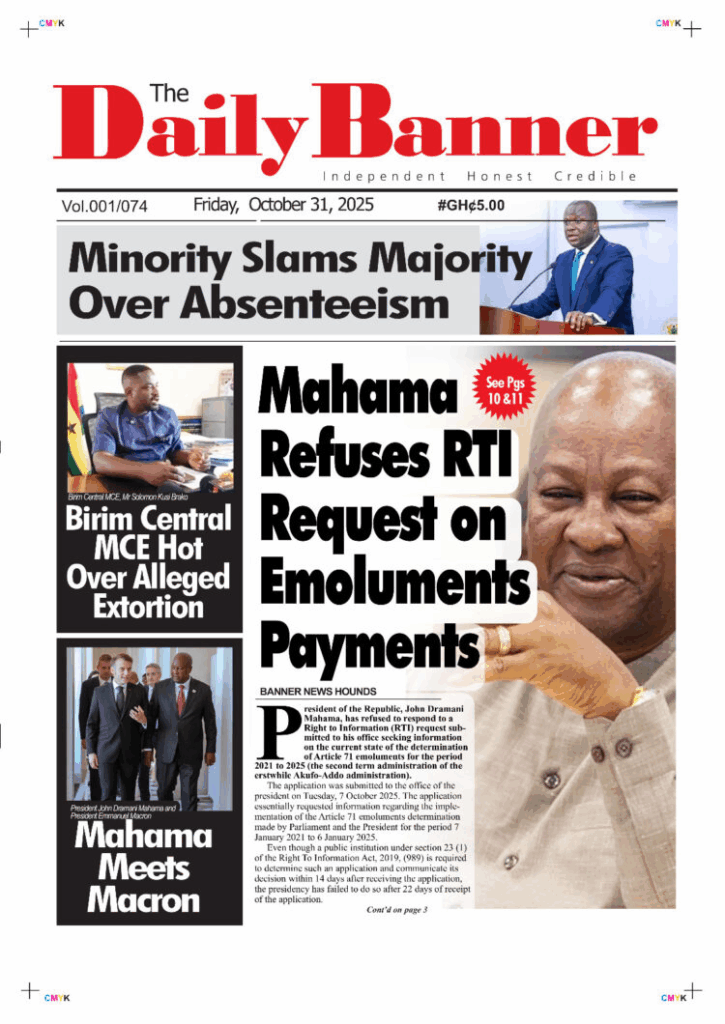
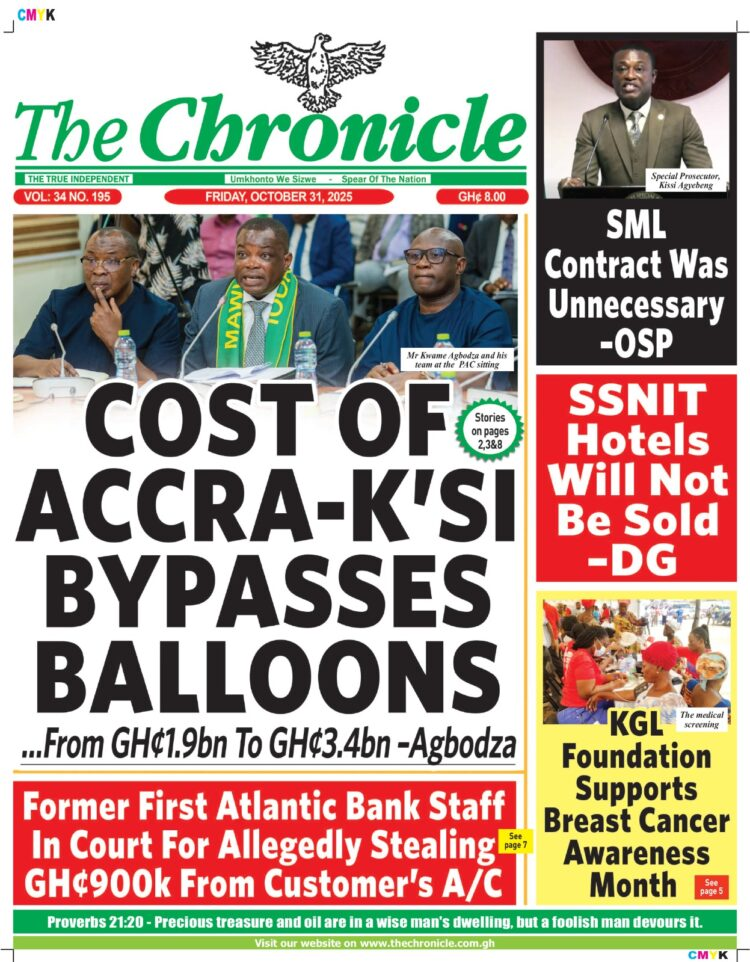
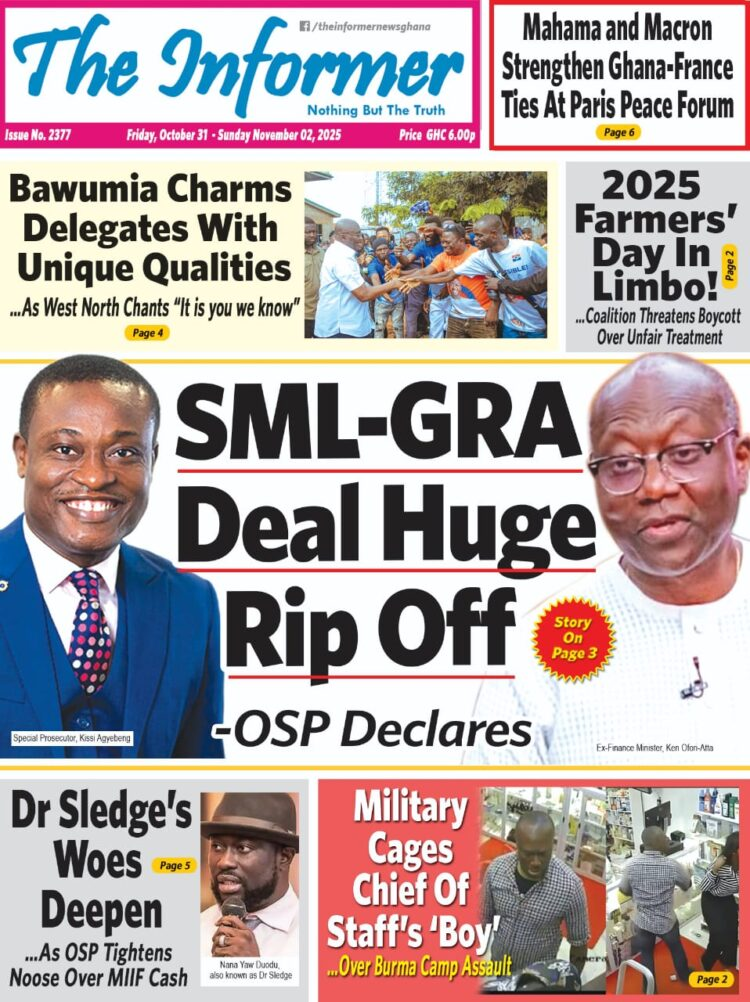
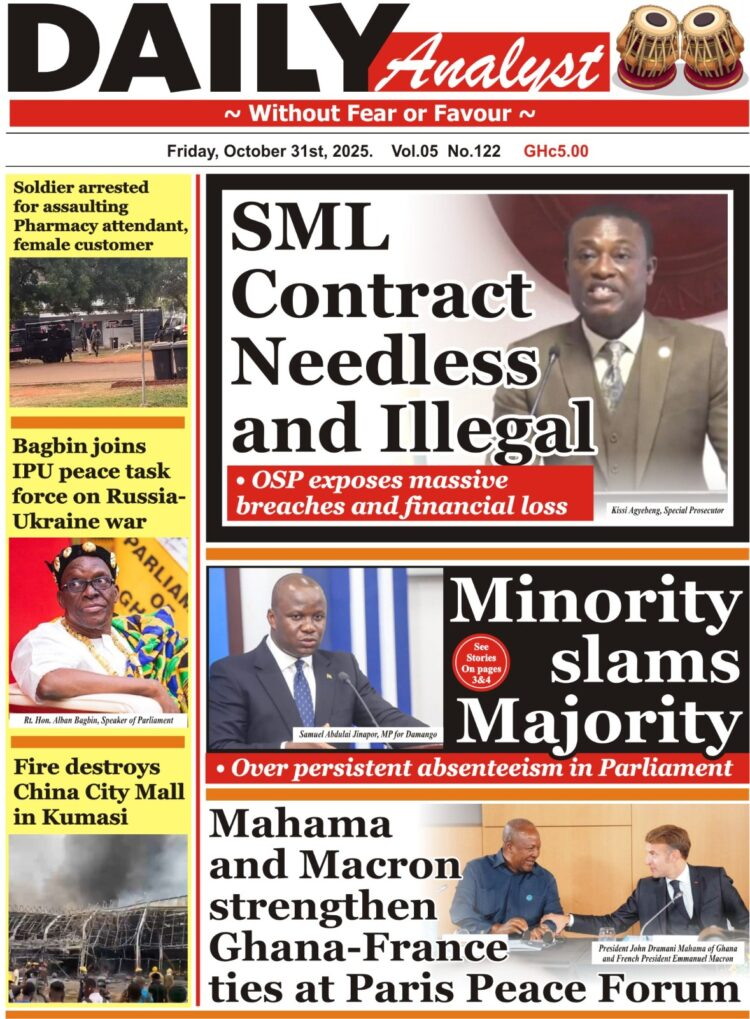
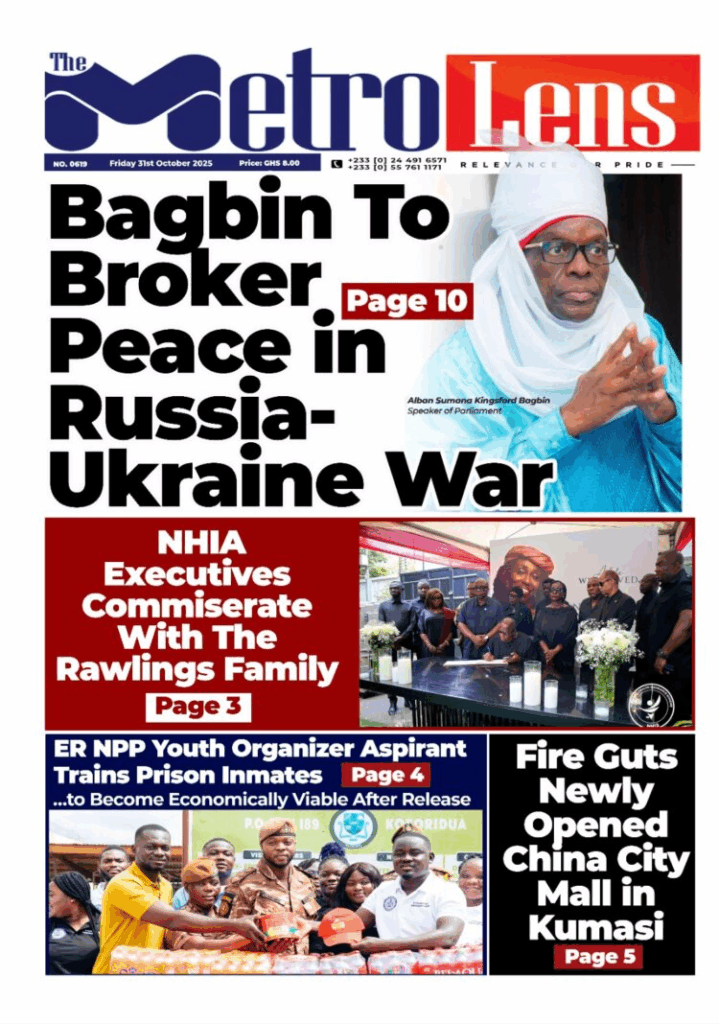
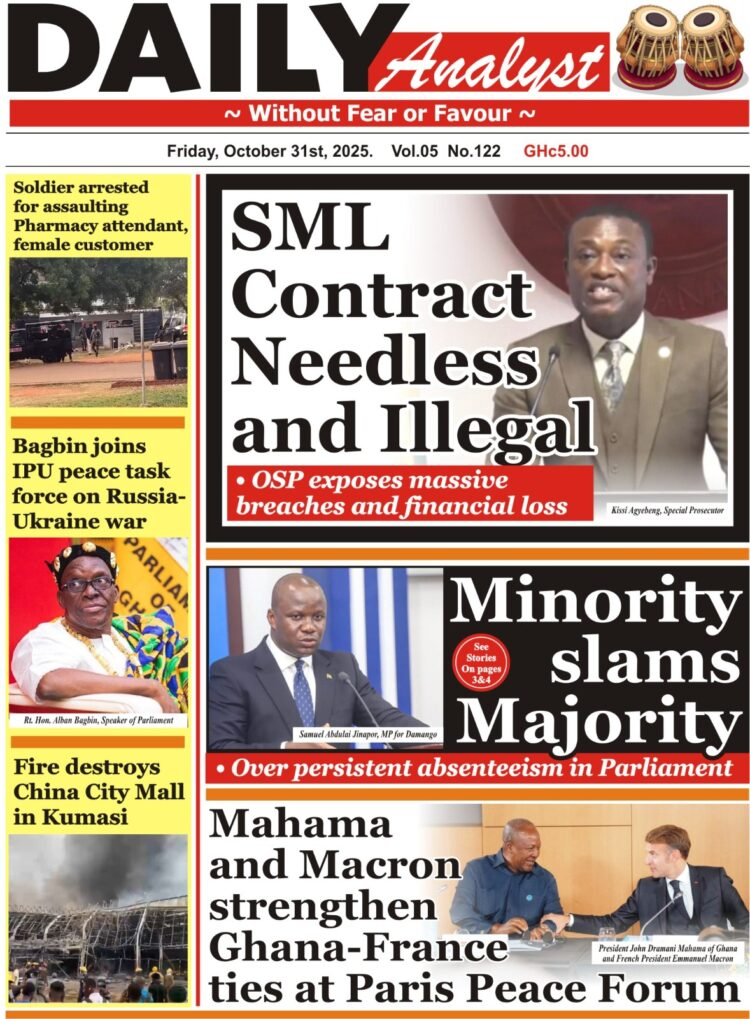
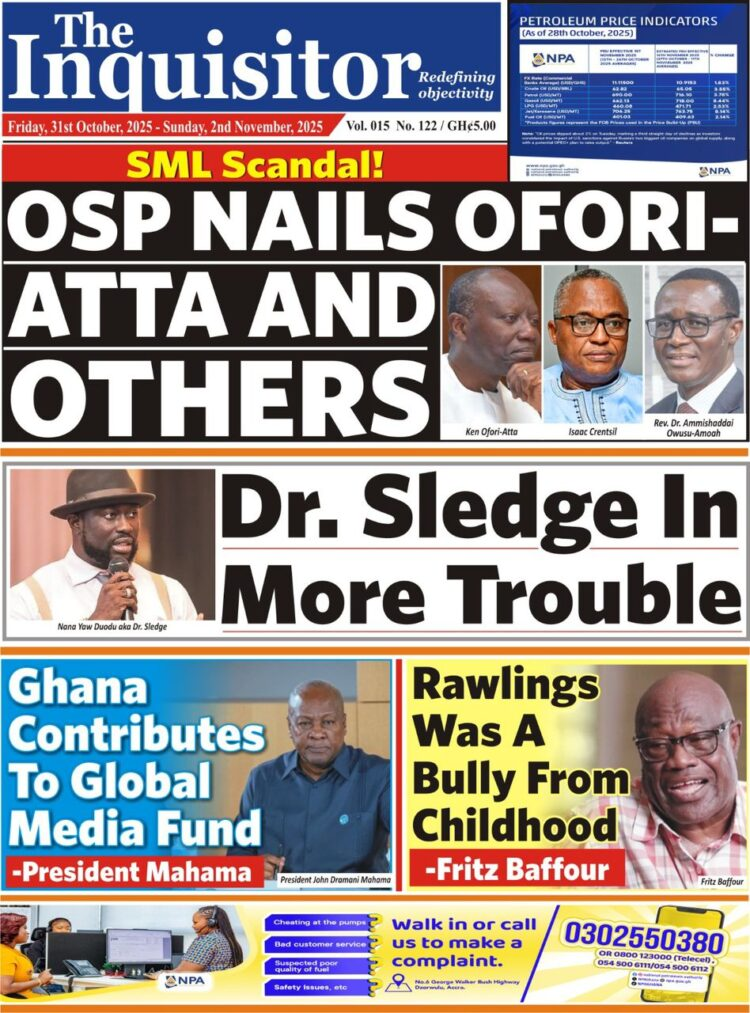
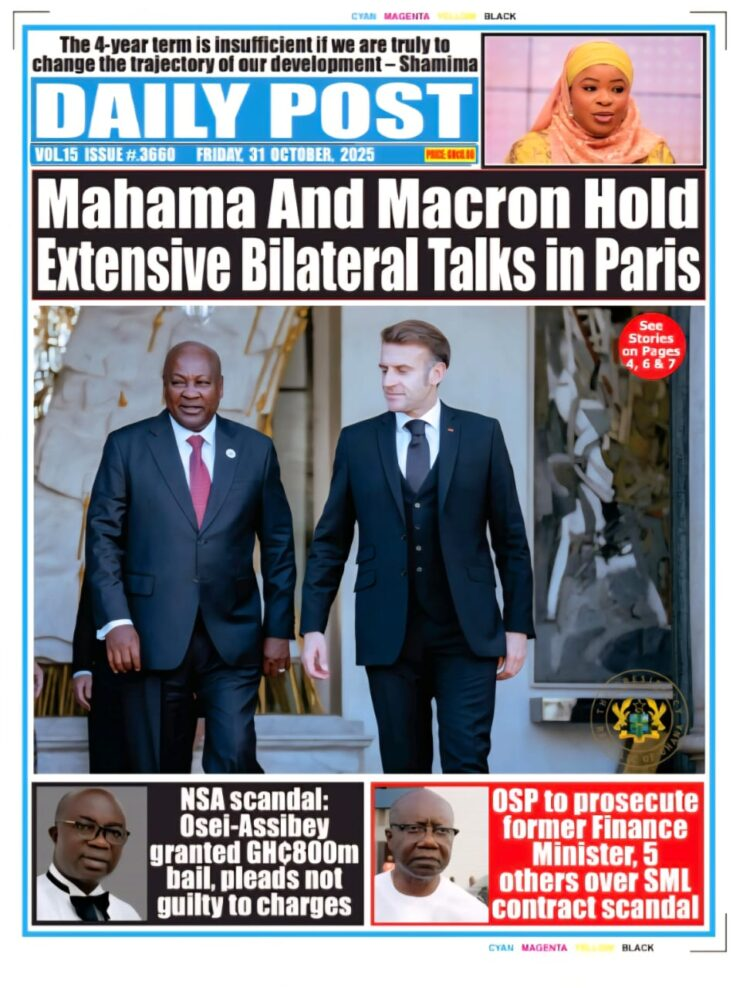
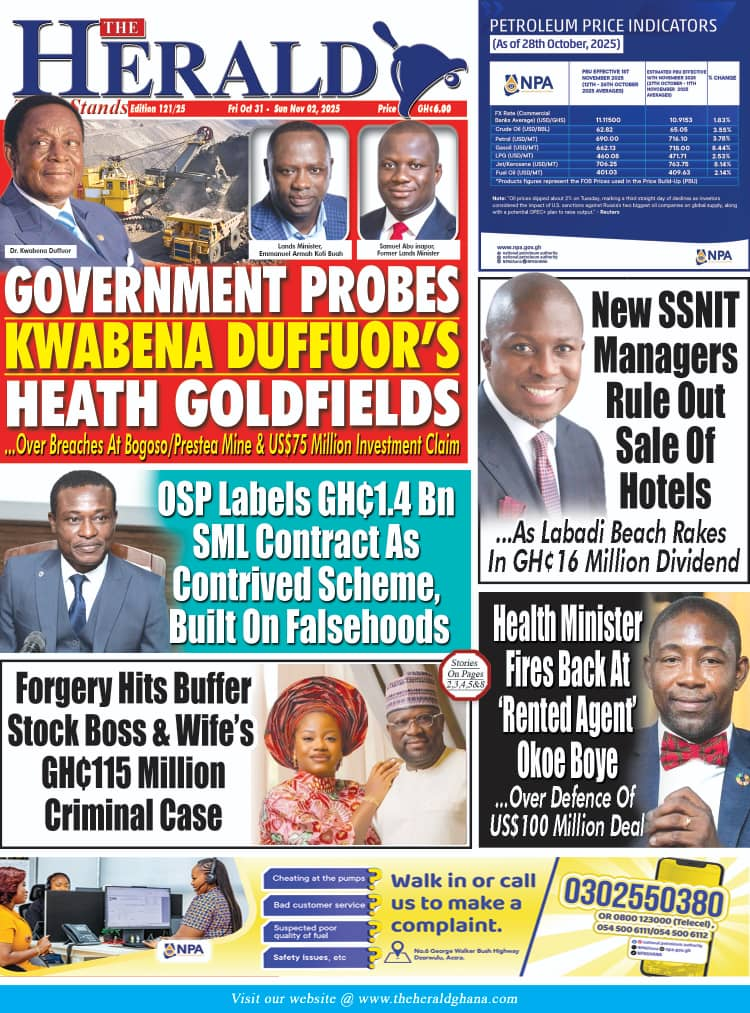
Myjoyonline.com brings you the front pages of the various newspapers across the country.
DISCLAIMER: The Views, Comments, Opinions, Contributions and Statements made by Readers and Contributors on this platform do not necessarily represent the views or policy of Multimedia Group Limited.
DISCLAIMER: The Views, Comments, Opinions, Contributions and Statements made by Readers and Contributors on this platform do not necessarily represent the views or policy of Multimedia Group Limited.
AUTHOR: KOFI BENTUM QUANTSON, FORMER NATIONAL SECURITY CO-ORDINATOR OF THE REPUBLIC OF GHANA AND THE FIRST EXECUTIVE SECRETARY OF THE NARCOTICS CONTROL BOARD (NOW NARCOTICS CONTROL COMMISSION). Number of Pages: 234 Printed by: Fahmin Ventures Review by: Kojo Kwarteng, Journalist, Marketer, PR, Media and Corporate Communications Specialist and Author. Available At: Airport Shell Filling Station, Legon Bookshop, University of Ghana and online platforms
Ghana Politics — as the title of the book, we can infer qualities from Mr Quantson’s style and prior works, experience and background that the book is not rhetorical. The book is a deeply informed perspective drawing from Quantson’s frontline experience in security and national governance, and blends personal anecdotes with sharp analytical insight.
Nine straight and harsh questions beneath the title, “Ghana Politics” raised on the front cover of the book with the bold statement, “No Apologies”, sums up the fearless nature of the author to confront what academics, media, clergy, the youth, leaders of all kinds and people perceived in society as of critical minds and boldness are running away from.
Ghana Politics; is it funny, confrontational impunity, sensible, nonsense, provocative arrogance, aggressive hypocrisy, corrosive impertinence, massive corruption or what?
Its thematically rich “episodes” with titles such as Voice From Afar, The Castle, From China With Love Plus Hate, Ambassador At Lost, Konkonsa Democracy, and Nature of Pass Power, the structure seems both narrative and reflective — likely blending storytelling, critique, satire, and evocation of political culture.
The 234-paged book is concise and with 23 episodes, the book is designed for clarity and engagement on current happenings rather than academic density.
Why Ghana Politics is worth reading
The reviewer as an author and ardent reader himself, assigns the following compelling reasons for politicians, historians, academics, security gurus, students of politics, governance and administrators to read the book not as an alternative but as a must-read document for sustainable living, survivorship, renewal of minds, resetting and true transformation.
These are stated below:
Firsthand authority: Few international, African and Ghanaian authors offer the same depth of experience in national security and political developments as Quantson, positioning him uniquely to interpret state dynamics. The author is an authority with practical experience and knowledge worth tapping into.
Aged over 90 years, he fearlessly states the points and elucidates from untainted language and glasses. The younger generation have and can benefit from the book without regret over the years to come.
Narrative diversity: The varied episodes (titles) suggest a multifaceted exploration — not just national history, but perhaps diplomatic comedy (From China With Love Plus Hate), institutional critique (The Castle), public awards (Bastardising National Awards), and media (Konkonsa Democracy) — likely offering both insight and wit.
Other topics such as Equalisation, The Prophet Again, Nature of Pass Power, render the book more relevant to society.
Accessible format: The episodic style makes it easy to dip in and out — great for both general readers and those keen on Ghana’s political culture. These days of biases, stomach direction and lack of truth among even the clergy, MPs, Advisors, professors, experts and CEOs, it is difficult to come by such writers who express the truth without looking at political colours, shoulders and selfish gains.
Mr Quantson, as we may be aware, has written several books including Ghana: Peace and Stability, Tears of God, Travelling and Seeing, Cocaine Hits Drug Family, Ghana National Security … The Dilemma, Bogus Informants… Nation Wreckers, Security In The Hand of God, You and Your Security Environment — recounting how intelligence failures contributed to coups, emphasising how political partisanship and institutional weaknesses can undermine national security, growth and national development.
For instance, his book National Security: The Dilemma tackled themes of intelligence being sidelined by partisan or tribal considerations and repeated in the current book.
About the Author
He is a highly respected figure in Ghana’s security and intelligence landscape. Starting his career in the Special Branch of the Ghana Police Service, later the Bureau of National Investigations (BNI), he rose to its leadership before serving as Commissioner of Police, setting up the Narcotics Control Board, and eventually becoming the National Security Coordinator.
This makes his new book an authoritative voice, rich with thematic chapters. He has written with deep, direct involvement, digestible structure with contextual resonance tapping into recurring issues in Ghanaian politics.
In conclusion, Ghana Politics by Kofi Quantson offers a compelling, authoritative, and richly textured take on Ghana’s political scene, rooted in the author’s extensive security and governance experience.
For readers interested in Ghanaian political narratives, national stability, and the interplay of power, memory, and institutions, this book promises both insight and engagement.
“The book is a deeply informed perspective drawing from Quantson’s frontline experience in security and national governance, and blends personal anecdotes with sharp analytical insight.”
📖 GHANAIAN Times – FRIDAY, OCTOBER 31, 2025 www.ghanaiantimes.com.gh
Alexander Kwamina Afenyo-Markin (L) and Haruna Iddrisu (R)
The Minority Leader in Parliament, Alexander Kwamina Afenyo-Markin, has taken a swipe at the Minister of Education, Haruna Iddrisu, accusing him of double standards and reluctance to take a firm stance on the controversial LGBTQ bill.
Speaking on the floor of Parliament on October 22, 2025, the Effutu legislator said the education minister’s current silence on the issue stems from his desire to maintain foreign aid and international support for his ministry.
“Mr Speaker, the bill was suffocating government at the time; we were in a difficult situation. We pleaded with our colleagues to manage the situation. Now, the education minister needs grant, he needs foreign aid, he needs support for his ministry. Do you like LGBTQ+ or not? Say it; let’s hear you on record,” Afenyo-Markin said.
The Minority Leader argued that Iddrisu, who previously served as the Chief Legal Adviser to government on the bill during the previous New Patriotic Party (NPP) government, had supported the anti-LBGTQ legislation in its earlier stages but is now “running away” from it due to political and diplomatic pressures.
“You supported it; you were the Chief Legal Adviser. You supported it. Now you are running away,” he charged.
Afenyo-Markin further suggested that the education minister’s silence might be influenced by potential help for his government.
Ministerial Vetting: Watch the moment Haruna Iddrisu surprised everyone when he spoke ‘Twi’
He stated that the Tamale South MP is vying for running mate slot ahead of the 2028 general elections hence he should state his position on the matter.
“You are vying for running mate. Do you like LGBTQ+ or not? Say it. You want a woman to be president, possibly you’ll be the vice president do you support LGBTQ+? Declare your position, Minister of Education,” he said.
The exchange took place amid renewed tensions in Parliament over the Promotion of Proper Human Sexual Rights and Ghanaian Family Values Bill, commonly referred to as the anti-LGBTQ+ bill, which has drawn sharp divisions both within Parliament and among the general public.
The bill, first introduced in 2021, seeks to criminalize LGBTQ+ activities and advocacy in Ghana.
Watch CCTV footage of alleged soldier assaulting two civilians inside a pharmacy
Tragedy as farmer drowns while seeking loan to send child to SHS
The wait is over! The GhanaWeb Excellence Awards 2025 is officially launched. Let’s Celebrate impact, innovation and excellence across Ghana.
Who deserves to be honoured this year?
Nominate now 👉 https://ghanaweb.com/ghanaexcellenceawards/nominate
AM/SSM
Tragedy as farmer drowns while seeking loan to send child to SHS
The wait is over! The GhanaWeb Excellence Awards 2025 is officially launched. Let’s Celebrate impact, innovation and excellence across Ghana.
Who deserves to be honoured this year?
Nominate now 👉 https://ghanaweb.com/ghanaexcellenceawards/nominate
Trouble Looms As Kevin Taylor Sends Strong Message To Metro TV Over Paul Adom Otchere’s Case
News Hub Creator14h
Outspoken broadcaster Kevin Taylor has lambasted Metro TV for what he described as an irresponsible silence after the Office of the Special Prosecutor (OSP) invited veteran journalist Paul Adom-Otchere for interrogation over a criminal allegation.
Adom-Otchere, known for hosting the popular political talk show Good Evening Ghana and for his previous role as chairman of the Ghana Airports Company Limited, is currently under formal criminal investigation by the OSP.
In a post shared on July 30, 2025, Taylor urged Metro TV’s management to temporarily take Adom-Otchere off airuntil the investigation is concluded. He argued that doing so would not suggest guilt but would reflect the ethical standards expected of any credible international media organization.
Taylor further warned that refusing to act could seriously harm the reputation of Metro TV, particularly if the investigation results in a conviction while Adom-Otchere remains the public face of its flagship program. He noted that the OSP’s decision to classify the case as a criminal matter rather than a routine probe underscores its seriousness.
According to Taylor, Adom-Otchere’s recent appearances on platforms such as UTV reveal his visible unease over the controversy.
He concluded by urging Metro TV to demonstrate its commitment to transparency and public trust through immediate and principled action. Taylor reminded the station that the Ghanaian public is watching closely and that indecision could permanently erode the network’s credibility.
A dramatic confrontation unfolded in Ghana’s Parliament on Thursday as Health Minister Kwabena Mintah Akandoh clashed fiercely with Public Accounts Committee (PAC) Chairperson Abena Osei Asare during a tense hearing, sparking nationwide debate over transparency and accountability in the health sector.
According to a report by Joy News on October 30, 2025, the heated exchange erupted over the controversial $77 million Lightwave e-Health contract, which has faced months of scrutiny amid allegations of missing funds and incomplete work.
Mrs. Osei Asare, leading the PAC session, demanded detailed explanations from the Health Minister regarding how funds meant for the Ministry’s digitalization programme were utilized. Citing the Auditor-General’s report, she accused the ministry of failing to properly account for disbursements linked to the Lightwave Health Information Management System (LHIMS). “Ghanaians deserve answers. The inconsistencies in payments and contract supervision are unacceptable,” she declared.
An irritated Akandoh, however, rejected what he called “political insinuations,” insisting that the ministry inherited the contract and was conducting a thorough audit. “The Ministry of Health has not lost a single dollar. Every payment made was duly approved. The so-called missing funds are part of ongoing reconciliations,” he retorted sharply.
The confrontation drew gasps and murmurs from MPs, forcing some members to intervene as tempers flared. Osei Asare pressed on, questioning why only 450 of the targeted 950 hospitals had been connected under the project despite the huge financial outlay. “We can’t keep spending millions on failed systems while hospitals lack essential tools,” she fired back.
Akandoh later announced that the Lightwave contract had been terminated and replaced with a new system — the Ghana Health Information Management System (GHIMS) — which he said would enhance data security and improve efficiency across health facilities.
Analysts described the confrontation as a reflection of deep-rooted tensions between Parliament’s oversight bodies and executive ministries. Civil society groups, including IMANI Africa and the Ghana Integrity Initiative (GII), have since called for the full Lightwave audit report to be made public.
The PAC has adjourned the inquiry to next week, with officials from the Ministry of Finance and Lightwave Technologies expected to testify.
It will get me into trouble again!” laughs Ghana President John Mahama upon the conclusion of our interview.
A few weeks earlier, Mahama’s Foreign Minister had visited the U.S. State Department, only to be immediately confronted with an op-ed that his boss had written for the U.K. Guardian newspaper. In it, Mahama eruditely excoriates U.S. President Donald Trump’s baseless claims of a white genocide in South Africa and calls his “unfounded attack” on its President Cyril Ramaphosa in a fractious Oval Office meeting “an insult to all Africans.”
“They asked, ‘Did your President actually write this?’” Mahama tells TIME in his presidential office within Accra’s Jubilee House. “He says, ‘Yes, my President is a writer and likes to express himself.’ And they said, ‘Well, he’s President now. Can you ask him to put his pen down?’”
Even if Mahama does acquiesce and pause his writing, it’s extremely doubtful he will ever stop shooting from the hip. On Sept. 25, the 66-year-old used a speech at the U.N. General Assembly to accuse its Security Council of exercising “almost totalitarian guardianship over the rest of the world,” while demanding that an African member be added to this apex body and the abolition of its veto power. “The future is African!” he said to rapturous applause.
A little showy, sure—but far from empty talk. By the year 2050, over 25% of the world’s population is expected to hail from the African continent, including a third of those aged 15 to 24. Africa’s combined GDP was $2.6 trillion in 2020 but is projected to reach $29 trillion by 2050. Africa boasts three of the world’s 20 fastest-growing tech hubs, including first place: Nigeria’s Lagos.
But while the trajectory is indubitable, the ascent is far from smooth, as Ghana’s recent experiences neatly encapsulate. The West African nation of 34 million has long been painted as a continental success story due to its democratic and economic stability. However, Mahama was returned for a second nonconsecutive term in January with his homeland embroiled in an acute economic malaise, characterized by a huge debt burden, soaring costs, and youth unemployment at a staggering 38.8%.
In just half a year, Mahama succeeded in restoring stability—halving inflation, strengthening the national cedi currency by 30%, and embarked on a radical “Resetting Ghana” agenda. He rolled out a 24-hour economy to empower businesses and public institutions to operate around the clock, abolished onerous levies on online purchases and betting wins, and established a code of conduct for all government officials to fight corruption. He pledged to wipe fees for all first-year students in public tertiary institutions and distribute free feminine hygiene products to school-age girls nationwide. To fight joblessness, he unveiled plans to train one million coders over four years, providing the talent to bolster a nascent tech sector.
“We must improve security to make sure that the streets are safe for people to be able to go to work and come back,” says Mahama. “So we know what our responsibilities are.”
But politics is dealing with the unforeseen, and an almighty curveball was looming over the Pacific. Less than three weeks after Mahama’s Jan. 7 inauguration, the Trump Administration began gutting USAID, which had allocated $12.7 billion to sub-Saharan Africa, accounting for 0.6% of the region’s GDP.
According to the Pretoria-based Institute of Security Studies, the aid cuts could push 5.7 million more Africans into extreme poverty by next year. Meanwhile, two to four million additional Africans are likely to die annually as a result of reduced global aid budgets, estimates the Africa Centre for Disease Control and Prevention. Within South Africa alone, cuts to HIV/AIDS programs could result in an additional 500,000 deaths over the next decade, reports the Desmond Tutu HIV Center.
Ghana lost $156 million allocated for HIV and AIDS control, combatting malaria, as well as research, governance, and education. Still, the cuts were “not fatal,” says Mahama. “All I did was to tell our Finance Minister to make adjustments … so we have covered it with our budget. We’re fine, but not so in some other countries. I was speaking to one of my colleague presidents and the USAID withdrawal has shut down their school feeding program. With countries like that, it will have quite a huge effect.”
As such, Mahama’s term coincides with a new paradigm for Africa. Despite vast agricultural and mineral wealth, the continent faces limited access to global markets, unfair trading conditions, and a lack of investment. These challenges hinder economic growth, perpetuate poverty, and prevent many Africans from realizing their full potential.
The hope is that, armed with new technology, that decline of foreign aid serves a rallying call that compels African countries to forge their own paths, free from the constraints of aid dependency and external policy pressures. And while challenges persist, there are already signs that hidebound profligacy is being replaced by newfound autarky. “Ghana will manage,” says Mahama. “And it teaches us to be self-reliant.”
Mahama talks with an unruffled, languid poise that belies the candor of his words—a fitting tribune for a new era of African confidence. He was born in the small town of Damongo in Ghana’s bucolic northwest. His father was a prominent rice farmer and local MP under Ghana’s first post-colonial leader, Kwame Nkrumah. After graduating with a degree in history from the University of Ghana, Mahama taught at a secondary school before pursuing a post-graduate degree in social psychology in Moscow, graduating in 1988. His experiences amid the Soviet Union’s death throes burnished the impression that every nation must forge its own path distinct from cookie-cutter dogma. After returning to Ghana, Mahama worked for the Japanese Embassy and Plan International NGO before standing for parliament in 1996.
Mahama’s first term as president from 2012 until 2017 might best be described as underwhelming. There was a severe power crisis and a slew of corruption allegations, including the revelation that Mahama received a Ford Expedition valued at $100,000 from a contractor while serving as vice president. (A subsequent probe cleared Mahama of graft, though decreed the gift broke rules and the car was returned.) GDP dropped from 9.3% when Mahama began his term to a low of 2.1% in 2015.
By 2017, growth had recovered to 8.1% but by then voters had made up their minds not to hand Mahama a second term. Yet his successor fared even worse, plunging Ghana into an economic crisis owing to fiscal mismanagement, a lack of economic diversification, and excessive public debt from unsustainable borrowing and spending. In 2022, Ghana—the world’s sixth-biggest producer of gold and number two exporter of cocoa—defaulted on its domestic and foreign debt obligations.
It hasn’t taken long for Mahama to steady the ship—success rendered all the more impressive against the background of aid cuts. Problems with the aid culture are well-documented. While aid provided ready cash, only a tiny fraction actually went to African stakeholders themselves. USAID tried stridently to have a quarter of their budget spent through local organizations. However, the highest they ever achieved was about 10%, and last year, it actually dropped. “Western consulting companies, contractors, think tanks, NGOs, got a lot of the money that was meant to go to Africa,” says Bright Simons, head of research at the IMANI Centre for Policy and Education, an Accra-based think-tank. “So Africans were never able to build capacity with this money.”
In healthy economies, citizens pay income taxes in return for public goods. Repeated studies have shown how foreign aid short-circuits this relationship, making governments accountable to donors rather than constituents, who spared the hardship of paying levies are less likely to hold officials to account. Meanwhile, the easy access to cash gnaws away at professionalism and fosters corruption. Every year, an estimated $88.6 billion—some 3.7% of Africa’s GDP—leaves the continent as illicit capital flight, according to U.N. data.
“Aid engenders laziness on the part of the African policymakers,” writes Baroness Dambisa Moyo, a Zambia-born economist in Dead Aid: Why aid is not working and how there is another way for Africa. “This may in part explain why, among many African leaders, there prevails a kind of insouciance, a lack of urgency, in remedying Africa’s critical woes.”
It’s criticism that has become widely accepted. Zambia’s President Hakainde Hichilema described the USAID cuts as a “long overdue” wake-up call, while his Rwandan counterpart, Paul Kagame, opined that the continent cannot “rely on the generosity of others forever,” adding: “I think from being hurt, we might learn some lessons.” While Mahama laments the way the aid Band-Aid was ripped off, he says that the end result will be positive—even if there are harsh lessons for Africa regarding U.S. priorities in this new world order. Aside from the aid withdrawal, the Trump Administration has hiked tariffs across Africa, including 15% on Ghanaian exports. Mahama cannot hide his frustration.
“One country cannot say, ‘I want to be an island by myself, so I’ll slap tariffs on you because I want to bring manufacturing back,’” says Mahama. “These tariff negotiations took many years under the WTO to achieve, and so for one person to start slapping everybody with tariffs.” Mahama breaks off in exasperation. “I don’t think it’s a very effective way of conducting foreign policy.”
What the aid cuts and tariff hikes mean for America’s standing overseas remains to be seen. After all, USAID was founded by President John F. Kennedy by executive order in 1961 at the height of the Cold War precisely to counter overseas Soviet influence. Today, the U.S. is embroiled in a new era of Great Power competition with China, whose clout is swelling across the globe, not least in resource-rich Africa. Mahama says the Trump administration’s nativist pivot “takes away U.S. soft power and opens [Africa] up for other players to come in.”
It’s not just superpowers that are clamoring for a piece of the action. Gulf nations, India, and Europe are seeking to leverage the opportunity. In August, London Mayor Sadiq Khan made the first ever African trade mission by a holder of his office, visiting Ghana as well as Nigeria and South Africa. “At a time when President Trump is attacking international students, we in the U.K. should be encouraging talented international students to come to our British universities,” he told TIME in Accra.
Still, the U.S. denies that it is in retreat, with the State Department highlighting the more than 100 American companies doing business in Ghana across many sectors, including oil and gas, healthcare, small modular nuclear reactors, and mining. On July 24, Google launched its Artificial Intelligence Community Center in Accra alongside $37 million in support for research and innovation in Africa. In particular, Rolf Olson, Chargé d’Affaires ad interim at the U.S. Embassy in Accra, insists to TIME that Washington is “ready to partner with President Mahama and his administration in combating illegal and corrupt activity” such as illegal gold mining, which he says “has been fed by foreign actors, including Chinese firms and nationals.”
Yet the adversarial tone isn’t shared by Mahama, who says “the Chinese government has been supportive” of law enforcement efforts. “I don’t like to focus on just China.” And the fact that Washington is quite clearly preoccupied with Beijing renders the new U.S. posture “surprising,” says Mahama. “I can understand U.S. insecurity when it comes to China … but that’s when you need your allies. That’s when you need Canada, that’s when you need Mexico, that’s when you need the E.U. But if you are threatening the E.U. and all others with 50% tariff increases, South American countries with 100% tariff increases, you can’t tell the objective of this whole policy. Collaboration would have been better than the current global tensions.”
Washington’s efforts to paint China as the bad guy are undermined by the clear perception that American engagement is now rooted in interests rather than values. Still, while China has been ramping up its overseas investment, especially through its $1 trillion Belt and Road Initiative—a trade and infrastructure network spanning the globe—there’s little chance it will (or even wants to) replace U.S. wholesale.
While Beijing is laser focused on ports, pipelines, and railways, the type of capacity-building engagement long characterized by USAID isn’t part of their strategy. China won’t fund projects promoting gender equity, affirmative action, training impartial judges, or improvements on regulatory performance in African nations as these are not things that its government values at home.
Although self-reliance is Africa’s goal, the challenge is achieving true autonomy without structural transformation of nations that remain highly unproductive. Every country around the planet that has achieved structural transformation—from the Asian Tigers to the Balkans—has relied on large injections of foreign capital. Because when the status quo in sub-Saharan Africa is so unsatisfactory—with substandard education, healthcare, security, and so on—these tend to be the focus of domestic resources. Consequently, the bulk of future-focused projects are funded by donor agencies: green transition, incorporating AI, youth leadership, media literacy.
In Ghana, for instance, USAID was a big investor in eco-tourism—attracting foreign visitors to nature sites to provide alternative livelihoods, so people will move away from illegal mining. “So even though the overall amount of aid is small, when you remove it you create a very big gap in that future-rented segment of the country’s structural transformation,” says Simons of IMANI. “The future does not often appear as essential because we are so focused on the present. But the present cannot take us anywhere.”
The issue is how to inject capital without falling prey to some of the pitfalls of aid dependency. With commodity prices at record highs, Africa’s natural resource endowments are among the first areas to receive attention. And freed from the client-benefactor relationship that aid engenders, African nations are insisting upon local processing and refining to retain more of the downstream benefits.
“One thing we’d better get away from is this paternalistic attitude,” Khan says. “The ‘helping hand’ is a better approach, because people are then able to trade.”
For decades, the largesse of Western nations put their African counterparts in an awkward predicament, where they must “play polite” while the sovereignty of their resources is diluted, says Marcus Courage, CEO of Africa Practice, a business consultancy. “Now, African governments have recognized that they have more autonomy and must use it to become more self-reliant and to achieve genuine financial sovereignty.”
Guinea, the world’s top bauxite exporter, has begun mandating that foreign mining companies invest in local alumina refineries to increase value. Non-compliant firms, such as Emirates Global Aluminium, have seen licenses withdrawn. In Ghana, the nation’s first commercial gold refinery opened in August 2024 and Mahama launched a new regulator, GoldBod, to crack down on smuggling and boost state revenues. Gold exports have increased 75% year-on-year as a result. “It means that Ghana is able to get more from its gold resources,” says Mahama.
Technology can also help Africa unleash its hidden potential. The continent is home to 60% of the planet’s uncultivated arable land that is capable of sequestering immense amounts of carbon—yet only 16% of the global carbon credits market. This presents an untapped opportunity for African nations to monetize their mature forests and pristine wetlands, which are particularly prized for carbon capture. Opportunities also abound to sell credits for switching from fossil fuel stoves—some 80% of sub-Saharan Africans use wood or charcoal for cooking—to solar or biomass.
So far, Kenya, Gabon, and Tanzania have been first movers with nations like Ghana, Uganda, and Zambia trying to catch up. The Congo Basin rainforest, for one, removes carbon from the atmosphere with a value of $55 billion per year, according to the Center for Global Development (CGD), or equivalent to 36% of the GDP of the six countries that host the forest. “This asset can and should be seen as akin to mineral or oil deposits that have significant benefits for the countries that host them,” argues the CGD in a 2022 report.
Ghana has 288 forest reserves of which 44 have been invaded by illegal gold miners. “We’ve been able to liberate nine of them,” says Mahama. “And we have a program for starting a reclamation of those forest reserves to restore them.”
But it’s not just carbon. While the world gushes over Africa’s natural resources, trouble brews with utilizing them—pollution, corruption, human rights abuses, criminal infiltration. But what if there was a way to leverage such resources while they remained undisturbed? The global tokenization of illiquid assets—everything from vintage paintings or vinyl records to collectors’ cards or real estate—is slated to become a $16 trillion business opportunity by 2030, according to the Boston Consulting Group. There is a growing clamor to use blockchain technology to tokenize commodities such as Ghana’s gold reserves, Botswana’s diamond reserves, and Zimbabwe’s platinum.
But while more efficient monetization of natural resources would provide a shot in the arm, the crux is leveraging that windfall to diversify the economy beyond extractive industries—futureproofing economies for when commodity prices drop.
Mahama wants Ghana to move past mining and agriculture into processing and agribusiness, including foods and beverages, refined vegetable cooking oils and things like that. “We’re looking at digital services, fintechs, textiles, manufacturing,” he says.
For Mahama, Africa should not just seek to export to developed states but instead trade with itself. He cites the 2018 creation of the African Continental Free Trade Area—the world’s largest free-trade area, comprising a $3 trillion market—as an underutilized opportunity. In July, Narendra Modi came to Accra in the first visit by an Indian Prime Minister for three decades and Mahama says the two leaders discussed sharing technology to boost Ghana’s budding pharmaceutical sector. “Already, we export [pharmaceuticals] in limited ways to our West African neighbors,” says Mahama. “But the African Continental Free Trade Area expands us beyond our 34 million population market to a 1.3 billion market.”
Of course, all this potential requires investment to realize. And while the drying up of no-strings aid money may well prove beneficial in the long-term, the lack of alternative finance remains a problem. While self-financing is the ultimate goal, it will be a long road. African nations collectively possess only 20 sovereign wealth funds with a capitalization of $97.3 billion—less than 1% of the global total.
Compounding issues, many African countries pay four times more interest on their debt than high-income nations despite often having lower debt-to-GDP ratios. As a result, an average African government spends 18% of all state revenue on interest alone, according to the Tony Blair Institute for Global Change (TBI), compared to 3% for E.U. nations.
The TBI has proposed a new cost-efficient $100 billion debt-swap facility administered by multilateral development banks to essentially consolidate and refinance existing liabilities at concessional rates. Kenya, for one, is servicing an international loan of $1.5 billion at 9.5% interest. Refinancing at 3% would save $97.5 million annually.
Of course, $97.5 million is a colossal amount that could be used to fund schools, hospitals, and key infrastructure. Still, it is less than half the $225 million Kenya was due to receive from USAID, of which half in turn was due to be spent on healthcare. The U.S. is not the only country to slash aid—the U.K. is cutting its aid spending from 0.7% of GDP pre-pandemic to 0.3% by 2027—though the manner that USAID was atomized combined with steep tariffs still leaves a nasty taste for Mahama.
“Since the end of the Second World War, we’ve had a world that has been more interdependent and has dealt with international relations in a multilateral fashion,” he says. “Things are changing now. It looks like unilateralism has become the order. But it does not help anybody because the world progresses together.”
Abronye DC, the outspoken Bono Regional Chairman of the New Patriotic Party (NPP), has stormed the offices of the Economic and Organised Crime Office (EOCO) with what he claims is concrete evidence linking Assin Central MP Kennedy Agyapong to a ¢5 million fraud case allegedly connected to the so-called “Bryan money.”
According to Abronye, he personally delivered a dossier containing bank statements, receipts, and other documents proving that the funds were misappropriated and diverted for personal gain. Speaking to journalists after meeting EOCO officials, Abronye declared, “This is the evidence, officers. Today, I have presented everything EOCO needs to act. Kennedy Agyapong must answer for this ¢5 million.”
He accused Ken Agyapong of using intermediaries to collect and divert funds meant for party operations and projects, claiming the money was disguised as part of an internal funding arrangement known among insiders as the “Bryan money.” Abronye said the scheme was a clear case of financial misconduct and called on EOCO to act swiftly.
“I have full confidence that EOCO will investigate this matter thoroughly. No one is above the law—not even Ken Agyapong. We must stop this culture of impunity and corruption,” Abronye stated emphatically.
Reports indicate that EOCO officials received the documents and are reviewing the materials submitted. Sources close to the investigative body say the evidence includes detailed financial trails and testimonies from individuals allegedly involved in the transactions.
Kennedy Agyapong has yet to respond publicly to the allegations. However, sources within his camp have dismissed the claims as politically motivated, insisting that the MP has always maintained transparency in his dealings and that Abronye’s move is part of a smear campaign.
The development has ignited another round of internal tension within the ruling NPP, with supporters divided between the two powerful figures. Political watchers warn that the growing rift between Abronye and Agyapong could destabilize the party if leadership does not intervene quickly.
As Ghanaian await EOCO’s official statement, many are calling for transparency and accountability in the handling of the case. If proven true, the ¢5 million scandal could become one of the biggest political corruption stories in recent times.
The Financial Intelligence Centre (FIC) has cleared Ghanaian businessman Richard Nii Armah-Quaye of any wrongdoing following a thorough investigation into his financial transactions.
The decision follows the earlier freezing of his accounts as part of a broader inter-agency probe into alleged financial irregularities. After months of scrutiny, the FIC has unfrozen the accounts, restoring his full access to funds.
This was confirmed by the Chief Executive Officer of the FIC, Kwadwo Twum Boafo, during an interview with GHOne television on October 29, 2025.
He stated that the investigation found no evidence of criminality or financial misconduct.
“The accounts of Richard Nii Armah-Quaye were frozen, but they have been unfrozen now because there was a determination that there was no need for it to go forward,” Ing Twum Boafo said.
He noted that Nii Armah-Quaye cooperated fully with investigators, providing a thorough explanation of his business and financial activities, which facilitated the assessment of their legitimacy.
Richard Nii Armah Quaye gains international recognition with Forbes
“He came here, sat down with us and gave us a thorough explanation of what he does and there was no problem. Like I said, we deal with people fairly and I don’t have a personal vendetta against anyone,” he added.
The FIC boss emphasised that the Centre’s operations are guided strictly by evidence and due process, with no political motivation or targeting of individuals.
He said the agency’s mandate is to protect Ghana’s financial system from abuse and not to persecute citizens or businesses.
Twum Boafo stressed that such investigations are part of Ghana’s commitment to strengthening its anti-money laundering framework and promoting transparency in the financial sector.
He urged Ghanaians to trust state institutions, assuring that decisions are based on facts rather than speculation.
Watch CCTV footage of alleged soldier assaulting two civilians inside a pharmacy
AM/SSM
Tragedy as farmer drowns while seeking loan to send child to SHS
The wait is over! The GhanaWeb Excellence Awards 2025 is officially launched. Let’s Celebrate impact, innovation and excellence across Ghana.
Who deserves to be honoured this year?
Nominate now 👉 https://ghanaweb.com/ghanaexcellenceawards/nominate
The Chief Executive Officer of the Independent Power Producers (IPPs), Dr. Elikplim Apetorgbor, has refuted claims that government-owned power facilities are less expensive to manage compared to private ones, asserting that Independent Power Producers offer greater operational efficiency and sustained value to Ghana’s power industry.
Speaking during a panel discussion themed “Financing the Future: Tackling Legacy Debts and Building a Resilient Energy Economy” at the 14th Ghana Economic Forum in Accra on Wednesday, October 29, Dr. Apetorgbor dismissed such assertions as “technically inaccurate,” arguing that the supposed cost gap does not reflect the true economic cost of generating electricity.
“In your intro, you mentioned that state-owned power plants are cheaper than independent power plants. That is not factual,” he said. “Many of the state-owned plants are almost at the end of their lifespan and have already recovered their capital costs, while most IPPs are newer and still recovering their investments in addition to energy charges.”
He emphasized that although the inclusion of capital recovery makes IPP tariffs seem higher, private operators employ more modern and efficient technologies, resulting in much greater energy output per unit of fuel used.
“For instance, if you give one million cubic feet of gas to a state-owned plant, it may generate about one megawatt of power. The same volume of gas to an IPP could produce up to 6.5 megawatts. That means state-owned plants could be operating at only about 25 percent of the efficiency levels of IPPs,” Dr Apetorgbor stated.
According to him, the cutting-edge systems utilized by IPPs significantly reduce fuel expenses—one of the largest cost components in electricity production—by as much as 40 percent.
On measures to ease the industry’s financial strain, Dr. Apetorgbor recommended that government monetize state-owned thermal assets to generate funds for the Electricity Company of Ghana (ECG) and help clear a portion of the sector’s long-standing debts.
He also proposed the commercialization of unused generation capacity instead of classifying it as overcapacity.
“We don’t have overcapacity; we have idle capacity. If we have contracted 200 megawatts and consume only 100, the remaining 100 can be sold to neighbouring countries that are hungry for power,” he said, adding that regulatory flexibility was needed to facilitate such cross-border sales.
On the subject of renewable energy, Dr. Apetorgbor urged policymakers to treat renewable investments as a core component of national energy security, not merely as development targets.
“Large-scale solar projects, for instance, should complement our thermal generation and shield us from the volatility of fuel supply and price hikes,” he opined.
The Electricity Company of Ghana (ECG) has announced a major power outage in parts of the Central Region scheduled for Friday, 31st October 2025, from 9:00 a.m. to 4:00 p.m. The power cut, according to ECG, is to allow for both emergency and planned maintenance works aimed at improving service delivery.
Several communities will be affected by the exercise. Areas including Akaikrom, Mpeasem, Brimsu, Asenadze, Kroforfodo, Yaayakwano, Hans Cottage, Brimso, and Nyamebekyere will undergo emergency maintenance. Others such as Ekumfi Asaman, Ekumfi Egyankwaa, Ekumfi Otuam, Ekumfi Kontankora, Ekumfi Etseebaadu, Ekumfi Rabbi, Ekumfi Immuna, and Gomoa Hweda will experience planned maintenance within the same period.
The announcement has caused concern among residents who fear the blackout will disrupt daily activities, especially for businesses and schools that rely heavily on electricity. Many have expressed frustration over the timing, questioning why the maintenance exercises are being done simultaneously across multiple districts.
Despite the backlash, ECG maintains that the exercise is necessary to enhance reliability and reduce future outages. The company has apologized for the inconvenience and urged residents to prepare adequately for the temporary shutdown.
Source: Electricity Company of Ghana (ECG), October 30, 2025.
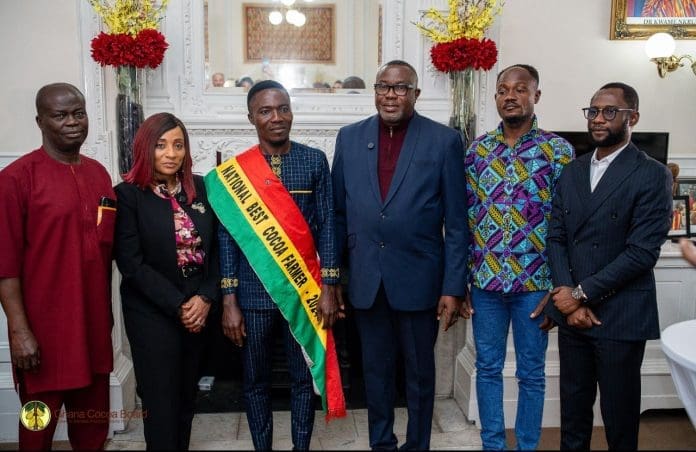
Cocobod Honours National Best Cocoa Farmers In London
Ghana Cocoa Board (COCOBOD) has honoured the nation’s 2024 National Best Cocoa Farmers at a special reception held at the Ghana High Commission in London, celebrating their outstanding contributions to the country’s world-renowned cocoa industry.
Speaking at the event, the Chairman of the Board of Directors of COCOBOD, Dr Samuel Ofosu-Ampofo commended the award-winning farmers for their hard work, dedication, and commitment to excellence, describing them as the backbone of Ghana’s cocoa success story.
The Board Chairman emphasized that the London visit was designed to expose the farmers to the broader cocoa value chain, including the international markets, chocolate manufacturers, and consumers who enjoy the end products of their labour. He encouraged them to use the experience to exchange ideas, build networks, and gain insights into evolving global trends affecting the cocoa sector.
“Your presence here in the United Kingdom marks not only a well-deserved recognition of your hard work and dedication, but also a continuation of COCOBOD’s proud tradition of celebrating excellence among our farmers,” the Chairman said.
He praised the trailblazing cocoa farmers as “true heroes of Ghana’s cocoa story,” urging them to continue serving as role models and ambassadors of Good Agronomic Practices (GAPs) within their communities. He encouraged them to share the experiences gained from the trip with their colleagues to inspire the drive for innovation and excellence to sustain Ghana’s cocoa sector.
Reaffirming COCOBOD’s commitment to improving farmer welfare, the Chairman highlighted ongoing initiatives in farmer training, climate-smart agriculture, rehabilitation of old farms, and the implementation of traceability systems aligned with emerging international standards, including the European Union Deforestation Regulation (EUDR).
He also underscored the importance of collaboration with global partners and chocolate manufacturers to promote sustainable and fair cocoa production. “Through stronger partnerships we can secure a more equitable and resilient future for Ghanaian cocoa farmers” he added. Ghana’s High Commissioner to the United Kingdom, H.E. Mrs. Sabah Zita Benson, congratulated the farmers for distinguishing themselves in the various award categories and reaffirmed the Mission’s commitment to strengthening collaboration with key stakeholders in the cocoa industry in the United Kingdom to drive investment and ensure the sustenance and growth of the industry
H.E. Mrs. Zita Benson admonished the farmers to desist from engaging in illegal mining and cocoa smuggling, which currently pose major challenges to the cocoa industry, and encouraged them to collaborate with COCOBOD and the security agencies in combating these environmental and economic vices.
She urged the farmers to continue as ambassadors of sustainable agriculture in Ghana to inspire and attract the youth to invest in cocoa farming as there are numerous economically viable opportunities along the cocoa value chain to gain from.
The 2024 National Best Cocoa Farmer, Mr. Kwame Alex, expressed his gratitude to COCOBOD and the Government for the honour bestowed on him and his colleagues, and for providing them with the exposure and platform to showcase their contributions, which continue to positively impact Ghana’s economy.
“This tour and the interactions with different stakeholders in the cocoa sector have enriched my experience and will go a long way to inspire me to do more. What I have observed will enable me to share my knowledge with the youth and inspire them to engage in sustainable cocoa farming and other agricultural ventures” he pledged.
Richard Kumadoe – Fraud Prevention Expert and Security.Consultant
Mr Richard Kumadoe, a Fraud Prevention Expert and Security Consultant, has described fraud as a “terrible canker capable of destroying businesses and nations faster than a tornado” if not effectively checked.
Mr Kumadoe, speaking to the Ghana News Agency (GNA) at Sege in the Ada West District as part of the Anti-Fraud Global Campaign, stressed the need for stronger anti-fraud strategies and collective national commitment to combat corruption and financial crimes.
He said fraud, financial crime, money laundering, and related criminal activities should not only be prevented and detected on time by anti-fraud agencies but also be abhorred and stopped at all costs.
Mr Kumadoe noted that one of the major challenges facing state investigative and prosecution institutions was the lack of capacity to successfully handle corruption and political fraud cases without political interference and judicial delays.
“In most cases, political fraud and related crimes should not only be seen to be investigated, but the culprits must be punished. A successful exercise of search, seizure, and confiscation of properties acquired through crime proceeds would go a long way to restore public confidence—even among young children observing society,” he said.
He added that the absence of a deliberate national anti-fraud strategy and a strong regime for forfeiting crime proceeds such as assets and properties remained a major setback in Ghana’s fight against corruption and financial crime.
According to him, frequent fraud and financial crime occurrences distorted economic systems, worsen inequality, and undermine the nation’s stability.
“Fraud creates unfair credit and economic systems and worsens the plight of the less privileged. This imbalance is unhealthy for any nation,” he said.
Mr Kumadoe urged frontline anti-fraud officers to continue exposing the negative influences of political fraud and work in collaboration with other stakeholders to prevent, detect, and deter financial crimes at all levels.
Daughters of Glorious Jesus in a photograph during the ANUONYAM Concert
Legendary Ghanaian gospel group Daughters of Glorious Jesus have called on the public and gospel music lovers to continue supporting rising gospel star Mabel Okyere.
Beginning their ministration at the second edition of the ANUONYAM Concert, held on October 26, 2025, at the Redemption Assemblies of God Church, Suame–Kumasi, the iconic trio delivered a heartfelt message of encouragement to the event’s host, Mabel Okyere.
Cynthia Appiadu, a key member of the group, made a passionate appeal, saying:
“I will plead with you all to help and continue supporting Mabel Okyere. Without the necessary help and support, she can’t go as far as expected.”
The group went on to share their own story as an example of perseverance and divine grace, revealing that they too started humbly, just like Mabel.
“We started like Mabel Okyere, and by God’s grace, we are now 36 years in ministry and still counting. Thank you all for coming to support her program,” they added.
The touching appeal from Daughters of Glorious Jesus resonated deeply with the audience, underscoring the importance of unity, mentorship, and sustained support within Ghana’s gospel music fraternity.
The ANUONYAM Concert, hosted annually by Mabel Okyere, continues to gain momentum and recognition, attracting both veteran and emerging gospel artistes. This year’s edition featured powerful performances from Georgia Adjei, Uncle Ato, Isaac Frimpong, Kwaku Gyasi, Odehyieba Priscilla, and many others.
The teenager suspects that a black pick-up vehicle is behind Fuseini Mohammed disappearance
A 16-year-old boy has appealed to security authorities and the government to help bring his father back home safely after he was kidnapped in Dambai.
Fuseini Mohammed, the teenager, shared the traumatic experience his family was going through since his father’s abduction and expressed concerns about their well-being, stating that his father was the sole breadwinner.
According to him, he had gained admission to Yabram Community Day Senior High School but unable to report due to his father’s absence.
Speaking to Ghana News Agency (GNA), he revealed that his sibblings have also stopped attending school, fearing they might be kidnapped on their way.
The teenager suspects that a black pick-up vehicle, spotted patrolling their area on the day of his father’s abduction, might be involved in the incident.
The teenager’s emotional plea highlights the plight of families affected by such incidents and the need for swift action to ensure the safe return of the abducted individual.
Meanwhile, Assistant Superintendent of Police (ASP), John Nchor, Acting Oti Regional Public Affairs Officer, who confirmed the incident to the GNA assured the public that the police will release their findings soon, promising transparency and thoroughness in their investigations.
Former Watford captain Troy Deeney believes Antoine Semenyo has the potential to play for Real Madrid if he continues his brilliant form for Bournemouth this season.
Semenyo has been one of the standout performers in the Premier League, helping the Cherries climb to second place on the table.
The Ghanaian forward has scored six goals and provided three assists in just nine matches, playing a pivotal role under manager Andoni Iraola.
Speaking to talkSPORT, Deeney said, “I just don’t know if Semenyo can keep it up, do you know what I mean? If he does, then my God, he’ll probably end up playing for Real Madrid. But I think he’s very good, very powerful, very direct.”
Semenyo’s pace, strength, and improved finishing have transformed him into one of the league’s most dangerous forwards.
His performances have not only caught the eye of pundits but also top European clubs monitoring his progress.
Having joined Bournemouth from Bristol City, the 25-year-old has grown rapidly under Iraola’s attacking system. Deeney’s praise adds to the growing recognition of Semenyo’s evolution into a complete forward capable of performing at the highest level.
With Bournemouth fighting near the top and Ghana preparing for the 2026 World Cup, the coming months could be crucial for Semenyo’s rise to global stardom.
A new study has indicated that household air pollution is a major contributory factor to the sharp rise in Chronic Obstructive Pulmonary Disease (COPD) deaths over the last three decades in Ghana.
The study, published by Frontiers in Medicineand conducted by Emmanuel Mensah, Min Liu, Lingling Pan, Wei Lu, Susheng Zhou, Liqin Zhang, Yusheng Cheng, Shuoshuo Wei andLei Yusheng Zha, found that “Ghana’s absolute COPD burden is increasing, driven by preventable risk factors such as household air pollution.”
The study noted that from 1990 to 2021, COPD deaths in Ghana rose by 157% from 693 to 1,782, despite deaths only rising by 49% globally.
“Ghana’s age-standardised death rate (ASDR) declined by only 7%, far below the global reduction of 37%. COPD prevalence in Ghana tripled, rising from 0.1 to 0.3 million, while incidence increased by 215% and Disability-Adjusted Life Years (DALYs) by 171%.”
Household air pollution from solid fuel use was identified as a major contributor to COPD deaths in Ghana, accounting for 40% of the lives lost, followed by ambient air pollution, which was linked to 25% of COPD deaths.
Worldwide, the trends were quite different, with particulate matter pollution linked to 41% of COPD deaths globally, ahead of smoking, which accounted for 36%.
Projections show an increased prevalence and incidence in adults aged 40-64, with mortality increasing significantly at the age of 60, with males at higher risk.
Source: State of Global Air 2025 report
State of Global Air
The recently released State of Global Air 2025 report also noted the impact of household air pollution on Ghana’s populace.
4,541 deaths amongst children under 10 years old were linked to household air pollution, mostly from cooking with solid fuels, like wood, charcoal and dung, while 12,790 deaths were recorded amongst persons aged between 50 and 85.
In total, the number of deaths attributable to HAP from solid fuels in Ghana saw a slight decline from 23,400 in 2022 to 23,100 in 2023.
Globally, HAP was responsible for 2,763,000 deaths in 2023, a drop from 2,904,000 deaths the previous year.
Low and middle-income countries like Ghana, where a large percentage of the population still use solid fuels like charcoal and wood to cook, contributed to 90% of deaths worldwide.
ClickHERE for the full State of Global Air 2025 report
Clean fuel
Emmanuel Mensah, Min Liu, Lingling Pan, Wei Lu, Susheng Zhou, Liqin Zhang, Yusheng Cheng, Shuoshuo Wei andLei Yusheng Zha suggested in their study that targeted policies to reduce the use of solid fuels, like clean cook-stove programmes, could be beneficial for countries like Ghana in reducing their COPD burden, while improved air quality monitoring would help identify high-priority areas for policy implementation.
This story was a collaboration with New Narratives. Funding was provided by the Clean Air Fund, which had no say in the story’s content.
Veteran Yoruba actor Ebun Oloyede, popularly called Olaiya Igwe, has shared one of the deepest regrets of his life.
The actor said his regret was refusing to lend his car to gospel singer Tope Alabi and her husband for their wedding.
Naija News reports that he narrated the incident during Tope Alabi’s 55th birthday celebration, recalling how he had just bought a Mercedes-Benz V-Boot, proudly labeled “Ololade Mr Money 1” after the success of his film.
Accra, Oct. 31, GNA – The Design and Technology Institute (DTI) has commissioned Africa’s first American Welding Society (AWS)-certified Welder Training and Testing Centre, marking a significant milestone in Ghana’s technical and vocational education and training (TVET) landscape.
The state-of-the-art facility, located at DTI’s campus, is equipped with a 40-booth workshop, digital welding simulators, and a metallurgical training laboratory.
It is designed to train and certify Ghanaian welders to international standards, positioning them for opportunities both locally and globally.
Speaking at the commissioning ceremony, Dr. Archibald Buah-Kwofie, Acting Director of the Nuclear Power Institute at the Ghana Atomic Energy Commission, described the centre as a “strategic national asset” and a “catalyst for transforming Ghana’s TVET landscape.”
“This facility is not just another training centre. It is a bold statement that Ghana is ready to train its youth to world-class standards,” he said.
Dr. Buah-Kwofie also underscored the importance of welding in Ghana’s emerging nuclear energy sector, noting that certified welders would be critical in the construction and maintenance of future nuclear facilities.
He called for a national welding dialogue to establish a framework for standardizing training, aligning curricula, and certifying welders across the country.
“This commissioning must inspire us to do more. Every region of Ghana should have access to a world-class TVET facility,” he added.
DTI President, Ms. Constance Swaniker, highlighted the institute’s five-year journey advocating for stronger collaboration between academia and industry.
She noted that the skills mismatch between graduates and industry needs has contributed to high youth unemployment and low productivity.
“DTI’s 70% employability score, validated by the ISE assessment, is a testament to our commitment to co-designed curricula, entrepreneurship training, and industry-led instruction,” she said.
The centre integrates soft skills training facilitated by clinical psychologists and arts-in-education specialists, ensuring graduates are not only technically competent but also emotionally intelligent and workplace-ready.
Ms. Swaniker said the initiative reflected a growing alignment between the public and private sectors to build a skilled, confident, and globally competitive workforce among Ghana’s youth.
She said the Centre, equipped with a 40-booth workshop, digital welding simulators, and a metallurgical testing laboratory, will offer internationally certified training and testing services to meet the demands of both local and global industries.
“This Centre sets a new benchmark for human capital development in Ghana’s TVET sector,” Ms. Swaniker said.
“It creates dignified, well-paying job opportunities for our youth, reduces costs and delays for industry, and transforms petroleum revenues into human capital dividends for Ghana.”
Ms. Swaniker highlighted the importance of bridging the gap between academia and industry, noting that the disconnect had contributed to high youth unemployment and limited productivity.
She cited global examples from China and India where structured collaboration between academia and industry has led to innovation and job creation.
She said DTI’s efforts over the past five years—including strategic partnerships, curriculum alignment, and work-based learning initiatives—had resulted in a 70 percent employability score for its graduates, according to the IFC Vitae Assessment.
The Centre adopts the AWS SENSE curriculum and aims to produce highly skilled welding and fabrication professionals who meet international standards.
It will also serve as a hub for training, inspection, and testing services for the industry.
Ms. Swaniker expressed gratitude to the Mastercard Foundation and other stakeholders for their continued support in advancing TVET in Ghana.
Mr Isaac Tetteh, DTI’s Welding and Fabrication Department Head, emphasized the centre’s role in producing globally competitive welders aligned with AWS, ASME, and ISO standards.
He called for strategic partnerships with international certification bodies and local regulators to expand certification opportunities and support Ghana’s industrialization agenda.
Additionally, he highlighted its state-of-the-art Mechanical and Metallurgical Testing Laboratory as a game-changer for the country’s industrial sector.
“For the first time in Ghana’s TVET space, organisations in oil and gas, power generation, mining and construction can conduct all required mechanical tests and welder qualifications locally,” Mr. Tetteh said, adding that it would significantly reduce dependency on international testing services and support local content development.
Furthermore, he announced plans to position DTI as the continent’s ‘Welding Centre of Excellence’ through strategic partnerships with globally recognised bodies such as DNV and ABS.
These collaborations will pave the way for advanced professional certifications, including Certified Welding Inspector and NDT certifications, crucial for the Ghana’s industrialisation and energy transition.
Moreover, Mr. Tetteh reaffirmed centre’s commitment to holistic development, integrating soft skills training facilitated by clinical psychologists to produce “well-rounded professionals who are not only technically competent but also emotionally intelligent, disciplined, and industry-ready.
The Centre adopts the AWS SENSE curriculum and aims to produce highly skilled welding and fabrication professionals who meet international standards.
It is expected to reduce reliance on foreign labour, enhance local content in major infrastructure projects, and create dignified, well-paying jobs for the country’s youth. GNA Christian Akorlie
Accra, Oct 31, GNA- As part of touching base with NDC party faithful, a former Deputy Upper West Regional Minister and former District Chief Executive , Mr Abu K. K., has commenced a week-long thank-you tour of the Daffiama/Bussie/Issa (DBI) Constituency. The aim was to express appreciation to National Democratic Congress (NDC) executives and supporters for their immense contribution to the party’s resounding victory in the 2024 general election.
In a statement copied to the Ghana News Agency in Accra on Friday, Mr Kasangbata explained that the visit was a continuation of his long-standing commitment to the grassroots, recalling how he personally toured the constituency during the 2024 campaign period to mobilize support for the NDC’s presidential and parliamentary candidates. He said it was only right to return and thank the people for responding positively to his call and working tirelessly to secure victory for the party.
“As part of the exercise, the meetings were clustered into two and held at Tabiasi and Wogu clusters, in the ultra-modern party offices constructed by Hon. Abu K. K. himself as his personal contribution to the NDC’s development in the constituency”.
The tour, according to the statement officially began on 29th October 2025 in the Issa Zone, aims to recognize and celebrate the selfless contributions of zonal and polling station executives whose dedication and commitment ensured a decisive win for the party.
Addressing the gatherings, the formerDeputy Upper West Regional Minister commended the executives for their hard work and loyalty throughout the campaign period and encouraged them to remain proud of the choice they made, stressing that the NDC government had already begun implementing sound economic policies.
He cited the decline in inflation and improved economic performance within the first nine months of the NDC government as evidence that the party’s leadership was delivering on its promises to restore stability and growth to the Ghanaian economy.
Mr Abu also acknowledged the high expectations among party members but urged them to exercise patience, unity, and faith in the government’s ongoing efforts to address their needs. He reminded them that meaningful progress could only be achieved when the NDC remained in power and called for continued togetherness to sustain victory in future elections.
Using himself as an example, the former Deputy Regional Minister advised supporters not to lose hope if their personal expectations have not yet been met. He assured them that the party valued every contribution and would ensure that all loyal members were duly recognized in due course.
He reaffirmed his unwavering commitment to the development of the Daffiama/Bussie/Issa Constituency and the Upper West Region, urging members to remain steadfast, disciplined, and united behind the NDC government as it continued to deliver on its mandate for a better Ghana.
As part of the next phase of his thank-you tour, he was expected to visit the Fian, Bussie, and Daffiama zones, where he would engage party members and stakeholders to complete the land acquisition process for the construction of similar ultra-modern party facilities across the constituency—further demonstrating his dedication to strengthening the NDC’s grassroots structures and promoting inclusive development.
He indicated that after the first leg of his thank-you tour in the DBI Constituency, he will continue to all other constituencies in the Upper West Region, where he actively participated during the campaign period. “These include Nadowli-Kaleo, Lawra, Lambussie, Nandom, Sissala West, Sissala East, Jirapa, and Wa Central, where he intends to replicate similar engagements with party members and stakeholders.” GNA Edited by George-Ramsey Benamba
The business community says reliable and affordable energy will be crucial to sustaining the country’s industrialization drive as government advances plans for a 24-hour economy.
President of the Ghana Union of Traders Association (GUTA), Joseph Obeng, speaking on the sidelines of the Power Energy Ghana Expo and BuildExpo Ghana 2025, said high energy costs continue to pose a major challenge for manufacturers and traders seeking to expand their operations.
As part of it recommendations, GUTA is urging greater efforts to scale up the adoption of renewable energy, emphasizing the need to make clean energy sources more affordable and accessible to businesses.
“In our quest to industrialize as a nation, it is very important we have affordable energy sources otherwise it will be in vain because of competition with the rest of the world. It is very important for us to access affordable energy sources rather than the old and obsolete ones that produce energy at a higher cost,” he said.
Deputy Energy Minister, Richard Gyan-Mensah, speaking on behalf of the sector minister, outlined key initiatives being implemented to transform Ghana’s energy sector and enhance efficiency across the value chain.
“Here in Ghana, we recognise that energy is the backbone of industrialisation – every factory that opens, every business that expands, and every home that lights up is powered by the silent force of electricity and infrastructure.
“That is why Government continues to prioritise reforms, innovation, and private sector collaboration to build a more resilient, inclusive, and future-ready energy economy.
“The Ministry has embarked on major reforms across the entire energy value chain. These include IPP tariff rationalisation to ensure affordability while protecting investor confidence, competitive and transparent procurement frameworks for all new generation and infrastructure projects, strengthening the Cash Waterfall Mechanism to guarantee fair and predictable payments across the sector, accelerating renewable energy adoption including the localisation of solar assembly lines and battery storage solutions, digitalisation of sector operations – from data-driven planning to smart distribution systems and crucially, enhancing local content participation so that Ghanaian enterprises can become integral players in our green transition,” he added.
India’s High Commissioner to Ghana, Manish Gupta, also expressed his country’s commitment to strengthening bilateral cooperation with Ghana, particularly in key sectors such as energy, trade, and technology.
Okyeame Kwame interacting with Dr Zanetor Agyeman-Rawlings
Kwame Nsiah-Apau, alias Okyeame Kwame, has mourned the passing of former First Lady Nana Konadu Agyeman-Rawlings.
In a Facebook post on Thursday, October 30, 2025, the rapper and singer-songwriter shared photos from when he and his family visited the Ridge residence of the Rawlings’ to commiserate with them.
OK, as he is sometimes called, penned a moving eulogy to Agyeman-Rawlings as caption.
He underlined her strength and said she was a glowing example he was proud to point to whenever he encouraged girls who were evaluating their suitors.
The Hiplife icon emphasised his appreciation of the grave moment the Agyeman-Rawlings children were in, given that their patriarch, former President Jerry John Rawlings, passed in 2020, and now their matriarch had joined him.
He admitted he did not know what he would do were his mother to join his late father.
Okyeame Kwame highlighted his grief when he revealed he could not muster words of condolence for the Agyeman-Rawlings who, apparently, recognised him as a son of their mother.
The decorated musician assured his words would be saved for a tribute song to be released soon.
“My father died a long time ago and I still cry sometimes because I miss him dearly,” OK wrote.
“My mother is still alive, but I know that no amount of meditation and mindfulness can prepare me for her departure.”
He said, “When I visited the Rawling’s Family, I couldn’t say any words of encouragement cos I know their pain goes deeper than my words.
“Awwww, awww, ohhhhh!” he cried, remembering: “Mrs Agyemang Konadu was so strong. She was so full of life and smiles. She was that example I could point to when I was telling young girls to see the potential in men instead of their cash and power. She was a powerhouse of strength, patience and dedication.”
“I have lost a Mum and a motivator,” he grieved, emphasising: “Ghana, due due due [woe, woe, woe].”
“When I greeted her youngest daughter she said, ‘Mummy’s other Son’. I couldn’t hold my tears back,” the author noted.
“I will put my pain in a song for such a great woman,” he promised, praying: “Da yie [rest in peace]!”
Nana Konadu Agyeman-Rawlings passed on October 23, at Ridge Hospital, Accra. She was 76.
The Founder and leader of Open Arms Ministry, St Sark, has fiercely criticised President John Dramani Mahama for his perceived failure to decisively tackle illegal mining, popularly known as galamsey.
St Sark, a disappointed spiritual leader, accused President Mahama of relaxing his stance despite previous campaign pledges to eradicate the menace, questioning why a state of emergency has not been declared.
Speaking at a passionate press conference held at his church premises, the controversial man of God asserted that all forms of mining activities, except deep mining, should be immediately halted to safeguard the nation’s future.
St Sark, who expressed deep concern over the devastating impact of galamsey, including the loss of innocent lives, birth deformities and various ailments, lamented the destruction caused by a “few greedy individuals” at the expense of the majority.
He vehemently dismissed arguments that declaring a state of emergency would lead to job losses for an estimated 4 million Ghanaians involved in mining.
Describing such comments as ‘senseless,’ St Sark declared that “Galamsey kills more than every disease in Ghana.
“Trying to shield individuals involved means we don’t know what we are doing as a nation.”
The furious man of God highlighted the plight of over 15 million farmers, whose livelihoods and farmlands are being destroyed by galamseyers.
He argued that it is illogical to prioritize the employment of 4 million “destroyers” while neglecting the critical role of farmers in feeding the country and preventing starvation.
“I get annoyed whenever I hear such an argument from people,” St Sark stated.
“If you say declaring a state of emergency could render about 4 million Ghanaians jobless, what about the over 15 million farmers who have had their farmlands destroyed by these wicked individuals who are enemies of God?
“Are these innocent farmers not rendered jobless, and our country too affected? They shouldn’t annoy me with such arguments.”
He further disclosed that thorough research had revealed that almost 90 percent of individuals engaged in galamsey already possess other jobs.
“Go and ask if most of these miners do not have jobs already. Over 90 percent of them already have jobs. Why are we doing these things to ourselves as a nation?” he quizzed.
He identified many as drivers, mechanics, masons, steel benders and carpenters who are lured into mining by the pursuit of quick money and greed, ultimately leading to environmental degradation.
Drawing on biblical references, St Sark emphatically declared that all who destroy water bodies, forests, and lands, as well as those who condone such acts, are “the worst enemies of God.”
He therefore issued a stern warning to President John Dramani Mahama, urging him to cease condoning these individuals with “flimsy excuses” and to promptly declare a state of emergency.
St Sark expressed profound disappointment that the former president had failed to take this decisive action even after a recent meeting with Civil Society Organizations (CSOs).
Tragedy as farmer drowns while seeking loan to send child to SHS
The wait is over! The GhanaWeb Excellence Awards 2025 is officially launched. Let’s Celebrate impact, innovation and excellence across Ghana.
Who deserves to be honoured this year?
Nominate now 👉 https://ghanaweb.com/ghanaexcellenceawards/nominate
The Super Eagles will face Gabon’s Panthers in the first semi-final on Thursday, November 13
The Nigeria Football Federation (NFF) has confirmed that the Super Eagles will open camp in Rabat, Morocco, on Sunday, November 9, as preparations begin for the 2026 FIFA World Cup playoffs.
Head coach Eric Chelle is expected to unveil his squad list for the crucial mini-tournament next week, as Nigeria target qualification for the intercontinental playoffs, a pathway that could secure Africa’s 10th World Cup slot.
The Super Eagles will face Gabon’s Panthers in the first semi-final on Thursday, November 13, 2025 while Cameroon and the Democratic Republic of Congo will contest the second semi-final.
The winners of both matches will meet in the final, with the eventual champion earning the right to compete in the intercontinental playoff.
The Confederation of African Football (CAF) is set to conduct a “draw” to determine the venues for the matches.
However, both the El Barid Stadium and the Prince Moulay El Hassan Sports Complex in Rabat have been earmarked as potential hosts for the fixtures.
Nigeria are aiming to return to the World Cup after missing out on the 2022 edition in Qatar and Chelle’s side will be eager to make a strong statement when camp opens next week.
Former Manchester United midfielder Paul Scholes says he stopped doing commentary work to fit his schedule around the routine of his autistic son Aiden.
The former England playmaker co-parents the 20-year-old with his ex-wife.
After retiring as a player in 2013, the 50-year-old moved into management before working in the media as a pundit and commentator.
“Everything I’m going to do now just works around him,” Scholes said on the Stick to Football podcast.
“I do studio work, but everything is built around his day.
“Last season on Thursday nights I’d do the Europa League for Manchester United. That’s the night I’d usually have him, so he was getting all agitated, biting and scratching. He knows the pattern’s not there straight away.”
Scholes initially kept his son’s diagnosis secret during his playing career and revealed he was dropped by United manager Sir Alex Ferguson while attempting to handle the situation privately.
“I never got a break from it, even when playing – it was very hard in those days,” Scholes, one of United’s key players in the 1999 Treble season, added.
“I don’t think they diagnosed it until he was two-and-a-half years old. But you knew early something was wrong, but then you get the diagnosis, and I’d never heard of it.
“I remember the first time after it, we were playing Derby away and I just didn’t want to be there.
“I remember the manager dropped me the week after, and I hadn’t told anyone. I ended up telling them a few weeks later, as it was quite hard.
“Even now, I don’t want sympathy or anything. I just thought, even if I did speak to someone about it, it’s not going to help Aiden.
“The big concern now is, because you’re getting a bit older, what happens when you’re not here? That’s the thing that’s now on my mind all the time.”
Autism spectrum disorder – its medical name – is the name for a range of conditions that affect how a person communicates and interacts with the world around them, as well as their interests and behaviour.
It is not a disease or an illness, but a condition that somebody is born with, and it is estimated that one in every 100 people in the UK is autistic.
DISCLAIMER: The Views, Comments, Opinions, Contributions and Statements made by Readers and Contributors on this platform do not necessarily represent the views or policy of Multimedia Group Limited.
DISCLAIMER: The Views, Comments, Opinions, Contributions and Statements made by Readers and Contributors on this platform do not necessarily represent the views or policy of Multimedia Group Limited.
The State of Global Air 2025 report has revealed that about a third of deaths from Chronic Obstructive Pulmonary Disease (COPD) in Ghana are attributable to air pollution.
Data from the report, produced by the Health Effects Institute (HEI), in collaboration with the Institute for Health Metrics and Evaluation (IHME) and the NCD Alliance, also indicated that 33% of deaths from both lung cancer and neonatal outcomes were also caused by air pollution, while 39% of lives lost from Ischemic heart disease could be linked to contaminated air.
What is COPD?
Chronic Obstructive Pulmonary Disease (COPD) is a common lung disease that restricts airflow and causes breathing problems.
Emphysema, which is when your alveoli become damaged and enlarged, causing shortness of breath and chronic bronchitis, where your large airways become inflamed, narrowing your airways, creating lots of mucus and inducing a cough, are examples of COPD, but people who suffer from either often suffer symptoms of both.
COPD can trap bacteria in your lungs, leading to infections, and also prevent oxygen from getting into your body, causing complications like Pneumonia and respiratory failure.
Source: Health Effects Institute. 2025
A study published by Frontiers in Medicine and conducted byEmmanuel Mensah, Min Liu, Lingling Pan, Wei Lu, Susheng Zhou, Liqin Zhang, Yusheng Cheng, Shuoshuo Wei andLei Yusheng Zha, found that “Ghana’s absolute COPD burden is increasing, driven by preventable risk factors such as household air pollution.”
The study found that from 1990 to 2021, “Ghana saw a 157% increase in COPD deaths (from 693 to 1,782), compared to a 49% global increase. Ghana’s age-standardised death rate (ASDR) declined by only 7%, far below the global reduction of 37%. COPD prevalence in Ghana tripled, rising from 0.1 to 0.3 million, while incidence increased by 215% and Disability-Adjusted Life Years (DALYs) by 171%.”
32,500 deaths
Air pollution remains a significant threat to lives in Ghana, with 32,500 confirmed to have died in 2023, according to the The State of Global Air 2025 report.
The new figure is a nearly two percent rise from the previous year, which saw about 31,900 deaths in the country attributed to air pollution.
While the new numbers pale in comparison with those from China, which recorded 2,051,000 deaths in 2023 and India, whose air pollution-attributable deaths rose to 2,006,000 that year, the ratio of the deaths to the population in Ghana remains disproportionately high.
470,000 lives were lost from ozone, most of which were linked to COPD.
“It will get me into trouble again!” laughs Ghana President John Mahama upon the conclusion of our interview.
A few weeks earlier, Mahama’s Foreign Minister had visited the U.S. State Department, only to be immediately confronted with an op-ed that his boss had written for the U.K. Guardian newspaper. In it, Mahama eruditely excoriates U.S. President Donald Trump’s baseless claims of a white genocide in South Africa and calls his “unfounded attack” on its President Cyril Ramaphosa in a fractious Oval Office meeting “an insult to all Africans.”
“They asked, ‘Did your President actually write this?’” Mahama tells TIME in his presidential office within Accra’s Jubilee House. “He says, ‘Yes, my President is a writer and likes to express himself.’ And they said, ‘Well, he’s President now. Can you ask him to put his pen down?’”
Even if Mahama does acquiesce and pause his writing, it’s extremely doubtful he will ever stop shooting from the hip. On Sept. 25, the 66-year-old used a speech at the U.N. General Assembly to accuse its Security Council of exercising “almost totalitarian guardianship over the rest of the world,” while demanding that an African member be added to this apex body and the abolition of its veto power. “The future is African!” he said to rapturous applause.
President of Ghana John Mahama speaks during the United Nations General Assembly (UNGA) on Sep. 25, 2025 in New York City. Michael M. Santiago—Getty Images
A little showy, sure—but far from empty talk. By the year 2050, over 25% of the world’s population is expected to hail from the African continent, including a third of those aged 15 to 24. Africa’s combined GDP was $2.6 trillion in 2020 but is projected to reach $29 trillion by 2050. Africa boasts three of the world’s 20 fastest-growing tech hubs, including first place: Nigeria’s Lagos.
But while the trajectory is indubitable, the ascent is far from smooth, as Ghana’s recent experiences neatly encapsulate. The West African nation of 34 million has long been painted as a continental success story due to its democratic and economic stability. However, Mahama was returned for a second nonconsecutive term in January with his homeland embroiled in an acute economic malaise, characterised by a huge debt burden, soaring costs, and youth unemployment at a staggering 38.8%.
In just half a year, Mahama succeeded in restoring stability—halving inflation, strengthening the national cedi currency by 30%, and embarking on a radical “Resetting Ghana” agenda. He rolled out a 24-hour economy to empower businesses and public institutions to operate around the clock, abolished onerous levies on online purchases and betting wins, and established a code of conduct for all government officials to fight corruption.
He pledged to wipe fees for all first-year students in public tertiary institutions and distribute free feminine hygiene products to school-age girls nationwide. To fight joblessness, he unveiled plans to train one million coders over four years, providing the talent to bolster a nascent tech sector.
“We must improve security to make sure that the streets are safe for people to be able to go to work and come back,” says Mahama. “So we know what our responsibilities are.”
But politics is dealing with the unforeseen, and an almighty curveball was looming over the Pacific. Less than three weeks after Mahama’s Jan. 7 inauguration, the Trump Administration began gutting USAID, which had allocated $12.7 billion to sub-Saharan Africa, accounting for 0.6% of the region’s GDP.
According to the Pretoria-based Institute of Security Studies, the aid cuts could push 5.7 million more Africans into extreme poverty by next year. Meanwhile, two to four million additional Africans are likely to die annually as a result of reduced global aid budgets, estimates the Africa Centre for Disease Control and Prevention. Within South Africa alone, cuts to HIV/AIDS programs could result in an additional 500,000 deaths over the next decade, reports the Desmond Tutu HIV Centre.
Ghana lost $156 million allocated for HIV and AIDS control, combating malaria, as well as research, governance, and education. Still, the cuts were “not fatal,” says Mahama. “All I did was to tell our Finance Minister to make adjustments … so we have covered it with our budget. We’re fine, but not so in some other countries. I was speaking to one of my colleague presidents, and the USAID withdrawal has shut down their school feeding program. With countries like that, it will have quite a huge effect.”
As such, Mahama’s term coincides with a new paradigm for Africa. Despite vast agricultural and mineral wealth, the continent faces limited access to global markets, unfair trading conditions, and a lack of investment. These challenges hinder economic growth, perpetuate poverty, and prevent many Africans from realising their full potential.
The hope is that, armed with new technology, the decline of foreign aid serves as a rallying call that compels African countries to forge their own paths, free from the constraints of aid dependency and external policy pressures. And while challenges persist, there are already signs that hidebound profligacy is being replaced by newfound autarky. “Ghana will manage,” says Mahama. “And it teaches us to be self-reliant.”
Mahama talks with an unruffled, languid poise that belies the candour of his words—a fitting tribune for a new era of African confidence. He was born in the small town of Damongo in Ghana’s bucolic northwest. His father was a prominent rice farmer and local MP under Ghana’s first post-colonial leader, Kwame Nkrumah. After graduating with a degree in history from the University of Ghana, Mahama taught at a secondary school before pursuing a post-graduate degree in social psychology in Moscow, graduating in 1988. His experiences amid the Soviet Union’s death throes burnished the impression that every nation must forge its own path distinct from cookie-cutter dogma. After returning to Ghana, Mahama worked for the Japanese Embassy and Plan International NGO before standing for parliament in 1996.
Mahama’s first term as president from 2012 until 2017 might best be described as underwhelming. There was a severe power crisis and a slew of corruption allegations, including the revelation that Mahama received a Ford Expedition valued at $100,000 from a contractor while serving as vice president. (A subsequent probe cleared Mahama of graft, though it decreed the gift broke rules and the car was returned.) GDP dropped from 9.3% when Mahama began his term to a low of 2.1% in 2015.
Posters of presidential candidate John Mahama and opposition counterpart Nana Akufo-Addo are seen on a wall on Oct. 23, 2012 in Accra ahead of December elections. Pius Utomi Ekpei—AFP/Getty Images
By 2017, growth had recovered to 8.1% but by then, voters had made up their minds not to hand Mahama a second term. Yet his successor fared even worse, plunging Ghana into an economic crisis owing to fiscal mismanagement, a lack of economic diversification, and excessive public debt from unsustainable borrowing and spending. In 2022, Ghana—the world’s sixth-biggest producer of gold and number two exporter of cocoa—defaulted on its domestic and foreign debt obligations.
It hasn’t taken long for Mahama to steady the ship—success rendered all the more impressive against the background of aid cuts. Problems with the aid culture are well-documented. While aid provided ready cash, only a tiny fraction actually went to African stakeholders themselves. USAID tried stridently to have a quarter of its budget spent through local organisations. However, the highest they ever achieved was about 10%, and last year, it actually dropped. “Western consulting companies, contractors, think tanks, NGOs, got a lot of the money that was meant to go to Africa,” says Bright Simons, head of research at the IMANI Centre for Policy and Education, an Accra-based think-tank. “So Africans were never able to build capacity with this money.”
In healthy economies, citizens pay income taxes in return for public goods. Repeated studies have shown how foreign aid short-circuits this relationship, making governments accountable to donors rather than constituents, who, spared the hardship of paying levies, are less likely to hold officials to account. Meanwhile, the easy access to cash gnaws away at professionalism and fosters corruption. Every year, an estimated $88.6 billion—some 3.7% of Africa’s GDP—leaves the continent as illicit capital flight, according to U.N. data.
“Aid engenders laziness on the part of the African policymakers,” writes Baroness Dambisa Moyo, a Zambia-born economist, in Dead Aid: Why aid is not working and how there is another way for Africa. “This may in part explain why, among many African leaders, there prevails a kind of insouciance, a lack of urgency, in remedying Africa’s critical woes.”
It’s criticism that has become widely accepted. Zambia’s President Hakainde Hichilema described the USAID cuts as a “long overdue” wake-up call, while his Rwandan counterpart, Paul Kagame, opined that the continent cannot “rely on the generosity of others forever,” adding: “I think from being hurt, we might learn some lessons.” While Mahama laments the way the aid Band-Aid was ripped off, he says that the end result will be positive—even if there are harsh lessons for Africa regarding U.S. priorities in this new world order. Aside from the aid withdrawal, the Trump Administration has hiked tariffs across Africa, including 15% on Ghanaian exports. Mahama cannot hide his frustration.
“One country cannot say, ‘I want to be an island by myself, so I’ll slap tariffs on you because I want to bring manufacturing back,’” says Mahama. “These tariff negotiations took many years under the WTO to achieve, and so for one person to start slapping everybody with tariffs.” Mahama breaks off in exasperation. “I don’t think it’s a very effective way of conducting foreign policy.”
What the aid cuts and tariff hikes mean for America’s standing overseas remains to be seen. After all, USAID was founded by President John F. Kennedy by executive order in 1961 at the height of the Cold War precisely to counter overseas Soviet influence. Today, the U.S. is embroiled in a new era of Great Power competition with China, whose clout is swelling across the globe, not least in resource-rich Africa. Mahama says the Trump administration’s nativist pivot “takes away U.S. soft power and opens [Africa] up for other players to come in.”
It’s not just superpowers that are clamouring for a piece of the action. Gulf nations, India, and Europe are seeking to leverage the opportunity. In August, London Mayor Sadiq Khan made the first-ever African trade mission by a holder of his office, visiting Ghana as well as Nigeria and South Africa. “At a time when President Trump is attacking international students, we in the U.K. should be encouraging talented international students to come to our British universities,” he told TIME in Accra.
Still, the U.S. denies that it is in retreat, with the State Department highlighting the more than 100 American companies doing business in Ghana across many sectors, including oil and gas, healthcare, small modular nuclear reactors, and mining. On July 24, Google launched its Artificial Intelligence Community Centre in Accra alongside $37 million in support for research and innovation in Africa. In particular, Rolf Olson, Chargé d’Affaires ad interim at the U.S. Embassy in Accra, insists to TIME that Washington is “ready to partner with President Mahama and his administration in combating illegal and corrupt activity” such as illegal gold mining, which he says “has been fed by foreign actors, including Chinese firms and nationals.”
Yet the adversarial tone isn’t shared by Mahama, who says “the Chinese government has been supportive” of law enforcement efforts. “I don’t like to focus on just China.” And the fact that Washington is quite clearly preoccupied with Beijing renders the new U.S. posture “surprising,” says Mahama. “I can understand U.S. insecurity when it comes to China … but that’s when you need your allies. That’s when you need Canada, that’s when you need Mexico, that’s when you need the E.U. But if you are threatening the E.U. and all others with 50% tariff increases, South American countries with 100% tariff increases, you can’t tell the objective of this whole policy. Collaboration would have been better than the current global tensions.”
Washington’s efforts to paint China as the bad guy are undermined by the clear perception that American engagement is now rooted in interests rather than values. Still, while China has been ramping up its overseas investment, especially through its $1 trillion Belt and Road Initiative—a trade and infrastructure network spanning the globe—there’s little chance it will (or even wants to) replace U.S. wholesale.
While Beijing is laser-focused on ports, pipelines, and railways, the type of capacity-building engagement long characterised by USAID isn’t part of their strategy. China won’t fund projects promoting gender equity, affirmative action, training impartial judges, or improvements on regulatory performance in African nations, as these are not things that its government values at home.
Although self-reliance is Africa’s goal, the challenge is achieving true autonomy without structural transformation of nations that remain highly unproductive. Every country around the planet that has achieved structural transformation—from the Asian Tigers to the Balkans—has relied on large injections of foreign capital. Because when the status quo in sub-Saharan Africa is so unsatisfactory—with substandard education, healthcare, security, and so on—these tend to be the focus of domestic resources. Consequently, the bulk of future-focused projects are funded by donor agencies: green transition, incorporating AI, youth leadership, and media literacy.
In Ghana, for instance, USAID was a big investor in eco-tourism—attracting foreign visitors to nature sites to provide alternative livelihoods, so people will move away from illegal mining. “So even though the overall amount of aid is small, when you remove it, you create a very big gap in that future-rented segment of the country’s structural transformation,” says Simons of IMANI. “The future does not often appear as essential because we are so focused on the present. But the present cannot take us anywhere.”
The issue is how to inject capital without falling prey to some of the pitfalls of aid dependency. With commodity prices at record highs, Africa’s natural resource endowments are among the first areas to receive attention. And freed from the client-benefactor relationship that aid engenders, African nations are insisting upon local processing and refining to retain more of the downstream benefits.
“One thing we’d better get away from is this paternalistic attitude,” Khan says. “The ‘helping hand’ is a better approach, because people are then able to trade.”
For decades, the largesse of Western nations put their African counterparts in an awkward predicament, where they must “play polite” while the sovereignty of their resources is diluted, says Marcus Courage, CEO of Africa Practice, a business consultancy. “Now, African governments have recognised that they have more autonomy and must use it to become more self-reliant and to achieve genuine financial sovereignty.”
Guinea, the world’s top bauxite exporter, has begun mandating that foreign mining companies invest in local alumina refineries to increase value. Non-compliant firms, such as Emirates Global Aluminium, have seen licenses withdrawn. In Ghana, the nation’s first commercial gold refinery opened in August 2024, and Mahama launched a new regulator, GoldBod, to crack down on smuggling and boost state revenues. Gold exports have increased 75% year-on-year as a result. “It means that Ghana is able to get more from its gold resources,” says Mahama.
Technology can also help Africa unleash its hidden potential. The continent is home to 60% of the planet’s uncultivated arable land that is capable of sequestering immense amounts of carbon, yet only 16% of the global carbon credits market. This presents an untapped opportunity for African nations to monetise their mature forests and pristine wetlands, which are particularly prized for carbon capture. Opportunities also abound to sell credits for switching from fossil fuel stoves—some 80% of sub-Saharan Africans use wood or charcoal for cooking—to solar or biomass.
So far, Kenya, Gabon, and Tanzania have been first movers, with nations like Ghana, Uganda, and Zambia trying to catch up. The Congo Basin rainforest, for one, removes carbon from the atmosphere with a value of $55 billion per year, according to the Centre for Global Development (CGD), or equivalent to 36% of the GDP of the six countries that host the forest. “This asset can and should be seen as akin to mineral or oil deposits that have significant benefits for the countries that host them,” argues the CGD in a 2022 report.
Ghana has 288 forest reserves of which 44 have been invaded by illegal gold miners. “We’ve been able to liberate nine of them,” says Mahama. “And we have a program for starting a reclamation of those forest reserves to restore them.”
Forest wardens walk into Kyebi Forest Reserve in the East Akim Municipal district in Ghana. Cristina Addehuela—AFP/Getty Images
But it’s not just carbon. While the world gushes over Africa’s natural resources, trouble brews with utilising them—pollution, corruption, human rights abuses, and criminal infiltration. But what if there was a way to leverage such resources while they remained undisturbed? The global tokenisation of illiquid assets—everything from vintage paintings or vinyl records to collectors’ cards or real estate—is slated to become a $16 trillion business opportunity by 2030, according to the Boston Consulting Group. There is a growing clamour to use blockchain technology to tokenise commodities such as Ghana’s gold reserves, Botswana’s diamond reserves, and Zimbabwe’s platinum.
But while more efficient monetisation of natural resources would provide a shot in the arm, the crux is leveraging that windfall to diversify the economy beyond extractive industries—futureproofing economies for when commodity prices drop.
Mahama wants Ghana to move past mining and agriculture into processing and agribusiness, including foods and beverages, refined vegetable cooking oils and things like that. “We’re looking at digital services, fintechs, textiles, manufacturing,” he says.
For Mahama, Africa should not just seek to export to developed states but instead trade with itself. He cites the 2018 creation of the African Continental Free Trade Area—the world’s largest free-trade area, comprising a $3 trillion market—as an underutilised opportunity. In July, Narendra Modi came to Accra on his first visit by an Indian Prime Minister for three decades, and Mahama says the two leaders discussed sharing technology to boost Ghana’s budding pharmaceutical sector. “Already, we export [pharmaceuticals] in limited ways to our West African neighbours,” says Mahama. “But the African Continental Free Trade Area expands us beyond our 34 million population market to a 1.3 billion market.”
Of course, all this potential requires investment to realise. And while the drying up of no-strings aid money may well prove beneficial in the long term, the lack of alternative finance remains a problem. While self-financing is the ultimate goal, it will be a long road. African nations collectively possess only 20 sovereign wealth funds with a capitalisation of $97.3 billion—less than 1% of the global total.
Compounding issues, many African countries pay four times more interest on their debt than high-income nations, despite often having lower debt-to-GDP ratios. As a result, an average African government spends 18% of all state revenue on interest alone, according to the Tony Blair Institute for Global Change (TBI), compared to 3% for E.U. nations.
The TBI has proposed a new cost-efficient $100 billion debt-swap facility administered by multilateral development banks to essentially consolidate and refinance existing liabilities at concessional rates. Kenya, for one, is servicing an international loan of $1.5 billion at 9.5% interest. Refinancing at 3% would save $97.5 million annually.
Of course, $97.5 million is a colossal amount that could be used to fund schools, hospitals, and key infrastructure. Still, it is less than half the $225 million Kenya was due to receive from USAID, of which half in turn was due to be spent on healthcare. The U.S. is not the only country to slash aid—the U.K. is cutting its aid spending from 0.7% of GDP pre-pandemic to 0.3% by 2027—though the manner in USAID was atomised, combined with steep tariffs, still leaves a nasty taste for Mahama.
“Since the end of the Second World War, we’ve had a world that has been more interdependent and has dealt with international relations in a multilateral fashion,” he says. “Things are changing now. It looks like unilateralism has become the order. But it does not help anybody because the world progresses together.”
DISCLAIMER: The Views, Comments, Opinions, Contributions and Statements made by Readers and Contributors on this platform do not necessarily represent the views or policy of Multimedia Group Limited.
DISCLAIMER: The Views, Comments, Opinions, Contributions and Statements made by Readers and Contributors on this platform do not necessarily represent the views or policy of Multimedia Group Limited.
Canadian rap musician Drake is appealing the dismissal of his defamation lawsuit against Universal Music Group over Kendrick Lamar’s Grammy-winning diss track “Not Like Us,” according to a court filing on Wednesday.
Drake will ask the 2nd U.S. Circuit Court of Appeals in Manhattan to overturn the October 9 dismissal by U.S. District Judge Jeannette Vargas.
UMG releases Drake’s and Lamar’s music. It did not immediately respond to a request for comment on Drake’s appeal but has said it was pleased with the dismissal.
Drake, whose given name is Aubrey Drake Graham, sued UMG in January over its promotion of “Not Like Us,” saying the song deceives listeners into believing the false accusation that he is a pedophile.
The lawsuit follows a decade-long feud in which Drake and Lamar released diss tracks said to target each other. Lamar is not a defendant.
In dismissing the case, Vargas said Lamar’s lyrics were not defamatory because they amounted to opinion.
“Although the accusation that Plaintiff is a pedophile is certainly a serious one, the broader context of a heated rap battle, with incendiary language and offensive accusations hurled by both participants, would not incline the reasonable listener to believe that ‘Not Like Us’ imparts verifiable facts,” Vargas wrote.
The appeals process could last at least several months.
“Not Like Us” won Grammy Awards in February for record and song of the year and spent three weeks atop Billboard’s Hot 100. Lamar performed it at this year’s Super Bowl halftime show.
The newly-opened China City Mall at Santasi, Kumasi, Ashanti Region, has been razed.
The fire destroyed the business’s entire structure, together with goods therein. The incident sent shoppers and workers fleeing.
The Ghana National Fire Service (GNFS) are yet to determine the cause of the Thursday, October 30, 2025, fire but have launched an investigation into the matter.
At the scene were personnel of the National Disaster Management Organisation (NADMO), to help with recovery efforts. They have reported no casualties so far.
The England Football Association has pledged its support to the young striker
Arsenal have confirmed that English-Ghanaian forward Michelle Agyemang will miss the remainder of the season after suffering a ruptured anterior cruciate ligament.
The teenager sustained the injury during England’s 3-0 friendly win over Australia at Pride Park earlier this week.
Agyemang was stretchered off the field in visible pain after an awkward landing midway through the match.
The 19-year-old had joined Brighton & Hove Albion on loan for the 2025-26 campaign to gain regular first-team experience.
In a statement on Thursday October 30, 2025, Arsenal said, “We can confirm that Michelle Agyemang suffered a ruptured anterior cruciate ligament injury while playing in England’s 3-0 win over Australia in Derby on Tuesday.
“The 19-year-old forward will miss the remainder of the 2025-26 season as a result of the injury.
“We are in close contact with Brighton as we determine a treatment and recovery programme for Michelle.”
“We can confirm that Michelle Agyemang suffered a ruptured anterior cruciate ligament whilst on international duty.
“Wishing all the best with your recovery, Mich – we’ll be with you every step of the way.”
The England Football Association also pledged its support to the young striker as she begins her rehabilitation process.
Agyemang had been tipped as one of the brightest prospects in English women’s football and was expected to feature prominently for Brighton this season before the setback.
Posting on Instagram after her diagnosis, Agyemang expressed disappointment but vowed to return stronger.
“Disappointed that results show a torn ACL. Recovery starts now, I will be back stronger than before,” she wrote.
ACL injuries are among the most serious setbacks for footballers, often requiring several months of recovery and rehabilitation.
Agyemang’s absence is a significant blow to both club and country, but Arsenal say she will receive the best medical support available to aid her comeback.
The Majority Chief Whip, Rockson-Nelson Dafeamekpor, has blamed Committee Chairpersons for the persistent low attendance of Members of Parliament during plenary sessions.
According to him, some Committee Chairpersons deliberately schedule meetings at the same time the House is in session, making it difficult to achieve the required quorum for business to proceed.
This comes after a parliamentary attendance report revealed that a significant number of Members of Parliament (MPs) missed sittings without official permission.
The report, which covers 43 sittings held between January and March 2025, showed that a number of MPs absented themselves, some for more than 20 days without official permission.
Addressing the issue on the floor of Parliament, Mr. Dafeamekpor said despite repeated calls for a review of committee meeting times, some Chairpersons have remained uncooperative.
“The records will bear me out that I drew the attention of the leadership of the committees to this matter. Mr. Speaker, we have discovered that some leaders of committees are arranging committee business in the afternoon when we have all agreed that committee business should be arranged in the morning, so that at 2 p.m. we will be ready to conduct business in the House,” he said.
He pointed out that the day’s Order Paper contained several advertised committee meetings scheduled for the afternoon, in clear disregard of prior agreements.
“Today’s Order Paper shows that there are advertised meetings of committees for the afternoon when we had encouraged them to shift those sittings to the morning so that we have adequate numbers in the afternoon to conduct business,” he added.
The Chief Whip urged committee leaders to adhere to the agreed schedule to ensure effective participation of Members and the smooth running of parliamentary proceedings.
The government has disclosed that Ghana’s gold industry contributed GH¢88.1 billion to the national Gross Domestic Product (GDP) in 2024, with gold exports reaching US$11.2 billion as of August 2025.
Vice President Professor Naana Jane Opoku-Agyemang made this revelation during the inauguration of the Newmont Ahafo North Mine on Thursday, October 30, 2025.
She noted that the mining sector remains a key driver of Ghana’s economy, with the latest figures underscoring its central role in job creation, revenue generation, and investment attraction.
“The opening of the Ahafo North Mine is an act of partnership and progress, and the fruit of mutual respect and collaboration,” Professor Opoku-Agyemang stated.
“Last year, Ghana’s gold industry contributed GH¢88.1 billion to our GDP. Also, this year, our gold exports reached a record of US$11.2 billion. These figures demonstrate and encourage more confidence in our economy, governance, and national potential.”
The Vice President further described the over US$1 billion investment in the Ahafo North Mine as a testament to Ghana’s ability to attract major global investors.
She emphasised that the project would not only boost national revenue but also stimulate development in the Ahafo Region and beyond through local employment and community projects.
Bagbin joins IPU peace task force on Russia-Ukraine war
“It will get me into trouble again!” laughs Ghana President John Mahama upon the conclusion of our interview.
A few weeks earlier, Mahama’s Foreign Minister had visited the U.S. State Department, only to be immediately confronted with an op-ed that his boss had written for the U.K. Guardian newspaper. In it, Mahama eruditely excoriates U.S. President Donald Trump’s baseless claims of a white genocide in South Africa and calls his “unfounded attack” on its President Cyril Ramaphosa in a fractious Oval Office meeting “an insult to all Africans.”
“They asked, ‘Did your President actually write this?’” Mahama tells TIME in his presidential office within Accra’s Jubilee House. “He says, ‘Yes, my President is a writer and likes to express himself.’ And they said, ‘Well, he’s President now. Can you ask him to put his pen down?’”
Even if Mahama does acquiesce and pause his writing, it’s extremely doubtful he will ever stop shooting from the hip. On Sept. 25, the 66-year-old used a speech at the U.N. General Assembly to accuse its Security Council of exercising “almost totalitarian guardianship over the rest of the world,” while demanding that an African member be added to this apex body and the abolition of its veto power. “The future is African!” he said to rapturous applause.
President of Ghana John Mahama speaks during the United Nations General Assembly (UNGA) on Sep. 25, 2025 in New York City. Michael M. Santiago—Getty Images
A little showy, sure—but far from empty talk. By the year 2050, over 25% of the world’s population is expected to hail from the African continent, including a third of those aged 15 to 24. Africa’s combined GDP was $2.6 trillion in 2020 but is projected to reach $29 trillion by 2050. Africa boasts three of the world’s 20 fastest-growing tech hubs, including first place: Nigeria’s Lagos.
But while the trajectory is indubitable, the ascent is far from smooth, as Ghana’s recent experiences neatly encapsulate. The West African nation of 34 million has long been painted as a continental success story due to its democratic and economic stability. However, Mahama was returned for a second nonconsecutive term in January with his homeland embroiled in an acute economic malaise, characterised by a huge debt burden, soaring costs, and youth unemployment at a staggering 38.8%.
In just half a year, Mahama succeeded in restoring stability—halving inflation, strengthening the national cedi currency by 30%, and embarking on a radical “Resetting Ghana” agenda. He rolled out a 24-hour economy to empower businesses and public institutions to operate around the clock, abolished onerous levies on online purchases and betting wins, and established a code of conduct for all government officials to fight corruption.
He pledged to wipe fees for all first-year students in public tertiary institutions and distribute free feminine hygiene products to school-age girls nationwide. To fight joblessness, he unveiled plans to train one million coders over four years, providing the talent to bolster a nascent tech sector.
“We must improve security to make sure that the streets are safe for people to be able to go to work and come back,” says Mahama. “So we know what our responsibilities are.”
But politics is dealing with the unforeseen, and an almighty curveball was looming over the Pacific. Less than three weeks after Mahama’s Jan. 7 inauguration, the Trump Administration began gutting USAID, which had allocated $12.7 billion to sub-Saharan Africa, accounting for 0.6% of the region’s GDP.
According to the Pretoria-based Institute of Security Studies, the aid cuts could push 5.7 million more Africans into extreme poverty by next year. Meanwhile, two to four million additional Africans are likely to die annually as a result of reduced global aid budgets, estimates the Africa Centre for Disease Control and Prevention. Within South Africa alone, cuts to HIV/AIDS programs could result in an additional 500,000 deaths over the next decade, reports the Desmond Tutu HIV Centre.
Ghana lost $156 million allocated for HIV and AIDS control, combating malaria, as well as research, governance, and education. Still, the cuts were “not fatal,” says Mahama. “All I did was to tell our Finance Minister to make adjustments … so we have covered it with our budget. We’re fine, but not so in some other countries. I was speaking to one of my colleague presidents, and the USAID withdrawal has shut down their school feeding program. With countries like that, it will have quite a huge effect.”
As such, Mahama’s term coincides with a new paradigm for Africa. Despite vast agricultural and mineral wealth, the continent faces limited access to global markets, unfair trading conditions, and a lack of investment. These challenges hinder economic growth, perpetuate poverty, and prevent many Africans from realising their full potential.
The hope is that, armed with new technology, the decline of foreign aid serves as a rallying call that compels African countries to forge their own paths, free from the constraints of aid dependency and external policy pressures. And while challenges persist, there are already signs that hidebound profligacy is being replaced by newfound autarky. “Ghana will manage,” says Mahama. “And it teaches us to be self-reliant.”
Mahama talks with an unruffled, languid poise that belies the candour of his words—a fitting tribune for a new era of African confidence. He was born in the small town of Damongo in Ghana’s bucolic northwest. His father was a prominent rice farmer and local MP under Ghana’s first post-colonial leader, Kwame Nkrumah. After graduating with a degree in history from the University of Ghana, Mahama taught at a secondary school before pursuing a post-graduate degree in social psychology in Moscow, graduating in 1988. His experiences amid the Soviet Union’s death throes burnished the impression that every nation must forge its own path distinct from cookie-cutter dogma. After returning to Ghana, Mahama worked for the Japanese Embassy and Plan International NGO before standing for parliament in 1996.
Mahama’s first term as president from 2012 until 2017 might best be described as underwhelming. There was a severe power crisis and a slew of corruption allegations, including the revelation that Mahama received a Ford Expedition valued at $100,000 from a contractor while serving as vice president. (A subsequent probe cleared Mahama of graft, though it decreed the gift broke rules and the car was returned.) GDP dropped from 9.3% when Mahama began his term to a low of 2.1% in 2015.
Posters of presidential candidate John Mahama and opposition counterpart Nana Akufo-Addo are seen on a wall on Oct. 23, 2012 in Accra ahead of December elections. Pius Utomi Ekpei—AFP/Getty Images
By 2017, growth had recovered to 8.1% but by then, voters had made up their minds not to hand Mahama a second term. Yet his successor fared even worse, plunging Ghana into an economic crisis owing to fiscal mismanagement, a lack of economic diversification, and excessive public debt from unsustainable borrowing and spending. In 2022, Ghana—the world’s sixth-biggest producer of gold and number two exporter of cocoa—defaulted on its domestic and foreign debt obligations.
It hasn’t taken long for Mahama to steady the ship—success rendered all the more impressive against the background of aid cuts. Problems with the aid culture are well-documented. While aid provided ready cash, only a tiny fraction actually went to African stakeholders themselves. USAID tried stridently to have a quarter of its budget spent through local organisations. However, the highest they ever achieved was about 10%, and last year, it actually dropped. “Western consulting companies, contractors, think tanks, NGOs, got a lot of the money that was meant to go to Africa,” says Bright Simons, head of research at the IMANI Centre for Policy and Education, an Accra-based think-tank. “So Africans were never able to build capacity with this money.”
In healthy economies, citizens pay income taxes in return for public goods. Repeated studies have shown how foreign aid short-circuits this relationship, making governments accountable to donors rather than constituents, who, spared the hardship of paying levies, are less likely to hold officials to account. Meanwhile, the easy access to cash gnaws away at professionalism and fosters corruption. Every year, an estimated $88.6 billion—some 3.7% of Africa’s GDP—leaves the continent as illicit capital flight, according to U.N. data.
“Aid engenders laziness on the part of the African policymakers,” writes Baroness Dambisa Moyo, a Zambia-born economist, in Dead Aid: Why aid is not working and how there is another way for Africa. “This may in part explain why, among many African leaders, there prevails a kind of insouciance, a lack of urgency, in remedying Africa’s critical woes.”
It’s criticism that has become widely accepted. Zambia’s President Hakainde Hichilema described the USAID cuts as a “long overdue” wake-up call, while his Rwandan counterpart, Paul Kagame, opined that the continent cannot “rely on the generosity of others forever,” adding: “I think from being hurt, we might learn some lessons.” While Mahama laments the way the aid Band-Aid was ripped off, he says that the end result will be positive—even if there are harsh lessons for Africa regarding U.S. priorities in this new world order. Aside from the aid withdrawal, the Trump Administration has hiked tariffs across Africa, including 15% on Ghanaian exports. Mahama cannot hide his frustration.
“One country cannot say, ‘I want to be an island by myself, so I’ll slap tariffs on you because I want to bring manufacturing back,’” says Mahama. “These tariff negotiations took many years under the WTO to achieve, and so for one person to start slapping everybody with tariffs.” Mahama breaks off in exasperation. “I don’t think it’s a very effective way of conducting foreign policy.”
What the aid cuts and tariff hikes mean for America’s standing overseas remains to be seen. After all, USAID was founded by President John F. Kennedy by executive order in 1961 at the height of the Cold War precisely to counter overseas Soviet influence. Today, the U.S. is embroiled in a new era of Great Power competition with China, whose clout is swelling across the globe, not least in resource-rich Africa. Mahama says the Trump administration’s nativist pivot “takes away U.S. soft power and opens [Africa] up for other players to come in.”
It’s not just superpowers that are clamouring for a piece of the action. Gulf nations, India, and Europe are seeking to leverage the opportunity. In August, London Mayor Sadiq Khan made the first-ever African trade mission by a holder of his office, visiting Ghana as well as Nigeria and South Africa. “At a time when President Trump is attacking international students, we in the U.K. should be encouraging talented international students to come to our British universities,” he told TIME in Accra.
Still, the U.S. denies that it is in retreat, with the State Department highlighting the more than 100 American companies doing business in Ghana across many sectors, including oil and gas, healthcare, small modular nuclear reactors, and mining. On July 24, Google launched its Artificial Intelligence Community Centre in Accra alongside $37 million in support for research and innovation in Africa. In particular, Rolf Olson, Chargé d’Affaires ad interim at the U.S. Embassy in Accra, insists to TIME that Washington is “ready to partner with President Mahama and his administration in combating illegal and corrupt activity” such as illegal gold mining, which he says “has been fed by foreign actors, including Chinese firms and nationals.”
Yet the adversarial tone isn’t shared by Mahama, who says “the Chinese government has been supportive” of law enforcement efforts. “I don’t like to focus on just China.” And the fact that Washington is quite clearly preoccupied with Beijing renders the new U.S. posture “surprising,” says Mahama. “I can understand U.S. insecurity when it comes to China … but that’s when you need your allies. That’s when you need Canada, that’s when you need Mexico, that’s when you need the E.U. But if you are threatening the E.U. and all others with 50% tariff increases, South American countries with 100% tariff increases, you can’t tell the objective of this whole policy. Collaboration would have been better than the current global tensions.”
Washington’s efforts to paint China as the bad guy are undermined by the clear perception that American engagement is now rooted in interests rather than values. Still, while China has been ramping up its overseas investment, especially through its $1 trillion Belt and Road Initiative—a trade and infrastructure network spanning the globe—there’s little chance it will (or even wants to) replace U.S. wholesale.
While Beijing is laser-focused on ports, pipelines, and railways, the type of capacity-building engagement long characterised by USAID isn’t part of their strategy. China won’t fund projects promoting gender equity, affirmative action, training impartial judges, or improvements on regulatory performance in African nations, as these are not things that its government values at home.
Although self-reliance is Africa’s goal, the challenge is achieving true autonomy without structural transformation of nations that remain highly unproductive. Every country around the planet that has achieved structural transformation—from the Asian Tigers to the Balkans—has relied on large injections of foreign capital. Because when the status quo in sub-Saharan Africa is so unsatisfactory—with substandard education, healthcare, security, and so on—these tend to be the focus of domestic resources. Consequently, the bulk of future-focused projects are funded by donor agencies: green transition, incorporating AI, youth leadership, and media literacy.
In Ghana, for instance, USAID was a big investor in eco-tourism—attracting foreign visitors to nature sites to provide alternative livelihoods, so people will move away from illegal mining. “So even though the overall amount of aid is small, when you remove it, you create a very big gap in that future-rented segment of the country’s structural transformation,” says Simons of IMANI. “The future does not often appear as essential because we are so focused on the present. But the present cannot take us anywhere.”
The issue is how to inject capital without falling prey to some of the pitfalls of aid dependency. With commodity prices at record highs, Africa’s natural resource endowments are among the first areas to receive attention. And freed from the client-benefactor relationship that aid engenders, African nations are insisting upon local processing and refining to retain more of the downstream benefits.
“One thing we’d better get away from is this paternalistic attitude,” Khan says. “The ‘helping hand’ is a better approach, because people are then able to trade.”
For decades, the largesse of Western nations put their African counterparts in an awkward predicament, where they must “play polite” while the sovereignty of their resources is diluted, says Marcus Courage, CEO of Africa Practice, a business consultancy. “Now, African governments have recognised that they have more autonomy and must use it to become more self-reliant and to achieve genuine financial sovereignty.”
Guinea, the world’s top bauxite exporter, has begun mandating that foreign mining companies invest in local alumina refineries to increase value. Non-compliant firms, such as Emirates Global Aluminium, have seen licenses withdrawn. In Ghana, the nation’s first commercial gold refinery opened in August 2024, and Mahama launched a new regulator, GoldBod, to crack down on smuggling and boost state revenues. Gold exports have increased 75% year-on-year as a result. “It means that Ghana is able to get more from its gold resources,” says Mahama.
Technology can also help Africa unleash its hidden potential. The continent is home to 60% of the planet’s uncultivated arable land that is capable of sequestering immense amounts of carbon, yet only 16% of the global carbon credits market. This presents an untapped opportunity for African nations to monetise their mature forests and pristine wetlands, which are particularly prized for carbon capture. Opportunities also abound to sell credits for switching from fossil fuel stoves—some 80% of sub-Saharan Africans use wood or charcoal for cooking—to solar or biomass.
So far, Kenya, Gabon, and Tanzania have been first movers, with nations like Ghana, Uganda, and Zambia trying to catch up. The Congo Basin rainforest, for one, removes carbon from the atmosphere with a value of $55 billion per year, according to the Centre for Global Development (CGD), or equivalent to 36% of the GDP of the six countries that host the forest. “This asset can and should be seen as akin to mineral or oil deposits that have significant benefits for the countries that host them,” argues the CGD in a 2022 report.
Ghana has 288 forest reserves of which 44 have been invaded by illegal gold miners. “We’ve been able to liberate nine of them,” says Mahama. “And we have a program for starting a reclamation of those forest reserves to restore them.”
Forest wardens walk into Kyebi Forest Reserve in the East Akim Municipal district in Ghana. Cristina Addehuela—AFP/Getty Images
But it’s not just carbon. While the world gushes over Africa’s natural resources, trouble brews with utilising them—pollution, corruption, human rights abuses, and criminal infiltration. But what if there was a way to leverage such resources while they remained undisturbed? The global tokenisation of illiquid assets—everything from vintage paintings or vinyl records to collectors’ cards or real estate—is slated to become a $16 trillion business opportunity by 2030, according to the Boston Consulting Group. There is a growing clamour to use blockchain technology to tokenise commodities such as Ghana’s gold reserves, Botswana’s diamond reserves, and Zimbabwe’s platinum.
But while more efficient monetisation of natural resources would provide a shot in the arm, the crux is leveraging that windfall to diversify the economy beyond extractive industries—futureproofing economies for when commodity prices drop.
Mahama wants Ghana to move past mining and agriculture into processing and agribusiness, including foods and beverages, refined vegetable cooking oils and things like that. “We’re looking at digital services, fintechs, textiles, manufacturing,” he says.
For Mahama, Africa should not just seek to export to developed states but instead trade with itself. He cites the 2018 creation of the African Continental Free Trade Area—the world’s largest free-trade area, comprising a $3 trillion market—as an underutilised opportunity. In July, Narendra Modi came to Accra on his first visit by an Indian Prime Minister for three decades, and Mahama says the two leaders discussed sharing technology to boost Ghana’s budding pharmaceutical sector. “Already, we export [pharmaceuticals] in limited ways to our West African neighbours,” says Mahama. “But the African Continental Free Trade Area expands us beyond our 34 million population market to a 1.3 billion market.”
Of course, all this potential requires investment to realise. And while the drying up of no-strings aid money may well prove beneficial in the long term, the lack of alternative finance remains a problem. While self-financing is the ultimate goal, it will be a long road. African nations collectively possess only 20 sovereign wealth funds with a capitalisation of $97.3 billion—less than 1% of the global total.
Compounding issues, many African countries pay four times more interest on their debt than high-income nations, despite often having lower debt-to-GDP ratios. As a result, an average African government spends 18% of all state revenue on interest alone, according to the Tony Blair Institute for Global Change (TBI), compared to 3% for E.U. nations.
The TBI has proposed a new cost-efficient $100 billion debt-swap facility administered by multilateral development banks to essentially consolidate and refinance existing liabilities at concessional rates. Kenya, for one, is servicing an international loan of $1.5 billion at 9.5% interest. Refinancing at 3% would save $97.5 million annually.
Of course, $97.5 million is a colossal amount that could be used to fund schools, hospitals, and key infrastructure. Still, it is less than half the $225 million Kenya was due to receive from USAID, of which half in turn was due to be spent on healthcare. The U.S. is not the only country to slash aid—the U.K. is cutting its aid spending from 0.7% of GDP pre-pandemic to 0.3% by 2027—though the manner in USAID was atomised, combined with steep tariffs, still leaves a nasty taste for Mahama.
“Since the end of the Second World War, we’ve had a world that has been more interdependent and has dealt with international relations in a multilateral fashion,” he says. “Things are changing now. It looks like unilateralism has become the order. But it does not help anybody because the world progresses together.”
DISCLAIMER: The Views, Comments, Opinions, Contributions and Statements made by Readers and Contributors on this platform do not necessarily represent the views or policy of Multimedia Group Limited.
DISCLAIMER: The Views, Comments, Opinions, Contributions and Statements made by Readers and Contributors on this platform do not necessarily represent the views or policy of Multimedia Group Limited.
The government has announced plans to procure 500 new buses over the short to medium term to strengthen the operations of Metro Mass Transit Limited (MMTL) and enhance public transport across the country.
The Minister for Transport, Joseph Bukari Nikpe, made the announcement in Parliament on Thursday, October 30, 2025, outlining the initiative as part of the government’s broader strategy to revitalise public transportation and support Ghana’s economic transformation agenda.
According to the minister, about 150 buses are expected to arrive early next year, marking the first phase of the rollout.
Mr. Nikpe noted that Metro Mass Transit’s current fleet of just 134 operational buses has made it difficult for the company to sustain operations, expand routes, and meet the growing demand for affordable and reliable public transport.
Responding to questions from Members of Parliament, the minister said the new procurement forms part of a wider plan to modernise terminal facilities, improve service quality, and create more employment opportunities in the sector.
“Mr Speaker, I wish to announce to this House that the company is in the process of acquiring new buses—about 500 of them over a short to long term—to augment our operations,” Mr. Nikpe stated.
““These buses will be deployed within the country to optimise existing routes and establish new ones in underserved areas.”
He further revealed that Metro Mass Transit is taking steps to operationalise aspects of a 24-hour economy, starting with its vehicle maintenance department and traffic unit, to ensure buses remain available and functional at all times.
Ridge Hospital staff jubilant over new digital health software – Beyuo
Bagbin joins IPU peace task force on Russia-Ukraine war
Accra, Oct. 30, GNA – Crafted Climate, a Ghanaian start-up, is participating in the 5th AirLab Microsensor Challenge, joining 32 global manufacturers in advancing affordable air quality monitoring.
The Accra-based company is the only Ghanaian entrant and one of two African participants, alongside a firm from Kenya. Its sensors are being evaluated exclusively in Ghana.
Dr Adrian Arfire, a sensor systems and robotics engineer at Airparif’s Meteorology and Innovation Department, confirmed the participation during a visit to Afri-SET, the host of the Accra site.
“Yes, we have one participant from Ghana, Crafted Climate. They are quite new. Their sensors are being evaluated only in Ghana, not in India or France,” he told the Ghana News Agency.
Airparif, the organisers of the Challenge, is a Paris-based organisation established in 1979 and mandated by the French Ministry of Environment to monitor air quality across the Île-de-France region, including the Paris metropolitan area.
Dr Arfire said the challenge, now in its fifth edition, independently assesses low-cost air quality sensors to provide governments, researchers, and the public with reliable performance data.
This year’s edition attracted 32 manufacturers, submitting around 50 sensor solutions for testing across three sites: Paris, Bengaluru, and Accra.
The Ghana deployment, running from mid-September to mid-January, involves testing sensors against reference monitors to evaluate data quality, usability, environmental impact, and cost.
Results would be announced at a final event, with top performers recognised.
Dr Allison Felix Hughes, Facility Manager of Afri-SET and Head of the Department of Physics at the University of Ghana, said Crafted Climate’s participation highlights the potential of Ghanaian innovators in a competitive global field.
“It is significant to have a Ghanaian start-up in this global competition. It allows them to test their product in real conditions, see how it performs during the Harmattan, and gain visibility with manufacturers and funders,” he said.
Dr. Hughes emphasised that Ghana and the region would benefit from increased access to sensors and collaboration with global experts like Airparif.
“For us, this is an opportunity to learn, improve our technical skills, and raise awareness about air pollution. For the manufacturers, including Crafted Climate, it provides valuable data to improve their algorithms and bring their products closer to the accuracy of reference monitors,” he explained.
Air pollution in Ghana is characterised by high levels of particulate matter from traffic, industrial operations, and domestic fuel use.
Crafted Climate’s participation in the global challenge supports efforts to improve environmental data for informed decision-making.
Ghanaian singer Sista Afia has opened up about a disturbing encounter with a fan that left the individual hospitalized after she struck him with a microphone.
Speaking in an interview with Andy Dosty on Hitz FM, the “Weather” hitmaker recounted how uncomfortable she feels when fans attempt to touch her while she’s making her way to the stage.
“I hate it when people like to touch me when I’m going on stage, especially the fans. It’s something I don’t like at all—it’s very uncomfortable for me. One time, somebody pressed me so hard, and I hit him with a mic. The person had to go to the hospital,” she said.
According to her, the incident occurred during one of her performances when a fan inappropriately touched her “front part.”
Feeling violated and acting on impulse, she struck the individual with her microphone.
Sista Afia explained that although there was security present at the event, the disorganized nature of the show made it difficult for her to access the stage safely.
“My first instinct was to react immediately. Sometimes, you have to go through the crowd to reach the stage, especially when the event isn’t well organized. So, when the guy did that, my first instinct was to find out who it was, and I hit him with the mic so hard,” she narrated.
The singer expressed her frustration with how poorly coordinated some events can be, noting that such situations often expose artistes to harassment and safety risks.
Reflecting on her journey in the music industry, Sista Afia also lamented that despite her efforts, she often feels unappreciated.
“I may never be a favourite in the music industry despite all my efforts,” she added.
Justice Avril Lovelace-Johnson chaired the five-member panel that heard the case
A five-member panel of the Supreme Court, on Wednesday, October 29, 2025, dismissed an application by former Director-General of the National Intelligence Bureau (NIB), Kwabena Adu-Boahene, for the court to remove the judge presiding over his ongoing prosecution.
Adu-Boahene, through his lawyer, Samuel Atta Akyea, asked the court, under the Supreme Court’s supervisory jurisdiction, to restrain the High Court judge from continuing with the case on grounds of alleged bias, prejudgment, and unfair treatment.
But the Supreme Court panel, in a 5-0 unanimous decision, threw out the application. The court ruled that the application lacked merit, stating that it would give the full reasons for its judgment on November 5, 2025.
The Law Platform, in a post shared on X on Wednesday, gave details of the justices who sat on the case.
According to the post, Justice Avril Lovelace-Johnson presided over the five-member panel.
Below are brief details of the members of the panel that sat on Adu-Boahene’s case:
Atta Akyea reacts as SC dismisses Adu-Boahene’s request for trial judge’s removal
Justice Avril Lovelace-Johnson:
Justice Avril Lovelace-Johnson was appointed to the Supreme Court in 2019 by former President Nana Addo Dankwa Akufo-Addo.
She previously served as a High Court judge and later as a Justice of the Court of Appeal before joining the Supreme Court.
Justice Lovelace-Johnson has sat on a number of high-profile cases, including the “Vacant Seat Case,” where she dissented from the ruling that overturned the declaration of four seats vacant by the Speaker of Parliament.
Richard Adjei-Frimpong JSC
Justice Richard Adjei-Frimpong was appointed to the Supreme Court by former President Nana Addo Dankwa Akufo-Addo.
He was sworn into office on January 3, 2024. Before his appointment to the Supreme Court, he was a Justice of the Court of Appeal.
Justice Adjei-Frimpong was one of the justices who voted to dismiss the application filed by former Chief Justice, Justice Gertrude Torkornoo, challenging her removal.
Senyo Dzamefe JSC
Justice Senyo Dzamefe is one of seven Supreme Court judges recently appointed by President John Dramani Mahama. Before his appointment, he was a Justice of the Court of Appeal, appointed to the Court of Appeal in 2010.
He served as a Justice of the High Court before his promotion to the Court of Appeal.
He was the chairperson of the Dzamefe Commission, which looked into the performance of Ghana’s senior men’s football team, the Black Stars, at the 2014 FIFA World Cup in Brazil.
Dennis Dominic Adjei JSC
Justice Dennis Dominic Adjei is also one of the newly appointed justices of the Supreme Court.
Before his appointment to the apex court of the land, he was a judge of the Court of Appeal of Ghana, appointed in July 2010. He is also a judge of the African Court, having been elected to the court in July 2022 for a six-year term.
Additionally, he is one of the nine members of the Advisory Committee of the International Criminal Court.
Kweku Tawiah Ackaah-Boafo JSC
Justice Kweku Tawiah Ackaah-Boafo is also one of the new Supreme Court judges. He was a judge at the Court of Appeal, appointed in 2022, after serving as a High Court judge for years.
He was one of the justices who presided over the Republic v. Ato Forson & 2 Others ambulance case and wrote the lead judgment, which exonerated the current Minister of Finance, Dr Cassiel Ato Forson, of any wrongdoing.
As a High Court judge, he also presided over what became known as the Ex Parte Zanetor case, where he ruled that Article 94(1)(a) of the Constitution is clear and does not call for interpretation after the candidature of the Member of Parliament for Klottey Korle, Zanetor Agyeman-Rawlings, was challenged.
BAI/AE
Tragedy as farmer drowns while seeking loan to send child to SHS
The wait is over! The GhanaWeb Excellence Awards 2025 is officially launched. Let’s Celebrate impact, innovation and excellence across Ghana.
Who deserves to be honoured this year?
Nominate now 👉 https://ghanaweb.com/ghanaexcellenceawards/nominate