


The rising cost of university accommodation in Ghana is becoming a serious burden on students and their families. What should ordinarily be an essential support service for tertiary education is increasingly becoming so expensive that many students are being forced to reconsider where they live, how they study and, in some cases, whether they can afford university education at all.
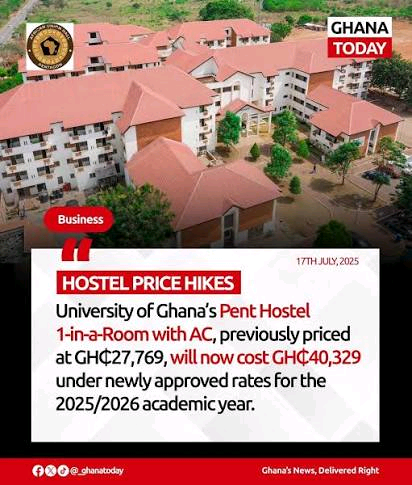
Across some public universities, students are confronted with hostel charges reportedly ranging from about GH¢3,500 to GH¢8,000 per bed for an academic year, depending on the institution, facility and type of accommodation. For families already struggling with tuition and academic fees, transportation, food, books, laptops and other necessities, accommodation can easily become one of the largest components of the cost of obtaining a degree.
The situation raises an important question: When did providing a bed for a university student become almost as expensive as the education itself?
University authorities and hostel operators have legitimate costs to meet. Electricity, water, security, maintenance, sanitation, internet services, staff salaries and general inflation have all increased. Universities also face severe accommodation shortages, while limited public funding has encouraged greater reliance on private investment and Public-Private Partnership arrangements.
These realities, however, should not become a justification for accommodation charges that place university education beyond the reach of ordinary families.
Students paying substantial amounts for accommodation should reasonably expect facilities and services that reflect what they are being charged. Yet complaints about overcrowding, unreliable water supply, inadequate sanitation, faulty facilities, poor maintenance and limited internet connectivity continue to emerge from some university residences.
The problem therefore goes beyond the amount being charged. It is also about value for money, transparency and accountability.
The growing involvement of private developers in student accommodation deserves particular attention. Public-Private Partnerships can help universities address infrastructure deficits that government alone may not have the resources to solve quickly. Private capital has contributed significantly to increasing the number of beds available to students.
But private participation without adequate safeguards can create another problem. When accommodation supply is limited and demand is extremely high, students have very little bargaining power. A student admitted to a university far from home cannot simply decide that accommodation is unnecessary. Housing is effectively part of the cost of accessing the education.
That makes student accommodation different from an ordinary commercial product.
The consequences of high hostel charges extend beyond household finances. Students unable to secure affordable accommodation may have to live considerable distances from campus and spend more money and time commuting. Others may share already crowded rooms to reduce costs. Some families may borrow or sacrifice other essential household expenditure to pay accommodation fees.
For financially vulnerable students, excessive accommodation costs can contribute to delayed enrolment, deferment or even abandonment of tertiary education.
This should concern policymakers because Ghana cannot seriously pursue greater access and equity in tertiary education while treating accommodation as an entirely separate issue. Admission into a university means little if the student cannot afford somewhere reasonable to live while studying.
There is therefore a strong case for greater oversight of accommodation charges within public universities.
The Ministry of Education and the Ghana Tertiary Education Commission, working with university councils, student representatives and private hostel operators, should develop clearer guidelines for determining accommodation charges. This does not necessarily mean imposing one uniform price on every hostel. Facilities differ in quality, location and services, and those differences should be recognised.
What is needed is a transparent framework that prevents arbitrary increases and ensures that charges can be reasonably justified by operating costs, inflation, investment requirements and the standard of facilities provided.
Universities should also publish clear breakdowns explaining major components of accommodation fees. If students are being asked to pay substantially more from one academic year to another, they deserve to know why.
Student representation must equally become an important part of the process. Students’ Representative Councils and national student bodies should be consulted before major changes in residential fees are approved. Consultation does not mean students should determine prices themselves, but those who ultimately bear the cost deserve a meaningful voice.
Government must also reconsider its long-term approach to student housing. Private investment is necessary, but it should complement rather than completely replace affordable public accommodation.
New halls of residence, renovation of existing facilities and innovative financing arrangements could significantly increase supply. Universities could also explore structured build-operate-transfer arrangements in which private investors recover their investments over an agreed period while pricing and service standards remain subject to clearly defined conditions.
Ultimately, the debate over hostel charges is a debate about what we believe public university education should represent.
Universities need money to operate. Investors are entitled to reasonable returns. Utilities and maintenance must be paid for. But students should not become captive customers simply because there are not enough beds available.
Education remains one of Ghana’s most important instruments for social mobility. A young person who qualifies for university should not find that admission is only the beginning of another struggle — finding thousands of cedis simply to secure a bed.
The objective should therefore not be to make university accommodation artificially cheap. It should be to make it affordable, transparent, properly regulated and commensurate with the quality of service provided.
Ghana must decide whether student accommodation is primarily an essential part of the educational system or simply another commercial opportunity.
If the cost of a bed becomes a barrier to obtaining a degree, then the country has an education-access problem that cannot be ignored.
