


The Rhetoric vs. The Reality
In the lead-up to the 2016 general elections, the political mantra of Nana Addo Dankwa Akufo-Addo was unambiguous: there would be absolutely no place for corruption in his government. He famously promised the Ghanaian electorate that he would use the “Anas principle” to root out graft and that anyone looking to make money should stay in the private sector rather than treat public office as a personal goldmine.
Yet, as the Fourth Republic reflects on his legacy, that lofty campaign rhetoric has collided heavily with reality. Public frustration has reached a boiling point as the gap between political anti-corruption promises and systemic financial malfeasance continues to widen. For readers of Modern Ghana, true patriotism requires moving past partisan defenses to analyze the high-profile convictions, ongoing state trials, and the deep institutional failures defining modern Ghanaian governance.
Convicted Political Figures and Officials
While public perception often assumes that elite politicians never face consequences, landmark legal actions have yielded definitive criminal convictions:
- Bernard Antwi-Boasiako (Chairman Wontumi): In a historic July 2026 judgment that shook the political landscape, the influential Ashanti Regional NPP Chairman was sentenced to 20 years in prison with hard labour by an Accra High Court. The court found him guilty of unlawfully assigning mineral rights without ministerial approval and facilitating illegal mining (“galamsey”) inside forest reserves through his firm, Akonta Mining Company.
- Asante Kwaku Berko: The former Managing Director of the Tema Oil Refinery (TOR) was convicted by a US federal jury for orchestrating over US$1 million in bribes to Ghanaian officials to secure a power plant contract. His conviction was built on critical intelligence shared by the Office of the Special Prosecutor (OSP).
- Abuga Pele: The former head of the Ghana Youth Employment and Entrepreneurial Agency (GYEEDA) was sentenced to six years in prison for abetment of fraud and willfully causing financial loss to the state before later receiving a controversial presidential pardon.
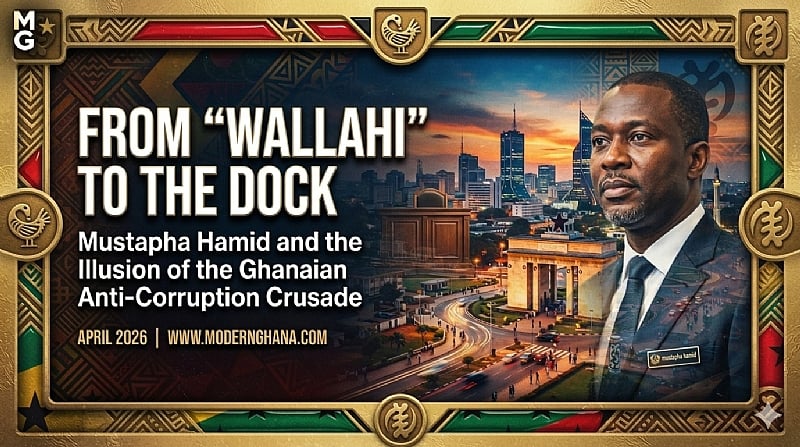
The Litmus Test: The Case of Dr. Mustapha Abdul-Hamid
The ongoing trial of Dr. Mustapha Abdul-Hamid, the former Chief Executive Officer of the National Petroleum Authority (NPA), serves as a key indicator for state accountability:
- The Scope: The OSP significantly escalated the legal battle by increasing the criminal charges from 25 to 54 counts after uncovering fresh evidence of institutionalized corruption.
- The Allegations: The state alleges large-scale extortion and money laundering amounting to GH¢291,574,087.19 and US$332,407.47 through an illicit scheme targeting bulk oil distributors and oil marketing companies.
- The Defiance: Despite Abdul-Hamid publicly dismissing his trial as “useless,” the Accra High Court rejected his lawyers’ attempt to halt proceedings over the legal vacation, ordering the trial to resume immediately on August 18, 2026.
The Pwalugu Dam Debacle: The Cost of Accountability Failures
The illusion of the anti-corruption crusade is not just measured in court dockets; it is measured in the abandonment of vital national infrastructure. The Pwalugu Multipurpose Dam project in the Upper East Region remains a glaring symbol of this structural failure:
- The Executive Failure: Championed heavily by Vice President Dr. Mahamudu Bawumia, the $993 million hydro-solar hybrid project was launched with immense fanfare in 2019. It was promised to permanently control the deadly perennial flooding from Burkina Faso’s Bagre Dam and transform northern agribusiness.
- The Missing Millions: Despite the project remaining at a complete standstill, parliamentary and ministerial probes revealed that approximately $12 million was disbursed as a mobilization advance.
- The Vanishing Act: In an embarrassment to the administration, official reports confirm that the contractor bolted out of the country with the funds before full-scale construction ever began.
- The Political Fallout: For critics, this massive financial loss under the Vice President’s direct oversight has sparked fierce debates on whether the current leadership possesses the oversight capabilities and integrity required to steer the Presidency of the Republic.
International Parallel: How Real Accountability Looks
To understand the illusion of Ghana’s anti-corruption fight, we must look at global examples where institutional independence actually succeeded in curbing elite corruption:
Botswana & Rwanda (Autonomous Anti-Corruption Organs): Both nations rank as Africa’s cleanest countries on Transparency International’s Corruption Perceptions Index. They achieved this by completely separating their anti-graft bodies from presidential influence, providing secure, independent funding, and ruthlessly prosecuting ministers without partisan shields.
Romania (The DNA Bureau Crusade): In Eastern Europe, Romania’s National Anti-Corruption Directorate (DNA) famously secured the criminal convictions of a sitting Prime Minister, dozens of MPs, and hundreds of judges within a five-year window. The DNA succeeded because prosecutors were insulated from executive removal and backed by specialized anti-corruption courts.
Strategic Recommendations and Suggestions for Ghana
To transform anti-corruption enforcement from a political show into a functional system, Ghana needs structural reforms driven by both institutional action and citizen engagement:
For Institutional and Legal Frameworks
- Insulate Legal Appointments: Amend the appointment structure of the Special Prosecutor, Attorney General, and Auditor General to eliminate direct executive influence.
- Establish a Public Confiscated Asset Registry: Maintain a transparent, online public log tracking all seized, frozen, and liquidated assets recovered from corrupt officials.
- Introduce Value-Based National Education: As championed by anti-corruption advocates, embed civic ethics, transparency, and anti-corruption modules into the basic Ministry of Education curriculum.
For the Citizenry and Civil Society
- Reject Partisan Defense Narratives: Refuse to support tribal, religious, or political narratives that protect accused officials from legal scrutiny.
- Engage in Citizen Budget Monitoring: Support civil society initiatives to track local assembly expenditures and state petroleum revenues.
- Exercise Voting Power Informed by Accountability: Use individual ballots to vote out representatives who have records of state misapplication, rather than voting based purely on party lines.
A Defining Moment for the Fourth Republic
Ghana’s ongoing battle against corruption cannot be won through campaign speeches or selective prosecutions. The multi-million cedi losses recorded across various regimes show that institutional vulnerabilities remain a deeply bipartisan issue. High-profile actions, such as the state’s tight grip on Chairman Wontumi and the ongoing extradition pursuit of former Finance Minister Ken Ofori-Atta, show that legal mechanisms can deliver results when properly enforced.
Ultimately, ongoing trials like that of Mustapha Hamid, combined with unexecuted capital projects like the Pwalugu Dam, will decide whether Ghana’s independent anti-corruption agencies can operate effectively or if elite impunity will remain the norm. For the everyday Ghanaian, demanding accountability is no longer just a civic preference—it is a financial and structural necessity to safeguard the future of the republic.
✍️ Submitted by:
Retired Senior Citizen
For and on behalf of all Senior Citizens of the Republic of Ghana 🇬🇭
Teshie-Nungua
[email protected]
