


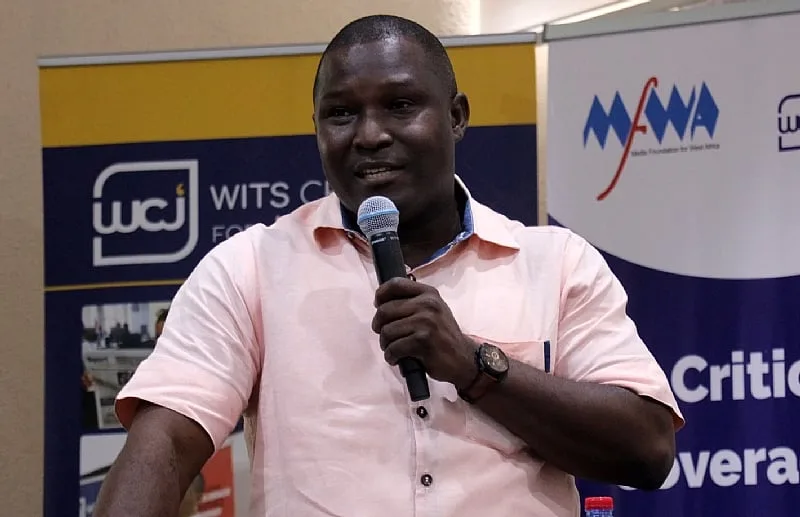
The Media Foundation for West Africa (MFWA) has concluded a specialised training workshop for journalists across the Anglophone West Africa region, equipping them to critically cover Africa–China trade, investment and political relations.
Funded by the Wits Centre for Journalism in South Africa, the training is part of a strategic partnership aimed at enhancing media accountability and investigative reporting in Ghana and the broader region.
One of the key sessions of the three-day workshop focused on China’s growing presence in Africa’s mining sector, with journalists urged to investigate the economic, geopolitical and environmental implications of the country’s expanding interest in the region’s mineral resources.
Daryl Bosu, Deputy National Director for Operations at A Rocha Ghana, who facilitated the session, said rising global demand for critical minerals is helping to drive China’s expanding footprint in Africa’s extractive sector.
China’s expanding mining footprint
Mr Bosu identified several factors behind China’s growing interest in Africa’s mineral resources, including rising global demand for critical minerals such as lithium, cobalt and copper.
He also pointed to China’s dominant position in the global refining and processing of several critical minerals, its strategic resource-security interests under the Belt and Road Initiative, and intensifying competition with the United States and other Western economies for access to Africa’s mineral deposits.
Mr Bosu noted that China’s influence extends beyond the extraction of minerals, highlighting its significant role in the processing and refining of resources that are increasingly important to the global economy.
He cited rare earth elements and graphite as examples of minerals for which a significant share of global refining capacity is concentrated in China.
According to Mr Bosu, China’s interest in Africa’s mineral resources is also linked to the country’s need to secure supplies for its industries and economy. Despite having mineral deposits of its own, China increasingly sources key resources from abroad.
Looking beyond official announcements
Mr Bosu challenged journalists to go beyond official announcements about Chinese investments, grants and development projects in Africa and investigate the interests and consequences underlying such engagements.
He urged reporters to examine the minerals involved, who controls their extraction and processing, where the resources ultimately go, and the impact of mining activities on local communities and the environment.
He stressed that journalists should scrutinise the relationship between investments in Africa and the continent’s natural resources rather than simply reporting the launch of projects or signing of agreements.
The session also examined illegal mining and illicit mineral trade, with Mr Bosu cautioning against portraying such activities as involving only Chinese actors.
While acknowledging that some Chinese operators enter African countries through illegal means and illicit trade, he stressed that African actors are also involved in these activities.
He said this makes it important for journalists to investigate the wider networks involved in the extraction, movement and trade of minerals, including the local actors who facilitate such activities.
Strengthening critical reporting
The discussions formed part of the broader objective of the MFWA training, which sought to strengthen journalists’ ability to critically examine Africa–China relations beyond official narratives.
The workshop encouraged participants to approach China-related trade, investment and political stories with greater scrutiny and to examine how such engagements affect governance, public resources, communities and the environment.
For journalists in West Africa, the region’s growing importance in the global supply chain for critical minerals presents opportunities for deeper investigative reporting on who extracts Africa’s resources, who controls their processing and financing, and where the economic benefits ultimately accrue.
The training therefore highlighted the need for sustained journalism that connects developments at the local level to the wider economic and geopolitical competition for Africa’s natural resources.
