


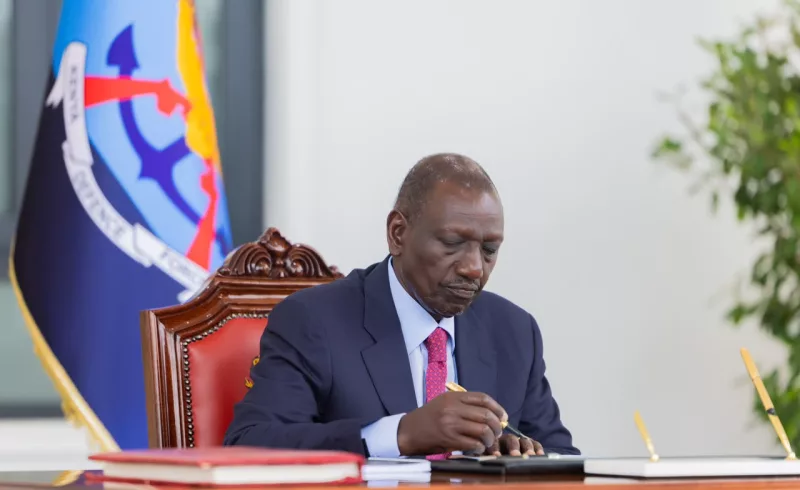
 President William Ruto./PCS
The government has given foreign nationals conducting businesses in Kenya 90 days to regularise their immigration, work permit, registration and licensing status.
This is to allow them time before enforcement agencies begin strict action against those operating outside the law.
State House Spokesperson Hussein Mohamed said the regularisation exercise will follow President William Ruto’s declaration that certain small-scale businesses should be reserved for Kenyans as the government moves to protect economic opportunities in the micro and small-enterprise sector.
“Over the next 90 days, the government will conduct an orderly regularisation exercise to facilitate compliance,” Mohamed said in a statement.
He said the exercise will be coordinated by relevant government agencies in consultation with the embassies concerned, giving affected foreign nationals an opportunity to regularise their immigration status and business operations.
Mohamed said every person conducting business in Kenya is required to comply with applicable immigration, work-permit, registration and licensing requirements.
“During the 90-day period, government agencies will provide guidance and administer the requirements “fairly, consistently and without discrimination,” he said.
“At the conclusion of the 90-day regularisation period, immigration, work-permit, registration and licensing requirements will be enforced firmly and strictly in accordance with the law and due process,” Mohamed said.
The announcement comes amid growing concerns among Kenyan traders over the increasing participation of foreign nationals in small-scale businesses and informal trade.
According to State House, Ruto received representations from Kenyan traders during an engagement last week over the issue and its impact on Kenyans who depend on small businesses for their livelihoods.
The President reaffirmed the government’s responsibility to protect and expand economic opportunities for Kenyan citizens, particularly in the micro and small-enterprise sector, which supports millions of households.
At the same time, Ruto affirmed the government’s duty to protect foreign nationals who are lawfully resident, employed, investing or conducting business in Kenya.
Mohamed said the President has directed that the Local Content Bill, 2025, currently before Parliament, be expanded to establish a framework governing participation in small-scale trade and enterprise.
The proposed framework will identify categories of economic activity that may be reserved for Kenyan citizens while providing legal certainty and protection for foreign nationals legally entitled to work, invest and conduct business in the country.
The government’s position is that protecting Kenyan businesses and allowing lawful foreign investment are not mutually exclusive.
“Kenya will protect economic opportunities for its citizens, especially within the micro and small-enterprise sector, while remaining open to lawful foreign investment, enterprise and employment,” Mohamed said.
He, however, warned individuals against taking the law into their own hands or targeting foreign traders.
“The interpretation, implementation and enforcement of the law are the exclusive responsibility of duly authorised State agencies,” he said.
“No individual or group has the authority to harass, intimidate, threaten or interfere with foreign nationals or their businesses.”
Mohamed said anyone engaging in such conduct would face action under the law.
He cautioned that legitimate concerns over economic opportunities could not be used to justify discrimination, lawlessness or violence.
The government also sought to reassure foreign nationals and investors that Kenya would remain an open and secure country while protecting the rights of people lawfully within its borders.
The statement further reaffirmed Kenya’s commitment to regional integration, including the East African Community and the African Continental Free Trade Area.
“We will continue to facilitate the movement of people, labour, services and capital in accordance with applicable legal and regulatory frameworks,” Mohamed said.
The government is also expected to use the 90-day period to clarify which categories of small-scale businesses could ultimately be reserved for Kenyan citizens once the proposed legislative framework is enacted.
