



The Ghanaian Development Paradigm And Its Politics
Introduction
A new road appears in a Ghanaian community. The surface is smooth, the markings are bright, and the photographs of the opening ceremony circulate widely. A few months later, a school block is commissioned somewhere else. Then comes a hospital, a market, a water project or a newly constructed district office. For a moment, development becomes visible. It has a physical form. It can be photographed, inaugurated and pointed to.
But there is a question that is harder to answer.
What exactly do we mean when we say Ghana is developing?
Is development the road itself? Is it the school building? Is it the number of kilometres of roads constructed, the number of hospitals opened or the amount of money spent on infrastructure? Or should we ask a more difficult question: what changes in people’s lives after these projects have been completed?
That question takes us beyond development as a collection of projects and towards development as a political process.
Ghana has spent decades trying to develop. Governments have changed. Economic strategies have changed. Political parties have changed. The language has changed too. We have moved from state-led industrialisation to economic liberalisation, structural adjustment, private-sector-led growth, poverty reduction, infrastructure development, social protection, digitalisation and renewed industrialisation. Yet some of the deeper problems have remained remarkably familiar.
This is where Claude Ake becomes useful. In Democracy and Development in Africa, Ake challenges the tendency to treat development as mainly an economic or technical exercise. His argument is that Africa’s development problems cannot be separated from politics because the way societies are governed determines who makes decisions, who controls resources and whose interests are served by development (Ake, 1996).
Seen from this perspective, Ghana’s development challenge is not simply that the country lacks resources, good policies or competent people. It is also a question of power. Who defines development? Who controls the state and its resources? Who decides which places and people should receive attention? Who participates in these decisions? And who ultimately benefits?
These questions have followed Ghana from independence to the present.
What Do We Mean by Development?
Ghana’s development story has often been told as a story of changing economic policies. After independence, the country pursued an ambitious state-led approach to economic transformation. Industrialisation, public enterprises, infrastructure and agricultural modernisation were central to the vision associated with Kwame Nkrumah. The underlying idea was straightforward: political independence would be incomplete without economic independence.
That ambition did not survive unchanged. Economic difficulties, political instability and changing international conditions produced new approaches. The state gradually retreated from many productive activities. The economic crisis of the late 1970s and early 1980s was followed by the Economic Recovery Programme and structural adjustment. Markets were liberalised, state enterprises were reformed or privatised, public spending was constrained and Ghana became increasingly integrated into the global economy. Nugent’s account of the 1980s captures the extraordinary political journey from revolutionary politics through economic reform to the return of constitutional government in 1992 (Nugent, 1995).
The important point is not that one strategy was simply right and another wrong. The deeper issue is that Ghana repeatedly changed the tools through which development was pursued without necessarily changing the political relationships surrounding those tools.
State-led development gave way to market-led development. Structural adjustment gave way to poverty reduction. Poverty reduction increasingly sat alongside infrastructure development. More recently, industrialisation, digitalisation and economic transformation have returned to the centre of political language.
But has the underlying development paradigm really changed?
A development paradigm is more than a policy document. It contains assumptions about what Ghana needs, who should provide it, what role the state should play and what kind of economy Ghana should become. If governments change policies without changing the underlying distribution of decision-making power, then policy change may be less transformative than it appears.
Ake’s insight helps us see why. Development is not simply about choosing the correct economic policy. It is about the political conditions under which policies are selected and implemented. In his earlier work, Ake also emphasised the way political power and economic structures reinforce one another in African states (Ake, 1981).
This does not mean that Ghana has made no progress. It clearly has. The Fourth Republic has provided political stability, competitive elections and repeated changes of government. Ghana has experienced periods of strong economic growth and major improvements in infrastructure, education, health and access to services. But progress in one area does not automatically mean that the structure of development has been transformed.
The question, therefore, is not whether Ghana has developed at all.
The question is what kind of development Ghana has produced, for whom, and through what political arrangements.
Ake and the Politics Behind Development
Ake’s usefulness to the Ghanaian case lies in the simplicity of the question he forces us to ask: what is development actually for?
If development is reduced to economic growth, then a country can be considered successful when its GDP rises. If development is measured mainly through infrastructure, then more roads, schools, hospitals and bridges suggest progress. If it is measured through macroeconomic stability, falling inflation and improved fiscal balances become central indicators.
All these things matter. But they are not the whole story.
Ake’s people-centred understanding of development pushes us to ask whether ordinary people acquire greater control over their lives and greater opportunities to shape the society in which they live (Ake, 1996). Development should not simply happen to people. People should have a meaningful role in determining what development means for them.
This distinction matters greatly in Ghana.
Consider a rural community where a road has been constructed but farmers still struggle to get good prices for their produce. The road may be a genuine development achievement, but the wider economic transformation may remain incomplete. Consider a mining community where gold contributes significantly to national revenue but residents continue to worry about land loss, environmental degradation and limited local economic opportunities. The country may benefit from the mine without the community experiencing development in the same proportion.
The same logic applies to education and health. A school building is not the same thing as quality education. A hospital building is not the same thing as accessible and effective healthcare.
This is why Ake’s argument remains relevant. It shifts attention from the visible product of development to the social and political process through which development is produced and distributed.
Ghana’s experience with decentralisation illustrates the problem. Decentralisation was supposed to bring decision-making closer to citizens. Yet research has found that participation in local development planning can remain dominated by elites, while poorer citizens struggle to influence decisions that directly affect them (Abdulai & Hickey, 2014; Adjei et al., 2017). More recent research similarly finds that decentralisation in Ghana has produced some improvements in local service delivery while leaving important questions about participation and local institutional capacity unresolved (Debrah & Owusu-Mensah, 2022).
The lesson is uncomfortable. Bringing government closer to citizens does not automatically give citizens greater power.
Institutions can be geographically close and politically distant.
When Four Years Meets Forty Years
There is a fundamental mismatch at the heart of Ghanaian development politics.
Political time is four years. Development time is generational.
A government must win elections in four years. A serious industrial policy may require fifteen or twenty years. A productive agricultural transformation may take even longer. Human capital development is measured across generations. Strong public institutions cannot be built overnight.
This creates a difficult political incentive.
Governments naturally want to show citizens what they have achieved. A road can be seen. A school block can be commissioned. A social programme can have visible beneficiaries. A factory can become a symbol of industrialisation. These projects can be politically useful because voters can associate them with a particular government.
But some of the most important development reforms are less visible.
Improving the quality of the civil service does not produce an immediate photograph. Reforming land administration is politically difficult and slow. Building productive relationships between government and domestic firms requires patience. Reforming taxation may be unpopular before its benefits become visible. Investing in research and industrial capability may take years before the results appear.
Research on Ghana’s political economy has repeatedly identified this tension. Whitfield argues that competitive clientelism has encouraged ruling coalitions to pursue policies with relatively short time horizons, while the country’s productive transformation has remained weak (Whitfield, 2011). Her analysis is particularly important because it does not require us to assume that politicians are simply irresponsible. Rather, politicians operate within a political system that rewards some kinds of behaviour more immediately than others.
This is a structural problem.
A government that spends heavily on a long-term industrial programme may receive little electoral reward if the programme has not yet produced jobs. A government that distributes visible projects across constituencies may receive greater immediate political returns, even if those projects do not fundamentally alter the productive structure of the economy.
Whitfield and Therkildsen (2011) make a related argument: ruling elites’ survival strategies influence whether governments create the stable policies, institutions and bureaucratic capacity needed to support productive sectors.
This helps explain why Ghana can have growth without sufficient transformation.
Growth can come from cocoa, gold, oil, services, construction and other existing activities. Transformation requires something more difficult: changing the structure of production so that the economy develops stronger domestic productive capabilities.
Ghana’s recent economic crisis made this weakness painfully clear. Yet the problem is not simply that governments have borrowed too much or spent too much. It is also that the political system has struggled to create durable arrangements for long-term economic transformation.
The National Development Planning Commission’s recent call for a consolidated long-term national development plan recognises precisely this problem. In 2026, the Commission warned that fragmented planning and policy discontinuity have undermined Ghana’s progress and renewed the case for a national vision that can survive individual governments (National Development Planning Commission [NDPC], 2026).
The challenge is therefore not merely writing another long-term plan.
Ghana has had plans before.
The harder question is whether political actors can agree that some national priorities should survive changes in government.
When the State Becomes the Prize
Ake’s analysis also draws attention to the importance of the state itself. In many African political systems, the state is not simply an impartial institution that implements decisions. Control over the state can provide access to valuable resources and opportunities.
Ghana is not an exception.
Political control can influence access to public expenditure, appointments, contracts, development programmes, infrastructure projects and public institutions. The state is therefore both an instrument of development and an arena in which competing interests struggle over resources.
This does not mean that every government decision is corrupt or that every public project is motivated by patronage. Such a claim would be both unfair and analytically weak.
The more useful question is how political incentives shape otherwise legitimate decisions.
If political parties must build broad electoral coalitions, politicians have strong reasons to respond to constituencies. That can be democratic and beneficial. Citizens should expect governments to respond to their needs. The problem arises when the pressure to maintain political coalitions overwhelms the need for long-term institutional and productive investment.
Research on Ghana’s education sector, for example, found that resource allocation between 1993 and 2008 was influenced by the distribution of political “holding power” within ruling coalitions, with poorer northern regions particularly disadvantaged by their weaker position within these coalitions (Abdulai & Hickey, 2014).
The same political logic can operate through public services. Research on Ghana’s urban water sector has shown how political interference and informal networks can shape public-service provision (Hirvi & Whitfield, 2015).
This is where the language of patronage and clientelism becomes useful—but only if used carefully.
Patronage is not simply a moral defect possessed by politicians. It can become part of the way political systems function when formal institutions coexist with informal expectations about who should receive what from government.
The result is a peculiar contradiction. Democracy can increase political responsiveness while simultaneously making long-term policy more difficult.
Politicians must listen to voters. But they must also win voters.
The two are not always the same thing.
Development for Whom?
Perhaps the most important question in Ghanaian development politics is the simplest:
Who is Ghana’s development actually reaching?
Recent evidence gives reason for both optimism and concern.
Ghana’s macroeconomic position has improved considerably. The IMF reported in July 2026 that real GDP grew by 6.0 percent in 2025 and by 6.4 percent year-on-year in the first quarter of 2026. Inflation had fallen sharply from the crisis years, while progress had been made in debt restructuring and rebuilding international reserves (International Monetary Fund [IMF], 2026a).
These are significant achievements.
But macroeconomic recovery is not the same thing as broadly shared development.
Ghana Statistical Service data show that unemployment remained 13.0 percent in the third quarter of 2025, while the multidimensional poverty rate was 21.9 percent. Food insecurity was also reported at 38.1 percent in the third quarter of 2025 (Ghana Statistical Service [GSS], 2026).
The poverty figures are particularly revealing because they move the discussion beyond income. GSS’s multidimensional approach considers deprivation in areas such as health, education, employment and living conditions. Earlier district-level evidence showed substantial differences between rural and urban Ghana and between regions (GSS, 2024). By the third quarter of 2025, multidimensional poverty had declined from 24.9 percent in 2024 to 21.9 percent, but more than seven million people still remained multidimensionally poor (GSS, 2026).
So Ghana can simultaneously be growing and struggling.
There is no contradiction here.
Growth is an aggregate measure. Development is about how economic and social gains are distributed and converted into better lives.
This becomes especially clear in natural-resource communities. Ghana has long depended on gold, cocoa and, more recently, petroleum. Yet mining communities can experience environmental damage, land pressures and unequal distribution of benefits. Research on community-based governance of mining revenues in Ghana has found that participatory structures can suffer from limited inclusion, inadequate knowledge and unequal power among participants (Lujala et al., 2021). More recent research on mining-induced resettlement similarly highlights land access and rising inequalities as continuing challenges in affected communities (2026).
The question, therefore, is not whether Ghana should mine.
The question is what kind of national and local political arrangements can ensure that mineral wealth becomes genuine development.
A mine can generate national revenue without transforming a mining community.
A road can be constructed without transforming a local economy.
A school can be built without producing quality education.
A hospital can be opened without guaranteeing accessible healthcare.
The distinction between development projects and development outcomes is therefore crucial.
The IMF, Stabilisation and the Question of Transformation
Ghana’s relationship with the IMF is another place where the politics of development becomes visible.
The recent crisis was severe. Inflation reached 54 percent in December 2022, and the country faced acute financing and debt pressures. The IMF-supported programme subsequently became central to Ghana’s efforts to restore macroeconomic stability and restructure public debt. By 2026, the IMF reported substantial improvements in inflation, debt sustainability, reserves and the fiscal position (IMF, 2026a, 2026b).
It would be too easy to describe this simply as an IMF success or an IMF failure.
Stabilisation matters. A country cannot pursue meaningful long-term development if inflation destroys household purchasing power, debt service consumes fiscal space and government cannot finance essential services.
But stabilisation is not the same as transformation.
That distinction matters enormously.
If Ghana stabilises the economy only to return to the same underlying structure that produced repeated crises, then the country may simply be preparing itself for another cycle.
The IMF itself has recognised that Ghana still faces large development needs and that sustaining stability will require stronger institutions, fiscal discipline and private-sector-led growth (IMF, 2026a).
The real test therefore comes after stabilisation.
Can Ghana use greater macroeconomic stability to build productive industries? Can it improve agricultural productivity and value addition? Can it create better jobs rather than simply more informal work? Can it develop domestic firms capable of competing beyond the Ghanaian market? Can public institutions become strong enough to implement long-term policies consistently?
These are political questions as much as economic ones.
From Development for Citizens to Development With Citizens
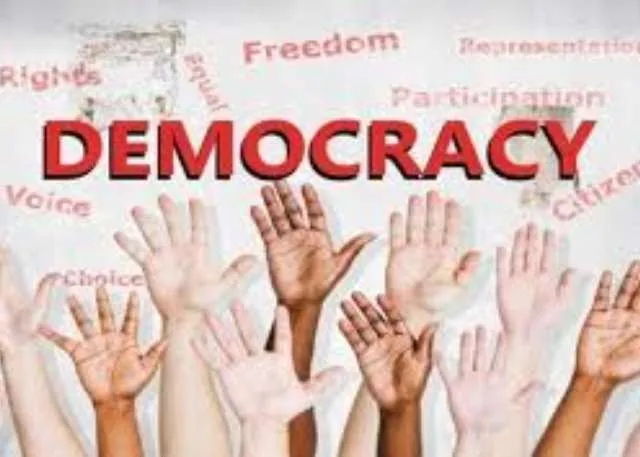
Ghana’s democratic record deserves recognition. The Fourth Republic has survived repeated elections, changes of government and intense political competition. The peaceful transfer of power has become an important part of Ghana’s political identity.
But democracy should not end at the polling station.
Ake’s later work warns against reducing democracy to periodic elections in which one political elite replaces another. Democracy becomes meaningful when citizens have the power to influence the conditions under which they live (Ake, 2000).
This distinction is important for Ghana.
Afrobarometer’s 2024 survey found that 84 percent of Ghanaians supported elections as the best way to choose leaders, while 69 percent preferred a system in which political power sometimes changes hands between parties (Asante-Darko, 2024).
Ghanaians therefore value electoral competition.
But electoral democracy is only one part of democratic development.
What happens between elections matters too.
Can a farmer influence the development priorities of the district assembly? Can residents meaningfully shape decisions about roads, markets, water and sanitation? Can communities influence how natural-resource revenues are used? Can citizens demand explanations when projects fail? Can local institutions respond to citizens without waiting for national political actors?
These questions take us back to decentralisation.
Decentralisation has produced genuine benefits in Ghana, including the provision of local infrastructure and services. But research also shows that participation can remain unequal, with poorer citizens often less able to influence planning processes (Debrah & Owusu-Mensah, 2022; Abdulai & Hickey, 2014).
The difference is therefore between development for people and development with people.
Development for people assumes that governments know what citizens need.
Development with people begins from the assumption that citizens possess knowledge about their own circumstances and should have some power to shape priorities.
That does not mean every local preference should automatically become public policy. National development requires coordination, expertise and difficult choices. But expertise should not become a substitute for participation.
The challenge is to combine professional state capacity with meaningful citizen influence.
Ghana’s Unfinished Development Question
Ghana does not need another development slogan simply for the sake of having one.
What it needs is a deeper conversation about the political foundations of development.
A more durable Ghanaian development paradigm would have to look beyond the four-year electoral horizon without ignoring democratic accountability. It would require institutions strong enough to protect long-term national priorities while remaining responsive to citizens. It would require decentralisation that transfers not only administrative responsibilities but meaningful decision-making power. It would require stronger domestic productive capacity, better relationships between government and productive businesses, agricultural transformation, accountable natural-resource governance and growth that creates decent opportunities for young people.
None of this is easy.
There is also no guarantee that a long-term plan will be implemented simply because it is written well. Ghana’s history is full of ambitious plans. The problem has often been continuity, institutional capacity and political incentives.
The emerging call for a long-term national development framework is therefore encouraging, but its success will depend on whether political parties, state institutions, businesses, civil society and citizens can build agreement around priorities that should not change every four years. The NDPC’s recent work on long-term planning reflects recognition of precisely this problem (NDPC, 2026).
The broader lesson from Ake is that development cannot be separated from the political structures through which society makes choices.
Ghana has never lacked development ideas. It has tried state-led industrialisation, liberalisation, structural adjustment, poverty reduction, infrastructure expansion, social protection, digitalisation and industrial policy. What has been less consistent is the political capacity to sustain a productive development strategy across changing governments and changing political incentives.
Perhaps, then, Ghana’s development problem is not simply that we have not done enough.
Perhaps the deeper problem is that we have not sufficiently questioned how development is defined, who gets to define it, who controls the resources used to pursue it, and who has the power to decide whether its benefits have actually reached them.
That is the question that makes Ghana’s development story political. And it may be the question that matters most for the next generation: when Ghana finally says that it has developed, whose Ghana will we be talking about?
References
- Abdulai, A.-G., & Hickey, S. (2014). Rethinking the politics of development in Africa? How the “political settlement” shapes resource allocation in Ghana (ESID Working Paper No. 38). University of Manchester.
- Adjei, P. O.-W., Busia, A. K., & Bob-Milliar, G. M. (2017). Democratic decentralization and disempowerment of traditional authorities under Ghana’s local governance and development system: A spatio-temporal review. Environment and Planning C: Politics and Space, 35(4), 701–719.
- Ake, C. (1981). A political economy of Africa. Longman.
- Ake, C. (1996). Democracy and development in Africa. Brookings Institution Press.
- Ake, C. (2000). The feasibility of democracy in Africa. CODESRIA.
- Asante-Darko, D. K. (2024, March 7). Ghanaians want fair and competitive elections, but mistrust the electoral commission. Afrobarometer.
- Debrah, E., & Owusu-Mensah, I. (2022). Decentralization and development in Ghana’s Fourth Republic. Politics & Policy, 50(6), 1304–1325.
- Ghana Statistical Service. (2024). Multidimensional poverty report. Ghana Statistical Service.
- Ghana Statistical Service. (2026). Ghana at a glance: Key economic and social indicators. Ghana Statistical Service.
- Gyimah-Boadi, E., & Prempeh, H. K. (2012). Oil, politics, and Ghana’s democracy. Journal of Democracy, 23(3), 94–108.
- Hirvi, M., & Whitfield, L. (2015). Public-service provision in clientelist political settlements: Lessons from Ghana’s urban water sector. Development Policy Review, 33(2), 135–158.
- International Monetary Fund. (2026a). Ghana: 2026 Article IV consultation, sixth review under the arrangement under the Extended Credit Facility, request for a waiver of nonobservance of a performance criterion, financing assurances review, and request for a 36-month Policy Coordination Instrument (IMF Staff Country Report No. 2026/212). International Monetary Fund.
- International Monetary Fund. (2026b, July 27). IMF Executive Board completes the sixth review of Ghana’s arrangement under the Extended Credit Facility, concludes the 2026 Article IV consultation, and reviews request for a 36-month Policy Coordination Instrument. International Monetary Fund.
- Lujala, P., Le Billon, P., & Aas Rustad, S. (2021). Community-based participatory governance platforms and sharing of mining benefits: Evidence from Ghana. Community Development Journal, 57(4), 635–655.
- National Development Planning Commission. (2026). NDPC promises intensified action on consolidated long-term development plan for sustainable growth. Government of Ghana.
- Nugent, P. (1995). Big men, small boys and politics in Ghana: Power, ideology and the burden of history, 1982–1994. Pinter.
- Whitfield, L. (2011). Competitive clientelism, easy financing and weak capitalists: The contemporary political settlement in Ghana (DIIS Working Paper No. 2011:27). Danish Institute for International Studies.
- Whitfield, L., & Therkildsen, O. (2011). What drives states to support the development of productive sectors? Strategies ruling elites pursue for political survival and their policy implications (DIIS Working Paper No. 2011:15). Danish Institute for International Studies.
- Whitfield, L. (2019). Strong democracy, weak state: The political economy of Ghana’s stalled structural transformation. In Ghana’s economic and agricultural transformation: Past performance and future prospects (pp. 49–94). Oxford University Press.
- Whitfield, L., Buur, L., & Therkildsen, O. (2015). The politics of African industrial policy: A comparative perspective. Cambridge University Press.
 WhatsApp