


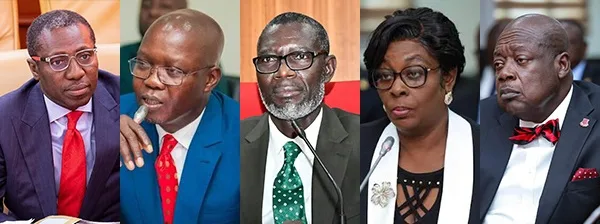
The Minority in Parliament on August 27, 2026, missed an opportunity to question three Supreme Court nominees over allegations that they had been nominated as part of a scheme to secure a constitutional interpretation that could pave the way for President John Dramani Mahama to seek a third term.
The Minority, led by Alexander Afenyo-Markin, boycotted the vetting of the three nominees: Justice Sophia Bernasko-Essah, Justice Edward Amoako Asante, and Anthony Forson, Jr, after objecting to what it described as an unnecessarily compressed timetable for the process.
The opposition New Patriotic Party (NPP) has, since 2025, claimed that President Mahama was interested in seeking an interpretation of Article 66(2) of the 1992 Constitution to determine whether the presidential two-term limit applies to two terms served consecutively or to any two terms served by an individual.
The Minority has also linked the issue to the removal of former Chief Justice Gertrude Araba Esaaba Sackey Torkonoo, alleging that her removal formed part of an attempt to influence the composition of the Supreme Court.
The government and President Mahama have, however, rejected suggestions that the President intends to seek a third term.
Under Article 66(2) of the 1992 Constitution, a person cannot be elected President for more than two terms, with each presidential term lasting four years.
Two separate cases currently before the Supreme Court are seeking an interpretation of the provision. The Courts are on a Legal Vacation, and it’s unclear whether a panel has been constituted by the Chief Justice, Justice Paul Baffoe-Bonnie, to decide on the matter.
One was filed by Ganiwu Alhassan, a teacher from Kpandai in the Northern Region, while the other was filed by Kenneth Kwabena Agyei Kuranchie, Editor of the Daily Searchlight newspaper.
Alhassan is asking the Supreme Court to declare that a person who has served two separate and distinct terms as President, rather than two consecutive terms, remains eligible to contest the presidency again.
He argues that preventing such a person from contesting would violate the Constitution and has also relied on Articles 60(6) and 60(7), which concern a Vice-President who succeeds to the presidency, to support his position.
Kuranchie is seeking three related declarations concerning the same constitutional provisions.
He wants the Supreme Court to declare that Article 66(2) only bars a person from being elected President after completing two consecutive four-year terms.
He further argues that a substantial break of at least one four-year electoral cycle should reset the eligibility count, with the constitutional bar arising only after a person has been elected and served two consecutive four-year terms.
The eventual interpretation by the apex court could therefore have significant implications for Ghana’s political landscape.
Speaking before Parliament’s Appointments Committee on Thursday, August 27, Minority Leader Alexander Afenyo-Markin said the Minority’s objection was not directed at the principle of vetting or the nominees themselves but at the manner and timeframe within which the exercise was being conducted.
He argued that there was currently no vacancy on the Supreme Court bench to warrant the urgency attached to the appointments and maintained that the nominees appeared to be intended to increase the existing complement of justices rather than fill vacant positions.
Afenyo-Markin challenged the Majority to demonstrate what harm would be caused to the state, the Judiciary or litigants if the nominees were subjected to the same level of scrutiny and consideration ordinarily applied to Supreme Court nominations.
“These nominations came to the House on Monday. Let us reason together, and let us be seen as being consistent with our political views. If you want to follow the precedent, please suspend today’s sitting, properly put out the advert as you requested when you were in opposition, and let us wait for the 14 days,” he said.
The Minority insisted that its position was not intended to obstruct the work of the Appointments Committee or embarrass the nominees, but to ensure that the process complied with parliamentary procedures and constitutional requirements.
The Chairman of the Appointments Committee, Bernard Ahiafor, however, dismissed the objection, describing the grounds raised by the Minority as “flimsy”, “hollow” and “baseless”.
He said any member dissatisfied with a decision of the House must use the procedures provided under Parliament’s Standing Orders to seek a reversal.
“If you are aggrieved by the decision of the House, the method available for you to reverse that decision is contained in our own Standing Orders,” Mr Ahiafor said.
“I will not preside over this committee and purport to vary the orders or directions or decision taken at the plenary by the entire House. It is not done in any democracy, and I will not be the first to introduce it in Ghana’s democracy,” he added.
Ahiafor also rejected calls for the committee to treat the Supreme Court nominees differently from other nominees appearing before it.
Following the chairman’s decision, the Minority, led by Afenyo-Markin, walked out of the vetting.
The boycott meant that the Minority was not present to directly question the nominees on several issues, including concerns surrounding judicial independence and the ongoing constitutional cases on presidential term limits.
The first to appear, Justice Edward Amoako Asante, a Court of Appeal Justice and former President of the ECOWAS Court of Justice, reaffirmed his commitment to judicial independence.
In response to a question from the MP for Dome-Kwabenya, Elikplim Akurugu, a member of the National Democratic Congress (NDC), said that judges must decide cases on the basis of facts and law, without interference from the appointing authorities.
“As a judge, when you’re appointed, you swear an oath which you go by; that is a very important thing that you do to ensure fairness and equity to all manner of persons who appear before you,” he said.
Justice Asante stressed that judicial decisions must be based on evidence and applicable law rather than personal relationships or considerations involving the appointing authority.
“Judges decide on cases by the facts before them; then you apply the law to the facts. Judges do not go mingling with the appointing authority just because they appointed you,” he said.
He further emphasised the importance of an independent mind in resisting any influence in the discharge of judicial duties.
“Independence of mind is very important, and that is why I have got to where I am now. I have independence of mind to withstand all kinds of influences, if any, to do my job,” Justice Asante added.
The second nominee, private legal practitioner Anthony Forson Jnr, a former President of the Ghana Bar Association and son of former Attorney-General Anthony Forson, opposed proposals to cap the number of Supreme Court justices.
He argued that the court’s broad constitutional jurisdiction and workload made a fixed limit impractical.
Forson said limiting the number of justices to 19 could create challenges for the efficient administration of justice unless the country first reduced the scope of matters falling within the Supreme Court’s jurisdiction.
“Well, I’m one of the advocates of no capping because of my experience and the kind of seminars that I have been to,” he told the committee.
He cited an earlier constitutional review discussion in Parliament, during which Justice Frimpong Manso reportedly raised concerns about limiting the number of Supreme Court justices due to the apex court’s extensive jurisdiction.
“So unless as a country we decide to reduce the jurisdictions which have been allocated to the Supreme Court, for now there should be no cap,” Mr Forson said.
His position comes amid ongoing constitutional reform proposals, including a government-accepted proposal to cap the Supreme Court’s membership at 19 and to introduce a fixed tenure for the Chief Justice.
Forson also pointed to the workload that had prompted previous expansions of the Supreme Court, arguing that the same considerations remained relevant.
“Indeed, if you look at the write-ups on the justification for the expansion of the membership of the Supreme Court, it was clear that the current composition was unable to cope with the workload,” he said.
“For now, I disagree that there should be a cap.”
Forson also expressed support for the recently passed Public Tribunals Act, arguing that there should be no concern about the legislation, provided Parliament enacted it in accordance with the 1992 Constitution.
Responding to questions on the legislation and the constitutional basis for public tribunals, he said his position was guided by the supremacy of the Constitution.
He stressed that the 1992 Constitution remained the supreme law of Ghana and that all legislation enacted by Parliament must conform to it.
“I have no problem with the public tribunals law. As stated, it is in the constitution. Article 12 says the constitution must be the highest law of the land, and so if the fundamental law of the land provides for it, I don’t have a problem with it,” he said.
“It is not something that is being imported into the constitution. I have no problem if Parliament is following the law.”
Justice Sophia Bernasko-Essah, the third nominee and a Justice of the Court of Appeal, also addressed the issue of judicial precedent.
She said previous decisions of the Supreme Court were important for maintaining certainty, predictability, and stability in the legal system, but stressed that the apex court should be prepared to depart from an earlier decision where necessary to prevent injustice or correct an error.
“To the extent necessary, the Supreme Court under Article 129(9) is required to depart from its decisions if need be,” she said.
Justice Bernasko-Essah said a departure could become necessary where an earlier decision had created injustice, contained an error of principle, was inconsistent with the Constitution, or had become unworkable.
She said the court would, in such circumstances, be required to give compelling reasons for departing from its previous position and establish a new position on the law.
