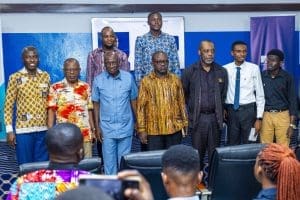
The University of Ghana’s Department of Political Science, in collaboration with the Konrad Adenauer-Stiftung (KAS) Ghana Office, held the maiden edition of its flagship outreach programme, titled “Time with a Politician”.
This initiative represents a deliberate and strategic effort by the Department to bridge the often wide gap between academic theory and the practical realities of political life in Ghana.
Addressing the gathering, Professor Isaac Owusu-Mensah, Head of the Department of Political Science at the University of Ghana, said the initiative would provide students with the opportunity to engage experienced political actors and deepen their understanding of governance, policy-making, and democratic practice.
“The primary purpose of “Time with a Politician” is to provide a neutral and academic forum for distinguished political figures to share their personal life experiences, leadership lessons, and insights gained from years of public service.
We are profoundly grateful to Hon. Dr. Kwabena Donkor for graciously accepting our invitation to be the very first speaker in this series”, he stated.
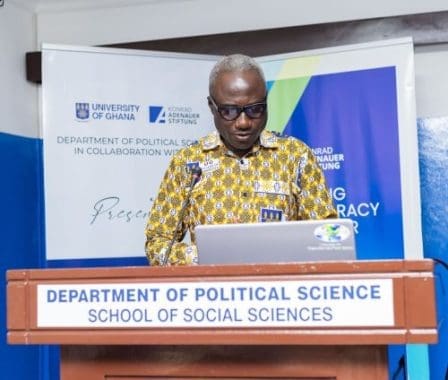
Dr Kwabena Donkor, former Minister for Power and Member of Parliament for Pru East, in his remarks, urged universities to align academic programmes with national manpower needs rather than the pursuit of internally generated funds (IGF).
He said many programmes in public universities were increasingly driven by revenue considerations instead of national development priorities, a situation he said risked undermining the quality and relevance of higher education.
Dr Donkor expressed concern that several academic programmes, particularly in business schools and law faculties, were structured mainly to generate income for universities.
“If we take all our public universities, the structure of academic courses today are largely driven by internally generated funding. They are not driven by national manpower planning,” he said.
“Universities run courses to make money, and I am not worried about stating that. Especially your business schools and law faculties, a number of programmes you run in our public universities are IGF-driven,” he added.
Dr Donkor warned that such trends could compromise academic standards, particularly in postgraduate programmes.
“There is no way you can do a proper master’s programme over weekends and complete it in one year,” Dr Donkor said, adding: “Graduate education is not just contact hours. It involves research papers, seminars and a lot of independent academic work.”
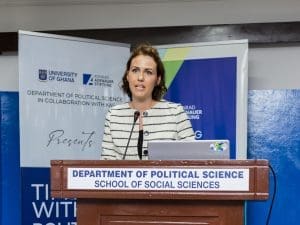
Mrs Anna Wasserfall, Country Representative of the Konrad-Adenauer-Stiftung Ghana, said cooperation and dialogue were essential in strengthening democratic governance.
She noted that the foundation had worked in Ghana for six decades and remained committed to supporting platforms that encouraged political dialogue, civic education and engagement between leaders and the younger generation.
“One of the most important areas of our cooperation has always been with universities. Academic institutions are places where ideas are tested, challenged, and refined. They are spaces where young people develop their perspectives and sharpen their thinking. And they are places where dialogue can take place in a way that is thoughtful and structured.
That is why partnerships with universities such as UG and students such as yourselves are central to our work. We aim to create platforms that bring different people together — not only to listen, but to engage, she observed.
The “Time with the Politician” series aims to in create a structured, respectful, and intellectually stimulating platform where politicians themselves can reflect candidly on their journeys, decisions, challenges, and contributions to national development.