


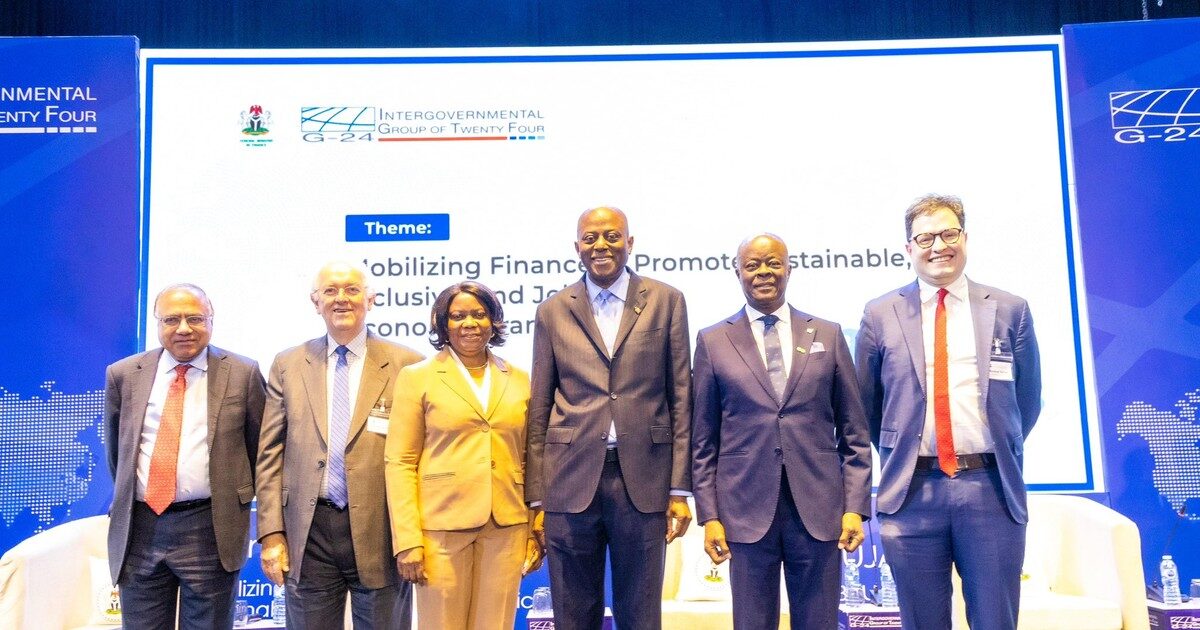
At the G-24 Technical Group Meetings in Abuja, the governor of Nigeria’s central bank, Olayemi Cardoso said cross-border payments are still too slow, expensive, and fragmented to support inclusive growth.
“Today, cross-border payments remain too slow, too costly, and too fragmented, especially for developing economies,” Cardoso said. “With global remittance corridors costing over 6.0 percent, settlement lags of several days, and compliance burdens that exclude MSMEs, millions remain disconnected from global opportunity.”
Cardoso argued that the world’s financial plumbing, the systems through which money moves across borders, has become a barrier rather than a bridge for emerging markets.
He warned that high transaction costs and settlement delays continue to limit participation for small businesses and households in poorer countries. “At the heart of this transformation lies a simple, yet powerful truth: an economy cannot be more inclusive than its payment system,” he said.
The G-24, which now includes 28 member nations from Africa, Asia, and Latin America, has long pushed for fairer access to global finance. For many of them, inefficiencies in payments translate into lost income, higher foreign-exchange costs, and barriers to trade.

Cardoso said digital innovation offers a historic opportunity to make the global financial system faster, cheaper, and more open. He cited examples from India and Brazil, where interoperable payment platforms and instant settlement systems have lowered costs and expanded access.
Nigeria, he said, is applying similar lessons. Under its Payment System Vision 2028, the Central Bank of Nigeria has modernized infrastructure, working with industry partners to build innovation and resilience into the country’s financial ecosystem.
In 2025, Nigeria launched its National Payment Stack, built on ISO 20022 messaging standards to handle multi-currency and cross-border transactions. Simplified KYC and AML requirements for low-value transfers, along with new diaspora account structures, have made it easier for SMEs and households to send and receive money.
Those reforms are starting to show results. Remittance inflows now average about $600 million per month, and authorities are aiming for $1 billion monthly in the near term.
Cardoso said the real goal goes beyond efficiency, it’s about sovereignty. “Digital cross-border systems could reshape global finance by enabling local-currency settlement, reducing dependence on reserve currencies, and strengthening South-South integration,” he said.
Innovation comes with risks
Still, Cardoso cautioned that the same digital tools could backfire if left uncoordinated.
“Without coordination, digital cross-border payments risk becoming fragmented across jurisdictions, entrenching dominant currencies and platforms, reducing interoperability, increasing costs and undermining the ability of Emerging Market and Developing Economies to safeguard monetary sovereignty,” he warned.
He urged central banks to take the lead in shaping the next generation of payment systems, balancing innovation with financial stability and inclusive growth.

Nigeria’s call for reform echoed through the meeting. Wale Edun, the country’s Minister of Finance and Coordinating Minister of the Economy warned that debt distress and tightening global conditions are threatening growth across emerging markets.
“Over a quarter of EMDEs have already lost access to international capital markets, while more than half of low-income countries are in or approaching debt distress,” Edun said. “This tightening financing environment threatens much-needed investments in health, education, infrastructure, and climate resilience.”
He said the world is entering an “Age of Competition,” shaped by geopolitical rivalries, trade restrictions, and shrinking multilateral cooperation. Such fragmentation, he noted, could reduce global output by up to two percentage points and hit trade even harder, with Africa likely to bear the brunt.
Despite making up 17 percent of the world’s population, Africa accounts for only 3 percent of global trade and 2.5 percent of GDP, Edun said.
He called for an overhaul of the global financial system, from strengthening the International Monetary Fund’s safety net to expanding concessional lending and enabling more local-currency financing.
Nigeria, he added, is shifting away from debt-driven growth toward an investment-led model, aiming to lift GDP growth to 7 percent, raise investment to 30 percent of GDP, and build fiscal resilience.

‘Measured Resilience, Constrained Ambition’
The Director and Head of the Secretariat for the G-24, Iyabo Masha, described developing economies as operating in an era of “measured resilience but constrained ambition.”
She said many countries face limited fiscal space, high debt burdens, and sluggish growth, all of which threaten long-term development goals.
“Public investment in many developing countries remains below the levels needed to achieve essential infrastructure and climate objectives,” Masha said, noting that external debt for developing nations reached $487 billion in 2023.
She called for stronger fiscal frameworks, credible monetary policy, and smarter investment in human capital and climate adaptation to restore growth momentum.
Bottom line is that Nigeria’s digital payment reforms are about more than moving money faster, they’re about rewriting the rules of participation in the global economy.
If successful, they could help emerging markets trade and grow on their own terms, not just within a system built for someone else.
