



Nepal’s first climate loss and damage payout falls far short of needs
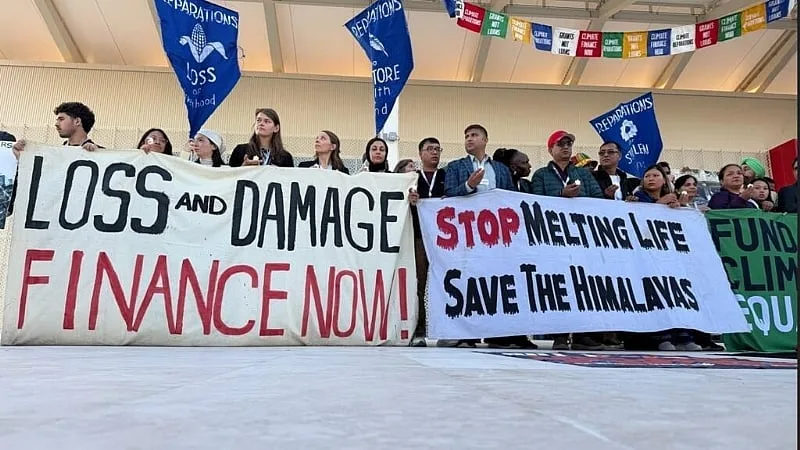
Dikshya Suibedi's family now lives in a rented flat in Kathmandu. Floods in August swept away their home in Devighat, in Nepal's Nuwakot district.
The 29-year-old's family lost its ancestral land, home and possessions worth thousands of dollars.
“The land that we used to hold so many memories of is now covered with sandy soil,” she told RFI at the Cop31 UN climate summit, under way in the Turkish resort city of Antalya.
The place she once called home is now a wide river.
The disaster struck on 26 August when a massive ice and rock avalanche in the Langtang region of the Himalayas triggered flash floods that swept through settlements along the Bhote Koshi and Trishuli river valleys.
The floods left 1,455 people dead and 5,285 missing across the Rasuwa, Nuwakot, Dhading and Chitwan districts. Nepal's disaster management authorities estimate the total damage and economic losses at $2.7 billion.
African push to triple climate adaptation finance left off Cop31 agenda
A historic first, but a fraction of what's needed
At Cop31, the Nepalese government confirmed that the board of the Fund for Responding to Loss and Damage had provisionally set aside $21.6 million following the disaster – including $20 million in potential recovery assistance and $1.6 million in administrative and oversight costs.
Nepal requested emergency support after the floods but must complete the application process before any money can be released.
The fund was agreed at Cop27 in Sharm el-Sheikh, Egypt, and became operational at Cop28 in Dubai. It was established to help vulnerable developing countries deal with the unavoidable economic and non-economic impacts of climate change. Climate activists gather at COP31 in solidarity with the flood victims in Nepal.
Overseen by a 26-member board representing developed and developing countries, the fund has the World Bank as its interim trustee.
If the money is released, Nepal will become the first country to receive support from the fund.
“This will be historical,” said Prayash Adhikari of the People's Movement for Climate Justice Nepal.
Paul Chukwuma of the Loss and Damage Youth Coalition welcomed the allocation as a step forward, however modest.
“There is an overall welcome of the fact that for the first time in history, we are having a fund that is allocated from within the UNFCCC process,” he told RFI.
But the $20 million earmarked for recovery represents less than 1 percent of the estimated $2.7 billion in damage and economic losses – and an even smaller share of the money Nepal needs to rebuild infrastructure and restore livelihoods.
“The amount provided is nothing compared to what is needed. And when you put $21m on a scale of what is needed for the entire restoration process, then we see that we are far from where we need to be,” Chukwuma said.
Demand for the fund also far exceeds the money available. Between December 2025 and July 2026, developing countries submitted 176 applications requesting more than $2.8 billion in assistance – more than three times the $822 million pledged by developed countries.
Turkey talks green at Cop31 while cracking down on activists
For campaigners, the delays in accessing the money are almost as troubling as the size of the allocation.
Adhikari said it was frustrating that the fund had yet to pay out, nearly three months after the floods devastated communities and forced families from their homes.
“Nepal has to go through the sticky provisions of the World Bank. At least, Nepal should have received some money by now. People are living in rented houses in faraway cities,” he said.
Chukwuma said campaigners had expected a mechanism capable of providing rapid assistance so that people could rebuild their homes and livelihoods, rather than one burdened by lengthy administrative procedures.
Cop31 negotiators unveil draft deal as fossil fuel divisions persist
Amos Wemanya, senior climate adviser at the Power Shift Africa think tank, said developing countries could not accept a system in which climate disasters unfold in hours but the money needed to respond takes months or even years to arrive.
He argued that climate finance needed to be adequate, accessible and predictable – and delivered at the speed of the crisis.
“What makes this even more troubling is the process. Communities lose their homes and livelihoods overnight, but governments must navigate lengthy applications, institutional requirements and approval procedures before resources can reach them,” he said.
“Climate disasters do not wait for board meetings, and neither should climate finance.”
As world leaders continue negotiations in Antalya, Suibedi hopes Cop31 will mark a turning point for people who have lost everything.
“High-emitting countries should provide more climate finance, particularly to the loss and damage fund,” she said.
 WhatsApp




Comments (0)
No comments yet. Be the first to share your opinion!