



The Selective Sword of Justice: Rohingya, Gaza and Western Hypocrisy
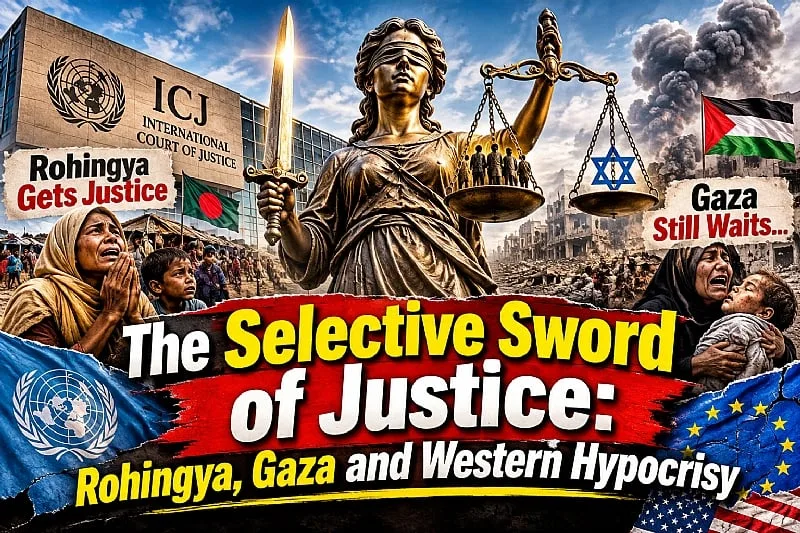
“Justice delayed is justice denied, but justice rushed is justice crushed.”
“The sword of justice is so sharp that it can cut off the hands that hold it.”
On 19 November 2026, the International Court of Justice (ICJ), the United Nations’ highest judicial body, delivered a historic verdict against Myanmar, finding the state responsible for genocide against the Rohingya Muslim minority in northern Rakhine State. For the first time, the Court held a state responsible for committing genocide, establishing that the atrocities committed during the 2017 military operations involved the intent to destroy a substantial part of the protected community. The verdict was delivered by nine votes to six in a case filed by The Gambia in 2019. After seven years of legal proceedings, the Rohingya finally received international recognition of their suffering. Refugees in Bangladesh’s Cox’s Bazar welcomed the decision, hoping it would pave their way back to their homeland. The Court ordered Myanmar to prevent further violations, investigate and punish those responsible, guarantee non-repetition, facilitate the safe, voluntary and dignified return of displaced Rohingya, and submit a report on restitution and compensation within two years. The decision is a breakthrough, but the selective application of international justice remains the real question. When Israel faces allegations of genocide, why does international legal and diplomatic discourse repeatedly return to the language of self-defence rather than accountability for the devastating civilian death toll in Gaza?
Why Can't Israel Be Held Accountable?
Since 2024, the United States has repeatedly vetoed ceasefire resolutions at the Security Council, raising questions about the diplomatic protection afforded to Israel by the Trump administration and its predecessors. European countries and the United States have also supplied weapons to Israel. The contrast is difficult to ignore: when Russia invaded Ukraine, Western governments responded with condemnation, sanctions and diplomatic pressure. Why, then, does the same urgency not apply to Israel's military operations in Gaza and the Palestinian territories? European diplomacy appears increasingly inconsistent, exposing a troubling gap between its declared commitment to international law and its political interests.
The ICJ has not yet delivered a final judgment on the merits of South Africa's genocide case against Israel. Its provisional measures, however, have established binding obligations that Israel must observe. South Africa has continued to pursue accountability, while the humanitarian catastrophe in Gaza has intensified. The Court has no independent enforcement force, and implementation ultimately depends on state compliance and, where necessary, the Security Council, where American opposition could obstruct meaningful action. If the proceedings continue for years, will justice arrive only after the destruction has become irreversible?
The human cost of war is the same in Europe, Asia and Africa, yet the diplomatic response often reflects political alliances rather than universal human rights. Germany alone authorised substantial arms exports to Israel in 2024, while Italy, France and the United Kingdom have also faced scrutiny over their positions and military relationships. Some European countries, including Ireland, Spain and Belgium, have recognised Palestine, but divisions among the 27 EU member states have prevented a unified and forceful response.
How can Europe demand accountability for violations in Ukraine while appearing less determined to confront the suffering in Gaza? Is protecting Jewish communities being politically conflated with protecting the Israeli government from international accountability? Human rights cannot be selective, nor can the suffering of one ethnic or religious community be weighed differently from another. The moral courage Europe demands from others must also be demonstrated by its own governments.
The GCC countries possess considerable diplomatic and financial influence, yet their response to Gaza raises another difficult question. Humanitarian assistance and food aid are necessary, but are they sufficient when political and economic engagement continues along other strategic tracks? The contrast between billions allocated for humanitarian relief and the wider ambitions of regional investment and normalisation deserves public scrutiny.
The region's security calculations increasingly revolve around Iran, the proposed Mecca defence framework, Vision 2030 and the Abraham Accords. Are GCC governments prioritising strategic security against Iran over the protection of Gaza and Al-Aqsa Mosque? Are concerns about Hamas, regional instability and the security of existing monarchies shaping their calculations? While diplomatic statements occasionally express grief and solidarity, stronger collective political action remains limited. The question is not whether the GCC can influence regional affairs, but whether it is willing to use that influence for Palestinian justice.
The world needs justice above borders, stars and states. Neither the EU nor non-EU countries, neither ethnic identities nor regional alliances, should become barriers to the equal application of international law. Otherwise, global chaos will continue to grow from the injustice suffered in the developing world's countryside and eventually reach the corridors of power in the world's most influential capitals.
Justice must remain independent of the judge's nationality, the accused state's power and the victim's identity. Jurisdiction should determine where justice is delivered, not whose suffering deserves recognition. The same legal principles must apply to crimes, regardless of the person, government or state accused. The sword of justice must cut through political influence, not bend before it.
 WhatsApp




Comments (0)
No comments yet. Be the first to share your opinion!