



Govt backs Police human rights training manual
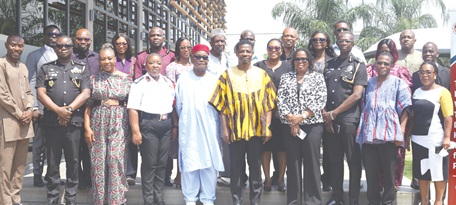
Government has thrown its weight behind the development of a Human Rights Training Manual for the Ghana Police Service, emphasising that the protection of human rights is essential to effective policing.
Alhaji Muntaka Mohammed-Mubarak, who said this in a speech read on his behalf at a stakeholder engagement on the drafting of a human rights manual for the Ghana Police Service in Accra yesterday, said, "Human rights policing is not separate from effective policing”.
The engagement, which was organised by the African Security Sector Network (ASSN) with support from the Danish Institute for Human Rights (DIHR), brought together representatives from the Ghana Police Service, the Ghana Immigration Service (GIS), the National Commission for Civic Education (NCCE), the Commission for Human Rights and Administrative Justice (CHRAJ), Ghana National Fire Service (GNFS), the Ghana Armed Forces (GAF), the Narcotics Control Commission (NACOCC) and the Ministry of the Interior and it will develop a comprehensive, context-sensitive manual reflecting Ghana's realities and the experiences of both officers and the public they served.
It is also expected to ensure the manual is inclusive, practical and rooted in dignity, fairness and safety.
Mr Mohammed-Mubarak observed that the police interacted directly with citizens in arrests, investigations, public order management, demonstrations and law enforcement operations.
He said how the police exercised those powers directly affected public confidence in the service and in the state.
In that regard, he said, the manual must be practical and accessible while translating constitutional principles and international human rights standards into guidance which officers could apply in real operations.
"A professional police service must not only protect life and property, maintain law and order and prevent and detect crime, but must also exercise its powers within the law and with due regard for human dignity, rights and freedoms," he said and stressed that officers must understand the limits of their authority, exercise discretion responsibly, and apply necessity and proportionality.
A Deputy Commissioner of the Commission on Human Rights and Administrative Justice (CHRAJ), Mercy Larbi, cautioned that abusive policing did not make Ghana safer but rather fuelled the very extremism the country was trying to prevent.
She said protecting human rights, building public trust, and preventing radicalisation were not three separate agendas, but a common linked chain.
Ms Larbi cited a 2017 United Nations Development Programme (UNDP) study, titled “Journey to extremism in Africa”, which found that 71 per cent of those who joined an extremist group made that final decision in response to government action, usually a traumatic encounter with state security forces, adding that "When people are treated fairly, they are less likely to carry the grievances on which extremist groups prey."
She reminded officers of Article 12 of the 1992 Constitution which, she indicated, obliged every organ of government to respect fundamental human rights and Article 15, which forbids torture, cruel, inhuman or degrading treatment, saying CHRAJ, Ghana's national human rights institution, was mandated under the Constitution to investigate violations by public officers, including police officers, and to educate the public on human rights.
The CHRAJ Deputy Commissioner said the gap was not the absence of standards, but the need for a practical manual officers could apply on the streets and at the station.
For his part, a Senior Member of the African Security Sector Network (ASSN), Major General Carl Coleman (Retd), pointed out that the ASSN launched the project to strengthen human rights protection, build public trust and help prevent radicalisation in Ghana and West Africa.
He said the work for the entire security services, including the Police, was long overdue.
Major General Coleman (Retd) said, "Strengthening public confidence in these institutions remained an important governance priority,” and added that the manual, when completed, would reflect Ghana’s context and draw on the experience and the perspectives of those who would use it, as well as people who interacted with and received services from the Ghana Police Service.
He expressed appreciation to the DIHR and the Embassy of Denmark in Ghana for its commitment and partnership which, he said, made it possible for ASSN to begin to work with the police.
 WhatsApp



Comments (0)
No comments yet. Be the first to share your opinion!