



Court Rejects Wontumi’s Request For Witness’s Plea Deal
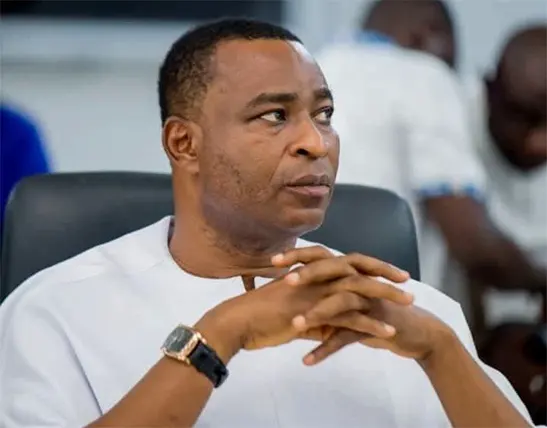
A High Court in Accra yesterday rejected a prayer by lawyers for embattled businessman, Bernard Antwi Boasiako, popularly known as Chairman Wontumi, for the prosecution to disclose a plea bargain that turned an accused person into a prosecution witness against him.
Chairman Wontumi, his company, as well as two others have been accused of “extreme environmental destruction, including the devastation of approximately 13 hectares of land,” in the Tano Nimiri Forest Reserve with illegal mining activities.
His lead counsel, Samuel Atta-Akyea, had questioned the conditions under which the Office of the Attorney General converted Edward Akuoko, a former Manager of Akonta Miming, a company belonging to Chairman Wontumi, into a witness against his former employer.
Edward Akuoko had been charged with offences including undertaking mining operation without licence, abetting the unauthorised felling of trees in forest reserves, and abetting the unauthorised erecting of building in forest reserve.
However, the Attorney General, during the pendency of the trial, dropped all charges against Akuoko and, in turn, used him as prosecution witness against Chairman Wontumi and his company.
Akuoko claims he personally requested the Office of the Attorney General to use him as a witness for the prosecution because of the magnitude of the evidence they have.
But Mr. Atta-Akyea disagrees, pointing out that he chose to turn his back on his ex-employer in order to save his own skin.
It was against this background that Mr. Atta-Akyea prayed the court to direct the Office of the Attorney General to disclose the plea deal that resulted in Akuoko testifying against Chairman Wontumi.
“My humble prayer is that he signed an agreement with the Government of Ghana working through the Attorney General so he converts from an accused person to witness. We pray that in the ultimate interest of justice and in terms of practice direction, all documents relevant to the trial should be made available to the court, whether the prosecution will use it or not. This is consistent with Article 19(2e),” Mr. Atta-Akyea said.
He further indicated that it will not cost the Attorney General anything to produce the signed document, adding that a failure to disclose same will be tantamount to concealment of evidence if that high office would want to withhold the document. And the rhetorical question will be why?
The request was opposed by Deputy Attorney General, Dr. Justice Srem-Sai, who argued that there is no provision in the practice direction on disclosures which says that a plea bargain agreement should be disclosed.
He said the Plea Bargaining Act protects lawyer-client privilege, which is the relationship between the Attorney General and the person who has bargained a plea.
He further contended that the Plea Bargaining Act provides for the circumstances under which a plea bargain may be disclosed, and that does not include a disclosure during the trial of the person.
“Thirdly, the argument that non-disclosure of a plea agreement constitutes concealment of evidence can only be a severe misapprehension of the law of evidence. The subject matter of the trial occurred long before a plea agreement was reached. Therefore, the content of the agreement can’t be evidence of the act in respect of which the accused person is being tried,” Dr. Srem-Sai argued.
He added that the purpose of recalling Akuoko was very specific and did not include reopening the case beyond the scope of the recall. “Our contention is that this prayer amounts to extending the recall of the witness beyond the scope,” he stressed.
The court, presided over by Justice Ruby Aryeetey, said the prosecution and the defence had agreed that the recall of the witness is not an opportunity to reopen the case as the prosecution had already closed its case.
She held that granting the motion for the disclosure of the plea agreement between Akuoko and the Attorney General would result in entering the space of reopening the case.
Justice Aryeetey, therefore, dismissed the application.
Meanwhile, the court has given the defence up to December 17, 2026 to file a submission of no case to answer and the prosecution to respond to same.
 WhatsApp



Comments (0)
No comments yet. Be the first to share your opinion!