



From Digging to Designing: How Ghana Can Spearhead Africa’s Economic Sovereign Shift
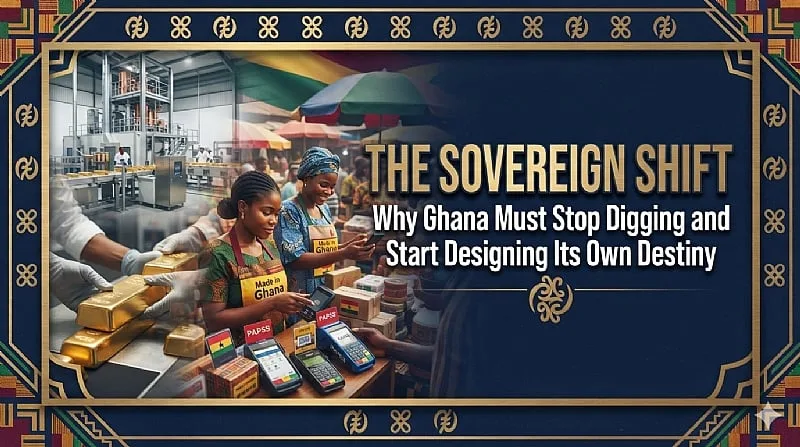
For decades, a familiar paradox has defined our home: Ghana is rich, yet Ghanaians remain financially strained. We are Africa’s top gold producer, yet our local currency constantly fights inflation. We boast brilliant minds across our regions, yet our youth struggle for sustainable jobs.
True independence cannot stop at a flag and a national anthem. To secure our future, Ghana must champion a radical shift in political and economic mindset. We must stop exporting raw wealth and importing foreign solutions. By executing hard-hitting economic policies, building transparent institutions, and leading continental trade, Ghana can turn our resource abundance into everyday prosperity.
1. Resource Nationalism: Keeping Ghana’s Wealth Inland
For generations, multi-national conglomerates have dominated our mining enclaves. They supply the machinery, extract our gold and critical green minerals, and fly the profits out, leaving our communities with nominal royalties and environmental degradation. Change is no longer just a demand—it is now Ghanaian law:
- The Local Gold Mandate: The Ghana Gold Board (GoldBod) enacted a strict directive requiring all gold doré to be locally refined before export. We are moving away from exporting raw wealth to stamping official Ghanaian markings on international-standard bullion.
- The Mining Ownership Ultimatum: In a major push for economic sovereignty, the state reclaimed major foreign mining leases and handed operations over to indigenous Ghanaian engineering firms. Furthermore, a strict year-end deadline mandates 100% Ghanaian ownership for surface mining and at least 50% local equity for underground mining.
- Protecting Green Minerals: Under our new Green Minerals Policy, raw exports of critical minerals like lithium and manganese are strictly banned. Global firms want our lithium? They must build chemical processing plants right here in Ghana.
What this means for you: This policy shift creates high-paying technical jobs for local engineers, expands corporate tax revenues to fund public infrastructure, and ensures that the wealth under our soil directly powers the development of our communities.
2. Institutional Reform: Uprooting Galamsey and Rewriting the Classroom
Economic policies are completely useless if our state coffers leak through corruption, or if our school systems fail to prepare children for the modern workforce. True ownership requires transforming our domestic institutions and tackling our gravest national security threat: Galamsey.
- Crushing Galamsey and Its Backers: Illegal small-scale mining has contaminated roughly 60% of our water bodies, devastated over 19,000 hectares of cocoa farmlands, and threatened our fundamental resource sovereignty. This fight requires uprooting systemic political corruption and elite complicity. As Engineer Kenneth Ashigbey, Convener of the Ghana Coalition Against Galamsey, fiercely noted at a press briefing in Accra: “The fight against galamsey will be meaningless if those who finance and benefit from it are not held accountable.” To disrupt the literal lifeblood of these operations, civil society groups are actively petitioning regulatory authorities to implement data-driven audits and permanently revoke the licenses of companies fueling illegal machinery inside our forest reserves.
- The Anti-Corruption Shield: To ensure public funds actually serve the people, Ghana deployed Public Expenditure Tracking Surveys (PETS). This framework allows civic groups and everyday citizens to transparently track state funds from the central treasury directly down to local primary schools. By digitizing financial tracking, we expose “ghost workers” and administrative leaks, making public spending accountable to the taxpayer.
- De-Westernizing the Classroom: We must stop preparing students exclusively for white-collar office jobs that no longer exist. Our educational institutions must aggressively pivot toward practical STEM (Science, Technology, Engineering, Mathematics) and technical vocational training. If we are building domestic gold and lithium refineries, our schools must produce the metallurgists, chemical engineers, and logistics specialists to run them.
3. The AfCFTA: Positioning Accra as the Engine Room of African Trade
The grandest tool for our economic liberation sits right in our backyard. Accra proudly hosts the Permanent Secretariat of the African Continental Free Trade Area (AfCFTA). This massive agreement unites 54 African countries into a single, duty-free $3.4 trillion market.
Ghana is aggressively capitalizing on this historic integration:
- The Guided Trade Initiative (GTI): Ghana was among the pioneer frontrunners to successfully ship locally manufactured goods—such as ceramic tiles, aluminum products, and cosmetics—completely duty-free to markets in East and North Africa under the AfCFTA framework.
- The 24-Hour Production Cycle: To satisfy a massive, duty-free market of 1.4 billion consumers, our Ministry of Trade is leveraging the 24-Hour Economy initiative. This system boosts local manufacturing, agribusiness, and logistics hubs to operate on round-the-clock shift structures.
- Dismantling Non-Tariff Barriers: While we have successfully cut import duties, bureaucratic red tape and slow customs clearances at regional borders remain significant roadblocks. Ghana is currently leading cross-border technical sessions to fully digitalize customs procedures, standardize shipping logistics, and eliminate corrupt border bottlenecks.
Step-by-Step: How Ghanaian Farmers and Youth Can Export Under AfCFTA
The AfCFTA is not just for massive conglomerates; it is built to empower small-scale farmers and youth entrepreneurs. If you produce local goods—like processed shea butter, clothing, or packaged agricultural products—you can export completely duty-free across Africa using this 4-step application framework:
[Step 1: Register Product] ──► [Step 2: Rules of Origin] ──► [Step 3: AfCFTA Certificate] ──► [Step 4: Ship Duty-Free]
- Product Registration & Invoicing: Ensure your business is registered with the Registrar General’s Department (RGD). Visit the official web portal of the Ghana Export Promotion Authority (GEPA) or head to their offices on the 9th–11th floors of the Africa Trade House in West Ridge, Accra (Contact: +233-302740909 / [email protected]) to register your specific product line for the AfCFTA market.
- Verify the Rules of Origin: Your product must qualify as “Made in Ghana.” This means the raw materials must be entirely sourced locally, or the production process must add substantial local value within Ghana. Submit your production breakdown to the Ghana Revenue Authority (GRA) Customs Division via the main Ghana Revenue Authority Portal for official verification.
- Apply for the AfCFTA Certificate of Origin: Once customs verifies your product’s origin, apply for the official AfCFTA Certificate of Origin through the integrated GRA Taxpayers’ Portal. This certificate is your legal pass to bypass import duties at foreign African borders.
- Leverage Digital Trade Hubs: Use the integrated AfCFTA Trading Hub digital platform to list your goods, clear regional regulatory standards, connect with buyers in participating countries, and utilize secure intra-African payment frameworks.
Trade in Cedis: The Power of PAPSS
Historically, a Ghanaian exporter selling clothes to a boutique in Kenya had to change Ghana Cedis into US Dollars, send it through European or American correspondent banks, and have the Kenyan buyer convert those dollars into Kenyan Shillings. This ridiculous loop wastes billions in conversion fees and causes immense settlement delays.
The game has completely changed with the Pan-African Payment and Settlement System (PAPSS):
- Bypass the US Dollar Entirely: Adopted as a fundamental structural instrument of the AfCFTA, PAPSS allows you to invoice your clients in foreign African countries directly in Ghana Cedis (GHS).
- Instant Local Currency Settlement: When an order is placed, your foreign customer pays instantly in their own local currency (e.g., Nigerian Naira or Kenyan Shillings). The revolutionary PAPSS Network securely processes, validates, and clears the transaction instantly across central banks.
- Straight to Your Local Bank: The funds land straight in your Ghanaian commercial bank account natively converted and completely settled in Ghana Cedis. This shields small business owners from painful forex fluctuations, preserves our central bank reserves, and ensures that local cash stays within our financial ecosystem.
The Verdict: The Destiny in Our Hands
The era of pleading for foreign aid and exporting raw resources must come to an end. True continental ownership begins with proactive domestic action.
By demanding total local value retention from mining firms, enforcing a zero-tolerance policy against galamsey to protect our lands, holding public institutions strictly accountable, and empowering our youth to dominate the vast AfCFTA market, Ghana will prove that Africa does not need saving. Africa simply needs to be led by leaders who believe in its people.
✍️ Submitted by:
Retired Senior Citizen
For and on behalf of all Senior Citizens of the Republic of Ghana 🇬🇭
Teshie-Nungua
[email protected]
 WhatsApp
Comments (0)
No comments yet. Be the first to share your opinion!