
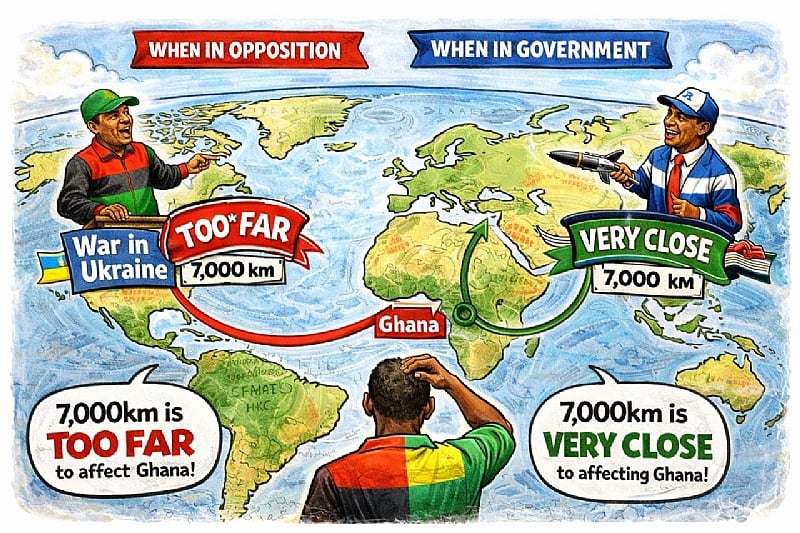
Citizen Asenso: Honourable “So can wars abroad affect our economy or not?”
Hon Jomo: “That depends.”
Citizen Asenso: “On what?”
Hon Jomo: “On whether we are in government or opposition.”
-The end-
With that brief exchange, one might already understand the curious paradox that often defines political debate in Ghana. In Ghanaian politics, distance behaves in very mysterious ways. It stretches, shrinks, and occasionally performs acrobatics depending on which political colours are in charge.
When the Blue and White Asafo Company occupied the Flag Staff House a few years ago, the Russia–Ukraine war erupted and began shaking global markets. Fuel prices rose worldwide, supply chains tightened, and economies across continents felt the tremors of a conflict unfolding thousands of kilometers away.
The government explained earnestly and desperately that Ghana was not immune to these global shocks. Oil prices were rising internationally. Shipping costs were increasing. Commodity markets were unstable.
But the Green and Black Army, then comfortably stationed in opposition at Bole, found this explanation deeply amusing.
“How,” they asked with dramatic disbelief, “can a war happening 7,000 kilometers away affect Ghana?” Seven thousand kilometers!! Are the Russian missiles flying over Kasoa? Is there a bomb drop at Kejetia market? They quizzed happily.
The way it was presented, Ukraine might as well have been somewhere beyond the solar system. According to the opposition’s calculations at the time, such a distance was simply too far to influence the price of fuel, food, or anything else in Ghana.
To them, the government was merely manufacturing ‘flimsy’ excuses for economic hardship. The government was simply being lazy and did not care about the plight of ordinary Ghanaians.
It was a confident argument. A loud argument. And above all, a politically convenient argument.
Fast forward to the present moment, and Ghanaian politics has once again demonstrated one of its most impressive talents: the ability to recycle arguments without changing the actors.
Today, the Green and Black Army now commands the seat of government, while the Blue and White Asafo Company has gracefully relocated to the familiar comfort of opposition in Walewale.
And suddenly, geography has changed.
Conflicts involving the United States, Israel, and Iran, we are now told, could have serious consequences for Ghana’s economy. Oil prices may rise. Global markets could react nervously. Gold purchases may decline. Economic pressures could follow.
In other words, something happening thousands of kilometers away might indeed affect Ghana. Eiii Massa!!! (in the voice of KP on Kokrokoo morning show)
The transformation is quite remarkable.
Apparently, 7,000 kilometers is no longer very far.
Naturally, the Blue and White Asafo Company, now speaking from the opposition benches, has seized the moment with enthusiasm. With admirable speed, they have retrieved the exact same argument once used against them.
“How,” they now ask, “can something happening so far away affect Ghana?” Are missiles now flying over Kantamanto Market? Are bombs dropping at Kotokoraba Market?
And just like that, the script has been perfectly reversed. Just by the click of Prof Hindu’s magic wand.
What was once ridiculous is now reasonable. What was once reasonable is now ridiculous. The same arguments have simply changed uniforms.
One might begin to suspect that Ghanaian politicians operate a national warehouse of recycled explanations, carefully stored and redistributed whenever power changes hands.
Yesterday’s excuse becomes today’s reality. Yesterday’s reality becomes today’s excuse.
Meanwhile, the Ghanaian public is expected to follow the performance with a smiling face. You dare not cry!!!
The truth, of course, is less entertaining. The global economy is deeply interconnected. Oil markets react instantly to geopolitical tensions. Investors panic. Shipping routes shift. Import-dependent countries like Ghana inevitably feel the ripple effects of conflicts far beyond their borders.
This is not political theory. It is ECONS101.
But basic economics often struggles to compete with advanced partisan politics, where arguments are frequently shaped not by facts but by political position.
When a party is in opposition, the world suddenly appears very small. Events beyond Ghana’s borders are dismissed as irrelevant, and every economic hardship is attributed solely to ‘lousy performance’ of the government of the day.
But when that same party enters government, the world expands dramatically. Suddenly the global economy becomes interconnected, complex, and highly sensitive to events taking place thousands of kilometers away. What an interesting paradox!
Distance stretches. Distance shrinks. And political memory quietly evaporates.
One saying reminds us that “the one who sits on the stool sees the village differently from the one standing outside it” The Akans also say “Sɛ wo kɔto sɛ tikɛseɛ rewe adwe a…” to wit… “If you go and see a big-headed fellow chewing palm nuts… Political power, it seems, has a remarkable ability to improve one’s understanding of reality.
Yet there is another troubling dimension to this political theatre.
In our increasingly polarized environment, citizens who raise concerns about economic realities are often quickly labelled. If you complain too loudly about hardship, you are branded as belonging to the opposition. If you acknowledge any positive development, you are suddenly accused of supporting the government.
In such an atmosphere, honest civic engagement becomes difficult. Citizens are gradually pushed into partisan boxes they never signed up for. The result is a subtle but dangerous form of public disorientation—where people begin to quietly stay in their ‘one corner’, not because they lack opinions, but because every opinion is forced into a myopic political microscope. Trust me, this write-up will be given a fitting political colour.
Soon, the safest political position for many Ghanaians may simply be silence, because in our politics, even common sense now carries a party card.
One sometimes wonders whether Ghanaian politicians secretly attend the same training school for arguments. Perhaps there is a classroom somewhere where yesterday’s speeches are carefully preserved, waiting patiently to be reused whenever power changes hands. When one party enters government, it opens the old file labelled “Arguments We Once Mocked but Now Need.” The other party, now in opposition, quickly retrieves the folder titled “Arguments We Once Used but Must Now Denounce.”
And so, the national debate continues; less like a serious economic discussion and more like a 4×4 race in which political actors keep passing the same batons back and forth while the Ghanaian citizen watches from the sidelines, wondering whether the finish line is ever meant to be reached.
Perhaps it is time for both the Green and Black Army and the Blue and White Asafo Company to take the intelligence of Ghanaians a little more seriously.
Citizens deserve explanations that remain consistent whether a party is in government or in opposition. Economic hardship should not become a rhetorical football kicked back and forth between political camps. Honesty, humility, and consistency would strengthen our national conversations far more than this endless exchange of recycled arguments.
In Ghanaian politics, the real distance is not between Ukraine, Iran, and Ghana.
The real distance is between what politicians say in opposition and what they suddenly understand in government.
And that distance, unfortunately, is far greater than 7,000 kilometers.
Prof Evans Asante, PhD
Asso.Professor of Theatre Studies
Department of Theatre Arts
University of Education. Winneba

