
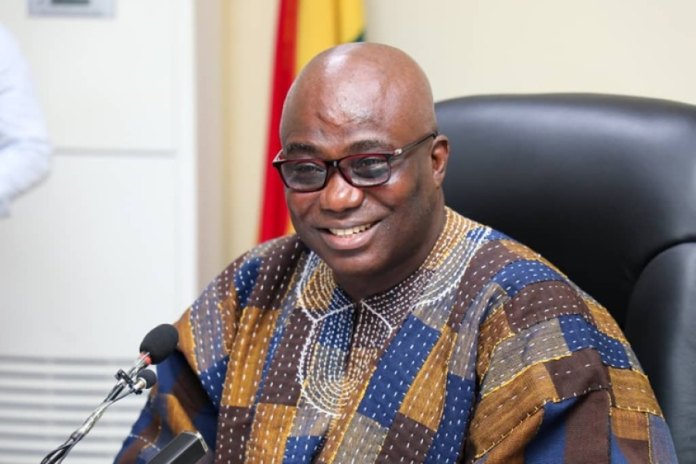

Ghana’s Minister of Food and Agriculture, Eric Opoku, has taken the country’s agricultural transformation agenda to one of the world’s most prominent development forums, arguing before a gathering of world leaders and economists in Rome that modernising farming is Ghana’s most direct answer to a worsening youth employment crisis.
Opoku spoke during a panel session at a high-level policy dialogue organised under Italy’s Mattei Plan for Africa, convened in partnership with the World Bank Group and Banca d’Italia to identify practical strategies for tackling unemployment across the continent. The session was themed “Laying the Groundwork for Jobs in Africa: Core Infrastructure and Business Environment.”
Among the high-profile participants were World Bank Group President Ajay Banga, Italian Prime Minister Giorgia Meloni, Singapore President Tharman Shanmugaratnam, and the President of the International Fund for Agricultural Development.
Opoku told participants that agriculture currently accounts for nearly 30 percent of Ghana’s gross domestic product (GDP) and employs roughly 24 percent of the workforce, yet has long been constrained by subsistence-level production and limited commercial infrastructure. With approximately 160,000 young Ghanaians entering the job market each year, he said incremental change is no longer sufficient.
“To generate sustained and productive jobs, we must transition from the traditional smallholder model to one that integrates large-scale production, value addition and agribusiness development,” Opoku told the forum.
The minister outlined three flagship government programmes driving that transition: the Agriculture for Economic Transformation Agenda (AETA), the Feed Ghana Programme, and the proposed 24-Hour Economy Policy, which he said would sustain continuous industrial demand for agricultural output. The government is also establishing Farmer Service Centres across agricultural districts to provide access to mechanisation services, including tractors and combine harvesters, for smallholder farmers who cannot afford to purchase such equipment independently.
Opoku stressed that financing remains the missing link between policy intent and measurable job creation. “When finance is available, farmers are more willing to invest in technology and processes, upgrade their equipment and improve productivity. As this happens, jobs will grow, capital will flow and stronger institutions will emerge,” he said.
He concluded that transforming Africa’s food systems requires coordinated action across infrastructure, energy, agriculture and industry simultaneously, noting: “There is common ground, but there is no single solution. Food systems are complex and require coordinated action across many sectors to address the challenges and unlock opportunities.”
The Rome engagement forms part of a broader diplomatic push by the Ministry of Food and Agriculture to secure international partnerships and investment for Ghana’s agricultural sector, and follows a bilateral meeting Opoku held with Food and Agriculture Organization (FAO) Director-General Qu Dongyu on the sidelines of the 44th FAO Ministerial Conference.

