
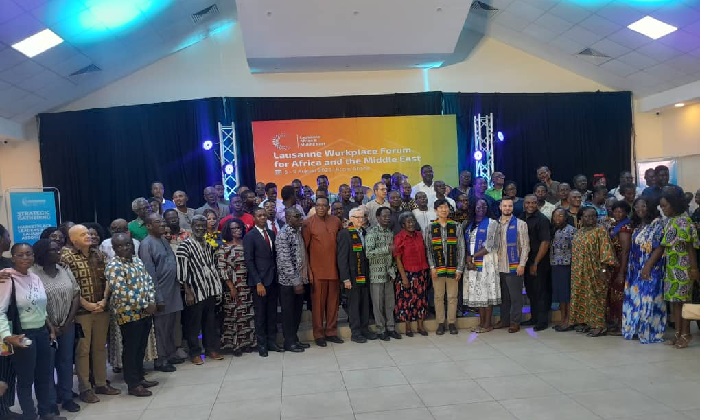
Global CEO of the Lausanne Movement, Michael Oh has stated that the Lausanne Movement Ghana Strategic Gathering in Accra, has strengthened collaboration among church leaders, Lausanne delegates, and marketplace professionals to mobilize ideas, resources, and partnerships for meaningful Christian mission both within Africa and globally.
Dr Oh emphasized that the Lausanne Movement is not merely an organization but a global movement built on relationships, shared convictions, and collaboration among believers committed to advancing the Christian mission.
He explained that the movement’s core objective is to connect influencers from different sectors—such as business, governance, education, and ministry—to work together in making Christ known and transforming societies.
Event
Dr Oh made the remarks while delivering the keynote address at a Strategic Gathering for Marketplace Leaders and Lausanne Associates held in Accra on Tuesday, March 3.
The event coincided with the commencement of Dr. Oh’s continental visit from the United States of America, beginning with Ghana from March 3 to 4, 2026.
The strategic engagements focused on the mission of the Lausanne Movement, particularly the upcoming Lausanne Workplace Forum for Francophone and Anglophone Africa and the Middle East.
Discussions highlighted the implications for leadership impact within the public sphere and explored potential avenues for collaboration.
The two-day event was held under the theme: “Kingdom Impact in Every Sphere of Society.”
In attendance were former President Emeritus for the Navigators and Members of the Lausanne Board, Jerry White, Former Second Lady, Mrs Matilda Amissah, Former Chairman of the Church of Pentecost, Apostle Opoku Onyinah, Regional and International Vice President of the Full Gospel Business Men’s Fellowship International, George Prah and Chairman of the Lausanne Ghana Committee, Rev. Dr Godwin Ahlijah.
Building networks
He highlighted the importance of building networks of trust and friendship among Christian leaders, describing these connections as the foundation for impactful mission work.
Dr Oh said the gathering in Ghana is intended to spark similar connections that could lead to new collaborations capable of strengthening churches, transforming communities, and influencing nations.
“My first Lausanne experience took place in 2004 in Pattaya, Thailand. And my second was at the second Lausanne Younger Leaders Gathering that took place in 2006 in Malaysia. And those gatherings didn’t just inform me, they shaped me. They changed the trajectory of my life. And that’s when I began to understand the heart of Lausanne. Connecting influencers and ideas for global mission,” he said.
“Why are connections so critical? Because in global evangelicalism, we don’t have a central authority. We don’t have a magisterium. We don’t have a headquarters that directs everything and everyone. What do we have? We have friendship. We have relationships. We have trust. We have shared conviction.”
He expressed hope that participants would form relationships that inspire joint initiatives in areas such as business, policy, ministry, and social development.
The Lausanne leader also underscored the strategic importance of Africa in the global Christian mission.
“So many kingdom initiatives over the centuries began not with strategic documents, but with Spirit-led connections. The power of I met. And I am praying that even today, and especially in August at the Workplace Forum, God will write, I met stories for you and through you.”
Africa’s influence
He stressed that Africa’s growing influence comes with responsibility, urging Christian leaders across the continent to steward their opportunities wisely and invest intentionally in shaping Africa’s future through Christ-centered leadership and ethical influence.
“The African church, as you know, is one of the fastest-growing, most prayerful, most vibrant parts of the global body of Christ. I have been saying this wherever I go. Yes, China is critically important.
Yes, there are tremendous opportunities in India. But Africa. Africa. Pray for Africa. Invest in Africa. The future is Africa,” he said.
Drawing from biblical teachings, he said every believer—whether an entrepreneur, engineer, teacher, policymaker, or civil servant—has a ministry in their workplace.
He noted that while pastors may not have access to boardrooms, parliaments, or corporate strategy meetings, Christian professionals working in those spaces can influence them with integrity, excellence, and servant leadership.
Working together
Regional and International Vice President of the Full Gospel Business Men’s Fellowship International, Mr George Prah, called for stronger collaboration between the church and the marketplace, stressing that both institutions have complementary roles in advancing God’s mission and transforming society.
Addressing participants on the need for a mindset shift, Mr Prah said Christian mission should no longer be viewed as an activity limited to church services, pulpits, or fellowship gatherings.
Instead, he argued that mission must be understood as a “total life assignment” carried out by believers in every sphere of society, including business, governance, media, education, healthcare, and the corporate world.
Mr Prah also criticized the long-standing separation between the sacred and the secular, saying it has led many Christians to compartmentalize their lives—living one way on Sundays and another during the workweek.
This mindset, he explained, has marginalized many talented believers within congregations who possess skills and influence that could be used to advance the kingdom of God in society.
He described these believers as a “sleeping giant of evangelism”, noting that with the right message, encouragement, and leadership, they could become a powerful force for positive change in communities and institutions.
Mr Prah further warned that denominational competition and divisions among churches have weakened the Christian mission, urging believers to refocus on unity and the broader agenda of Christ’s kingdom rather than institutional rivalries.
Central to his message was the need for closer collaboration between the church and marketplace leaders.
“Mission is not confined to purpose, fellowships, or other Christian affairs, but to persons trained by Jesus with a clear mandate for missions. Our mission should be lived out in marketplaces, in our boardrooms, in offices, factories, courtrooms, media houses, hospitals, laboratories, and of course, corridors of governance as well. Every believer, irrespective of his or her profession or vocation, carries the mandate of missions,” he stressed
He encouraged Christian entrepreneurs and professionals to see themselves not merely as business people who attend church but as kingdom citizens strategically placed in the marketplace to advance God’s purpose.
“The church must develop a deeper understanding of the marketplace. And likewise, the marketplace must fully embrace its God-given mandate and its redemptive rules in society. When this happens, transformation becomes possible.”
“The Christian businessman must know who they are in Christ and operate with conviction about who they are in Christ. You are not just a businessman who happens to be a Christian. You are a kingdom citizen who has been placed marketplace to advance the cause of the kingdom of our God,” he added.
Faith beyond church
For his part, Chairman of the Lausanne Ghana Committee, Rev. Dr Godwin Ahlijah called on Christians to actively live out their faith in the workplace and across all sectors of society in order to drive national transformation.
Rev. Dr Ahlijah explained that the Lausanne Movement began in 1974 as a global evangelical initiative led by Billy Graham and John Stott, and has since grown into a worldwide movement focused on mobilizing Christians for global mission.
He emphasized that Christian ministry should not be limited to church activities such as worship services or fellowship meetings. Instead, he urged believers to recognize that their true mission field lies in the workplace, where they interact daily with colleagues, institutions, and decision-makers.
He also encouraged Christians to see their professional spaces as platforms for ministry, urging them to use their desks as pulpits by demonstrating integrity, ethical leadership, and Christ-like character in their work.
The Lausanne Ghana Chairman stressed that national development requires Christians to take up influential roles in key sectors including government, media, business, and other professional fields.

