
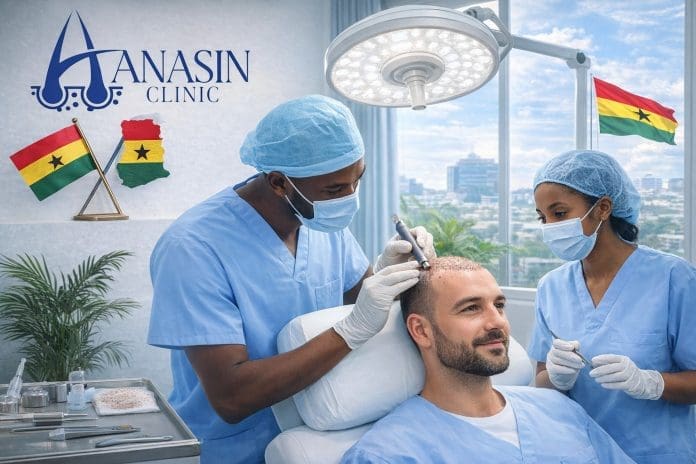
Not long ago, a Ghanaian seeking a hair transplant would almost certainly book a flight to Turkey, India, or Europe. That calculation is quietly changing. A small but growing cluster of clinics in Accra now offers surgical hair restoration, and the professionals, entrepreneurs, and urban professionals knocking on their doors suggest the market is real.
Industry observers note a growing awareness around aesthetic medicine in Ghana, particularly among young professionals and middle-aged individuals experiencing hair thinning, receding hairlines, or bald patches. Social media exposure, improved medical technology, and changing perceptions about cosmetic procedures are all contributing to the trend.
Among the clinics at the centre of the shift is Anasin Clinic, based in Accra, which reports a significant rise in consultations in recent years. Vinci Hair Clinic, which has operated in West Africa with a presence in Accra and a surgical facility in Lagos, and Elitecare Center in Accra, are among others serving the market. The options available locally even a decade ago were nearly non-existent.
A procedure that once required a passport
The standard technique used across these clinics is Follicular Unit Extraction (FUE), a method that removes individual hair follicles from the back of the scalp and implants them into thinning or bald areas. FUE does not involve cuts or stitches, significantly reducing the risk of scarring and post-procedure discomfort, and delivers long-lasting, natural-looking results.
Patients are warned to expect a waiting period before results become visible. Transplanted follicles typically shed before new growth takes hold, with meaningful results emerging between three and twelve months after the procedure, and near-final outcomes often taking up to eighteen months to fully appear.
Hair transplant costs in West Africa start from approximately $2,500, varying based on the extent of hair loss, the density required, and the patient’s expectations. While significant, this compares favourably with the combined cost of surgery plus international travel and accommodation in Turkey or Europe, the destinations most commonly associated with the procedure.
Clinics in Accra also argue there is a practical aftercare advantage. Patients who undergo surgery locally can attend follow-up appointments in person, which specialists consider an important part of achieving good outcomes. Those who travel abroad for the procedure often find post-operative monitoring difficult once they return home.
Afro hair expertise matters
One factor specific to African patients is hair type. Afro-textured hair has distinct structural properties that affect how follicle extraction and implantation are performed. Surgeons who specialise in hair transplants for all types of hair, including Afro hair, produce more natural and lasting results — a consideration that international clinics marketing aggressively to African clients do not always address adequately.
Local practitioners argue this makes geographic proximity less important than finding a surgeon with genuine expertise in working with Afro-textured hair, whether in Ghana, Nigeria, or elsewhere on the continent.
Broader changes in Ghana’s private healthcare sector
The rise of hair restoration services fits within a wider transformation of Ghana’s private healthcare industry. Over the past decade, specialist services across dermatology, cosmetic dentistry, and aesthetic medicine have become increasingly visible in Accra. Growing disposable income among urban professionals, greater public openness around personal care, and advances in medical technology have all contributed.
What was once spoken about in hushed tones is increasingly part of ordinary conversation. Patients are arriving at consultations already informed, having researched techniques online and reviewed before-and-after results on social media.
Healthcare professionals nonetheless caution that rapid growth in any aesthetic medical sector carries risks if regulation and patient screening do not keep pace. Hair transplantation is a surgical procedure requiring sterile environments and properly trained personnel. Patients are urged to seek thorough consultations, verify the credentials of any facility they approach, and understand both the realistic outcomes and the limitations of the procedure before committing.
Whether Ghana develops into a regional destination for hair restoration, drawing patients from across West Africa in the way Turkey does globally, remains an open question. The patient volumes are still modest, the number of specialist surgeons small, and the infrastructure young. But the direction of travel appears clear.
Reported by Accra Street Journal and NewsGhana

