
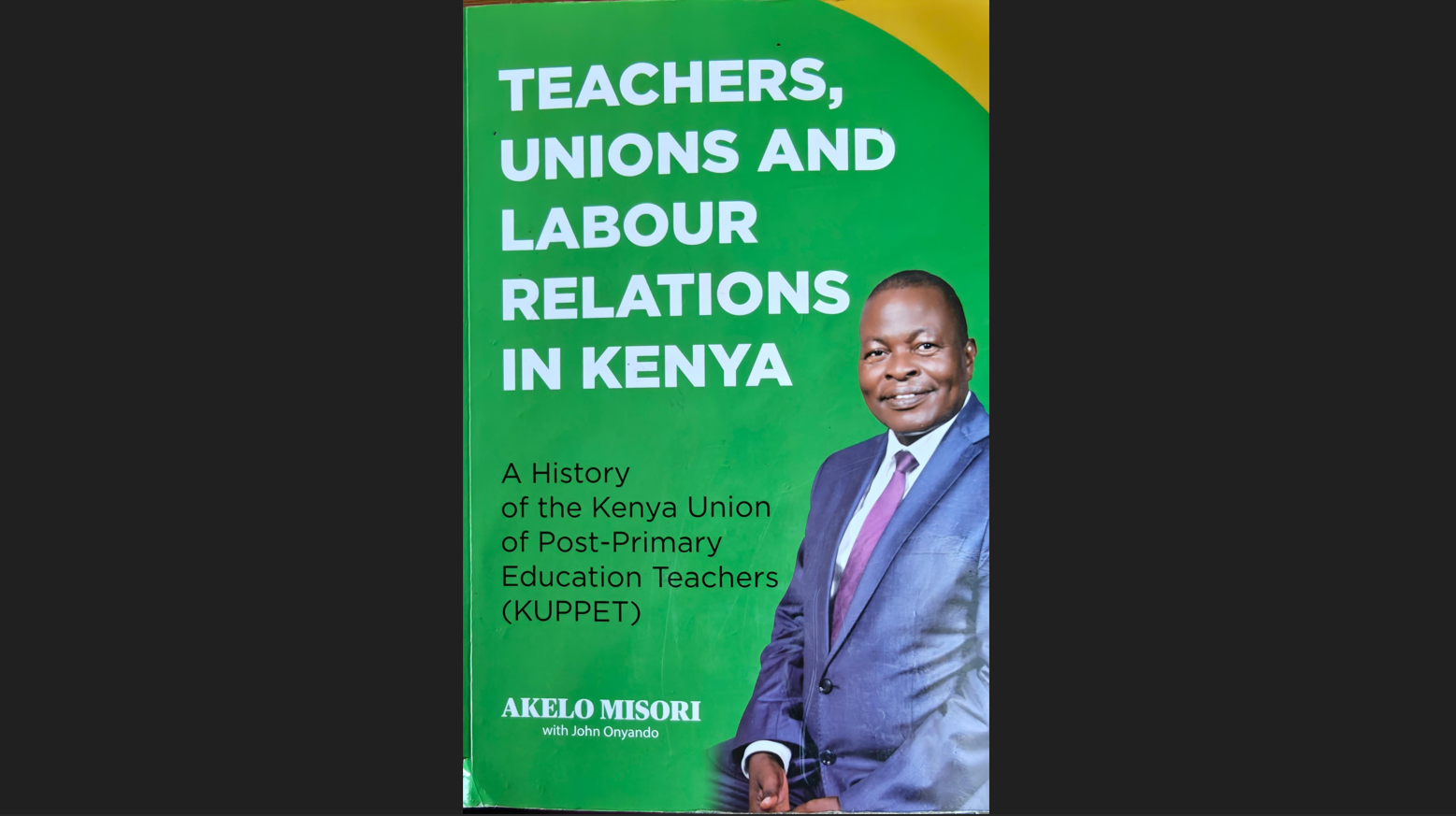
Title: Teachers, Union and Labour Relations
in Kenya (A History of The Kenya Union of Post-Primary Education Teachers (Kuppet))
Author: Akelo Misori with John Onyando
Publisher: Free Press Publishers Limited,
2020
Volume: 364 pages
Reviewer: Faith Matete
The Kenya Union of Post-Primary Education
Teachers just finished branch elections, which were marred with violence and
court cases, and its national elections are looming. It is, thus, a fitting
time to look back at the two-decade-old administration through the prism of a book
by the current national secretary general.
Akelo Misori has been a teacher for more
than three decades and served Kuppet in various leadership capacities. He got
into union politics by 2002, when he was elected as the first Kuppet Migori
branch executive secretary, and rose to national secretary general in 2011.
With such vast experience, Misori,
alongside journalist John Onyando, did the teaching profession justice by
writing this book. It is divided into nine chapters, with the first two delving
into unionism and Kenya’s independence journey and the place of teachers in it.
The third to fifth chapter deal with the
birth of Kuppet, and the sixth to eighth capture teaching problems. The last
chapter comes across as the author’s musings on the future of union and labour
relations, not only in Kenya but across the continent and the globe.
When I picked the book, I expected it to only
talk about teachers and safeguarding of their rights, such as remuneration and
work environment, and leave out that solemn part of ensuring efficient and
quality public basic education. But it goes deeper.
Misori hooks the reader with a tragic anecdote
from September 23, 2019: Eight pupils died when a building collapsed at Precious
Talents Academy in Ngando slums, Nairobi. The incident paints a picture of the dire
state of education in Kenya.
The author expounds on a simple circular by
the then Education CS George Magoha to close the school and all other schools
with unsafe structures to show how grim the reality is for Kenyans seeking
better education.
He compares data from institutions,
teachers and students, and looks into harambee and government schools in the
past, showing the need for access to education.
Misori shares his own personal experience
in 1980, when, as a student at Alara Secondary School in Homa Bay, he led a
strike demanding teachers be posted at the harambee school, but ended up being
transferred to a better government school at Wang’apala Secondary School.
He shows that the same problems bedeviling
education from pre-independence through the 80s to the present day are like
history — it might not be the same but it rhymes.
He acknowledges that many teachers are yet
to join unions but attributes it to protracted union leadership wrangles.
KUPPET RISE, KNUT FALLOUT
The most intriguing part about Kuppet is its
formation. It was officially registered as a trade union on November 26,
1998, with Tom Chariga as the first secretary general.
A lingering perception is that the then
President Daniel Moi pushed for its formation as he was tired of the long-running
strikes by the Kenya National Union of Teachers (Knut), including a 12-day strike
in 1997 and a 28-day one in 1998.
Ever since, Kuppet has been tagged as
government moles and saboteurs against teachers’ rights, an image Misori goes
to great lengths to fight. The hostility between the two unions is still palpable
even today.
Misori dedicates the entire chapter eight
to the subject, where he is at pains to set the record straight. He shares a
personal anecdote from 2005, when he was a teacher at Migori Boys’ Secondary
School, which he served for 16 years. He went to complain at Migori branch
official after a strike but was told to be satisfied with an increase on his
payslip. It was just Sh180.
Misori says that from the 1980s, Knut
leadership chose to ignore intern teachers, especially those in universities,
who were harassed by the Kanu regime, adding that the union did not agitate
enough for secondary and university-educated teachers.
Here, he even brings in Wilson Sossion in
2002 during a botched teachers’ strike when they were both students at Kenyatta
University, him having being elected as Kuppet secretary general in Migori and
Sossion as his counterpart from the Knut Bomet branch.
OPEN TO CRITICISM
The book contributes immensely to the body
of knowledge on teachers’ unionism in Kenya over the last 50 years. Misori goes
deep in his research, interviewing key players such as Tom Chariga, the first
interim secretary general of Kuppet, and gleaning through Parliament Hansards,
libraries and research records.
The book is written in an academic prose,
with citations and annotated footnotes.
Onyando’s hand as a seasoned journalist and
Misori’s adviser in the book comes out clearly when the book breaks into long
prose of narration that makes the reader whizz through the pages in captivation.
But this combination between putting
historical events on record and juxtaposing them with personal opinion makes
the book to lack objectivity. Misori acknowledges this in the preface: “While I
have tried to be objective, I will accept that this is just one narrative.”
He generously welcomes critics because he
has personally criticised several union figures and government officials, and
says such criticism will be a key lesson in addressing weakness for a better
education sector in future.
